St Giles-in-the-Fields Church is a beautiful and historic building in the heart of central London. In any other location it would no doubt be much admired, but amidst the shops, bars, restaurants, theatres and seemingly endless redevelopment work of Soho, it proves surprisingly easy to overlook.
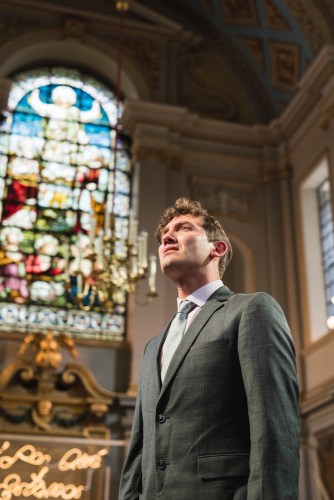
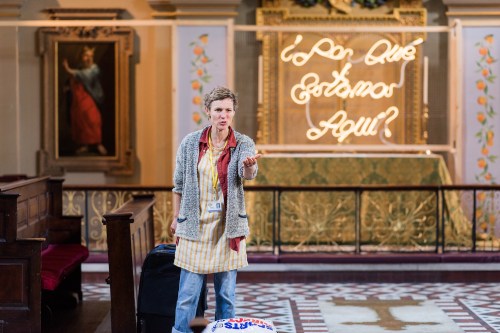
The End of History was written by Marcelo Dos Santos specifically for and about the church, and explores the building’s relationship with its local community in the face of the area’s rapid and relentless gentrification. It does so through the chance encounter of two very different Londoners, who are both drawn to the church on the same day as they face life-changing personal crises. One – Wendy, an art therapist working with the homeless, is all too aware of the church and the sanctuary it offers to those in need. The other – Paul, a real estate marketer who works hard and plays harder – has never really given it a lot of thought, except as a redevelopment opportunity.
Photo credit: Mike Massaro
On paper, there’s no competition – the characters even observe themselves that “she’s a good guy… he’s a bad guy” – but Dos Santos’ play is more subtle than it first appears. In Wendy’s eyes, Paul and people like him are responsible for all the negative changes that have taken place over the years in her beloved city, and she blames him by extension for the perilous housing situation in which she currently finds herself. In fact she’s so blinded by her rage that she misses all the signs that Paul’s going through a pretty major crisis of his own. Her lack of empathy as he gradually crumbles only serves to give ours a boost, and by the time the play ends the line between good guy and bad is considerably less clear.
The result of this is that we ultimately end up with two convincing, complex human beings, nicely played by Sarah Malin and Chris Polick, who finally look up from the chaos of their own lives and share a touching moment of human contact. After an hour’s build-up, the encounter itself is brief and not particularly dramatic or life-changing, but it doesn’t need to be; it’s just two lonely people making a connection when they need it most, and expect it least.
Photo credit: Mike Massaro
Directed by Gemma Kerr, the site-specific production takes full advantage of the unconventional setting, with the actors roaming all over the church (and occasionally climbing over audience members). This leads to a few awkward sight lines and occasional acoustic issues, particularly during Edward Lewis’ quietly charming musical numbers. But that’s a small price to pay to see the play performed in such a unique and visually stunning venue that really means something to the piece as a whole.
Can’t see the map on iPhone? Try turning your phone to landscape and that should sort it. I don’t know why but I’m working on it… 😉
Adapted by Ruby Lawrence from a short story written in 1892 by Charlotte Perkins Gilman, The Yellow Wallpaper is an unsettling portrayal of a woman suffering from depression after the birth of her daughter. Separated from her baby and spirited away to the country by her husband John, Alice (Gemma Yates-Round) finds herself increasingly disturbed by one room in particular, believing she can see a woman moving behind the sickly yellow wallpaper.
Photo credit: Lidia Crisafulli
Gilman, who was advised in 1887 to manage her own depression by having “but two hours’ intellectual life a day” and giving up writing altogether, wrote the story to explore the damaging effects of the treatment imposed on women by men. (She even sent a copy to her doctor, and claimed he later confided to friends that he had changed his methods after reading it.) Lawrence’s adaptation goes a step further, hinting at a more sinister purpose behind Alice’s incarceration. The well-meaning but misguided doctor husband of Gilman’s story becomes two separate characters – albeit both played by the same actor (Charles Warner) – and with the addition of housekeeper Nancy, who’s recruited by the doctor, we begin to feel a creeping sense of conspiracy.
This is reinforced by our own bond with Alice, which is established early on as she directly addresses us, confiding her hopes and fears for her future relationship with her daughter Violet, and later makes us complicit in her efforts to rebel against her treatment. We also see everything she sees; the yellow walls of the deceptively simple set designed by Mayou Trikerioti really do change significantly in appearance under Clancy Flynn’s lighting, and stretch in undeniably sinister fashion to allow glimpses of a figure pressing through from the other side. The fact that we share this vision suggests it isn’t only Alice’s paranoia, and perhaps there really are other forces at work.
Gemma Yates-Round gives an excellent performance as Alice; over the course of 70 minutes, we can see her gradually unravelling before our eyes from the poised, intelligent young woman who first meets the doctor to discuss her five-month pregnancy to the dishevelled figure obsessively clawing at the yellow walls. Meanwhile Charles Warner plays every other character – or rather he plays “Not-Alice”, leaving the true identity and even existence of Alice’s husband, doctor and housekeeper open to interpretation. This ambiguity calls for a subtlety in the performance which Warner successfully captures, simultaneously keeping the characters individual enough that we can differentiate between them, but similar enough that they could feasibly all merge into one.
Photo credit: Lidia Crisafulli
Despite the strong performances, however, and an atmosphere of growing suspense effectively created by director Dave Spencer, the layers of ambiguity added to Gilman’s story for this adaptation mean the play at times feels overcomplicated, and leaves us with a frustrating multitude of possible interpretations of what’s really going on. Things are further confused by the addition of a fairy tale composed by Alice for her daughter, an act of rebellion in defiance of the others’ attempts to keep her from writing. This takes the plot away from the original text, and then ends abruptly as the play reaches its climax, with Alice so intent on passing on her story that the woman behind the wallpaper is left feeling like an afterthought. While all this certainly makes for a meaty post-show debate, for those who like their stories to have a beginning, middle and end the play may prove frustratingly open-ended.
Can’t see the map on iPhone? Try turning your phone to landscape and that should sort it. I don’t know why but I’m working on it… 😉
Paper Creatures Theatre was founded by actors Nathan Coenen and Jon Tozzi on a mutual love of new writing, truthful storytelling and innovative theatre. Their mission is to tell simple, compelling and bold stories that hold up a mirror to the millennial generation.
“The media often portrays millennials as social media-fixated, self-involved and careless of the society in which we find ourselves,” explains Jon. “Paper Creatures is committed to making theatre that breaks away from that stereotype and digs deeper. Good theatre for us is about storytelling. We lead with the idea that the story should be the primary focus from which everything else springs. Our shows aim to provoke, engage and encourage discussion after having left the auditorium.”
And they’re hoping to do just that with their second show, Section 2, which explores the often sensitive subject of mental health, and in particular aims to shine a light on the topic of sectioning. “Mental health is thankfully an issue that is gaining a brighter spotlight and focus in recent years, especially with depression and anxiety,” says Jon. “However, not much is said about sectioning, a treatment that is increasingly required, particularly among those aged 18 – 35, not to mention those who work in the arts.
“Section 2 is a part verbatim story about a young man named Cam, the golden-boy in high school, who is sectioned under the mental health act, but no one can figure out why. Taking place in real time on potentially the final day of his sectioning, we follow a glaringly insightful truth into the process, challenges and effects of sectioning, on the patient but also his key worker, girlfriend and best friend.
“Sectioning is a subject that is rarely talked about in theatre, and definitely not in such an honest and revealing way. When Peter Imms, the writer, approached us with the initial story, we felt it important to take the opportunity to shed some light on the subject and tackle its effects head on. The fact that this piece was inspired by a personal encounter of our playwright means the approach to the text is much more truthful and raw in comparison to many other mental health plays. Section 2 is told in real-time, allowing audience members to experience every joy, hope, silence and heartbreak right there along with the characters – as if they were in the room with them. The play oozes subtext and Pete’s writing style allows for lots of exploration for the director and actors to explore this in various ways through each performance.”
Photo credit: Monika Jastrzebska
The production began life in September 2017 as ten pages of script and a short verbatim piece from a personal experience Peter had with sectioning. “Since then, we’ve done what we do best: given Pete the time and creative support necessary to write the play Section 2 has become,” says Jon. “This included several read throughs with different actors and creatives listening in, an R&D week away in Wittering, and taking part in A Pleasance Scratch at the Pleasance Theatre to gain some useful feedback. We work extremely collaboratively and have given the piece the time and dedication it needs to be performance ready. The key for us was to approach this play and the subject matter with sensitivity and a clear understanding, so lots of research was undertaken and it has been invaluable; we hope that comes across after having watched the play.
“In today’s day and age, it’s important, particularly as millennials, that we continue to open our minds and expand our knowledge of a lot of key issues that affect many people in our society, such as mental health. What Section 2 will give you is a brave and truthful insight into the world of sectioning, at the same time as letting you come away with a hopeful outlook on how we as humans can help break the stigma attached to mental health and how we as a theatre community can help support this. What makes this piece so special is that we have had support from MIND, the mental health charity during the script development stages, so what we are bringing to The Bunker is a play that accurately depicts the inner workings of a mental health hospital and the emotional journey of those that are a part of it.
“We want our audiences to leave with a greater awareness and knowledge of sectioning and, with that, the ability and willingness to reach out to those in their lives who suffer from mental health conditions and become a part of their support network. Something as simple as an informed conversation can help sufferers immensely.
“Good theatre is about connection and we hope that there will be at least one moment in the piece which the audience is able to connect and empathise with. We also strongly encourage audiences to stick around after to discuss the play with us so we can begin the conversation regarding mental health.”
Following the success last year of their debut production, Flood, Paper Creatures are excited to be bringing their new project to The Bunker as part of the Breaking out season. “The Bunker has been attracting a young, vibrant and, most importantly, diverse crowd since their debut show which we saw back in 2016,” says Jon. “Just sitting in the space, there is a distinct buzz and community feel. Having the opportunity to share our stories with this kind of audience is an incredibly exciting opportunity for us. The performance space itself will lend itself perfectly to the production as the audience will be looking in on the action of the play, giving a fly on the wall type feel.
“To be in repertory theatre for a month with five other emerging new-writing theatre companies is also an absolute privilege for us here at Paper Creatures Theatre. The chance to meet and work alongside these different creatives, each with their unique approach to their craft, has taught us a lot and given us the opportunity to expand our audience. We hugely appreciate and champion The Bunker Theatre’s efforts to make this happen – more needs to be done to support new companies and this is one hell of a start.”
Update (28/8/18): Londoners have a second chance to catch GUY this week at the King’s Head Theatre – see link at the bottom for ticket info.
Leoe & Hyde are a musical theatre duo from Manchester, whose previous collaborations include immersive pop-musical Queueue: A Coffee ShopMusical and genre-bending mashup The Marriage of Kim K, which toured the UK last summer to widespread critical acclaim. Now they’re preparing for the world premiere of their latest show GUY, a new gay rom-com about the hook-ups and downs of 21st-century dating, at The Bunker Theatre as part of the Breaking Out season.
Writer and producer Leoe Mercer explains, “GUY is about modern dating. Our whole generation has a shared experience of using apps like Tinder and, in the gay community, Grindr. The show is a diverse, body-positive rom-com about love in the gay community, but at the same time Guy, the protagonist, swings back and forth between the highs and lows of these apps in such a way that resonates, regardless of sexuality.”
Leoe & Hyde was set up in late 2016, but the creative partnership between Leoe and composer Stephen Hyde actually began a couple of years earlier. “We met in 2014, and decided to start writing musicals, with Stephen writing and producing the music and me writing the story and lyrics. Soon after, we decided to produce our own shows too – mainly because we were impatient to see them performed! With an eye for real life characters, an ear for fresh pop sounds, and a taste for the sexier side of the zeitgeist, we want to create a sophisticated language for 21st century musical theatre.
“We grow up hearing stories from previous generations about how musicals like Hair in the 60s and Rent in the 90s captured the music and attitude of a generation. We have a hunch that millennials want something similar for ourselves, a musical which honestly captures the unique post-internet variant of life and love using the electronic/pop soundworld we listen to normally.”
Following the success of The Marriage of Kim K, a 72-minute musical/opera about Kim Kardashian’s infamous 72-day marriage to Kris Humphries, Leoe & Hyde were keen to try something different – and GUY was the result. “GUY came out of nowhere for us,” says Leoe. “In October 2017 we sat down to write some pop songs for the fun of it. A few weeks later, we realised that they actually formed the skeleton of a story, which over the next six months we developed into GUY. We’ve actually grown a lot from this process: the music style is very fresh because we were trying to write pop music instead of musicals, and the show is more unique because of it.”
Leoe believes there are three key things that make GUY unique: “First, the music. Musicals tend to sound quite like musicals, but the soundworld for GUY is more like you may hear if you switch on the radio in 2018. Second, the story. It’s a feel-good gay rom-com, but at the same time it challenges stereotypes and undermines clichés from start to end. I recently saw Love, Simon, which has the perfect tagline: ‘Everyone deserves a great love story.’ I’d hope that comes across strongly too: telling a gay love story isn’t enough, it’s important that the gay world you’re representing is full of variety and honesty.”
“And last but not least, the cast. We have a cast of four, with remarkable voices, including X Factor finalist Seann Miley Moore, who was a favourite to win the show in 2015 and has since notched up millions of views on YouTube.”
The show opens next week as part of the Bunker Theatre’s Breaking Out season, a festival of world premiere shows from six emerging theatre companies over four weeks. “Having people who get behind your work is a huge confidence boost, so being selected for a festival is great,” says Leoe. “It’s also exciting because this musical draws from so much of our actual experience – beginning writing only six months ago, it’s great to see that it can be on so soon.
“When you normally watch a musical, the stage and the singers are miles away. Doing a musical at The Bunker with four incredibly powerful singers and a huge electronic score will create a level of intimacy and immersion that will be quite overwhelming. Come along so you can say ‘I saw it first!’”
Formed in 2017, Second Circle Theatre is an emerging theatre company of three core members and five associate artists, including street performers, musicians, visual artists and devisors. Last year they were finalists of the Pleasance Charlie Hartill Special Reserve, alongside emerging companies Unpolished Theatre and ThisEgg, and their debut show Meeting at 33 premiered to five-star reviews and a sell-out run. This month they’re bringing their second show, Kiss Chase, to The Bunker Theatre as part of the Breaking Out season.
“Our company aims to challenge what a night at the theatre looks like and how it is experienced, and put real people and stories at the heart of our work,” says artistic director Hannah Samuels, who founded Second Circle along with Topher Collins and Zoe Gibbons. “We want to encourage communities to feel connected to each other and individuals to feel less alone, and to create honest, visceral theatre in unique and intimate spaces. We aim to make work that can be and should be experienced by everyone. As a company, by revealing our hopes, fears, obsessions, anxieties and secrets, we strive to make work about the people we care about and the issues we want to scream about.”
Kiss Chase is a part-interactive, part-verbatim speed dating event, which explores the barriers we face when forming relationships, both in and out of love. “Audiences will be taken through a series of interactive tasks/games to develop their intimacy skills – as participants – as well as watching the narrative,” explains Hannah. “We’re inviting them into a world where they are immediately congratulated for taking the leap and entering the unknown. In keeping with our company style, minimal tech requirements and a reduced audience capacity will create an intimate experience for individuals as well as the collective group.
“During the event, the audience will go on dates, talk to characters and listen to songs, as we invite them to look up from their phones and to find commonality in shared experience. The original inspiration for the show sprung from the question: what is it about the pursuit of love that allows us to sometimes be treated badly in order to find it? As the show progressed we came across research calling London the ‘loneliness capital of Europe’ and we wanted to explore why this was and how/if this could be changed. With the rise of online dating, self-help books and the emergence of the Instagram filter, now feels an important time to look one another in the face.
“We’d like our audiences to feel changed in some way by the performance and connected to those they’ve only just met, having been through the experience together, and also to leave questioning what of Kiss Chase was performance and which parts were real. We want to celebrate a world where interactions happen face-to-face, drawing similarities between the ‘live-ness’ of seeing a theatrical event rather than something filmed. We hope to champion the forming of friendships as much as romantic relationships and to challenge who our significant other might be, and to create a shared audience experience celebrating similarities not differences.”
Kiss Chase has been in development since the beginning of 2018, and was still at a very early stage when it was selected for the Breaking Out season. “As with our first show, we always start developing a seed of an idea by doing lots of research,” explains Hannah. “The company have been out and about interviewing people across the country who have shared their stories of love, loss and friendship with us. We have also been going speed dating… a lot. Our associate artists have been involved in the development phase of the process, which is a really collaborative and fulfilling way of working. We’ve been building character through the verbatim interviews and experimenting with the game format of the show, and we’ve worked with Rich Maskey at Potential Difference, looking at ways to integrate technology into the show or to form part of our marketing campaign.
“The Breaking Out programme has quite literally helped us to ‘break out’ and launch ourselves into the industry with our second show, granting us the professional support to secure further funding and exposure as we strive to make life-changing theatre. Having worked alongside other emerging companies through the Pleasance Charlie Hartill tryouts 2017, we were delighted to be offered this opportunity to continue to learn from and support our peers. We are incredibly excited to develop our work with support from such an incredible and intimate venue, and we have already learned so much from the mentorship that’s been offered to us as part of the program. We love how The Bunker encourages shows and companies they work with to take risks and push the boundaries of conventional theatre. It has an incredible reputation for producing a hugely diverse programme and we share a passion for engaging the local community to tackle pressing personal/collective issues, with a unique approach.
“The Bunker is a perfect venue for Kiss Chase, local to us in East London, with a uniqueness and site-specific edge. The intimacy the space invites is amazing – it’s like watching a show in your lounge! Our first show was site-specific in a non-traditional theatre space, so we want to use the environment of The Bunker and all its various nooks and crannies when creating the work specifically for this venue. The mentorship we have already received from David and Josh has been invaluable at this early stage of the company’s growth, and we are really excited about continuing this relationship long after Breaking Out season is complete.”




 Theatre Things