Review: Belly of the Whale at Greenwich & Docklands Festival

Belly of the Whale, the new show from acclaimed aerial theatre company Ockham’s Razor, began in 2016 as an idea to make “an easy to tour, small outdoor show exploring the relationship between two people”. Somewhere over the last two years, the “easy to tour” part has clearly gone out the window – the centrepiece of the performance is now a huge, heavy and architecturally fascinating structure of wood and steel affectionately known by the company as “the beast”. Despite this physical expansion, however, the heart of the show remains the same and the performance, directed by Tina Koch, retains a feeling of intimacy as it explores themes of friendship and collaboration in a unique and quietly thrilling 40 minutes.

Photo credit: Mark Dawson Photography

It soon becomes clear that the structure is much more than a prop; its versatility is revealed gradually, to the delight of adults and children alike, as it transforms from a slide to a see-saw to a climbing frame to a catapult – each demanding a different kind of interaction with the performers. The mechanical complexity is such that even when we think we’ve seen it all, another configuration is just around the corner, with at least one of these drawing a collective “ooh” from the assembled Greenwich crowd as it was revealed.

Each of the three performers – Amanda Homa, Nathan Johnston and Stefano di Renzo – gets an opportunity to impress with their own solo spot, but while their talent as individuals is undeniable, this isn’t a show that relies on sensational, gasp-inducing stunts to make its point, and in fact it’s when the three work together that the performance really comes alive. This is particularly true of the finale, which is obviously – and necessarily – very carefully choreographed to ensure the structure remains balanced, but to all intents and purposes appears to be just three friends having fun and existing together in peaceful, productive harmony. That image contrasts powerfully with moments early on in the show during which the three go out of their way to disrupt each other, and end up achieving very little as a result.

Included in this group camaraderie is composer and musician Gabriele Pierro, who provides a fascinating soundscape for the performance, combining live music with recorded sound effects that reflect the movement and mood on stage. When all these elements are brought together, the result is a show that’s innovative, entertaining, and mesmerising in more ways than one – and because it’s neither too long nor too scary, it’s perfect for audiences of any age.

Belly of the Whale continues on tour throughout the summer – all performances are free to attend. For a full list of dates and venues, visit Ockham’s Razor’s website.

Review: Stepping Out at Brockley Jack Studio Theatre

We all love a good underdog story, so it’s no surprise that Richard Harris’ 1984 comedy Stepping Out continues to pull in audiences over 30 years after its first performance. Written after observing the various interesting characters at his wife’s weekly dance class, the play is a charming, feel-good story about friendship and perseverance against seemingly impossible odds that ultimately proves impossible to resist.

In a small North London community hall, we’re introduced to tap teacher Mavis, pianist Mrs Fraser, and eight enthusiastic but rather rhythmically challenged students. They’re very different characters, who constantly misunderstand and antagonise each other, to the point where you have to wonder why they’d all – Mavis and Mrs Fraser included – put themselves through it every week. It quickly becomes obvious, however, that the class means a huge amount to all of them, even the ones who appear to have life all worked out.

Photo credit: David Ball

While some of the characters feature more prominently than others – among them shy, nervous Andy (Emily Sitch), for whom the class is the only time she gets to herself all week, token male Geoffrey (Sean McDowell), whose wife recently passed away, and newest member Vera (Helen Jeckells), who can’t stop cleaning and starts every sentence with “I’m not being funny or anything…” –  we do get to know all of them just well enough that by the end of the show, we’re rooting for the whole group to succeed (even Vera). And yet at the same time there’s still so much we don’t know; the play’s finale somehow succeeds in bringing the story to a satisfying close while at the same time leaving us with a frustrating number of loose ends about every character.

The small venue for this production, directed and choreographed by David Ball, mostly works well, with the cramped conditions on stage only adding to the chaos each time the class attempts a routine. Such is the level of noise and general incompetence, in fact, that by the time Mavis finally, inevitably snaps, the audience is right there with her (and possibly wondering what took her so long). In a play where the most memorable performances are the funniest – Ceris Hine’s permanently anxious Dorothy, Jessica Brady’s straight-talking Sylvia and Harriet Earle’s eccentric Mrs Fraser, to name a few – it’s Christina Meehan as Mavis who leaves the deepest impression. Her passion for her art, her motherly affection for her students, and her growing frustration at their inability to follow simple instructions are all completely believable, and there are moments when she’s teaching that it really does feel like we’re watching a tap class rather than a play.

Photo credit: David Ball

Light and frothy it may be, but there’s something about Stepping Out that strikes a chord and may even bring a tear to the eye. Anyone who’s ever felt lonely, or unloved, or worried that they’re not good/clever/pretty/talented enough, will be able to relate to at least one of the characters, and the play is a great reminder that sometimes it’s possible to find companionship and support where we least expect it. But all that aside, it’s also great entertainment – and as Mavis herself would say, as long as we’re enjoying ourselves, that’s the most important thing.


Can’t see the map on iPhone? Try turning your phone to landscape and that should sort it. I don’t know why but I’m working on it… 😉

Review: No One is Coming To Save You at The Bunker Theatre

2018 is both a fascinating and a terrifying time to be alive – and particularly to be young. Climate change, Brexit, Trump, knife crime, terrorism, the threat of nuclear war: all these and more have brought us to a place where it’s far easier, and feels a lot more feasible, to fear the worst for our future than to hope for the best.

Photo credit: This Noise

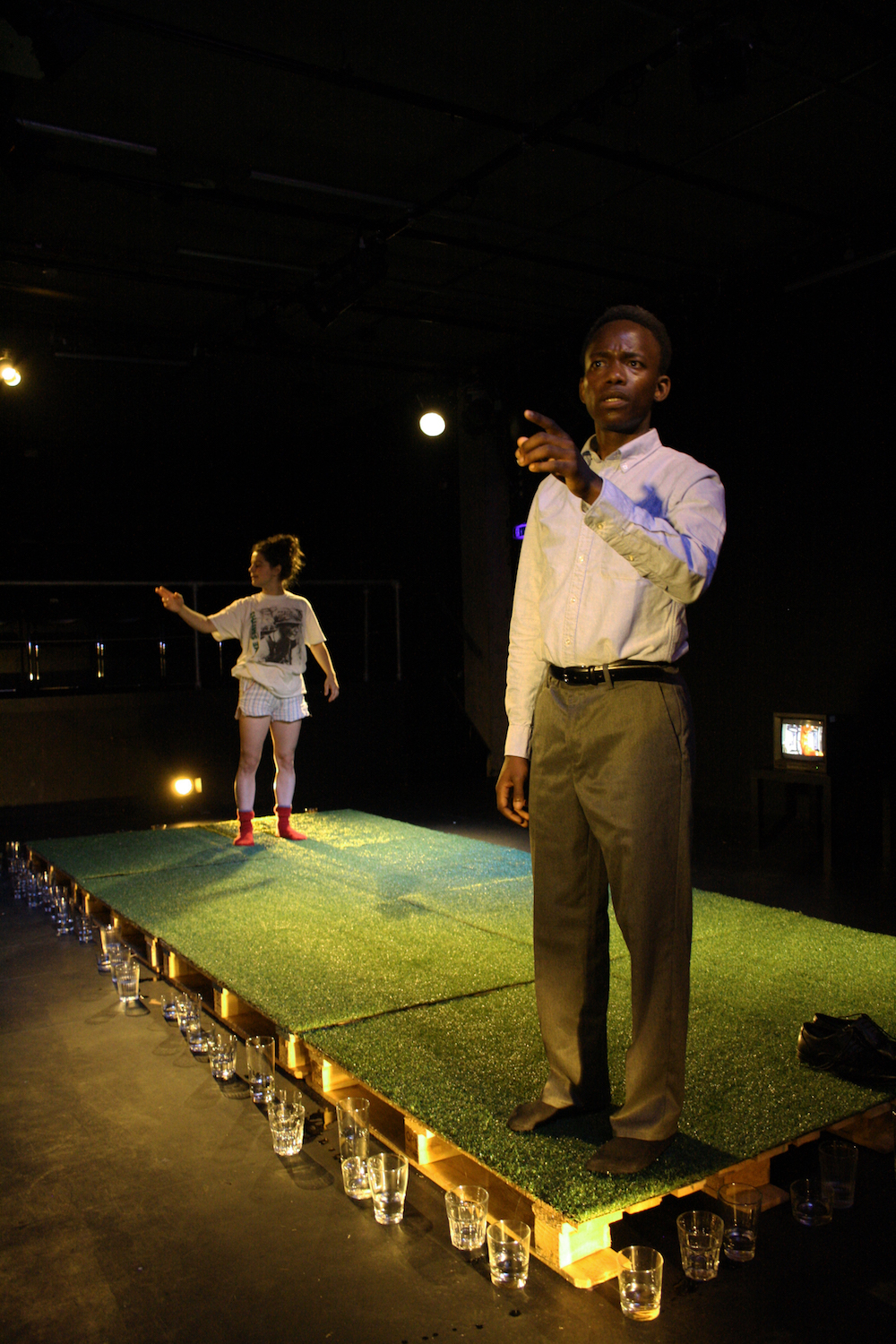
None of the above are mentioned by name in This Noise’s No One is Coming To Save You, but the atmosphere of dread that accompanies them is very much present. The play, written by Nathan Ellis and directed by Charlotte Fraser, is about a young man and woman, each of whom finds themselves alone with their thoughts over the course of one long sleepless night. She’s transfixed by a half empty (or half full?) glass of water on the table, and stubbornly ignoring her ringing phone. He’s watching late night TV with the sound off, while his girlfriend and baby daughter sleep in the next room. Their stories are separate but gradually intertwine, as each reaches out desperately for someone – anyone – to reassure them it will all be okay.

The play is billed as an experimental duologue, and it certainly lives up to that description. The non-linear narrative jumps about in time as the two characters lose themselves in memories, with the audience never totally sure which ones are real and which imagined. While this means it’s at times difficult to pin down where in the timeline we are or what exactly is happening, the writing is so beautifully evocative, and the performances from Agatha Elwes and Rudolphe Mdlongwa so engaging, that we have no trouble at all picturing the scene or sensing the building atmosphere of doom that surrounds the two characters. We don’t know why they’re both awake on this particular night, but from the start there’s the feeling that something terrible might happen – whether it does or not I can’t say, but the threat is credible enough to keep us constantly on edge. (It’s worth noting also that the script conjures some rather disturbing images, particularly of physical injuries, which some audience members may find distressing.)

Photo credit: This Noise

And yet for all that, No One is Coming To Save You is often surprisingly funny, and there are several laugh out loud moments, which help to restore our faith that all may not yet be quite lost. The play’s conclusion, also, feels cautiously optimistic, and there’s the suggestion that though life may not necessarily be all we’d hoped for, we’re all on the same uncertain road and we don’t necessarily have to travel it alone.

No One is Coming To Save You is quite an abstract piece, which leaves much open to interpretation. As such, it may not be everyone’s cup of tea – but what it lacks in terms of plot, it more than makes up for in its portrayal of the general mood in a world where it often feels things will never get better. An interesting and thought-provoking show for the millennial generation.

Can’t see the map on iPhone? Try turning your phone to landscape and that should sort it. I don’t know why but I’m working on it…

Review: Section 2 at The Bunker Theatre

Despite great strides in awareness over recent years, there’s still a huge amount we’ve yet to learn about mental illness. But if there’s one thing we do know, it’s that it can strike anyone, at any time – even those who seem to have it all together.

Cam, the central character in Paper Creatures’ new play Section 2, is one of those people. At school he was the golden boy, the star of the rugby team; now he’s in the army, and has been in a steady relationship with his girlfriend for five years. Nothing particular seems to have happened, although there are unproven suspicions, but despite all this somehow he’s ended up being sectioned. That was 28 days ago, and today is the day that Cam – along with his girlfriend Kay, key worker Rachel, and friend Pete – will find out if he can go home. The play takes place on the ward in real time, and as the minutes tick away on Cam’s 28th day, we get an informative and moving glimpse into the workings of a system that’s rarely discussed, on stage or indeed anywhere.

Photo credit: Tim Hall Photography

Section 2 was written by Peter Imms in response to a personal experience he had when a school friend was sectioned, and then developed collaboratively with Paper Creatures in association with Mind, the mental health charity. As such, Nathan Coenen’s portrayal of Cam’s fragile mental state feels both sensitive and authentic: one moment he seems fine, the next he’s forgotten how to breathe; his meds make him forgetful, he seems frequently on the verge of tears, and when he hugs someone, he clings on to them like he’s drowning. The frustrating fact that we don’t know what caused his breakdown only enhances this realism, reminding us that where mental health is concerned, sometimes there simply aren’t neat, easy answers.

The play also examines Kay, Rachel and Pete’s different responses to what’s happened; in fact the balance of the script is such that this is just as much their story as it is Cam’s. Imms moves the characters around very naturally between two rooms, which allows us to witness one-on-one interactions between each pair, and get to know all the characters a little better. Alexandra Da Silva adopts an air of weary resignation as Kay arrives for yet another visit, but we soon realise that behind her tough exterior she’s struggling to keep a lid on her own fear and distress in order to protect the man she loves. She clashes frequently with Esmé Patey-Ford’s Rachel, mistaking her calm professionalism for a lack of empathy, and irritated that Rachel seems more able than she is to establish a meaningful connection with Cam.

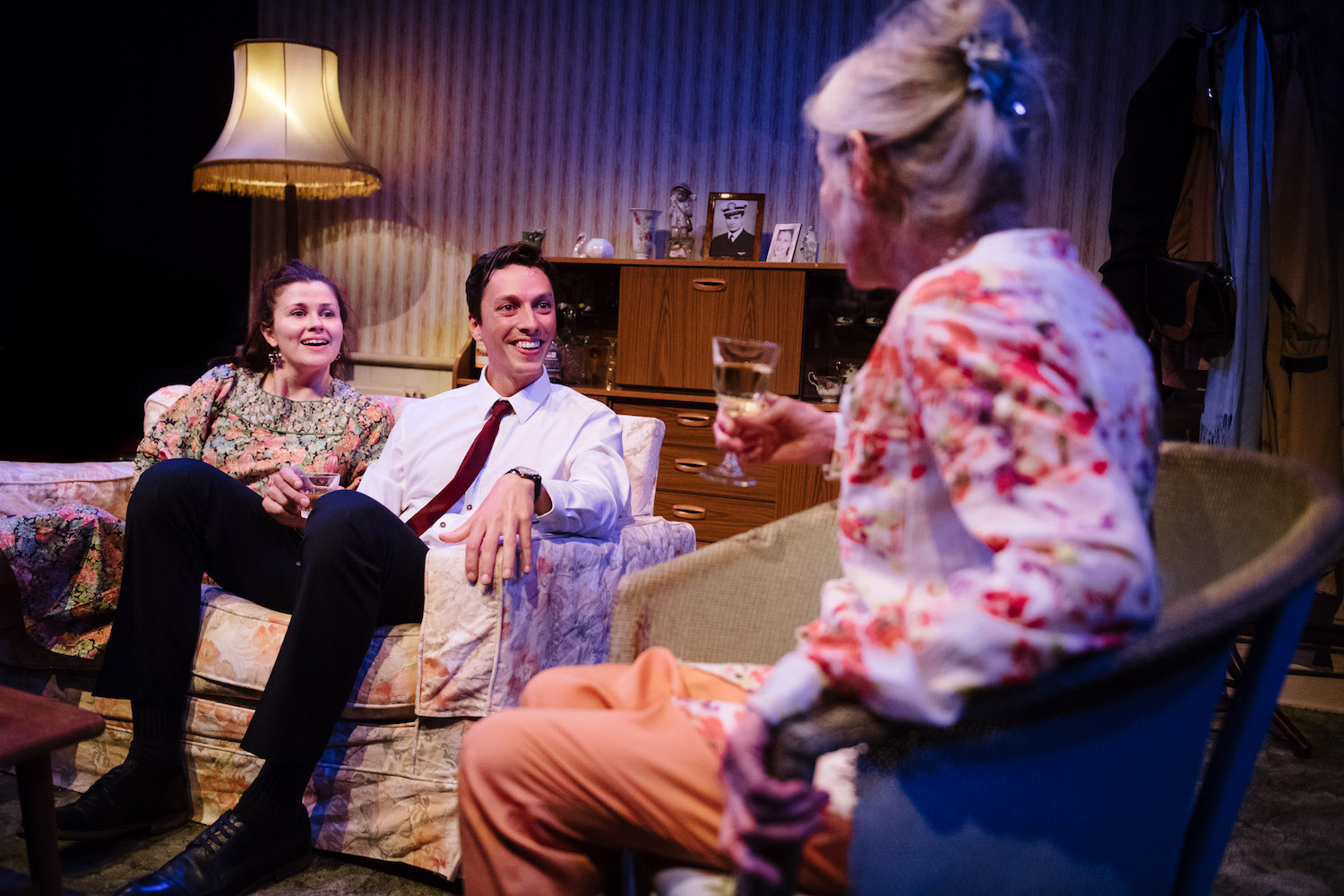
This atmosphere of simmering tension is brought to a head by the intervention of Pete, a first time visitor who hasn’t seen Cam for five years. Played by Jon Tozzi, Pete is perhaps the most relatable of the characters: way out of his depth but with an obvious desire to understand, he still maintains a fragile hope that he can somehow find the magic button that will make everything better.

Photo credit: Tim Hall Photography

Section 2 is an important and timely piece of theatre, raising awareness of the far-reaching impact of mental illness, and sectioning in particular. More than that though, it’s a play about friendship and human relationships; though it’s undoubtedly difficult to watch at times, there’s something very uplifting about seeing so many loved ones lining up to support Cam on his road to recovery, each in their own individual way. Sensitively written and performed, this powerful play is well worth a visit.

Can’t see the map on iPhone? Try turning your phone to landscape and that should sort it. I don’t know why but I’m working on it…

Review: Cockamamy at The Hope Theatre

A little over a year ago, I sat at The Hope Theatre and sobbed my way through Off The Middle’s In Other Words, a devastatingly sad story about a husband and wife coming to terms with his diagnosis of dementia. This week, I was back at The Hope to see Think and Hit’s debut production Cockamamy, another play about dementia – and surprise surprise, I ended up in floods again.

I don’t know why theatre on this topic tends to hit me so hard, but I suspect it’s because so often it’s inspired by real experiences and people, and you can tell it comes from a place of deep love and affection mingled with pain and often loss. If that’s the case then Cockamamy is a double whammy, as both writer and actor Louise Coulthard and director Rebecca Loudon know what it’s like to care for a grandparent with dementia, and have put that experience to powerful use to create a funny and deeply poignant play.

Photo credit: Alex Brenner

Let’s back up a bit, though, because Cockamamy isn’t just a play about dementia. It’s really the story of Alice and Rosie, who are far more than just grandmother and granddaughter; they’re best friends. Alice raised Rosie following the death of her mother when she was a little girl, and the strong bond between them is clear from the outset. But there are clouds on the horizon: Alice is getting increasingly confused and forgetful, and she’s convinced she’s being visited by her late husband Arthur. When Rosie meets a new boyfriend, both she and Alice are forced to make some tough decisions about their futures.

It was always going to be a tough story to watch, but what makes Cockamamy so heartbreaking is how instantly likeable the characters are. Alice is a particular delight: a feisty, quirky old lady with a mischievous sense of humour and a surprising habit of quoting Beyonce. We love her from the start, so it’s painful to watch her become more and more fragile and bewildered as the play goes on – particularly as there are moments when the old Alice reappears.

Mary Rutherford’s superb performance is matched by that of Louise Coulthard as Rosie, as she struggles with the conflict between wanting to protect her gran and wanting to get on with her own life. She’s just met the perfect man – Cavan, an Irish junior doctor played by Rowan Polonski – but although he’s patient and supportive of Alice’s situation, their relationship is put under ever greater strain as Rosie repeatedly finds herself forced to choose between them. Unsurprisingly, this building tension ultimately comes to a head in a final scene that’s ugly and brutal in both its honesty and its emotional impact.

Photo credit: Alex Brenner

If I have one quibble, it’s that the long scene changes interrupt the pace of the production and leave us looking at Alice’s empty living room for rather longer than feels necessary. But this minor irritation doesn’t detract from a play that perfectly balances entertainment with an honest, powerful portrayal of the impact dementia can have on families and relationships. Highly recommended, but prepare to be put through the emotional wringer.


Can’t see the map on iPhone? Try turning your phone to landscape and that should sort it. I don’t know why but I’m working on it… 😉