Review: Serve Cold at Katzpace

The programme notes describe Mark MacNicol’s Serve Cold as a “cracking wee script” – and I think I’d have to agree. When two women – one a prostitute, the other a doctor – meet one night on a bridge in Glasgow, a chain of events is set in motion that only one of them could have foreseen… and it’s not necessarily the one we might expect. Darkly humorous and unapologetically twisted, Serve Cold makes us question our assumptions and reflect on the lengths some people, even those we think of as “respectable”, will go to in the name of revenge.

Concerned that Joy (Paula Gilmour) is about to throw herself in the river, Grace (Anna Marie Burslem) stops to try and talk her out of it. The two end up back in the attic that Joy calls home, where events take an unexpected turn as she reveals calmly that she’s been stalking her ex-boyfriend in a variety of unpleasant and twisted ways. Tonight is the grand finale – if Grace is willing to do her part, that is.
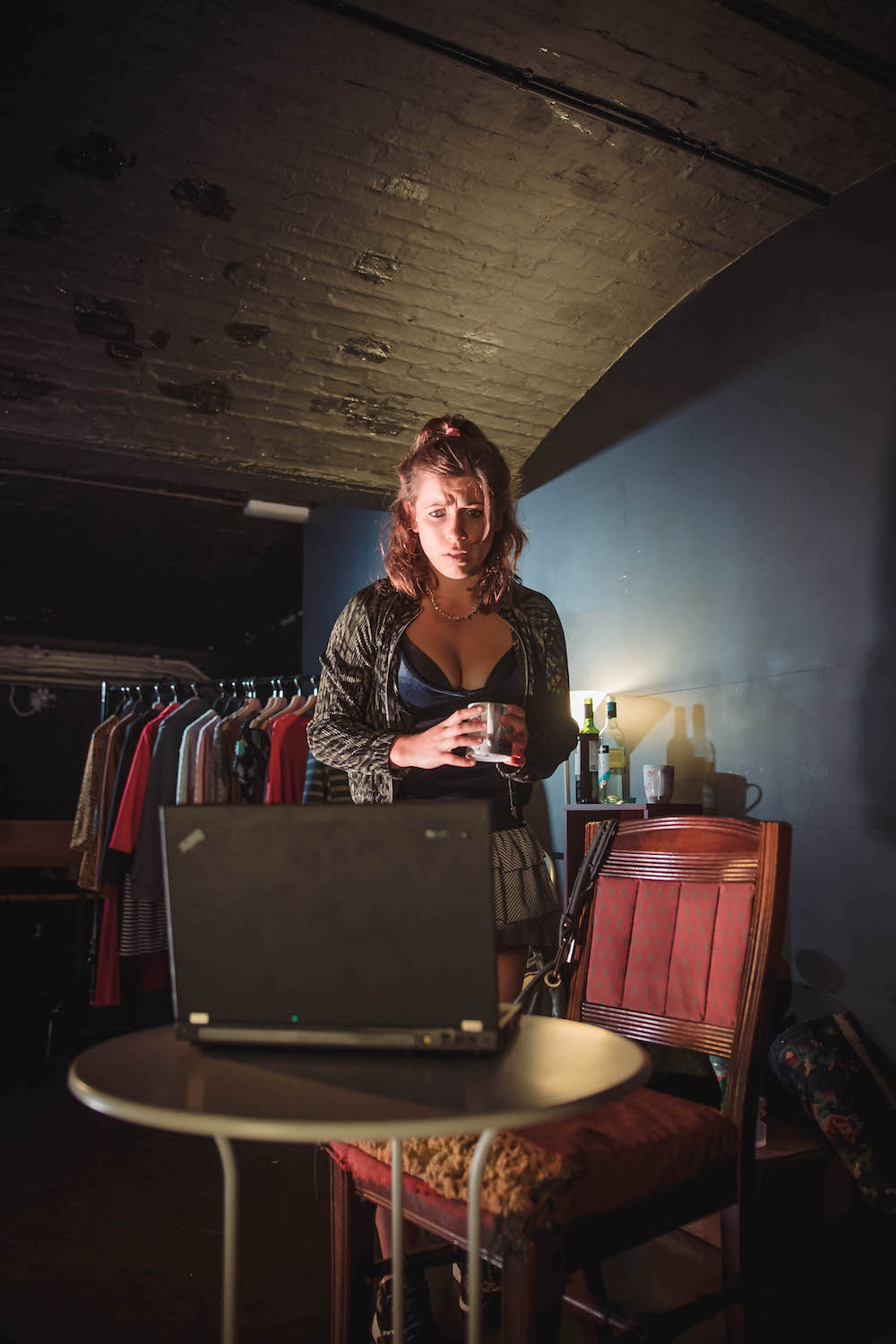
Photo credit: Liz Isles Photography

MacNicol’s storyline at times strains credulity a bit, but PJ Stanley’s production is consistently excellent. Serve Cold is driven by its characters, and the performances from Anna Marie Burslem and Paula Gilmour are right on the money. Grace has every reason to be mad at the world, but her innocent, almost childlike determination to see the positives in everything and everyone around her means she’s the one we instantly warm to and root for throughout the play. She has no filter; she says what she thinks and doesn’t try to hide her growing discomfort (which matches our own) as the evening progresses and humour turns to horror.

In contrast, Joy is the picture of calm professionalism – alarmingly, even when discussing in detail all the shocking things she’s done to her ex – and displays a truly psychopathic lack of remorse. It’s chilling to reflect that this is a woman countless people entrust their lives to every day – people who would probably turn their backs on someone like Grace if they saw her in the street. It’s testament to Paula Gilmour’s performance, however, that we find ourselves unable to hate Joy completely; every now and then we catch a small glimmer of humanity behind the mask, and the play’s conclusion is actually oddly heartwarming – albeit in an extremely dark and messed up way.
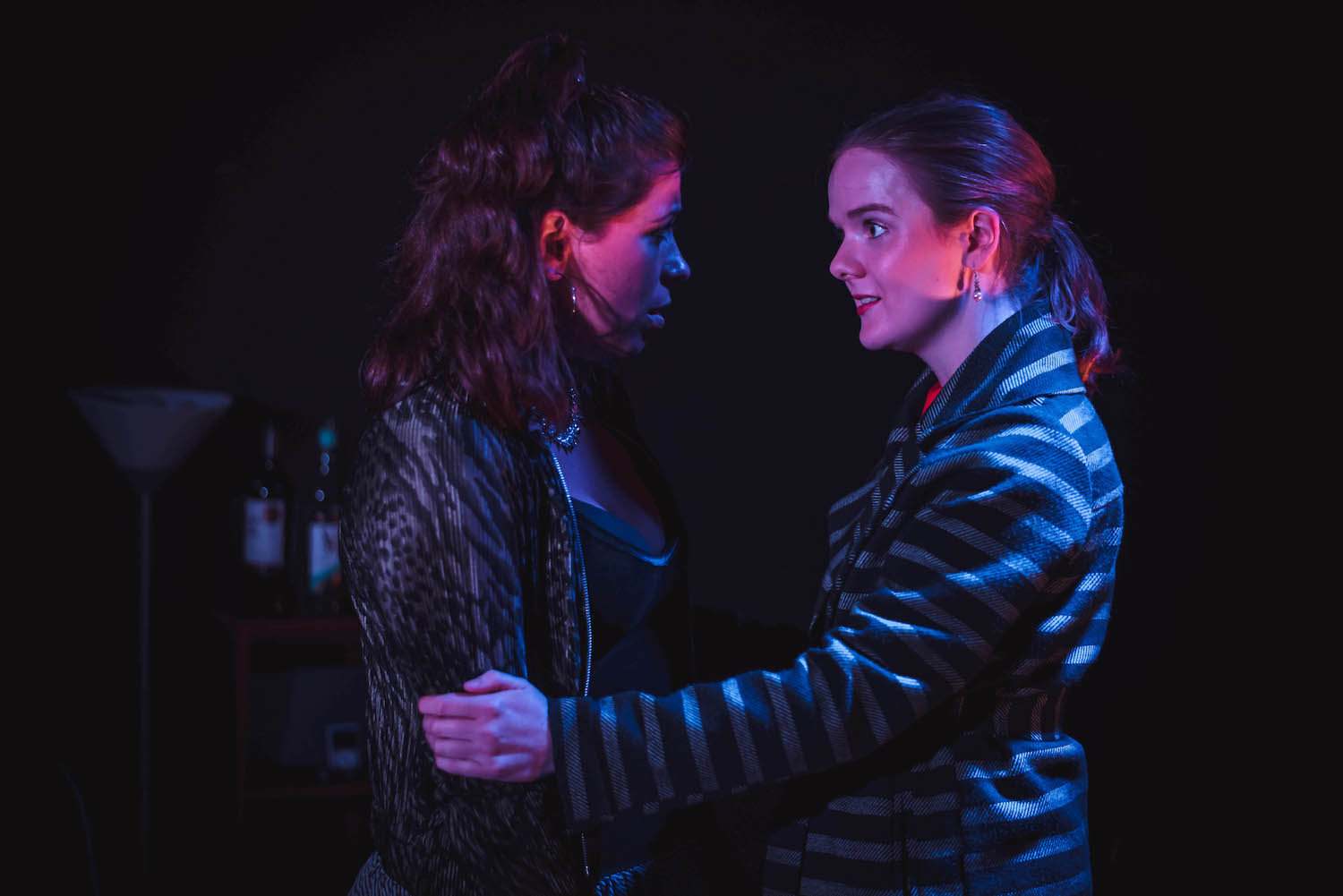
Photo credit: Liz Isles Photography

It’s not only in personality that the two women are worlds apart; a recurring theme of religion (their names are, I suspect, no accident) looks at two very different ideologies when it comes to retribution. While Grace lives in constant fear of going to “the bad fire”, a hangover from her evangelical Christian upbringing, Joy is a great believer in doling out more earthly punishments – ironically, by subscribing to the biblical principle of an eye for an eye.

Though its short two-day run at the appropriately atmospheric Katzpace is already at an end, Serve Cold is the kind of play that’s not that easy to forget. Gripping and disturbing, it boasts two fantastic performances and provides a good amount of food for thought – but more importantly, it makes you think long and hard about going anywhere near the attic any time soon.

Review: The Three Musketeers at St Paul’s Church

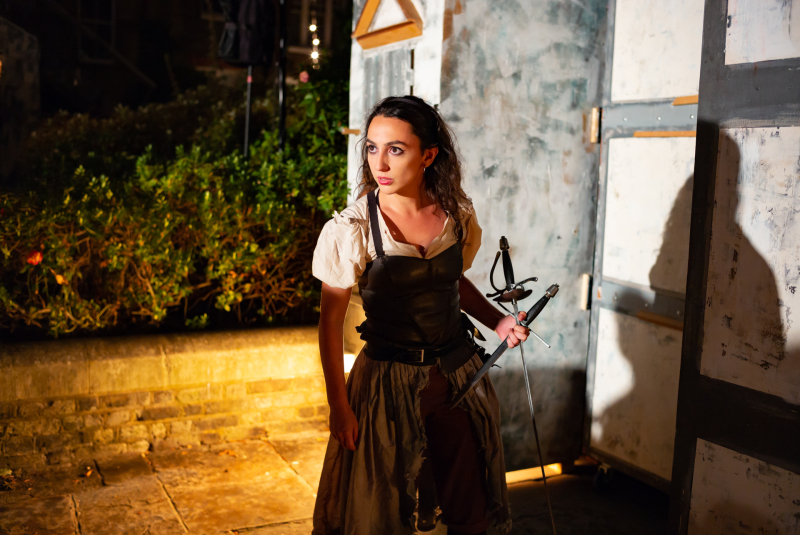
For swashbuckling family fun this summer, look no further than Iris Theatre’s The Three Musketeers. Set at the beautiful St Paul’s Church in Covent Garden, the largely open-air production takes Alexandre Dumas’ 1844 novel and condenses it into a thrilling adventure that sees Athos, Porthos, Aramis and new recruit d’Artagnan battle the mysterious and cunning Milady de Winter.

Even if – like me – you haven’t read the novel, there have been enough TV and film adaptations over the years of the Three Musketeers story that most people will probably have some idea what it’s all about (“all for one, and one for all” etc). What makes Daniel Winder’s adaptation particularly unique and refreshing, however, is that both its hero and its villain are women.

Photo credit: Nick Rutter

Faced with a future of limited opportunities following the death of her father, the young d’Artagnan (Jenny Horsthuis) has realised the only way she can hope to achieve her dream and gain a position with the Musketeers is to disguise herself as a man. Meanwhile Milady (Ailsa Joy), having suffered years of brutality at the hands of men, has decided to give them a taste of their own medicine; though she’s every inch the baddie, when we learn her story we can’t help but feel some sympathy for her motives. As Milady eventually observes, she and d’Artagnan are more alike than they realise – they’ve just chosen to tackle their situation in very different ways.

Despite having two strong female leads, it’s very telling that it’s still the male characters who make it into the show’s title, despite being rather less heroic than we might expect. The three Musketeers – Aramis (Albert de Jongh), Porthos (Elliot Liburd) and Athos (Matt Stubbs) – are certainly brave, but as individuals, and particularly in their attitude towards women, they leave quite a bit to be desired. (In a funny but significant sequence at the start of Act 2, d’Artagnan – having single-handedly saved Bethan Rose Young’s Queen of France from a plot hatched by Milady and Cardinal Richelieu – is then forced to extricate her colleagues, at great personal cost, from a variety of scandals in a series of country pubs.)

While it does give us plenty to think about, Paul-Ryan Carberry’s promenade production is also a lot of fun, with an immersive atmosphere and plenty of opportunities for audience members of all ages to get involved in the action as we make our way around the gardens and into the church itself. A hard-working cast play multiple roles, with special credit going to Stephan Boyce, who has to change costume and personality every five minutes as he plays four very different characters during the course of the show. The sword fights, choreographed by Roger Bartlett, are also particularly impressive – even more so given that cast member Albert de Jongh’s “wounded warrior” Aramis broke his ankle three days before the show opened.

A rip-roaring adventure full of humour, intrigue and drama, The Three Musketeers offers a fresh perspective on a well-known classic that can be enjoyed by the whole family – and in particular by young girls who want to see female characters do more than fall in love and get rescued. And with tickets starting from just £14, and special family offers available, it’s one of the best value theatrical experiences you’ll find in central London this summer.

Can’t see the map on iPhone? Try turning your phone to landscape and that should sort it. I don’t know why but I’m working on it…

Review: On Mother’s Day at the Cockpit Theatre

“I could tell you I’m a good man… but you wouldn’t believe me.” Inspired by writer Saaramaria Kuittinen’s seven-year correspondence with prisoners on death row, On Mother’s Day from Ekata Theatre tells a heartbreaking tale that’s all too familiar. It’s the story of a crime – a violent, horrific murder that should never have happened. But it’s also the story of the man who committed it, his shame and guilt over what he’s done, and his desperate need to cling on to who he is in a world that’s specifically designed to dehumanise him.

Ramón (Christian Scicluna) is a murderer – but he’s also thoughtful, creative, funny and extremely likeable. He doesn’t try and make excuses, nor does he ask us to condone what he’s done. Instead, he shares with us his memories, which are all that he has left of his former life, and in doing so tells us all we need to know about the path that brought him here.

Those memories are recreated not only through Ramón’s words but by the mesmerising movement and physicality of ensemble members Lukas Bozik and Silvia Manazzone. The violent abuse suffered by his mother at the hands of his father; the party at which he met Maria, the love of his life; the precious childhood holidays at his grandma’s in the countryside – all are brought vividly to life and allow Ramón to step outside the confines of his tiny cell and experience in his mind a world he no longer gets to see, hear or touch.

Although, on the surface, the story told by On Mother’s Day is personal, not political, it’s difficult to watch it without feeling a growing sense of anger at a system that places retribution above rehabilitation, and utterly disregards the circumstances that may have led someone to commit a terrible crime. Ramón’s has been a life of violence, but at the hands of others, not his own. The crime for which he was condemned was, he tells us, the one time in his life that he acted without thinking – and yet it’s enough, in the eyes of the law, to wipe out any good he may have done or may go on to do in the future.

The set is simple – just Ramón’s cell, a metal bedframe and a small box of possessions, right in the centre of the stage. Director Erika Eva makes creative use of The Cockpit’s in-the-round stage area, however, extending it to include the high walkways that overlook the stage, and where the actors pace up and down like prison guards. The show also makes particularly effective use of light, which is used both as an interrogation tool and to create the play’s striking and desperately poignant final image.

I had a personal interest in seeing this show because I also have some experience of writing to prisoners on death row, and have been struck repeatedly by the wit, wisdom, compassion and astonishing creativity of men and women who’ve been written off by society. This is exactly what On Mother’s Day captures so well. However incongruous it may seem, Ramón is both a murderer and a good man; he deserves to be punished for his crime, but there’s so much more to him than the single worst thing he’s ever done. Although the current run is at an end, let’s hope it isn’t the last we see of this beautiful and heartbreaking story of life on death row, which succeeds not only as a piece of theatre but also as a powerful argument against the senseless violence of the death penalty.

On Mother’s Day ran at the Cockpit Theatre from 13th to 16th August. For more details about Ekata Theatre and future productions, visit www.ekatatheatre.com or follow @EkataTheatre.

Review: Love Lab at Tristan Bates Theatre

Love Island meets Big Brother meets Black Mirror in Sam Coulson’s Love Lab, which sees two singletons locked in a room together for 7 days in an attempt to make them fall in love. It’s the latest reality TV show, watched by millions – but that’s little comfort to Perry (Michael Rivers), who doesn’t even remember applying. And he’s definitely not okay with being kidnapped and forced to live on cold baked beans for a week with a total stranger, while a cheerful disembodied voice asks them increasingly personal questions.

Photo credit: Sam Tibi

Livia (Harriet Barrow), on the other hand, is much more at ease. She’s watched the show before, which helps, but we also learn this isn’t her first time in front of the cameras. And she’s considerably more au fait with dating apps and social media than her selected match, who’d much rather meet up with his friends in person over a cuppa than follow them on Facebook. Livia’s even been allowed to keep her phone, whereas Perry’s is nowhere to be seen. She seems to have the upper hand, but then the mind games kick in and the balance of power begins to shift – until, in a final fiendish twist, the Love Lab pulls the rug from under both their feet.

Set in a perhaps not so distant future, Séan Aydon’s slick production embraces the technological theme with stark lighting and unsettling sound effects – and let’s not forget the frequent interruptions of friendly matchmaker Lucy, whose pleasant but mechanical enunciation begins to sound increasingly sinister as the play goes on. Actors Michael Rivers and Harriet Barrow have great chemistry as the mismatched pair, whether they’re engaging in rapid-fire banter or sharing a moment of genuine connection. In fact, despite some significant flaws both characters ultimately prove rather likeable, and by the end we’re almost rooting for them to run off into the sunset together.

My main complaint about Love Lab is actually a compliment in disguise: I wanted more. The premise is intriguing, and the play offers some fascinating (and slightly scary) insights about dating in the 21st century – but at only 50 minutes it feels too short, and as clever as the final twist is, it’s all a bit abrupt. Just as we feel like we’re starting to get to know the characters and what might have brought them here, it’s all over. I’d love to see a longer version of the play that lets us spend a bit more time in the Love Lab (and yes I appreciate the irony of that statement, given that Perry spends a significant amount of his time trying to get out).

Photo credit: Sam Tibi

Witty and insightful, the play asks “what is love?” in a world where off-line connection is starting to feel like the exception rather than the rule. We may lament the fact that nobody meets in person any more, but Love Lab leaves us wondering if that’s actually a self-fulfilling prophecy – are we all too glued to our dating apps to look up and see who’s right in front of us? The play doesn’t condemn online dating; even Perry acknowledges it’s a great idea in theory. But it still might make you stop and think twice the next time you swipe right.

Review: Coelacanth at the Cockpit Theatre

The second production from Moonchild – following their debut last year with PLUTO – is the darkly comic Coelacanth. Written by Callum O’Brien, the play is set in a dystopian future where assisted suicide is not only legal but available at the touch of a button through a new app that lets you select your killer.

It’s not immediately obvious that Yvette (Lizzie Back) has invited a man to her flat to end her life; she’s spent hours getting ready and appears to have everything to live for. Nor does Morningstar (Jack Michael Stacey), on first encounter, look like a killer, though there’s clearly something odd about their meeting, which veers from cheekily flirtatious to deadly serious and back again before you can say Sylvia Plath. And yet as he begins his preparations, which include allowing an excited Yvette to choose how she wants to die, we can see the line between business and pleasure gradually begin to blur – not just for Morningstar but for the hundreds of eager followers watching via webcam.

Photo credit: Dave Bird

Everything’s going according to plan until the moment Yvette’s housemate Rachel (Rebecca Camilleri) bursts into the flat. Seemingly unperturbed by the presence of a strange man in her friend’s bedroom, and blissfully unaware of what she’s walked in on, she decides to keep the party going with an enthusiasm that borders on manic, and which begins to shake her friend’s resolve.

Quite apart from providing a good twist in the story, and some much-needed light relief and a change of pace just as things are getting particularly sinister, Rachel’s entrance is interesting because at first glance she appears much more likely to be suicidal than Yvette. She’s drunk, she’s obviously been crying, nobody turned up to her birthday party except the gay guy she once had sex with, and – for reasons that are unclear – she’s drinking rose out of a plastic bag. Seeing her, we get to marvel all over again at how calm and collected Yvette is, given what she’s about to do. It’s a powerful reminder that you can’t always tell what’s going on inside someone’s head, even if they look like they’re fine.

The story does get a bit muddled around the middle, though, and while we may accept that she’s not as fine as she looks, it’s never really explained what actually has brought Yvette to this point. There are signs that all is not well in the outside world, and a suggestion that the apocalypse may be near, but whether that’s real or only in Yvette’s head isn’t really made clear. It also seems odd, given the obvious affection between the two girls and Rachel’s disdain for the app and those who use it, that Yvette would choose her best friend’s birthday to kill herself, knowing that Rachel would almost certainly be the one to find her when she returned home. In an otherwise intriguing and very well performed plot, these unanswered questions about the central character’s motivation prove to be a significant stumbling block.

Photo credit: Dave Bird

That said, what the play does do extremely well is to keep us on edge. This is partly because we’re waiting to see how this bizarre and unsettling chain of events will end; director Liz Bacon skilfully builds the tension as the story builds towards its dramatic climax. But it’s also in no small part because O’Brien forces us to confront some issues we’d perhaps rather not face up to: like how well we know our friends, our obsession with technology, our macabre fascination with tragedy, and the fact that just because something’s legal (and easy), that doesn’t make it right.

By the way, in case you were wondering, a Coelacanth is a rare type of fish that was thought to have died out 66 million years ago, but was rediscovered in the early 20th century off the coast of South Africa. Let’s hope we don’t have to wait quite that long for a revival of this play.

Coelacanth was performed at the Cockpit Theatre on 10th and 11th August. For details of future productions, visit moonchildtheatre.co.uk or follow @MoonchildTheatr.