Review: The British Theatre Challenge at Brockley Jack Studio Theatre

The British Theatre Challenge was founded in 2012 by Sky Blue Theatre Company to support playwrights by giving them the opportunity to see their work professionally produced, directed and performed. This year’s five finalists have been whittled down from over 200 entries, and presented to audiences at the Brockley Jack over five evenings this week. Each night, the audience is asked to rank the plays in order of preference, with the overall winner – announced tonight – taking home the Anne Bartram Playwright Award. We were asked to cast our vote based not on the acting or directing, but on the quality of the writing alone. In keeping with this instruction, my review will do the same.

Three of the plays followed a similar theme, taking a look at how technology could shape the future – and funnily enough, the future doesn’t look great in any of them… In 2045 by Scott Lummer, a family prepare for The Transformation, a global programme that aims to combine all human bodies with machines. But what seems like a great idea to reduce consumption of limited resources can’t resolve the fact that people are people, and that even with mechanical bodies they still bring with them the potential for conflict and inequality. Like all the plays, 2045 is short – less than half an hour – but even in that limited time shows strong character development and gives us plenty to think about – though not all of it is particularly encouraging.
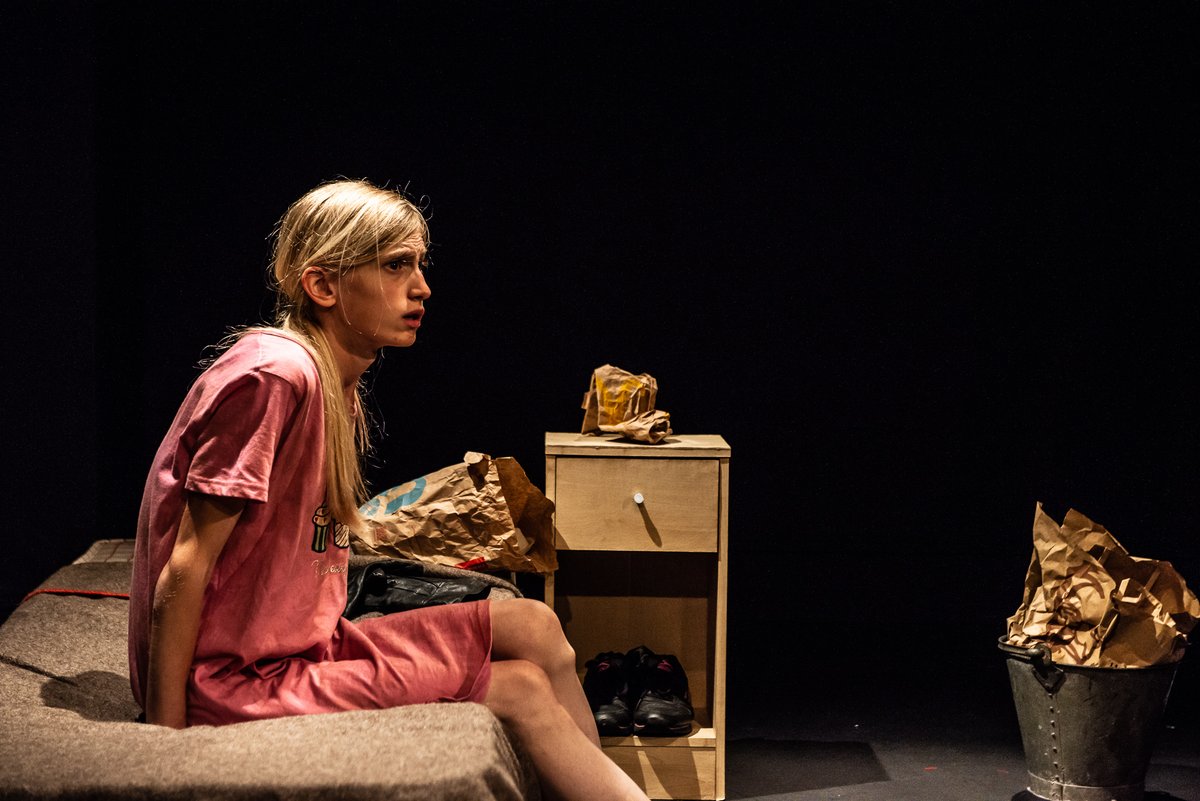
Photo credit: Rah Petherbridge

Tagged by Jim Moss takes an equally dark view of our relationship with technology as we meet Allie, who’s been kidnapped and locked in a room where she’s forced to meet clients and ensure they have “exquisite encounters”. If she objects, the cuff on her ankle injects her with a drug to make her comply. Moss skilfully builds the tension and keeps us guessing until the final twist; when Allie’s latest client turns out to be a police officer, we learn the truth about how she got there – and it’s all the more shocking because it’s a situation any one of us could easily get ourselves into, even today.

Far less dark but still with a bit of a sinister edge, Elspeth Tilley’s Bunnies and Wolves takes an extreme view of what a public-private healthcare system could look like. Riley and Casey’s daughter has been admitted to hospital, but it turns out everything, from the ability to purchase a cup of coffee to the quality of their daughter’s treatment, depends entirely on how many points they can earn on the in-house marketing programme. Though the play rapidly spirals from vaguely feasible to utterly surreal, it nonetheless makes some shrewd points about the consumer-driven society in which we live – and brings home more powerfully than ever how lucky we are in the UK to have the NHS.

Sheila Cowley’s Teatime is set in the ruins of a library during an unnamed conflict, and focuses poignantly on the ways in which human beings adapt to traumatic circumstances. When Kim stumbles into the library looking for an exit, she meets Archie and Annabelle, who live in an entirely imaginary world where everything’s fine – although we learn, in snatched asides, that both have suffered terrible losses as a result of the war. In its current form, it’s hard to really get to know the characters and appreciate what they’re going through before the play comes to an end; I’d love to see a longer version that tells us more.

Photo credit: Rah Petherbridge

Finally, easily the most emotional play of the five is Accident of Birth by Trevor Suthers.It follows the first meeting between Margaret and Anthony since she gave him up for adoption as a baby – a meeting that takes place at Broadmoor, where he’s detained at her Majesty’s pleasure for undefined crimes. What begins as an awkward but – in the circumstances – reasonably affable reunion becomes more and more uncomfortable as Anthony tries to make sense of who he’s become by finding out more about his biological parents from an unwilling Margaret. This gripping contribution to the nature versus nurture debate doesn’t give us the answers to all his questions, but it does tell us just enough to ensure we’re completely caught up in and moved by their encounter.

Taking all the plays together, this year’s British Theatre Challenge – hosted by Sky Blue Theatre’s John Mitton – made for a really enjoyable evening of new writing. Like everyone else I cast my vote at the end of the evening, but regardless of tonight’s outcome, all five pieces absolutely deserved their place on stage and will, I hope, be seen by audiences again in the future.

For more details about the British Theatre Challenge, visit the Sky Blue Theatre website.
Review: Eros at the White Bear Theatre

In June of this year, Instagram hit a new milestone: one billion active monthly users. Facebook, meanwhile, is still streets ahead with 2.23 billion people logging in every month. It’s becoming more and more difficult to remember (or for the younger generation, imagine) what life was like before the Internet – and particularly before we were able to take it with us wherever we go.

Obviously, it has its benefits; without the Internet I wouldn’t be here writing this review, for one thing. But there are growing and legitimate concerns about the amount of time we now spend in the digital world, being exposed to fake news and impossible ideals, and the risks this poses on both a global and a personal level.

Photo credit: Stephanie Claire Photography

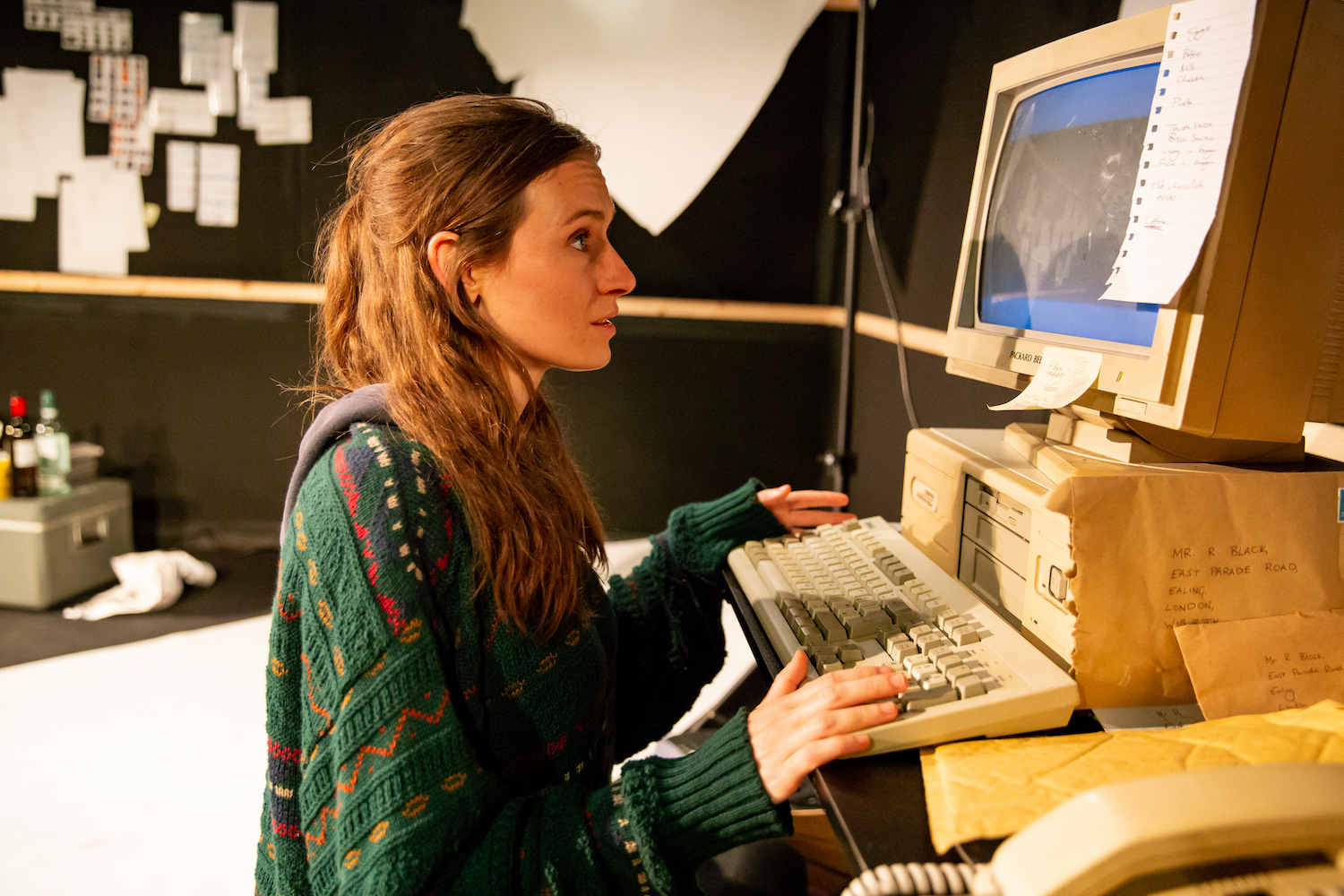
Set in the 90s, Kevin Mandry’s Eros takes us back to the early days of the Internet, and into the studio of Ross Black (Stephen Riddle). A former glamour photographer, he’s fallen on hard times and now scrapes a living helping small businesses produce marketing brochures. He dreams of giving it all up and moving to Scotland, much to the horror of his assistant Terri (Felicity Jolly), for whom the studio is much more than just a job. And then his ex-lover Kate (Anna Tymoshenko) arrives out of the blue to remind Ross of his glory days – and not in a good way.

The first thing to say about Eros is that it doesn’t necessarily go where you think it’s going… but it’s also difficult to pinpoint exactly where it does end up. Touching on various extremely topical themes – consent and female agency, our obsession with untouchable perfection, the growing influence of technology – it doesn’t really focus on any of them in any depth, and despite some intriguing details and hints that there could be a big twist coming, the explosive revelation we’ve been waiting for never arrives. As such the production, directed by Stephen Bailey, becomes somewhat lacking in pace before concluding on a disappointingly lacklustre note.

On a more personal level, as a portrait of the relationships between three disillusioned characters whose lives haven’t gone the way they hoped, the play is more successful. Felicity Jolly’s Terri is by far the most likeable of the three; after escaping a troubled past, she’s found some kind of stability with Ross, who she clearly idolises as a father figure. She’s terrified of losing both her home and her new-found Internet connection, which has allowed her to make new friends all over the world through the miracle of chatrooms.

Photo credit: Stephanie Claire Photography

The majority of the stage time belongs to Anna Tymoshenko and Stephen Riddle as Kate and Ross, whose relationship is complex and at times confusing. One minute Kate is bristling with righteous anger and hatred, the next she’s flirting, dancing around the studio, and even suggesting they get back together. She has what appears to be a picture perfect life – big house, successful business – but something’s missing, and it’s clear that despite everything she still feels some lingering affection for her former lover. There are a few moments where the two connect and it seems like this affection might be reciprocated, but they never last long; Ross has his own idea of a perfect life and Kate, it seems, has never featured in it.

Eros sets out to tackle some interesting questions about human nature and our relationship with the ever-changing world around us, and offers an enjoyable opportunity for those old enough to reminisce about the joys of dial-up internet. The personal story of the characters is intriguing to watch as it unfolds, but unfortunately a lack of focus reduces the topical contribution that the play could have made to more than one ongoing discussion.

Can’t see the map on iPhone? Try turning your phone to landscape and that should sort it. I don’t know why but I’m working on it…

Review: How To Save A Life at Theatre N16

According to Cancer Research, around 1 in 135 women in the UK will be diagnosed with cervical cancer in their lifetime. Maybe that makes it sound like the odds are in our favour – but what if you’re the one?

Written and directed by Stephanie Silver, How To Save A Life is the story of Melissa (Heather Wilkins), who’s just learned she’s got cervical cancer after going to the doctor with an embarrassing and apparently minor complaint. The play follows her through her journey and explores how her diagnosis affects her relationship with those closest to her – in particular, her boyfriend Toby (John Mark Slade) and best friend Maria (Katerina Robinson).

The first surprise is how funny the play is; Melissa is an engaging central character who’s not afraid to (over)share intimate details about her life, and who, despite her immediate fears that as a cancer patient she’ll never smile again, still manages to find silver linings to her condition. All the Spice Girls dance routines, gap year plans and glitter cannons in the world, though, can’t quite distract us – or Melissa – from the sobering reality of what’s happening to her, as with each new doctor’s appointment the prognosis gets a little worse. Heather Wilkins’ performance captures really well the growing sense of panic that constantly intrudes, despite Melissa’s best attempts to smother it, and we feel each new blow right along with her.

How To Save A Life at Theatre N16

Some of the play’s most poignant scenes are shared moments with Toby and Maria, who never leave her side (literally; both John Mark Slade and Katerina Robinson remain on stage throughout, filling in all the other roles and ensuring the right prop is always to hand). Though it’s initially heartwarming to see their unwavering support, as the play goes on it begins to make things worse, because Melissa’s all too aware of how much she means to them and what it’ll be like for them to lose her. Should the play be developed into a full-length piece – and let’s hope it is – it would be great to see this complex relationships angle explored in more depth.

Perhaps inevitably, given that it was written by a medical professional, the play’s immediate impact is also to educate its audience about the symptoms to look out for, and the importance of cervical cancer screening. Far from lecturing, however, it does this very naturally through Melissa, as she not only shares what initially led her to consult the doctor but also reflects on the other earlier signs she brushed off as “normal”. As a woman in the audience, it’s almost impossible not to be affected or go away with a heightened awareness of the risks.

It’s still early days for How To Save A Life, which is performed at Theatre N16 this week as part of the Catapult new writing festival – but already there’s a huge amount of potential in this short but impactful piece. If nothing else, it should encourage more people to go for screening, but it’s also a deeply poignant look at one young woman’s devastating personal journey through a cancer diagnosis and beyond. I hope we’ll see more of it in the future.

Review: The Government Inspector at Brockley Jack Studio Theatre

Paula Chitty’s new adaptation of Nikolai Gogol’s The Government Inspector is an entertaining comedy of errors, which relocates the action from 19th century Russia to northern England in 1979. With public workers on strike in response to cuts and corruption within the council, the town of Worsborough Dale has fallen into unsanitary disrepair – so it’s with some horror that the local officials learn there’s a government inspector on the way.

When they hear there’s a well-dressed young man staying at the local B&B, they jump to the obvious conclusion, and deal with the problem the only way they know how: by throwing money at it. There’s just one problem – said well-dressed young man isn’t the inspector at all, but Norman, a minor civil servant who’s gambled away all his funds, and is consequently only too happy to accept every penny of the council’s generosity.

Nobody comes out of this story very well: as loathsome as Norman (Jack Blue) and his travelling companion Osip (John Stivey) are, we can’t help but enjoy seeing them take advantage of the equally vile council officials, who’ve been cheerfully lying, cheating and lining their own pockets at the expense of the local residents. Property dealers Black and Jack (Elizabeth George and Richard Houghton-Evans) are dreadful gossips, Tommy the postman (Robert Mclachlan) routinely opens everyone’s mail, the Deputy Leader (Richard Willmott) is a creep who’s already having at least one affair, and the Chairman (Bernard O’Sullivan) is a tyrant who’s only interested in his own career advancement. The one character for whom we have any sympathy is Anna (Fiona Vivian), the Chairman’s daughter, who ends up an innocent pawn in the schemes of her father and Norman.

The real victims, however, are the people of Worsborough Dale, who’ve seen their wages cut, jobs lost and public services slashed; the town’s overrun with rats and the lights keep going out, so it’s hardly surprising that they’ve taken to the streets in protest. Though the play’s set in the 70s, it’s not hard to draw parallels with the current political situation, and the lack of public faith in those elected to lead our country.

The production is at times a little unpolished, but the enthusiasm of the cast can’t be faulted as they throw themselves gleefully into their various unsavoury roles. There’s also some excellent physical humour, particularly in Act 2 when events really begin to spiral out of control. Jack Blue and John Stivey make an enjoyably unscrupulous comedy double act as Norman and his long-suffering companion Osip, and Bernard O’Sullivan also stands out as the increasingly frustrated Chairman; when he finally explodes, it’s quite a sight to behold.

At a time when it feels harder than ever to trust those in power, it feels both appropriate and depressing to see Gogol’s play revived, almost 200 years after it was written. Perhaps one day we’ll no longer need cautionary tales like these – but based on humanity’s track record to date, it seems sadly unlikely.

Review: Much Ado About Nothing at Gray’s Inn Hall

Well, it’s official. I was already a fan of Antic Disposition’s work after enjoying their productions of Henry V and Richard III – but their latest offering, a joyous and hilarious take on Much Ado About Nothing, has well and truly sealed the deal. The play itself I have all kinds of issues with, but I’m not going to get into those, because I had such a great time watching this production that I’m seriously considering a return visit before the run ends on 1st September.

Photo credit: Scott Rylander

Transplanted from Italy to a small French village at the end of World War II, Much Ado sees Don Pedro (Theo Landey) and his triumphant soldiers call in to visit the town’s Governor, Leonato (Chris Hespel) on their way home. One of the officers, Claudio (Alexander Varey), falls in love with Leonato’s daughter Hero (Floriane Andersen), and Don Pedro steps in to arrange their marriage. He then turns his attention to convincing Hero’s cousin Béatrice (Chiraz Aïch) and another of his men, Benedick (Nicholas Osmond), that their constant bickering actually masks much deeper feelings. It’s all going swimmingly, until Pedro’s bastard brother Don John (Alfie Webster) teams up with soldier Borachio (Tommy Burgess) and Hero’s unwitting maid Margaret (Molly Miles) to convince Claudio that Hero’s been unfaithful to him, leading him to publicly shame her and leave her for dead on her wedding day. But this is a Shakespearean comedy, so we can all guess what happens next: Don John’s plot is uncovered, all is forgiven, and everyone has a song and dance to end the evening.

The Anglo-French cast are superb. Chiraz Aïch and Nicholas Osmond give brilliant verbal and physical comedy performances as Béatrice and Benedick, while Alexander Varey is a perfectly petulant Claudio to Floriane Andersen’s tender-hearted (and, in my opinion, far too forgiving) Hero. But the stars of the show, for me, are the two relatively minor characters of Dogberry and Verges, played by the wonderful Louis Bernard and Scott Brooks. Presumably there’s not a lot of policing to be done in this small rural village, because Constable Dogberry and his long-suffering deputy also appear to run – somewhat ineptly – a cafe on the side. This not only means we get to see much more of their characters in Act 1 than we usually would; it also allows directors Ben Horslen and John Risebero to explore the predominantly silent comedic style of French film director Jacques Tati. Bernard is particularly delightful to watch; we may not understand everything he says but such is his charisma it really doesn’t matter – and because English isn’t Dogberry’s native language, we’re much more sympathetically inclined than usual towards him and his bizarre vocabulary. (Also, “I am an ass!” sounds much funnier in a French accent.)

Photo credit: Scott Rylander

In addition to the bilingual cast, there are other elements of the production that will be familiar to fans of Antic Disposition’s previous shows. Music plays an important part in the play; Nick Barstow’s compositions, performed by the cast, contribute to the evening’s celebratory mood. The venue too is unique: having visited some of the nation’s most stunning cathedrals during July, followed by performances in France earlier this month, the tour concludes at London’s historic Gray’s Inn Hall, which is transformed for the occasion into Dogberry’s very traditional French cafe.

In summary, this production is so much fun that you’re pretty much guaranteed to leave with a smile on your face (and possibly with a hankering to run away to the French countryside). Don’t miss the final few opportunities to be charmed by this riotously entertaining clash of cultures.

Can’t see the map on iPhone? Try turning your phone to landscape and that should sort it. I don’t know why but I’m working on it…