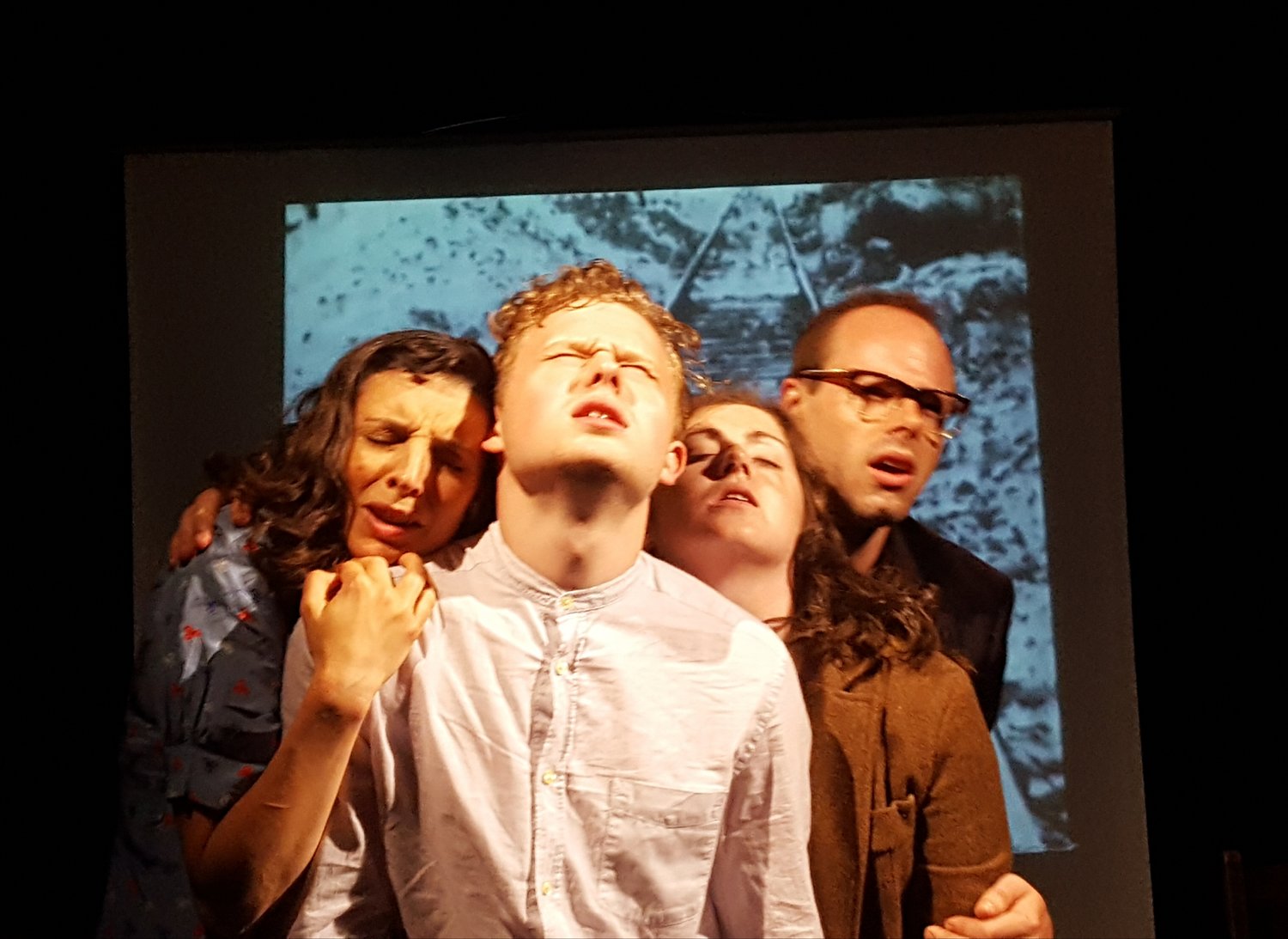
Review: The Unspoken at Barons Court Theatre

Begun all the way back in 2003, writer and director Jody Medland’s The Unspoken was chosen to be part of the Actor Awareness summer festival in July this year, after which it was immediately picked up by Barons Court Theatre for a two-week run. It’s an unconventional story, full of surprising twists and turns, and which does indeed leave a lot unspoken. It leaves the audience with considerably more questions than answers, along with a creeping sense of unease over both what we’ve seen, and what we haven’t.

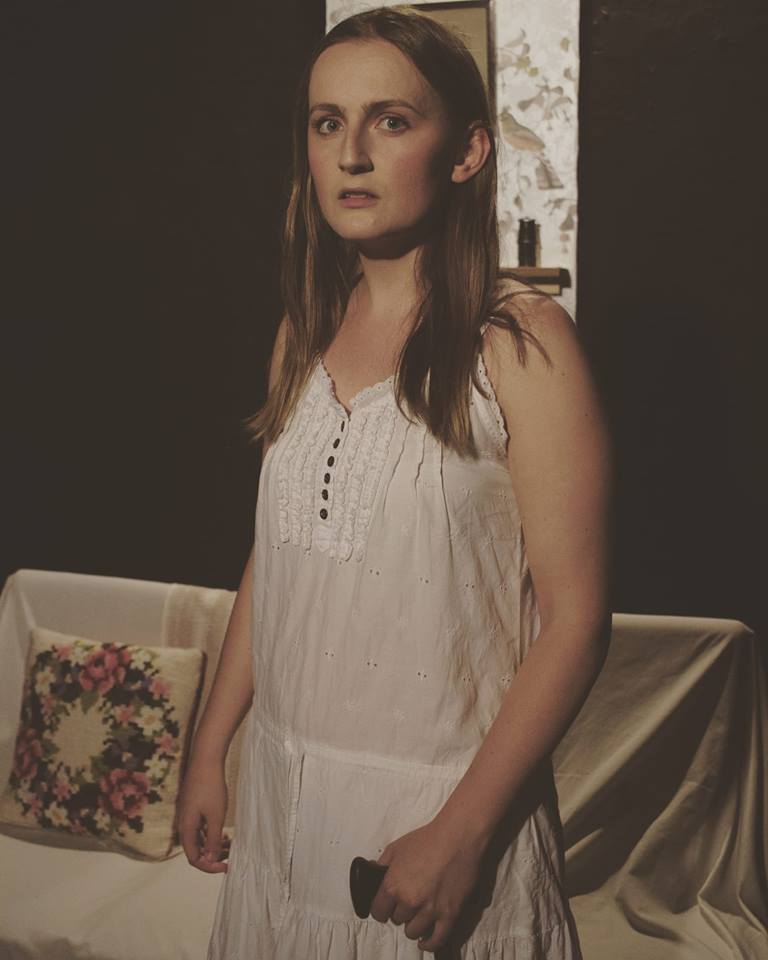
It’s also likely to prove divisive among audiences, largely for its depiction of the difficult relationship between miner Jimmy (Will Teller) and his blind daughter Maggie (Hannah Tarrington). He’s raised her alone from birth following the death of her mother, and over the years has convinced her that he’s an architect, and that the two of them live in a beautiful house that’s the envy of their whole town. He does this, we’re told, out of love – but any sympathy we might have felt for his situation is lost in the opening moments of the play, when we hear him beating his daughter offstage as she begs for mercy. Nor is this an isolated incident; he repeatedly strikes her throughout the play, chains her up like a dog, and punishes her harshly just for talking through the door to regular visitor Father Alderton (Elliot Blagden).
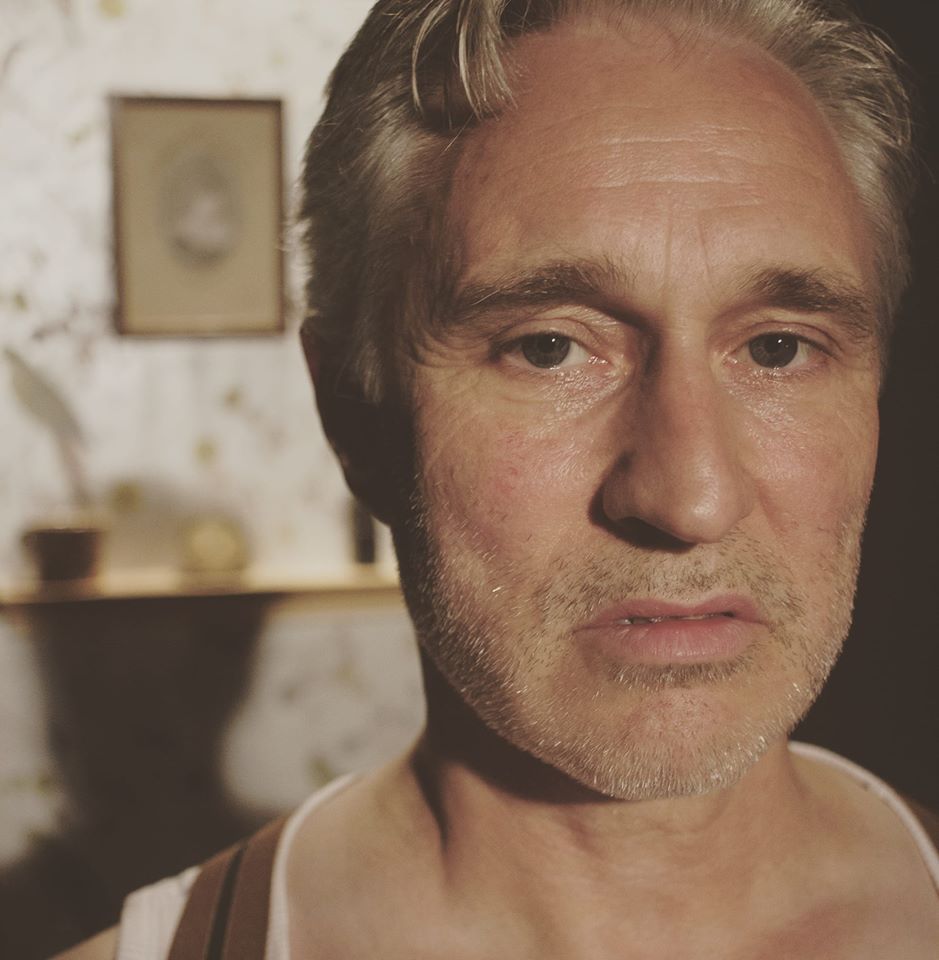
He tells himself – and her – that he’s doing all this to protect her from a world that not only won’t help but may actively harm her, and the play’s unexpected final scene proves that he may have been right to be concerned – although, like Maggie, we never leave the house, so have no way of knowing for sure who or what is really out there. Regardless, it’s difficult to get past the fact that this is a relentlessly abusive and controlling relationship, which is built almost entirely on deceit, and which makes for very uncomfortable viewing.

This also means that the play’s central theme of classism gets a bit lost, because while we can appreciate the difficulties of Jimmy’s situation – the play is set in 1972, in the looming shadow of the impending miners’ strike – it still doesn’t seem like enough to justify his brutal methods. And though he ultimately takes steps to ensure a future for Maggie that will see her elevated in society, the way in which he does it, and in which the final scene is performed, leave us questioning whether he may not have just moved her from frying pan to fire.

Whatever your reaction to the play’s themes and content, however, there’s no denying the performances are excellent. Will Teller has arguably the toughest role as Jimmy, walking with great precision the narrow line between loving father and vicious tyrant, and there are moments when we do genuinely sympathise with his situation – if not with his reaction to it. Alongside him, Hannah Tarrington is painfully vulnerable as Maggie, submitting meekly – almost willingly – to her father’s abuse and taking scraps of comfort from the hours she spends listening to her radio. And yet despite the attempts of several men to rescue her from dangers she can’t see, she’s not quite the damsel in distress they all believe her to be – as Dr Rose later discovers to his cost. Elliot Blagden plays both Father Alderton and the doctor, and though we never see the former and only meet the latter for a few minutes, he brings an ambiguity to both roles that poses one of the play’s more intriguing questions: is seeing really believing?
There are certainly aspects of The Unspoken that feel problematic, and for that reason the play won’t be for everyone; I still haven’t quite decided how I feel about it myself. On the other hand, so much is left unexplained that it gives the audience plenty to talk about, debate and almost certainly disagree over. Sometimes it’s obvious what a writer wants us to take away from seeing their play; this is not the case here, and that alone makes it worth a visit – just make sure you allow plenty of time for post-show discussions.


Can’t see the map on iPhone? Try turning your phone to landscape and that should sort it. I don’t know why but I’m working on it… 😉

Review: Hobson’s Choice at the Brockley Jack Studio Theatre

Many years ago, I studied Hobson’s Choice for GCSE English, and my lasting memory is of our teacher trying to convince us to read it out in a Salford accent (a suggestion met with all the derision you’d expect from a class of 15-year-old girls). What I didn’t remember was it being set in the 1950s – mostly because it wasn’t; the action of Harold Brighouse’s play, first performed in 1916, originally took place in 1880. Newly reimagined for a different generation by Matthew Townshend, the play proves just as entertaining and relevant as ever – although it is depressing to reflect that in many ways not a lot has changed, both between 1916 and 1958, and between 1958 and now.

Photo credit: Peter Clark

Henry Hobson (John D Collins) is the father of three daughters. He’s also the owner of a successful shoe shop – although the success has little to do with him, as he’s usually in the pub. Instead, his oldest daughter Maggie (Rhiannon Sommers) runs the business, much to the amusement of her two younger sisters Alice (Greta Harwood) and Vickey (Kelly Aaron), who are too busy enjoying themselves to be a lot of help. Hobson complacently assumes Maggie’s too old to marry – right up until she decides her future lies with the shop’s shy but brilliant bootmaker William Mossop (Michael Brown). Having convinced her intended that it’s a good idea (those two little words every woman wants to hear on her wedding day: “I’m resigned”) she sets about turning Will into the man she knows he can be, and in doing so puts her bullying father firmly in his place.

Rhiannon Sommers gives a commanding and very funny central performance as the supremely confident Maggie; cool, calm and entirely in control throughout, she nonetheless shows us glimpses of vulnerability, which prevent her from coming across as manipulative or cruel. And there are aspects of her story that resonate even now; the idea that women have a sell-by date remains widespread, as does the belief that women must be “feisty” if they want to succeed in what is still very much a man’s world.

That man’s world, in this case, is run by pompous patriarch Hobson, played wonderfully by John D Collins. He bullies all three of his daughters, expecting them to work unpaid in his shop and repeatedly accusing them of “uppishness”, and consequently it’s hard to feel much sympathy for the pathetic figure he ultimately becomes – even though two of his daughters are particularly unpleasant. Greta Harwood and Kelly Aaron are exquisitely irritating as Alice and Vickey, Maggie’s whiney, self-involved younger sisters. They’re interested only in capturing rich husbands Albert and Fred, who are so bland and interchangeable that both are played by Connor McCreedy with only a change of glasses to differentiate between them.

With the action taking place in two separate locations, Martin Robinson’s set is a work of genius, transforming very quickly and neatly. There’s a clear symbolic difference between the two settings; while Hobson’s shop could easily be back in 1880, the cellar where Maggie and Will live and work is very clearly from the 1950s – as are the play’s costumes, soundtrack and dance moves. There’s a strong sense that change is coming, and to bring the point even more firmly home, the doctor called out to treat Hobson in act 2 – originally a man – is replaced by no-nonsense District Nurse McFarlane, in a brief but hilariously memorable appearance by Natasha Cox.

Photo credit: Peter Clark

To watch Hobson’s Choice as a woman in her 30s, particularly – gasp! – an unmarried one, is a very different experience to reading it (with or without the Salford accent) as a teenager. Back then, I probably did think Maggie was getting on a bit, and nor did I fully appreciate the barriers women faced – and continue to face over a century after the play was written. This excellent production offers a welcome opportunity to revisit a classic with fresh eyes, and to be well and truly entertained in the process.


Can’t see the map on iPhone? Try turning your phone to landscape and that should sort it. I don’t know why but I’m working on it… 😉
Review: And Then They Came For Me at The Hope Theatre

The title of James Still’s harrowing play about the Holocaust has a double significance. On the one hand, it’s a factual statement made by 15-year-old Eva to describe her arrest by the Nazis – an arrest that led to several months in Auschwitz, and the loss of her father and brother. But it also recalls the haunting final line of Martin Niemöller’s well-known poem: “Then they came for me — and there was no one left to speak for me.”

The Holocaust is one of those moments in history that feels almost mythical; we all grow up hearing about it, but it’s so impossible to imagine such brutality that unless you have a personal connection to those events, it doesn’t feel quite real. And Then They Came for Me: Remembering the World of Anne Frank doesn’t allow us to shrug it off so easily, though – in no small part because the production was personally requested by Holocaust survivor Eva Schloss, who approached the director, June Trask, and asked her to take the show on tour around the UK.

Photo credit: Moondog Productions

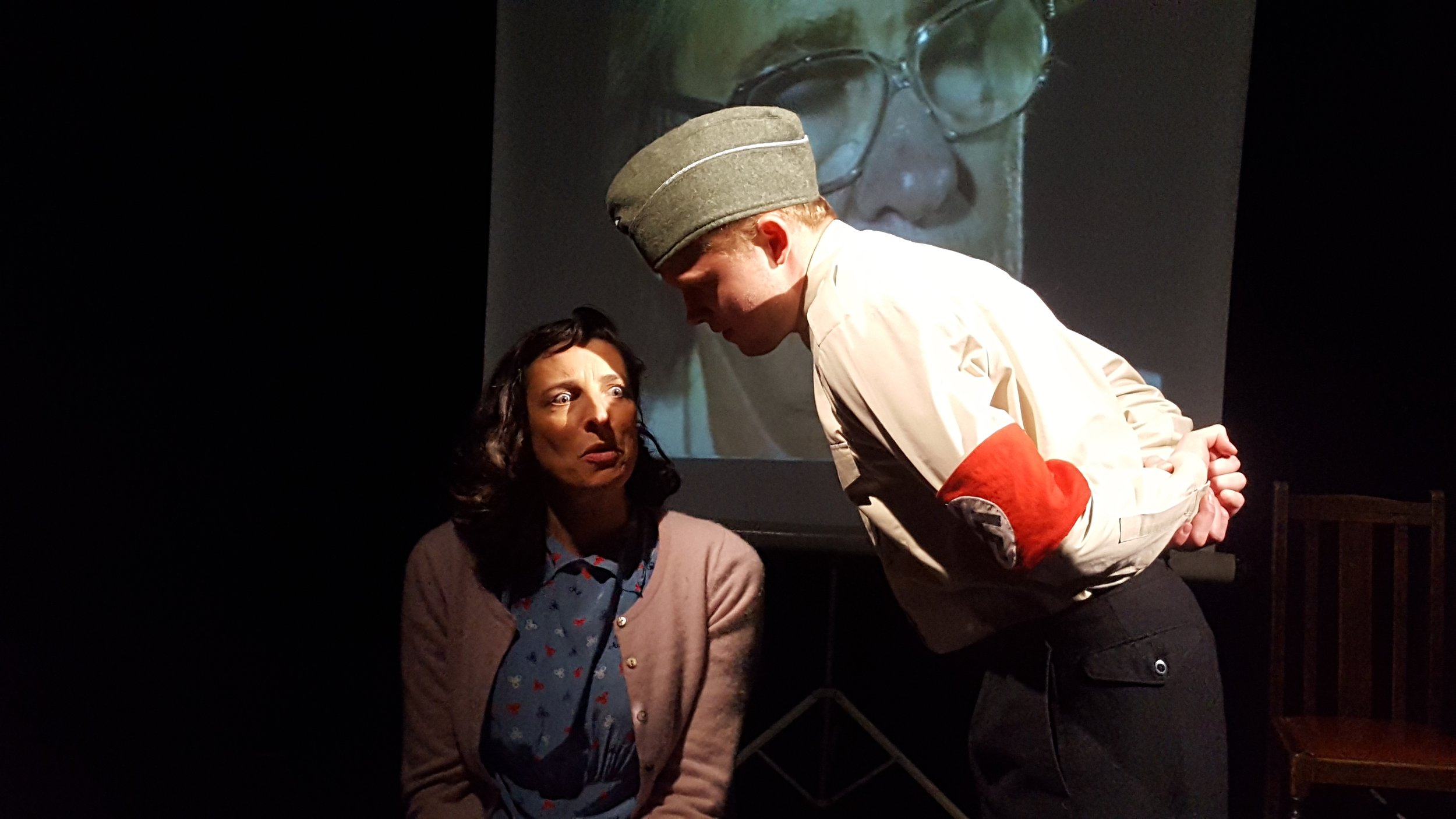
Eva herself also appears in the play, which uses a unique combination of video footage and live action to tell her story, along with that of Ed Silverberg (formerly Helmuth ‘Hello’ Silberberg) and their mutual friend, Anne Frank. All three were young teenagers when the persecution of the Jews began, and so we see the nightmare through two sets of eyes: those of the adult Eva and Ed looking back on what happened, and those of the confused children trying to comprehend the terrifying ordeal they’re living through.

The play deals first with the rapid spread of anti-Jewish prejudice and persecution in the early 1940s, and the attempts of Eva, Ed, Anne and their families to find safety in Amsterdam. It then kicks into another gear altogether with a portrayal of the unspeakable horror experienced by Eva and her mother, Anne and so many others in Auschwitz, where human lives were treated as utterly worthless and a split second decision could mean the difference between life and death. The scenes within the camp are sensitively and minimally portrayed, but the outstanding cast – Gemma Reynolds, Leo Graham, Bethan Kate-Tonkin and James Coupland – ensure that we feel every moment of their fear, pain and grief, and are themselves visibly shaken by the performance’s poignantly staged conclusion.

Photo credit: Moondog Productions

Eva Schloss felt this play needed to be seen by audiences around the UK, not only so that her family’s ordeal can be remembered, but so that we can take steps to ensure it’s never repeated. That’s an easy idea to dismiss – surely we’d never allow such a thing to happen now – but this play reminds us that it happened once before, and the world let it happen. We only have to read the news to see that we’re headed back in that direction: millions of people around the world have been forced to flee their homes; anti-Semitism and Islamophobia are rife across Europe and the USA; far-right groups are on the rise, emboldened by the anti-immigration rhetoric of politicians. It’s a frightening picture, and one that will only get worse if left unchecked. The best way we can honour the memory of Anne Frank, Heinz and Erich Geiringer, and the millions of others who lost their lives in the Holocaust, is to speak up now – while we still can.

For information about future productions, or to book a performance of And Then They Came for Me: Remembering the World of Anne Frank for a school, organisation or public group, visit the website.

Review: That Girl at the Old Red Lion Theatre

Hatty is 29 years old and works in advertising. When one of her housemates gets engaged, she and best friend Poppy prepare to move into a new place together. Except Poppy’s just got a new boyfriend, whereas Hatty is still single, bored with her job and suffering from frequent bouts of anxiety – all of which is a far cry from her glamorous past as a child movie star.

Written by and starring Hatty Jones, That Girl is the story of a young woman who still hasn’t quite figured out who she is or where her life is going. Based on the writer’s own experience as the star of 1998 children’s movie Madeline, it examines how this early fame continues to affect her as an adult, long after giving it all up in favour of a “normal” life.

Photo credit: Sunny Smith

Although Hatty the character has the same backstory as Hatty the writer, it’s not clear how much the two now overlap – though it does seem unlikely that the Hatty on stage would allow herself to be portrayed the way we see her. Insecure and needy, this Hatty is unable to celebrate even her best friends’ successes and, despite her protests to the contrary, only really comes to life when given an opportunity to relive her childhood fame.

Even these opportunities aren’t as frequent as she’d like everyone to believe, and it’s often Hatty herself who brings up the subject, shoehorning her early success into conversation by any means possible. It’s clear that her memories of Madeline are a comfort blanket, a reminder of a time when life was exciting, and a stark contrast to her current mundane existence. These days, she’s just like everyone else – a young woman approaching her 30th birthday, watching her friends settle down with boyfriends and mortgages, and panicking about being left behind. While we’re able to relate to her motives, it’s difficult to approve of her methods as, in her desperation to hold on to her lifelong friendships, she ends up putting them at risk.

Whatever our feelings about the character, it’s difficult not to warm to the real Hatty Jones, who makes a powerful playwriting debut with That Girl, and also gives a thoroughly engaging performance as “herself”. She’s joined by fellow cast members Alex Reynolds as Hatty’s colleague Lola and housemate Poppy, and Will Adolphy, who plays Poppy’s boyfriend Adam and Hatty’s date Dylan. Both actors move seamlessly between their two characters with just a quick change of outfit, to show us a cross-section of the people that make up Hatty’s world – a superficial world of Tinder, bloggers, avocados and brunch.

Photo credit: Sunny Smith

Directed by Tim Cook, the action moves at a steady pace as we follow Hatty over two days. They’re not particularly eventful days – which is sort of the point – but that certainly doesn’t mean there’s a lack of tension. With cardboard boxes scattered around Sunny Smith’s set, we’re constantly reminded of the impending move and the pressure it’s placing on Hatty and Poppy’s already strained relationship. This eventually comes to a head after a deeply uncomfortable moment between Hatty and Adam, which is so well written that it feels like watching a car crash in slow motion; we know what’s coming, but can do nothing to stop it.

Simultaneously funny and heartbreakingly sad, That Girl is a very relatable story about fame, friendship and the pressures of adulthood. Madeline may be all grown up, but if this play is anything to go by, her adventures aren’t over yet.

Review: Hamilton (Lewis) at the King’s Head Theatre

As you may have heard, a little show called Hamilton opened last year in the West End. It’s been fairly successful, and it’s no big surprise that it’s already been the inspiration for more than one comedic parody. One of these is Hamilton (Lewis) by Fiona English and David Eaton, freshly returned from Edinburgh to the King’s Head, which tells the somewhat less epic story of – you guessed it, British Formula 1 star Lewis Hamilton.

Photo credit: The Other Richard

Born and raised in Stevenage, young Lewis (Letitia Hector) wants only one thing: to become world champion. Until 2007, when he’s taken on by Big Ron Dennis (Jamie Barwood) to join the team at McLaren, and meets his villainous teammate/rival Fernando Alonso (Louis Mackrodt), who advises him to “drive less… smile more” and focus instead on building his brand. Cue a seven-year celebrity romance with the only Pussycat Doll anyone ever remembers, Nicole Scherzinger (Liberty Buckland), which gets them on the cover of Hello! magazine but otherwise proves wholly unsatisfying on both sides. Driven by an increasingly obsessive ambition to regain his world champion title at all costs, Hamilton loses sight of what’s important and – well, that’s it really; it’s hardly a spoiler to reveal that this story doesn’t end in a deadly duel.

A pre-show disclaimer from the cast makes it clear we shouldn’t get our hopes up too much; after all, it took Lin-Manuel Miranda over four years to write Hamilton, and who has that kind of time on their hands? Instead, Benji Sperring’s production openly plays to its disadvantages, turning its lack of budget, actors and stage space into a running joke. Similarly, there’s no hesitation about admitting that compared with the charismatic Hamilton (Alexander), Hamilton (Lewis) is considerably less interesting, and much of the humour takes aim directly at the characters; nobody comes out of this story in a particularly positive light.

The main joke, though, is obviously the references to Hamilton. Some of these are blatant, others more subtle – but while the story can and does stand alone, the nods occur frequently enough in both script and musical numbers that to fully appreciate what’s going on, you probably need to have at least listened to the Hamilton soundtrack once or twice. Taking such a universally adored show as its inspiration pretty much guarantees a warm reception from an audience who are quickly able to spot the successful jokes, and willing to forgive when a few of them fail to land.

Photo credit: The Other Richard

The production’s biggest success is its excellent cast, who deliver strong vocal performances even as they embrace the madness, hamming it up to outrageous levels in the name of comedy. There’s nothing more enjoyable for an audience than seeing the actors having a good time on stage, and this cast are clearly enjoying themselves immensely.

If you turn up at the King’s Head expecting Hamilton, you’ll be disappointed on several different fronts. But then again, Hamilton (Lewis) never claims to be Hamilton – in fact the cast take great pains to point out to any lawyers in attendance that it definitely isn’t. Chaotic, silly and 100% unendorsed, it nonetheless makes an enjoyable pit stop while you wait for your next chance to buy tickets to the original.

Can’t see the map on iPhone? Try turning your phone to landscape and that should sort it. I don’t know why but I’m working on it… 😉