Review: The Full Brontë at The Space

The life and works of the Brontës have been the traffic of many a stage over the years – but I suspect never quite like this. Scary Little Girls’ two-hander “literary cabaret” The Full Brontë is a joyously chaotic homage to the famous writing family, which features song, dance, storytelling, Kate Bush, Black Lace, a “ukelady”, quite a bit of audience participation and several packets of crisps.

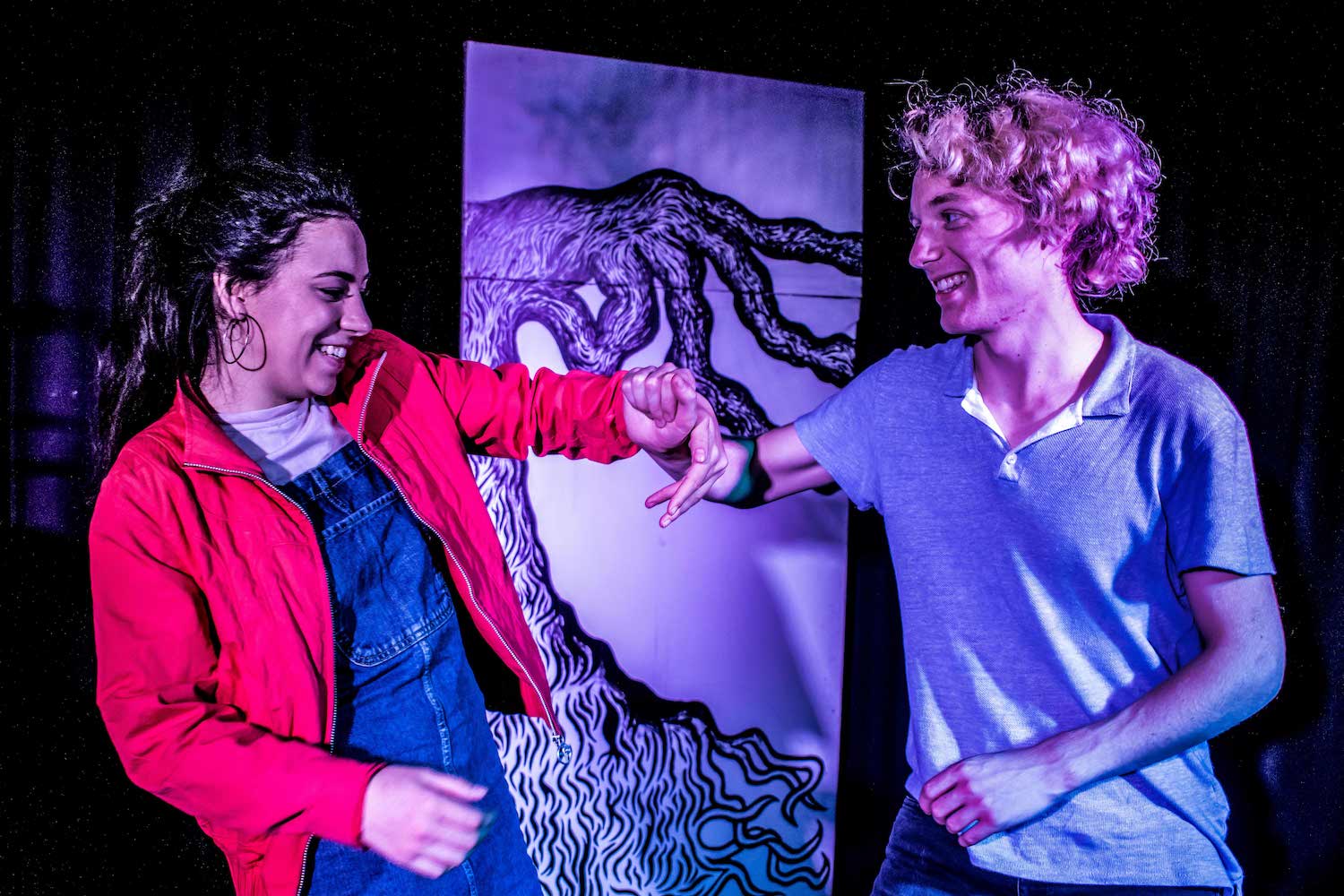
The show is hosted by “actor-manager” Maria (Rebecca Mordan) and her amiable, much put-upon assistant Brannie (Sharon Andrew), who does everything else – music, props, wardrobe, stage management… you get the idea. It quickly transpires that what was supposed to be a celebration of the Brontës is in reality intended as a celebration of Maria’s great artistic talent – or at least it would be if Brannie didn’t keep stealing all the best lines and showing her boss up with a more in-depth knowledge of the Brontë family history. Somewhat predictably, though Maria casts herself as the star, Brannie quietly – and quickly – wins us over, so it’s no surprise that in any moment of conflict between the two, the audience always sides with her.

It’s also no particular surprise that despite the title, there’s not actually much about the Brontës in the show. References to their novels and poetry are sketchy at best, often straying on to other topics including (of course) a couple of awkwardly shoehorned jokes about Brexit and Trump. Even the extended scenes based on the Brontës’ two best-known novels – Jane Eyre and Wuthering Heights – reveal far more about the tense partnership between Maria and Brannie than they do about the literary works that inspired them.

That isn’t necessarily a bad thing, however (although anyone going along to actually try and learn something about the Brontës might disagree), and the comedic talents of Rebecca Mordan and Sharon Andrew more than compensate for the show’s lack of literary substance. Both audience and actors are kept on our toes by the threat/promise that most of us will be “used” at some point during the evening, and it’s often these improvised exchanges with audience members – when neither party quite knows what might happen next – that get the biggest laughs.

The Full Brontë is without doubt a very silly, chaotic 80 minutes, during which you’ll learn next to nothing about the Brontës (except that they may or may not have been Cornish…?) and may well come out a bit more confused and considerably more flustered than when you went in. But even so, it’s hard not to be charmed by this thoroughly entertaining comedy duo, and for an evening of good-natured fun, the show is well worth a visit.


Can’t see the map on iPhone? Try turning your phone to landscape and that should sort it. I don’t know why but I’m working on it… 😉

Interview: Erika Eva, Unbelonger

Ekata Theatre is an international theatre company based in London and Helsinki. Most recently seen in London with physical theatre piece On Mother’s Day, in November they’ll be back at the Cockpit Theatre with Unbelonger, as part of Voila! Europe Festival.

Unbelonger is about the feeling of not belonging or not fitting in, being pushed out or pushed to the margin,” explains Ekata’s artistic director Erika Eva. “We’re creating our own world, where it’s not nationality or looks that set the protagonist apart, but a headscarf – and what I want to say with that is how artificial sometimes the borders are. She has a very close relationship with her scarf, which we’re bringing to life through object puppetry, and that’s the best relationship she has throughout her life; she doesn’t really fit into any groups, but she has that one bond. But also she realises that that’s the thing that sets her apart, and what I’d like to explore is that the one thing that sets us apart might be very integral to our identity, whether we end up loving or hating it.”

Devised by the company, a shorter work in progress version of the show was first performed at last year’s Voila! festival, and returns this year with a new cast and a broader perspective. “Last year we had the protagonist and her relationship to the scarf and we were looking at her in a school environment,” says Erika. “But now I want to make it a bit larger so we’re looking at different points of her life, because there’s a lot of discrimination and bullying in school but as we know it often continues after that.

“I’m saddened by the rising nationalism in many countries – in Britain, in Finland where I come from, in Europe and around the world. Our politicians are advocating that kind of message where we’re starting to divide people artificially, like the ban in the USA – there have been people living in the USA for a long time and suddenly they’re banned from living there.”

Erika established Ekata Theatre after graduating from East 15 last year, and Unbelonger was the company’s first production. “I’ve had a super year!” she says. “I’ve done five plays in two different countries, so it’s been a hectic year, which now comes full circle with Unbelonger coming back to London. I’ve learnt tons and I’ve got lots of really good experience, and I now know what I want to do, and the style that I’m going for has become a bit more clear.

“Ekata means unity in Sanskrit. Our idea is to do physical theatre that transcends national and linguistic barriers, and more and more we want to encourage cross-national work. Representation is a very big thing for us, we want to tell stories with diverse representation and I believe physical theatre is something that really unites, because it’s universal.”

That universality is reflected in Unbelonger’s diverse cast of four, who speak different languages as part of the show. “I’m a linguist so I love languages, I love playing with them,” says Erika. “I love the fact that you can understand sometimes even though you don’t speak the language, and that’s amazing, it intrigues me. Emotions and our physicality are universal, and that draws me to physical theatre because it can tell a story without a need for actual words.”

Another very important part of Unbelonger is the live music, from Ekata’s composer in residence Xavier Velastín, who hacks gaming controllers and motion-capture devices to control the sound design with his body. “Xavier is incredible,” says Erika. “Last year he created the music for Unbelonger with us, so as we were devising he was reacting to the actors and composing the music live. And this time we’re going to add a layer, because it’s at the Cockpit so we’re going to give him the lower gantry.”

The third member of the Ekata team is writer in residence – and Erika’s sister – Saaramaria Kuittinen, who wrote the company’s previous production, On Mother’s Day, based on seven years of correspondence with people on death row in the USA through a UK-based organisation, Human Writes. “The response to On Mother’s Day was really good, and we’re looking forward to hopefully bringing it back to other places. It is a very marginal theme and not very many people think that it’s an issue or know it’s an issue. The best feedback we got was that Human Writes got new volunteers through it, and that was one of the main goals – to raise awareness and to tell that story.”

With just two weeks until Unbelonger opens at the Cockpit, Erika and the team are excited to share it with new London audiences. “I think it’s going to be a magical play with object puppetry, some acrobatics and live music – and I don’t think people should miss out on that,” she says. “More than anything, what I want the audience to go away with is knowing what not belonging feels like; whether it’s something they can relate to or something that’s new, that feeling should come through – that’s what’s most important.”

Review: Pickle Jar at Soho Theatre

When you’re at school, you tend to assume your teachers are fully functioning adults who have life all figured out. Then a few years pass, you reach the age they were when they taught you, and you’re startled to realise that perhaps they weren’t quite as together as you thought.

In Maddie Rice’s one-woman play Pickle Jar, Miss is a young English teacher struggling to find her footing both in and out of the classroom. Away from work, she’s just been dumped and can’t stop obsessing over how bad her life is compared to everyone else’s. At work, her approach to teaching is to try and be friends with her teenage pupils, who fascinate her with their apparent confidence and worldliness – it often seems her attempts to connect with them are as much for her own comfort and support as they are for her students’ benefit.

Photo credit: Ali Wright

Maddie Rice, who previously starred in the touring production of Fleabag, was encouraged by that show’s creator, Phoebe Waller-Bridge, to write something that made her laugh or cry. Pickle Jar ticks both boxes. Directed by Katie Pesskin, the first half of the show is straight-up, laugh-out-loud comedy, as Miss reflects on everything from her meagre Instagram follower count, to the night her ex broke up with her (shortly after advising her to get tested for chlamydia), to her fumbling attempts – egged on by best friend Mairead – at flirtation with Mr Ellis, the much-fancied food tech teacher.

And then, about halfway through, the story takes a dark turn, and just keeps getting darker as one twist follows another, ultimately catching us off guard with some very uncomfortable, and topical, questions around consent and victim blaming. The humour is still present, but the laughs become far less frequent, and the overwhelming emotion we feel as the show comes to an end is much closer to anger than amusement. Even in the #metoo era, the fact that a female character feels she has to shoulder any of the responsibility for a man’s actions shows how very far we still have to go.

One thing that’s immediately clear is that Maddie Rice is an exceptional performer, bringing an extensive cast of characters, a complex back-and-forth timeline, and a number of different locations to life without ever missing a beat. Colleagues, friends, students, strangers: they’re all here, and all perfectly distinct from each other. Miss in particular is a well-drawn, realistically flawed character who most of the show’s target audience – women in their 20s and 30s – can identify with to some extent (whether we’re willing to admit it or not). The half hour that we spend getting to know her, laughing with – and at – her, never feels like wasted time, even though it delays the show getting to its actual point.

Photo credit: Ali Wright

There’s so much to enjoy about Pickle Jar, a very funny and brilliantly acted hour of theatre that will no doubt resonate with teachers, women and indeed anyone still trying to figure out how this whole adulting thing works (which, let’s be honest, is most of us). But behind the laughter, the play does have a point to make – and it’s a point that needs to be heard and acted on, however uncomfortable that might be.

Can’t see the map on iPhone? Try turning your phone to landscape and that should sort it. I don’t know why but I’m working on it… 😉

Review: Adventures in Black and White at Camden People’s Theatre

The theme of displacement has become increasingly topical in recent years, largely as a result of the intense media coverage of the refugee crisis. It’s important to remember, however, that displacement didn’t start there; it’s been happening for centuries, all across the world – and its effects are often felt down the generations.

Photo credit: Nina Carrington

Such is the case for Miriam Gould and Judita Vivas, also known as Double Trouble, the creators and performers of Adventures in Black and White. Inspired by their grandparents’ diaries, this is the story of Stasys and Lilly – the former exiled as a child from Lithuania to Siberia, the latter sent to England from Austria on the Kindertransport. But it’s also the story of Judita and Miriam, and of all those trying to figure out where they fit within a world that seems ever more obsessed with the invisible borders between nations.

The show combines projected images, improvisation and physical theatre to tell these stories, and as a result it becomes an intriguing mix of poignant and bizarre. Some anecdotes are related in a straightforward way through the reading of letters or diary entries, or in one case a simple monologue direct to the audience, delivered with the help of a particularly appealing visual aid (which only slightly softens the blow of the story’s tragic conclusion). These memories are often supported by photos of the real people involved, displayed on an old-school projector which is set up early on in the show, even as the reliability of some of them is called into question; at one point Lilly swears that the letters in her hand aren’t real, despite acknowledging that they contain many accurate facts about her life.

In between these scenes of reminiscence are moments that feel deliberately alienating. One such scene includes many words, but not one of them in English, and though we can get the gist of what’s being said, there’s still an uncomfortable sense that we’re missing something – much as it must feel to arrive in a strange country as a young child. This isn’t the only moment where it’s difficult to say with certainty what exactly is happening, but there’s a playfulness to the performance of these scenes that means we remain engaged and entertained even when we don’t quite know what we’re watching. Poignant and thought-provoking the show may be, but it also has a great sense of humour, found not only in the characters and their stories but also in the interactions of the two performers as they wrestle for the spotlight and our attention.

Photo credit: Nina Carrington

Much like the two performers’ patchwork outfits, the idea of displacement is portrayed in the show as far more than just a single, universal experience that everyone goes through in exactly the same way. A humorously awkward conversation between Stasys and Lilly reveals that each knows little about what happened to the other; nor are their lives as grandparents in any way similar. Adventures in Black and White shares two families’ stories, whilst reminding us there are many, many more out there waiting to be told – in fact Double Trouble are in the process of collecting these memories from their audiences and others, for a new online archive launching in 2019 as a continuation of their work on this show.

At a time when we’re more aware than ever of the idea of displacement, but still lack so much understanding of what that actually means, this timely and well performed piece provides much needed food for thought*.

* And also actual food – although I won’t ruin it by giving away the details…

Review: Testament at The Hope Theatre

Following a warm reception in Edinburgh, Chalk Line Theatre bring their show Testament to The Hope Theatre for a limited run, and one thing is instantly clear: this is not a company who believe in doing things by halves. Written and directed (with William Harrison) by Sam Edmunds, Testament comes at us like the head-on collision that begins the story, sweeping us up in a strobe-lit whirl of panic and confusion, punctuated by just the right amount of darkly comic relief.

Photo credit: Tongchai O. Hansen

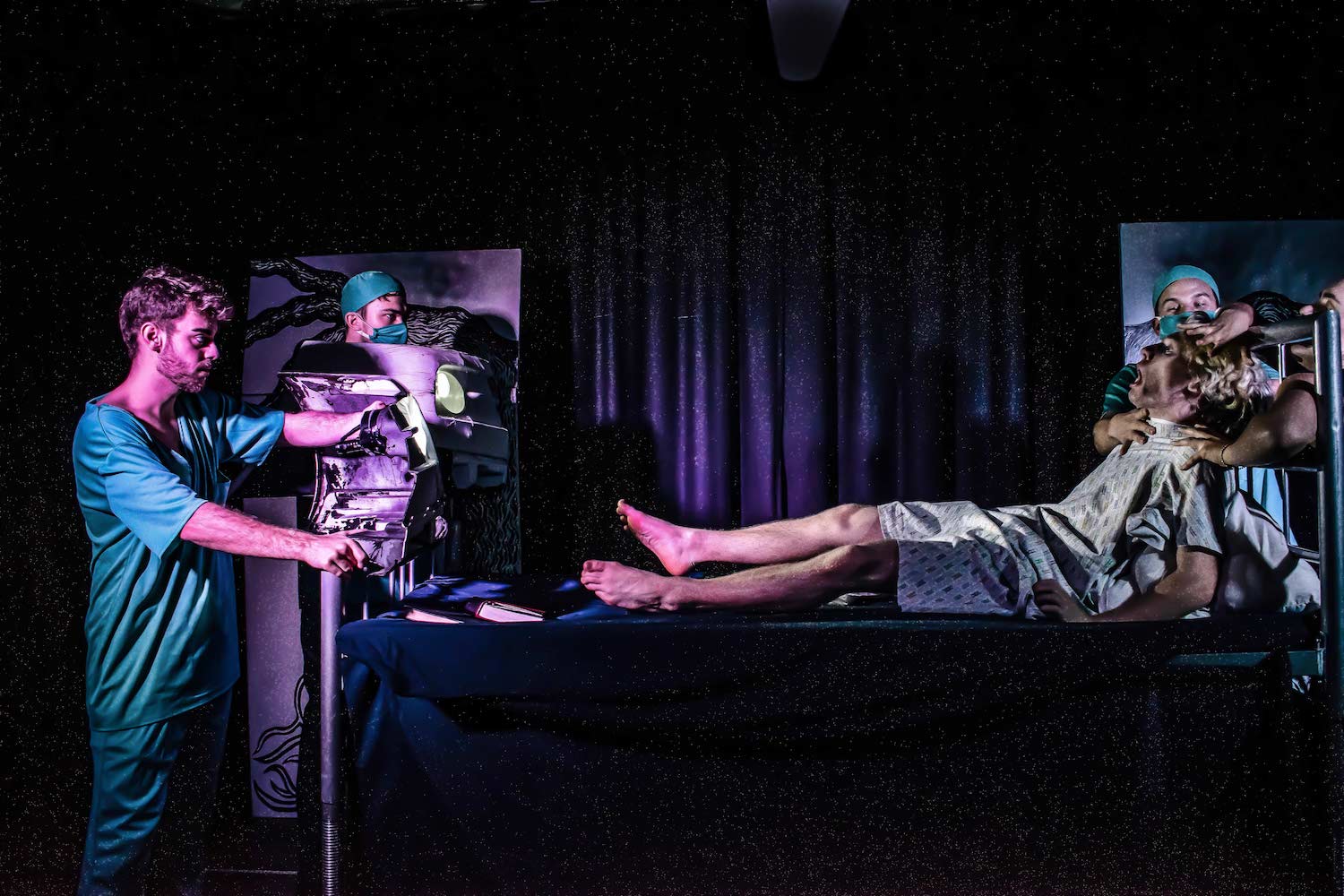
At the centre of it all is Max (Nick Young), who’s just woken up in hospital after jumping off a building – a suicide attempt prompted by the recent death of his girlfriend Tess (Hannah Benson) in a car accident. There’s just one problem; Max doesn’t remember that Tess is gone, and he can’t understand why his brother Chris (William Shackleton) and his doctor (Jensen Gray) are keeping her from him. As his medical condition worsens, Max has a decision to make – with a little bit of “help” from a visiting Jesus (David Angland) and Lucifer (Daniel Leadbitter) – to accept treatment for his injuries and risk losing Tess all over again, or refuse it and keep hold of her for a little longer.

As Max struggles to choose a path, remembering funny moments with Tess one minute and wrestling with sinister masked surgeons the next, we get a glimpse of the chaos inside his traumatised mind. The pre-show warning about strobe effects is not to be taken lightly; there are several scenes in which these feature prominently and for prolonged periods, intensifying the nightmarish quality of Max’s visions. These include reliving more than once the car crash that started it all, which leads to a surprising twist revelation about what really happened that night.

Set in counterpoint to these dramatic scenes are moments of stark reality, where Chris and the doctor discuss Max’s treatment. These scenes are played convincingly by Jensen Gray and William Shackleton, bringing us back to the real world and the growing urgency to take action. The obvious concern they both feel contrasts sharply with Max’s view that the medical staff are out to harm him, and once the truth about the accident is revealed, their conversations and the decision they need to make take on an interesting new direction.

Though the play deals with some difficult themes – bereavement, suicide, survivor’s guilt – there’s also plenty of humour, buckets of energy, and the faintest glimmer of light at the end of the tunnel, all of which keep Testament from becoming too traumatic even in its darkest moments. Nick Young leads a strong cast, skilfully juggling the pre-accident Max – exuberant, charismatic, a bit immature – with the fragile, tormented figure we find curled up in a hospital bed, discussing the meaning of life with biblical figures, each of whom has their own agenda.

Photo credit: Tongchai O. Hansen

If the play’s conclusion feels a little flat compared with the unstoppable energy and unsettling oddness of what’s gone before, it’s a minor complaint. The themes of Testament have been written about many times before, in many different ways, so to find an approach that still feels fresh and unique is quite an achievement. This high quality production will stress you out, make you laugh and send you home with plenty to think about. With only two dates left at The Hope, grab a ticket while you have the chance.


Can’t see the map on iPhone? Try turning your phone to landscape and that should sort it. I don’t know why but I’m working on it… 😉