Review: Rumpelstiltskin at Queen Elizabeth Hall, Southbank Centre

Think you know the story of Rumpelstiltskin? Think again. This Christmas, the classic fairy tale gets a distinctly bizarre new look courtesy of Windmill Theatre Company’s Rosemary Myers and Julianne O’Brien. And while there’s a lot to enjoy – plenty of humour, a rocking soundtrack and a strong message, not to mention it looks amazing – the show feels at times like it’s trying too hard to be different, and it loses something in the process.

Photo credit: The Other Richard

In this adaptation, Rumpelstiltskin (Paul Capsis) is a reclusive but brilliant fashion designer, who’s so ugly his staff – a Rat (Alirio Zavarce) and a Crow (Elena Carapetis) – have had to hire a model (Mitchell Butel) to play him in public. When Harriet (Sheridan Harbridge) arrives in the city looking for a job and determined to prove her childhood bullies wrong, Rumpel helps her out – for a price. But then she wants more, and more… and with nothing left to offer, she promises to give up her most precious future possession if she can live happily ever after with the man she thinks is Rumpelstiltskin, despite the fact that means stealing him from her best friend Tootie (Michaela Burger). Soon Harriet has everything she ever wanted – until she gives birth to her first child, and the real Rumpel returns to call in the debt…

There are recognisable elements of the original plot, and the moral of the story (be careful what you wish for) is still there, but otherwise the show veers a little too far from both the source material and format, and as a result it ends up feeling at times unnecessarily complicated, particularly in Act 1. Australian cabaret star Paul Capsis makes an enjoyably eccentric Rumpelstiltskin but he’s not at all villainous, and if anything is actually quite likeable. In contrast, it’s hard to feel much sympathy for selfish, greedy Harriet when her baby’s stolen, given everything she’s done to get to where she is; unlike in the original, she’s almost entirely responsible for her own misery. All this makes it difficult to know who exactly we’re meant to be rooting for throughout the story, and the show’s abrupt, sugar-coated finale – though brilliantly performed by the undisputed star of Act 2, Ezra Juanta – feels both unlikely and a bit unsatisfying for an audience used to seeing a bad guy get their comeuppance.

Photo credit: The Other Richard

Problematic though the content of the show is, there’s no denying that from a design perspective, it’s a triumph. Together, Jonathan Oxlade’s set and Chris Edser’s animations make for some truly magical and slightly mind-bending effects, and everything on stage is so colourful and over the top that it feels like we’ve stepped right into the middle of a cartoon. (The 1960s look does seem a bit out of step with the show’s very modern dialogue and messaging – hashtags, Instagram and the like – but that seems a small price to pay for a production that looks as good as this.)

Rumpelstiltskin only partially succeeds in its ambition to reinvent a classic fairy tale for the 21st century, but though it’s let down by a lack of clarity in the writing, it’s still undeniably good entertainment. A high-energy family show with strong performances and plenty of silliness to appeal to both kids and grown-ups, it makes for a flawed but fun festive outing.

Review: Cinderella: A Fairytale at Brockley Jack Studio Theatre

If you enjoy a good festive fairytale but you’re not a fan of panto, Cinderella: A Fairytale, this year’s Christmas production at the Brockley Jack, offers an excellent alternative. Fairy godmothers and glass slippers are nowhere to be seen in this darkly humorous take on the well-known story – but despite a few grisly moments, there’s still a happy ending and more than enough fun and adventure to send the audience home full of glad tidings and cheer.

Photo credit: Tim Stubbs Hughes

Devised by Sally Cookson, Adam Peck and the original company back in 2011, this Cinderella borrows from the Brothers Grimm version, Aschenputtel, but with a few details tweaked. For starters independent, no-nonsense Ella (Molly Byrne) needs no rescuing; she’s more than able to take care of herself, first encountering the birdwatching prince (Charlie Bateman) in the woods after tricking her stepsiblings into doing her cleaning for her. Instead of stepsisters, this story has a stepsister (Aimee Louise Bevan) and a stepbrother (Joel Black), who may not be ugly but are definitely mean, though still portrayed in a more forgiving light than in most adaptations. The undisputed villain here is Ella’s awful stepmother (Bryan Pilkington), who’s more than prepared to mistreat her own children as well as Ella in order to get what she wants.

In a nod to the panto spirit, the show includes live musical numbers composed by Elliot Clay, and a little bit of harmless audience participation, led by Charlie Bateman as a prince whose social awkwardness actually makes him all the more charming. You won’t be called on to shout “oh no it isn’t” or “he’s behind you”, but it is tempting on more than one occasion to boo Bryan Pilkington’s wicked stepmother. The part of the baddie is very much played for laughs – and very successfully so – but that in no way detracts from the character’s viciousness, particularly in contrast to Pilkington’s other role as Ella’s kindly, mild-mannered father.

The Brockley Jack’s final show of the year is always a festive treat, and the latest offering from Kate Bannister and the team is no exception. While other productions of Cinderella may attempt a lavish Disney-style affair, this one uses the power of imagination to bring the story and its settings to life. The opening sequence charts Ella’s childhood years through some delightfully creative puppetry from Will Pinchin, and the all-important birds, who appear throughout the story as Ella’s friends and helpers, are portrayed using pages from books. Meanwhile Karl Swinyard’s deceptively simple set has a few magical surprises up its sleeve, and sound designer Phil Matejtschuk has rather too much fun with grisly sound effects; we may not see what happens when the meat cleaver comes out, but that doesn’t stop the audience flinching as one each time it finds its target.

Photo credit: Tim Stubbs Hughes

Meat cleavers (and vengeful birds) aside, Cinderella: A Fairytale is feel-good family fun, which discards the predictable cheesiness, chaos and risqué humour traditionally associated with festive shows, while retaining all the humour and entertainment value for audiences of any age. A charming, polished and hugely enjoyable Christmas production, this show is well worth venturing out in the cold to see. Oh yes it is…

Review: Little Women at The Space

The story of me trying to see Little Women at the Space over the last few weeks has become almost as epic as Louisa May Alcott’s novel, which is why this review comes so late in the run (the final performance is tonight). After a first cancellation by me and a second by the theatre after a cast member was taken ill an hour into the show, I was determined to make it back and see the play all the way through – and I’m really glad I did.

Updated and moved to London, Rachael Claye’s adaptation of the classic novel makes the story accessible to a whole new audience, while still remaining true – with one significant exception, which is explained in the programme – to Alcott’s central plot. This follows the March sisters, Meg (Isabel Crowe), Jo (Amy Gough), Beth (Miranda Horn) and Amy (Stephanie Dickson), four very different personalities who each have a clear role within the family home, but have yet to figure out where they belong in the world. Over the course of the evening, we see them take their first steps over the threshold between childhood and adulthood, experiencing all the opportunities and pitfalls that life has to offer, but never leaving behind the strong family ties that hold them all together.

Photo credit: Matthew Thomas

This family feel extends to the audience, who are so drawn in by the drama and relationships that when something very, very bad happens in Act 2 (anyone who’s read the book will know what I mean) we feel it almost as keenly as the characters. The production achieves this connection with admirable efficiency; the opening scene, which sees the sisters preparing for Christmas, very quickly establishes their different personalities, and director Sepy Baghaei begins both acts with cast members already on stage, chatting and interacting – a simple but very clever way of making us feel we’ve stepped into a world that already exists, even when there’s nobody there to see it.

The production is made even more compelling by the strength of the performances. Each of the four sisters embraces her unique character – Isabel Crowe as Meg, who’s so busy being everything to everyone she’s forgotten who she is; Amy Gough as Jo: witty, creative but with a fiery temper that often gets her into trouble; Stephanie Dickson as spoilt Amy, who as the youngest always expects to get what she wants; and Miranda Horn, who easily captures our hearts as sweet, shy Beth, with a fragility that just makes you want to take care of her. At this particular performance, the girls’ devoted and hard-working mother Ma was played by Rachael Claye (understudying original cast member Victoria Jeffrey) – and in a way, this felt appropriate; the play is, after all, her baby and her emotional connection to both story and characters was clear to see.

This is a story about women, and so it’s only right that the depth of emotion in the production should come from the female characters. There are some men in the play though, and they’re brilliant, providing some much-needed humour to lighten the mood. Sean Stevenson is charmingly mischievous (and a great musician) as next door neighbour Laurie, Joshua Stretton brings an endearing awkwardness to the role of Laurie’s tutor John Brooke, and in a late appearance, Jonathan Hawkins almost steals the show as the eccentric Professor Bhaer.

Photo credit: Matthew Thomas

The updating to 21st century London also works surprisingly well; there’s a freshness to the adaptation that makes it feel like a whole new story, but it’s still recognisably Little Women, and if you know the story there’s that reassuring comfort/dread of knowing more or less what’s going to happen next (if you don’t, prepare yourself for some twists and turns). Some creative licence has been taken with plot details, but the Marches’ contrasting personalities and their turbulent but loving relationship are retained; it turns out sisters will always squabble, whether they’re in 19th century Massachusetts or 21st century Crouch End. Who knew?

In the programme, Rachael Claye comments that “writing eight characters’ storylines over two acts” was one of the challenges she faced in adapting the play. There is undoubtedly a lot to cover (although the opening to Act 2 fills us in on the intervening years with the same efficiency we saw at the start of the play) and the show’s running time comes in at just under three hours. That said, everything about this production is so compelling that the time really does fly; it’s a lovely piece of storytelling, and I only wish I had more time to recommend it.


Can’t see the map on iPhone? Try turning your phone to landscape and that should sort it. I don’t know why but I’m working on it… 😉

Review: Walk of Shame at the White Bear Theatre

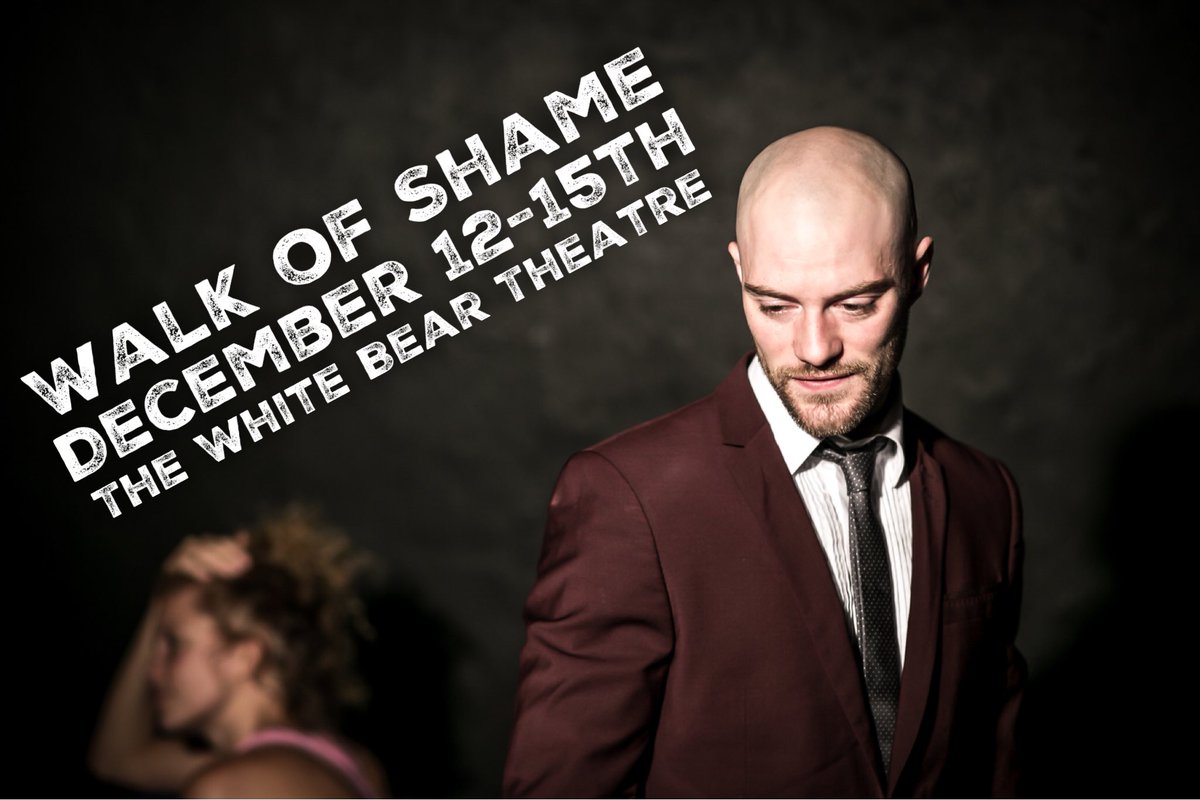
Originally written as a monologue by Amelia Marshall Lovsey, Walk of Shame has been expanded into a hard-hitting two-hander with the addition of an alternative point of view, written by Stephanie Silver. We now have two perspectives on one night – and while on a purely factual basis the accounts may coincide, there’s a fundamental difference in how each character feels about the outcome and the events that precede it.

Alice likes sex, drinking, and wearing tight shorts to show off her figure. She’s in a relationship, but feels unsatisfied and unappreciated – and after a row with her boyfriend she heads out for a drunken night, with one very particular goal in mind. Liam is a nice guy who spent most of his teenage years caring for his sick mum, before moving to London and getting a job in the City. He’s having a heavy night out with the guys from work when he finds himself alone in a bar and runs into Alice.

If you had absolutely no context and had to decide based solely on first impressions who to believe about the way the rest of the evening unfolds, there’d probably be little doubt. Alice – played by co-writer Stephanie Silver – is a deliberately abrasive character who does what many people would consider all the “wrong” things, not just on that one night but in general. Calum Speed’s sharply dressed Liam, on the other hand, is at great pains from the start to convince us he’s a good guy – and the truth is that he probably is, under normal circumstances. But even when it’s revealed that his night out involves taking copious amounts of cocaine, nobody stops him – as they do Alice – to warn him that he “needs to be careful”. Infuriatingly, and as is so often the case, it’s generally accepted that the woman should be the one taking precautions to defend herself, with the man absolved of any responsibility.

At just over 30 minutes, the thought-provoking play, directed by Michelle Payne, certainly makes an impact, and the pivotal scene is played very powerfully, in almost total darkness, by both actors. The very short run time could, perhaps, be seen as an opportunity to expand the play and explore in more detail what happens in the immediate aftermath, what action each character chooses to take, and the reaction they face – particularly since the play’s title seems to suggest the story is more about the morning after than the night before.

As it stands, though, the play is already a very topical and important piece from Glass Half Full Theatre, which makes us all pause and question society’s – and our own – assumptions and judgments whenever a story like this makes the headlines. The company are hoping to take the show on tour to universities in the future and start a crucial conversation about issues of consent and drink and drugs. Hopefully it’ll also encourage its student audiences (and beyond) to consider the uneven distribution of responsibility between men and women; depressing though it may be, it’s clear that’s a lesson which is still desperately needed.

Can’t see the map on iPhone? Try turning your phone to landscape and that should sort it. I don’t know why but I’m working on it…

Review: Cabaret at Laban Theatre

Willkommen, bienvenue, welcome… to Cabaret, presented by final year Musical Theatre students from Trinity Laban Conservatoire of Music and Dance. Written in 1966 by Kander and Ebb, the musical is set in Berlin during the rise of the Nazis, and explores how easily good people can be taken in by clever propaganda, or choose to look the other way and ignore what’s going on around them. In light of all that’s going on in the world in 2018, this subject matter makes it, depressingly, a particularly timely choice for the students’ two-date showcase.

Photo credit: Trinity Laban Musical Theatre

American writer Clifford Bradshaw (Harry Newton / Michael McGeough) arrives in Berlin hoping to find inspiration for his novel. What he finds is the Kit Kat Klub, a nightclub overseen by the sinister Emcee (Barney Fritz / Jake Lomas), where Cliff falls for carefree English cabaret singer Sally Bowles (Jenny Coates / Amy Blanchard). Meanwhile, his landlady Fräulein Schneider (Hannah Macpherson / Hannah Qureshi) is enjoying a romance with another resident, Herr Schultz (Calum Rickman), but when her friends and neighbours realise he’s Jewish, she must decide if marrying him is worth all the trouble it would undoubtedly bring to her door.

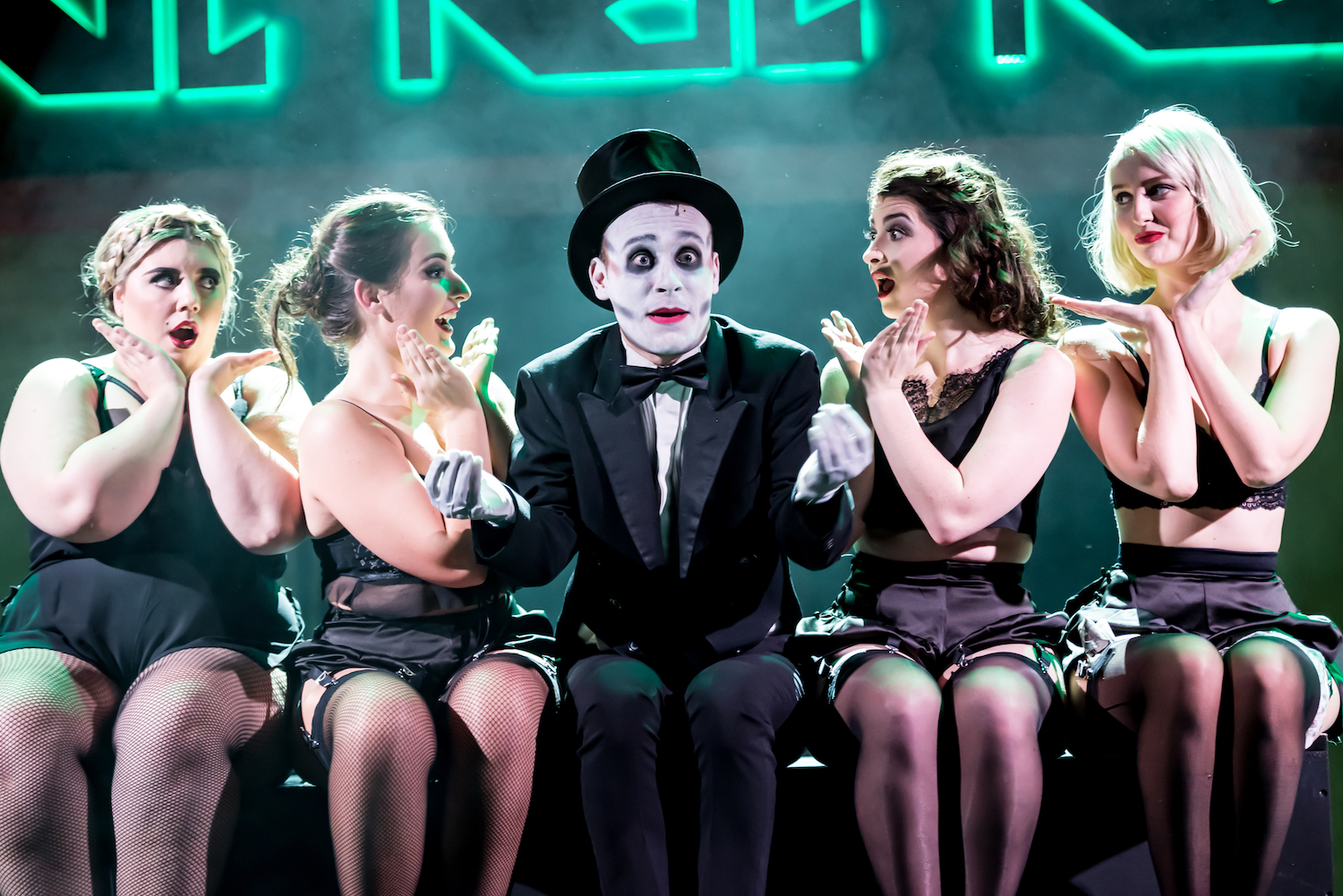
For the majority of the 90-minute Act 1 Cabaret is very much a feel-good show, peppered with infectiously toe-tapping tunes and charting two charmingly unconventional new romances. It’s only as the first act comes to a close that we see through the Emcee’s carefully constructed facade and begin to understand what’s really happening, before a much shorter Act 2 hammers the message home with brutal efficiency. And immediately following Sally’s defiant performance of the show’s big title number, the deliberately off-key finale is unsettling – if not particularly shocking – as it forces the audience to re-evaluate all that we’ve just watched from a dark new perspective.

On a brighter note the production, directed by Karen Rabinowitz, was excellent, with confident performances from a talented young cast and stage band. It’s worth noting that most of the central characters were played by two actors over the two days; at the performance I attended, Barney Fritz absolutely owned the stage as the Emcee – intensely creepy but weirdly seductive, he quickly won the audience over with the opening number, and never looked back. Jenny Coates and Harry Newton were strong leads as Sally and Cliff (the former bringing the house down with her performance of Cabaret), but for me the more compelling of the two romances was that between Hannah Macpherson and Calum Rickman as Fräulein Schneider and Herr Schultz. Despite playing two people much older than themselves, both were totally convincing in their roles, and utterly charming whenever they were on stage together.

Photo credit: Trinity Laban Musical Theatre

With slick choreography from Graham Newell and a simple but attractive set designed by Louis Carver, if you didn’t know then you’d be hard pressed to guess that you were watching a student performance. With the exception of rare – and always quickly corrected – moments of over-exuberance from the band that briefly drowned out the dialogue, there was little to set this apart from a professional performance; it’s certainly a show I’d happily recommend to anyone looking for a great night out. And it also offered a valuable opportunity to see a cast of exciting new talent, who I’ve no doubt will go on to own plenty of much larger stages in the future.

Cabaret was performed at Laban Theatre on 6th and 7th December. For details of future productions, visit trinitylaban.ac.uk/whats-on.