Review: Macbeth at Jacksons Lane

There’s a lot to like about Proteus Theatre’s original take on Macbeth, especially if you’re a fan of all things 80s. The action of Shakespeare’s tragedy has been transplanted to the cut-throat financial markets of London in 1987, inspired by the crash of Black Monday. Director Mary Swan’s vision is one that fits well with the story of Macbeth, in which power is everything and rivals will stop at nothing to come out on top – but despite some solid performances and strong design decisions, the production as a whole never quite takes off.
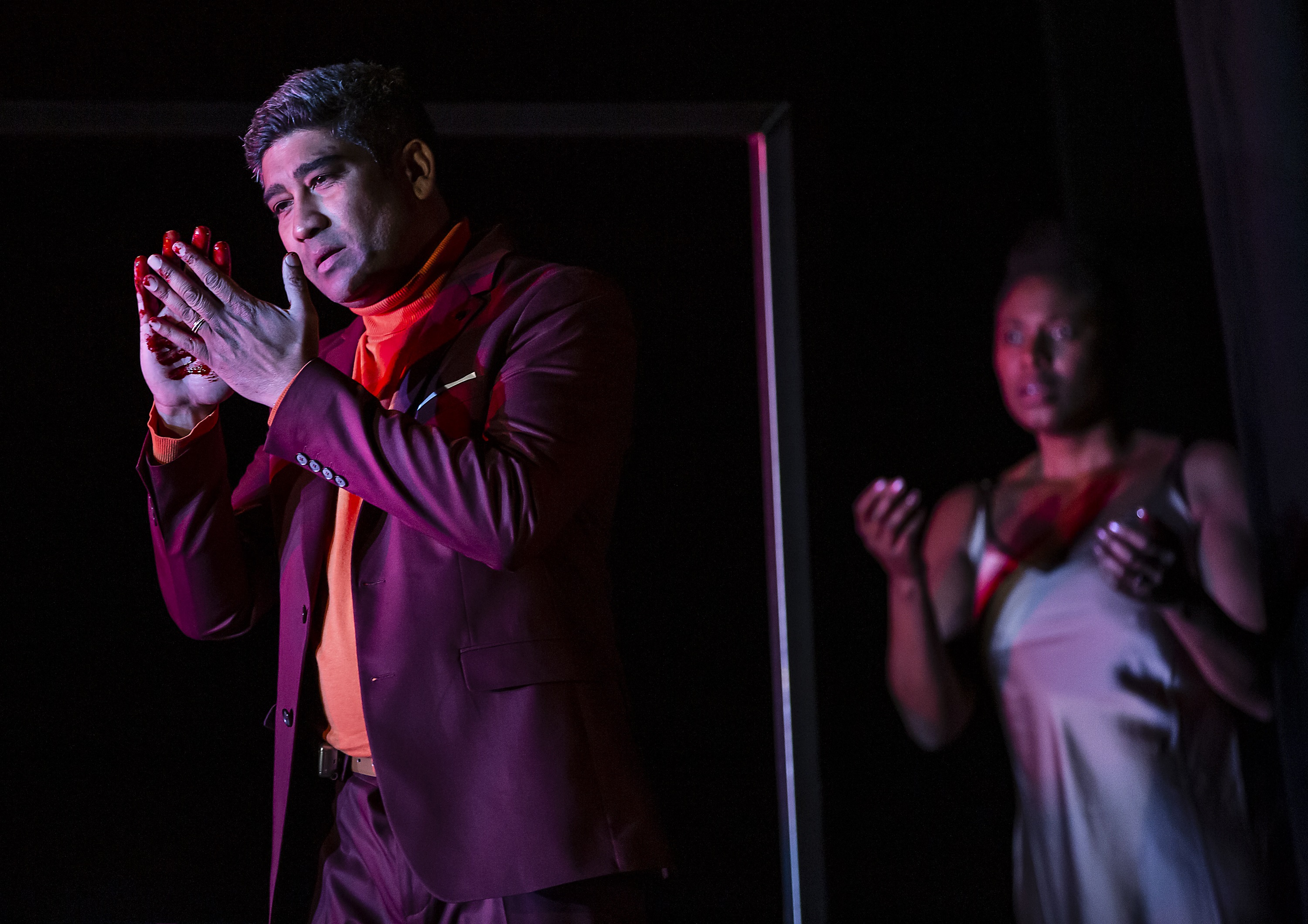
Photo credit: Pamela Raith

Unfortunately, this is largely due to an unconvincing portrayal of Macbeth by Riz Meedin. Though he does a decent enough job as the hen-pecked husband who’s browbeaten into regicide by his scheming, ambitious wife (Alexandra Afryea), the character never really develops beyond that. Even later in the play, his Macbeth still feels hesitant and not at all like the murderous tyrant hellbent on slaughtering men, women and children alike to secure his position. If anything, Danny Charles’ slightly sleazy Duncan and Jessica Andrade’s manipulative Malcolm come across as more threatening.

While both Charles and Andrade prove themselves adept at playing multiple parts (including a couple of very entertaining cameos), the play’s strongest performances come from Alexandra Afryea as Lady Macbeth – already at the brink of insanity when the play begins as a result of both her ambition and her grief for a lost child – and Umar Butt, in two very different guises as Banquo and Ross; his appearance as the ghost Banquo is one of the play’s most striking (and gruesome) scenes.

The 80s setting is cleverly worked in; each scene change is heralded by another classic hit, and the characters’ power suits and corded phones leave us with no doubt what decade we’re in. Instead of a crown, the current “king” is portrayed as a sort of mafia don figure with their coat draped across their shoulders, Macbeth snorts cocaine before murdering Duncan, and Banquo and Fleance head out for their fateful ride wearing motorcycle helmets. Katharine Heath’s clever multifunctional set design finds the characters first battling it out on the stock exchange trading floor (with Duncan and Scott on the rise; a nice detail) but with a few simple rearrangements transforms into a lift, an office, a dinner table and a phone box, among others.
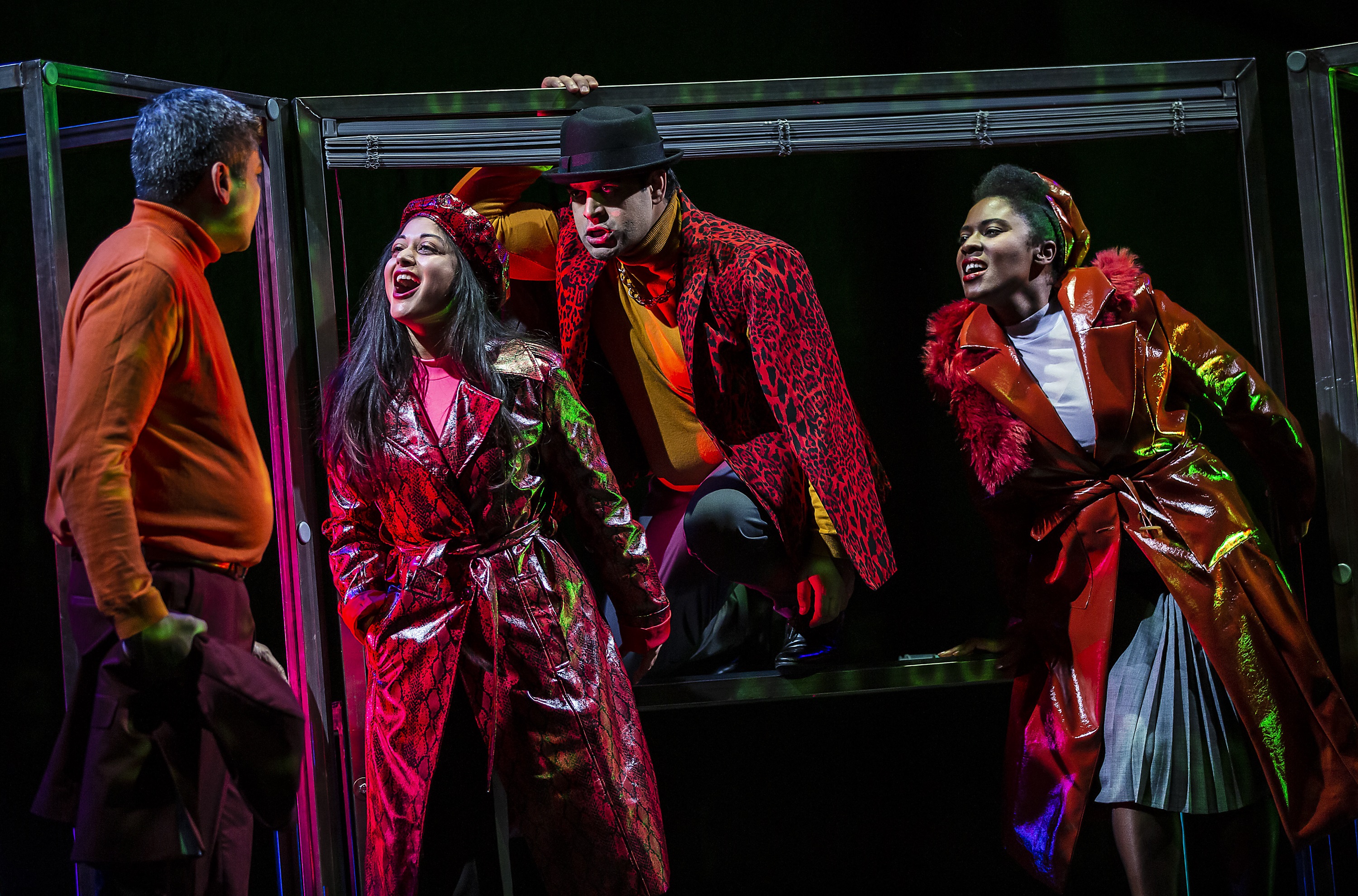
Photo credit: Pamela Raith

The concept does slightly lose its way in the final battle, because it’s not really clear who’s fighting who, or how or where. The confrontation between Macduff and Macbeth also feels a bit anticlimactic, although the framing of Macbeth’s killing as a hit rather than a death in combat is interesting and gives the play’s conclusion an original new angle. There’s certainly no lack of drama, either, with Peter Harrison’s excellent lighting design bringing an intensity to the stage even at times when it’s missing from the performance.

Shakespeare’s work is so frequently performed that it’s refreshing to see a version like this one, which makes you consider a story you know well in a completely different way. It’s also great to see Shakespeare performed by an entirely BAME cast, something we still don’t see enough of in London. Tapping into the greed and corruption of the business world is a clever move, so it’s a pity that the production itself – though imaginatively staged – doesn’t always reflect the necessary ruthlessness to quite carry it off.

Review: Never Trust a Man Bun at Stockwell Playhouse

Double dates don’t get much more awkward than this one. Lucy (Katherine Thomas) just wants to stay home and watch Gogglebox – but her best friend Gus (Calum Robshaw) and his recently back-on-again girlfriend Rachael (Natasha Grace Hutt) have other ideas. They’ve just announced they’ve set her up with the man bun-sporting Caps (Jack Forsyth Noble), for some unfathomable reason; the two of them are clearly a match made in hell from the moment they set eyes on each other. It doesn’t help that Caps has got his eye on Rachael, and soon he’s trying to drag Lucy into his dastardly plan to steal her from Gus. Worse: she’s actually thinking about it, for reasons that both confuse and annoy her.

Never Trust a Man Bun at Stockwell Playhouse

Katherine Thomas makes her professional writing debut with Never Trust a Man Bun, which transfers to Stockwell Playhouse following a short run at Theatre N16. Under Scott Le Crass’ direction, the jokes fly thick and fast through the course of one disastrous evening – most of them at the expense of one or other of the characters. As in any good sitcom, each has their “thing”: Rachael is irritating and almost unbelievably stupid (“the plural of ‘mice’ is ‘mice’!” she declares proudly at one point), Gus is a total pushover, Caps is obnoxious, manipulative and not ashamed to use his autistic sister to get sympathy, and Lucy’s default setting against everyone – even people she likes – appears to be defensive sarcasm and general nastiness. It’s no surprise the evening doesn’t end well; what’s significantly more surprising is that we don’t end up hating everyone on stage.

The jokes are well-placed and delivered with excellent comic timing by the cast of four, though a couple of the gags go on for a bit longer than feels strictly necessary. At times, too, realism takes a hit at the expense of humour (it’s hard to believe anyone could seriously be that proud of putting pretzels and crisps together) but what does ring true is the complicated tangle of emotions being experienced by these confused 20-somethings. It’s not all about their romantic disasters, as entertaining as they may be; there’s also career anxiety, money worries, and the not altogether welcome realisation that they’re no longer the same people they were ten years ago. It’s a play about growing up and finding your place in the world – and perhaps coming to terms with the fact that it isn’t where you thought it would be. That’s a panic I think most of us can relate to, at least to some extent, and it’s in the brief moments where the play stops looking for laughs and gets serious that it’s at its strongest.

Never Trust a Man Bun is a promising and well performed debut, peppered with some great one-liners and laugh out loud moments. It doesn’t quite feel like the finished article yet, but with a bit of polishing and strategic pruning, there’s potential for a play that offers up real insight as well as laughs.

Review: 100% Chance of Rain at Chickenshed

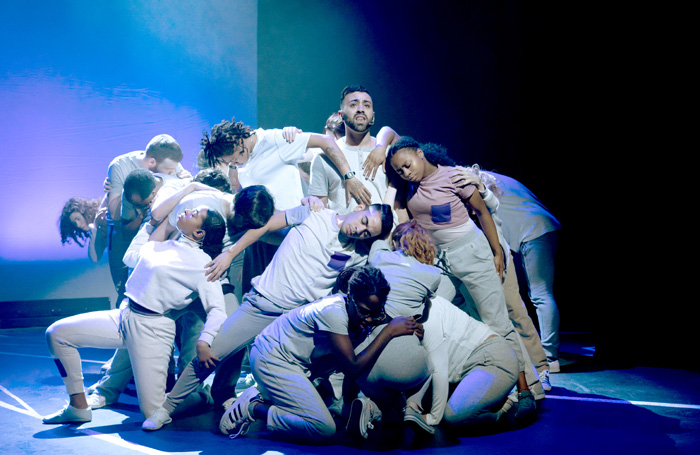
Since 2017, Chickenshed have used their annual spring show as an opportunity to tackle important issues affecting young people. Following the success of Don’t Stop Thinking About Tomorrow, last year’s Offie-winning take on climate change, this time around the inclusive theatre company is exploring mental health in new show, 100% Chance of Rain.

Conceived and directed by Lou Stein, the ambitious production doesn’t follow a “traditional” narrative thread, but instead is made up of several individual pieces, each depicting a different aspect of mental health through music, movement and storytelling. Linking these together are monologues from the show’s single recurring character, Liz Abulafia (Belinda McGuirk) – an arts therapist who reflects on her own mental health journey through creative expression, and encourages us to do the same.

100% Chance of Rain at Chickenshed
Photo credit: Caz Dyer

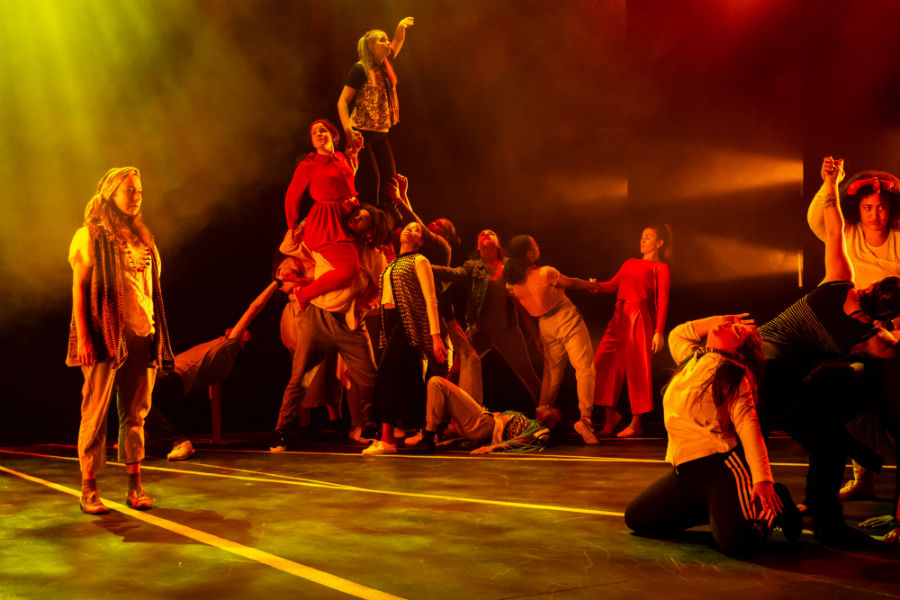
Taking this instruction to heart, the production practically bursts with creative talent. The use of colour, light and movement make for a visually stunning combination, the songs are beautifully performed by Chickenshed’s Vocal Voices (their a cappella rendition of Back to Black is a particular highlight), and there’s effective use of projections and video to supplement the action on stage. Though some of the pieces are a little more abstract in their presentation, they remain (with one possible exception) accessible to the audience, never losing sight of their message amidst the spectacle.

One of the things that makes the performance a success is that the diverse and predominantly young cast clearly have a deep understanding of the issues they’re portraying. Each of the seven aspects of mental health explored – which include self-harm, panic attacks, the pressures of being a single parent, and the growing obsession with online gaming – has been workshopped extensively, to ensure that the voice of its performers comes through loud and clear in every case. And as always, it’s a joy to see the Chickenshed spirit of inclusivity and community represented so completely on stage. Just as mental health can affect anyone, so this production has a place for everyone in its cast.

Perhaps unsurprisingly, 100% Chance of Rain is not always an easy watch; it’s both startling and saddening to realise how many different ways young people are suffering, and the decision to add an interval (the performance was originally advertised as 90 minutes straight through) offers a welcome respite. Similarly, the show’s upbeat ending comes at just the right time to save us from descending into a pit of gloom, with the acknowledgment that though things may seem dark right now, at some point the clouds will part and it will get better.

100% Chance of Rain at Chickenshed
Photo credit: Daniel Beacock

Mental health has become an increasingly topical issue in recent years, but it’s still one that individuals can find difficult to discuss on their own behalf, because of embarrassment, denial or simply not realising that what they’re going through “counts” as a mental health problem. Some of the issues covered in 100% Chance of Rain are well-documented – self-harm, for instance, is a serious problem that we know affects many young people. Others are less so; one piece explores the impact of leaving the family home for the first time, and the feelings of isolation and abandonment that it can cause on both sides. Taken as a whole, the show seeks to open up the conversation, and to encourage anyone who’s suffering – in any way – that it’s okay to reach out for help.

Review: The Silence of Snow: The Life of Patrick Hamilton at Brockley Jack Studio Theatre

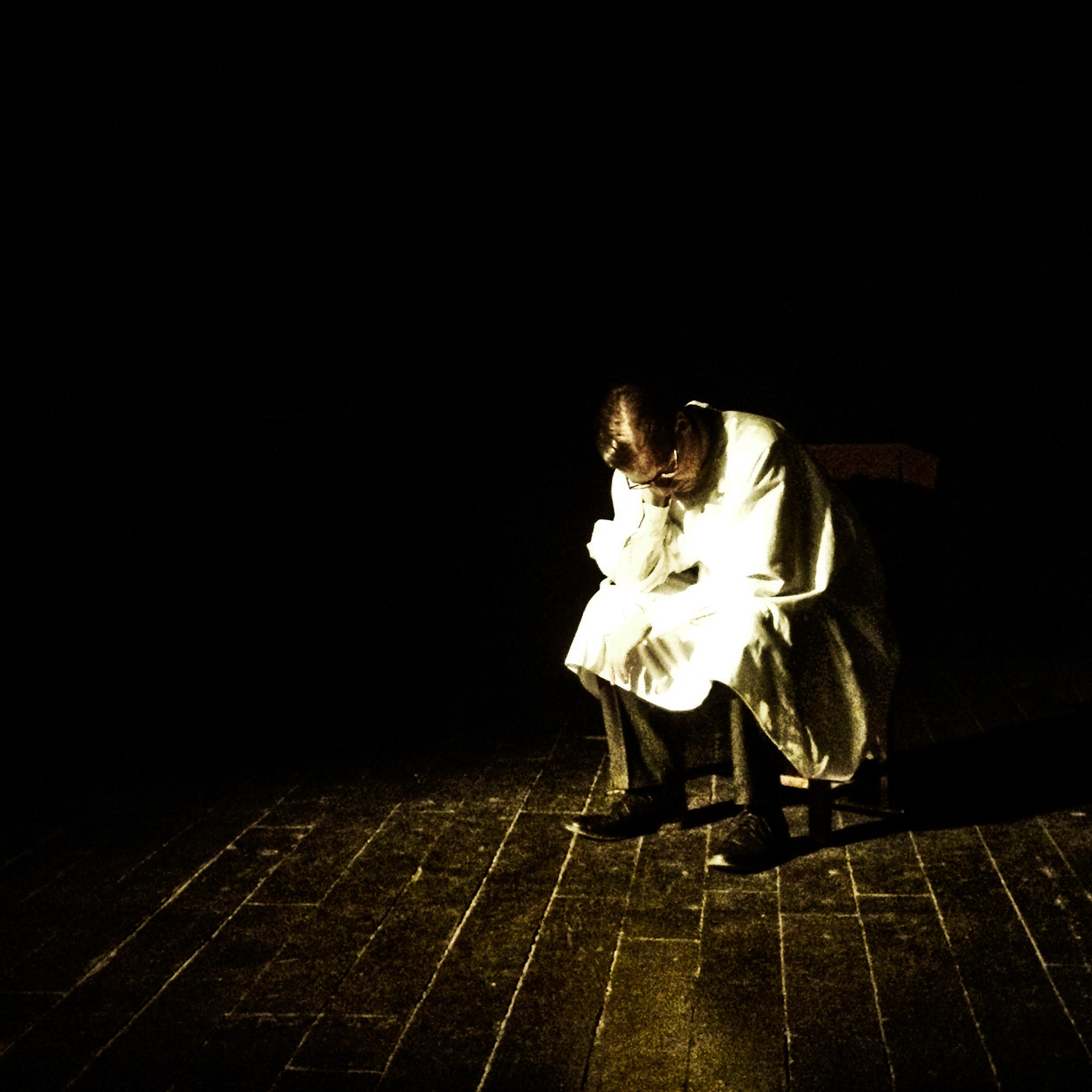
First performed in Edinburgh in 2014, Mark Farrelly’s solo show about the life of writer Patrick Hamilton is a fascinating insight into a troubled mind. Hamilton, who came from a family of novelists, enjoyed success as a writer from a young age; despite producing several bestselling novels, he’s perhaps best known today for his plays Rope and Gaslight (which, as a side note, gave us the modern expression gaslighting). But he also struggled for years with alcoholism and depression, and when we first meet him, he’s awaiting his final session of electroconvulsive shock therapy – an ultimately unsuccessful attempt to beat the Black Dog once and for all.

The Silence of Snow at Brockley Jack Studio Theatre

Encouraged by our “earnest silence”, Hamilton goes back to the beginning, sharing the story of his life in a monologue that combines Farrelly’s own words with excerpts from Hamilton’s work. Both are of a high standard, playing gleefully with language to paint unique and vivid pictures in our minds. These come to life in the masterful hands of Farrelly himself, who doesn’t so much play as inhabit the role of Hamilton. Charismatic and unpredictable, he builds an instant rapport with the audience, and then proceeds to hold us spellbound for the next 70 minutes. The total absence of any set behind him feels increasingly irrelevant as he easily holds our attention, conjuring up settings, characters – both real and taken from Hamilton’s work – and even a horrific car crash (which left him disfigured for the rest of his life) quite literally out of thin air.

Despite the lack of set, Linda Marlowe’s production is still highly atmospheric, due in no small part to the very effective lighting and sound design. The hiss and crackle of the impending shock therapy creates a sense of urgency in Hamilton’s monologue, and there’s an intense scarlet light that floods the stage each time he relives – somewhat vicariously, it seems – the violent acts committed by his characters. In contrast, at one point the lights are extinguished altogether, to great comic effect.

In fact, for a play about a depressed alcoholic, The Silence of Snow is very enjoyable and often surprisingly funny. Hamilton narrates his life with a wry humour and gently mocking tone – more than once the audience is invited to “keep up” – that masks his intensifying mental struggle. Late in the play, he invites his wife, ex-wife and brother to an intervention of sorts, which rapidly falls apart and leaves him alone and terrified of what lies ahead; it’s only in this moment that we really see the fragility of the man behind the mask. This scene gains greater poignancy when we learn that the play’s dedicated to Farrelly’s close friend Tim Welling, who was the first person to read it, but who took his own life before he could see it performed. (A collection for MIND taken after the show has so far raised over £7,500.)

The Silence of Snow at Brockley Jack Studio Theatre

Patrick Hamilton was once one of Britain’s most successful writers, but less than a century later, he’s faded into relative obscurity. The Silence of Snow seeks to shine a light not just on Hamilton’s work but also on the man himself – even if that light isn’t always particularly flattering. It’s not a very cheery tale, but it is an informative and expertly performed biographical piece, which – if you’re anything like me – will send you home wanting to know more.

For future tour dates, visit markfarrelly.co.uk.


Can’t see the map on iPhone? Try turning your phone to landscape and that should sort it. I don’t know why but I’m working on it… 😉

Review: Angry Alan at Soho Theatre

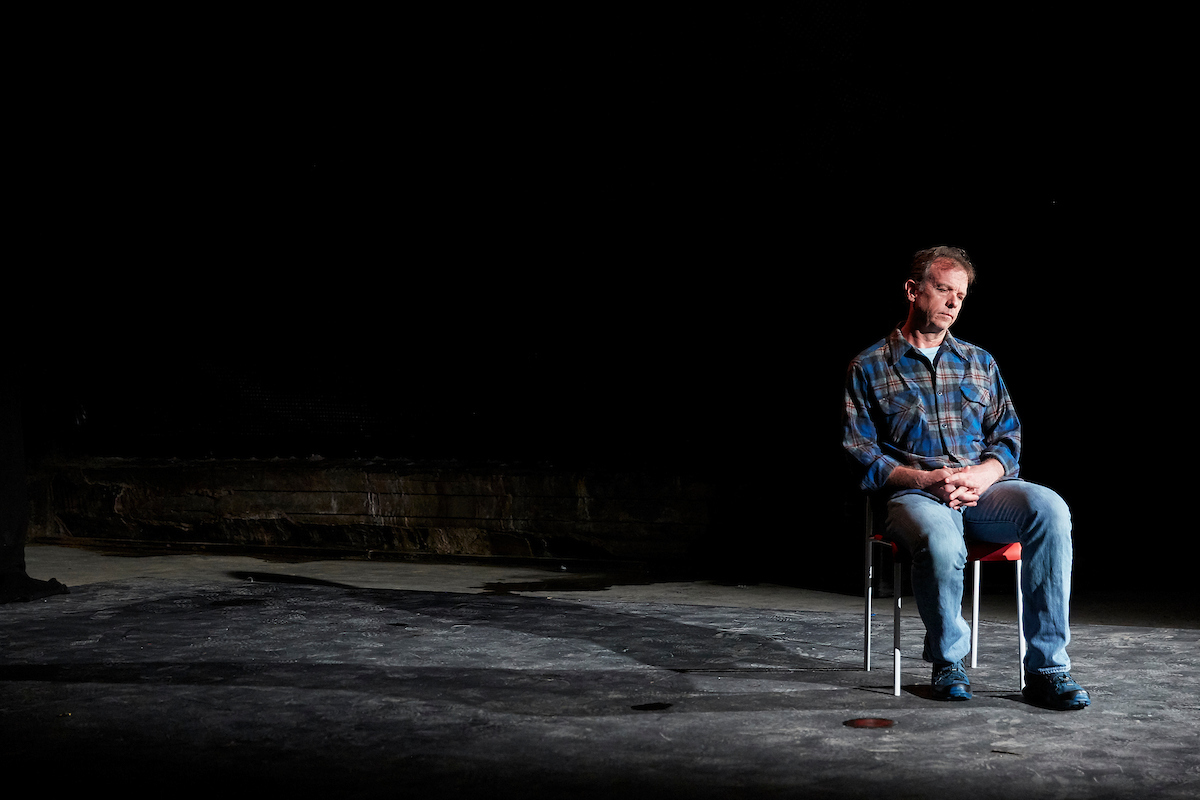
There’s a depressing inevitability about the protagonist’s journey in the one-man show Angry Alan. His name is not, in fact, Alan – but he is very angry. Life hasn’t gone the way Roger wanted, but he never realised why… until he goes online and finds Angry Alan and his men’s rights movement. Not long after that, Roger realises that everything – losing his big corporate job, getting divorced, losing contact with his son – is the fault of women and the gynocentric society in which we’re now living. Because of course it is.

Angry Alan at Soho Theatre
Photo credit: The Other Richard

Written and directed by Penelope Skinner, Angry Alan was a hit at last year’s Edinburgh Fringe, where it picked up a Fringe First award. The show takes timely and merciless aim at the increasingly prevalent “but what about the poor men?” argument that’s been a predictable side-effect of feminism and #metoo. It begins as a bit of a joke – a few harmless cranks who are easy to dismiss – but soon turns more serious, and a dramatic turn of events forces Roger to confront the damaging impact of Angry Alan’s angry rhetoric.

Roger’s character follows a similar trajectory. Played brilliantly by the show’s co-creator Donald Sage Mackay, he at first comes across as very much a regular guy next door, whose delight at having finally found a satisfactory answer to all his woes seems both funny and a bit pathetic. But his beliefs, both old and new, are shocking and offensive to listen to, and on hearing how he talks both to and about his girlfriend, ex-wife and women in general, we quickly lose any respect or sympathy we might have had for him.

There’s a reason this play isn’t called Angry Roger, though. He thinks he’s narrating his own story, but it’s clear that very little of what Roger says during the course of the hour-long play comes from his own head – instead it’s Alan’s voice we’re hearing. Roger’s just looking to deflect the responsibility for his own misfortune on to someone else, and that makes him an easy target emotionally, intellectually and financially. What’s really scary – if not surprising – is to see how quickly the hate spreads.

Angry Alan at Soho Theatre
Photo credit: The Other Richard

To make sure we can’t dismiss what we’re hearing as exaggeration or fake news, the show invites us to watch some of the videos promoted by Angry Alan, and viewed so eagerly by Roger – all of which are real and taken from YouTube. And just in case we’re not taking these seriously enough, the last one is instantly recognisable, having been shared a few months ago not just by angry activists in a dark corner of the internet, but by the mainstream media as headline news. Similarly, before the show begins the screen is filled with comments from social media bemoaning the plight of men in a world now run by women. Unlike the videos, we don’t need to be told that these are real; we’ve all seen enough of such comments on our own social media to know they can and do exist.

Angry Alan might appear at first glance to be a comedy (albeit a pretty dark one), and there are plenty of laughs to be had at the expense of both Roger and his new friends in the men’s right movement. But ironically, what this intelligent and thought-provoking play teaches us above all is that such toxic and damaging views are anything but funny – and perhaps the first step towards confronting them is to stop laughing.

Can’t see the map on iPhone? Try turning your phone to landscape and that should sort it. I don’t know why but I’m working on it… 😉