Review: Tony’s Last Tape at Omnibus Theatre

Tony Benn is well known for being one of Britain’s most divisive politicians – and yet when he died in 2014, tributes poured in from colleagues across the political spectrum, who spoke of their great respect for his enduring commitment to the values and causes in which he believed. In his tribute, then Labour leader Ed Miliband said, “He believed in movements and mobilised people behind him for the causes he cared about, often unfashionable ones. In a world of politics that is often too small, he thought big about our country and our world.”

Photo credit: Robert Day

That commitment comes across powerfully in Andy Barrett’s play Tony’s Last Tape, in which a frail 87-year-old Benn (or rather “a character called Tony Benn, based on the real life Tony Benn”) decides it’s time to finally quit politics… well, maybe. For 50 years he’s recorded the events of his life in his diaries, and on this rainy morning he’s recording his final tape. What emerges from the meandering monologue that follows is a picture of a principled and still fiercely dedicated politician, but also a devoted family man with a mischievous sense of humour… and an enduring love of bananas.

Most importantly – and refreshingly, particularly at the moment – Tony Benn comes across as a human being fighting for other human beings. And whether we agree with or even understand everything he says (I suspect you’d need to know quite a bit about British political history to pick up every reference and name-drop in the play), it’s impossible not to like and respect him for his passion and determination. It’s also very obvious that a man like that, despite his best intentions, won’t be able to stop; he can’t even resist risking life and limb to change a lightbulb, even though common sense dictates he should definitely not be climbing on the desk in his condition.
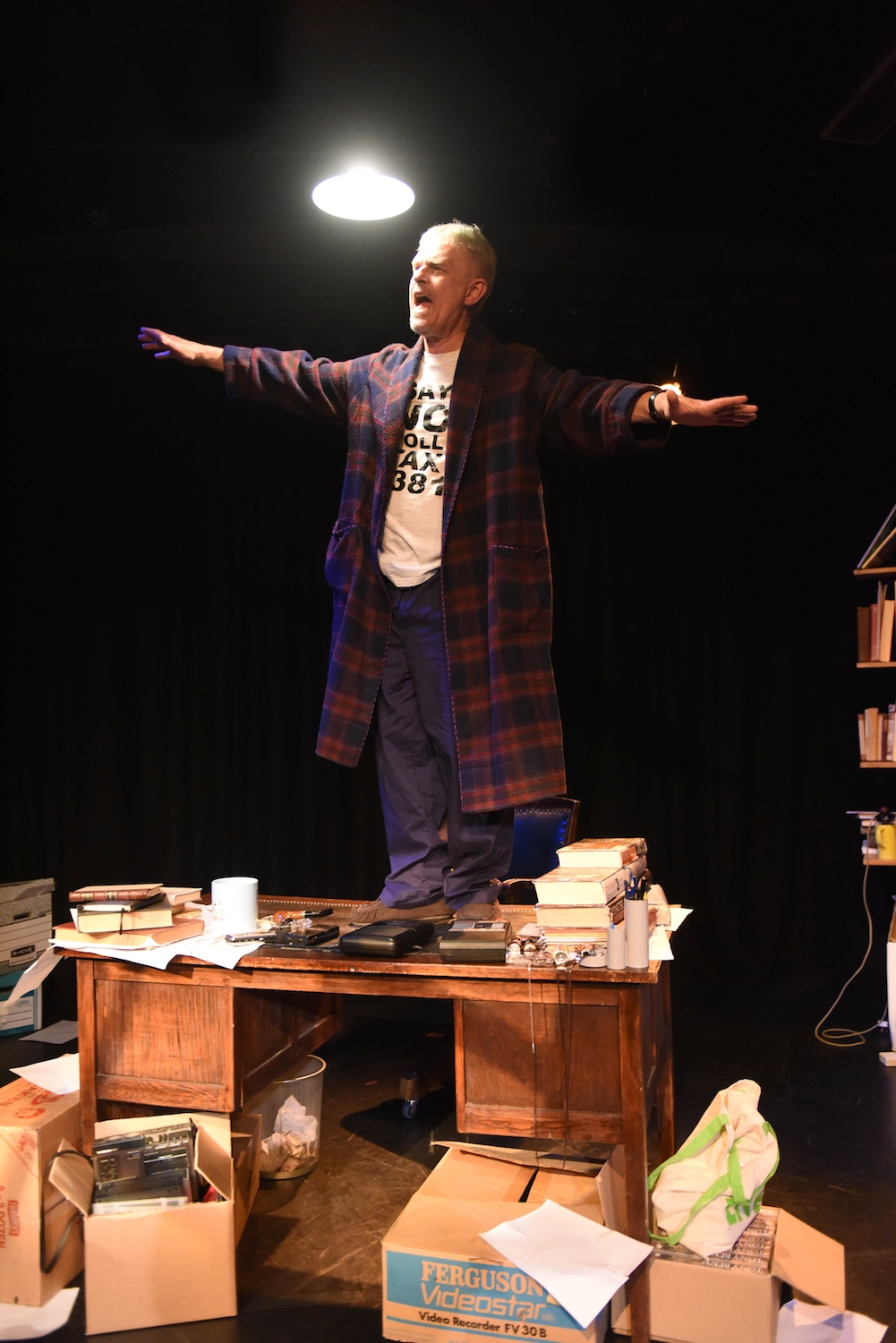
Photo credit: Robert Day

Philip Bretherton gives a strong solo performance, recognisably portraying the real Tony Benn in voice, appearance and mannerisms. He’s equally convincing, however, in his depiction of an elderly man looking back over an eventful life and reflecting thoughtfully on the decisions – both right and wrong – that he’s taken, and emotionally on the loved ones he’s lost along the way. Director Giles Croft manages the pace and energy of the production well; rather than just sit at his desk and talk, Benn potters around his cluttered study and rummages in desk drawers and bookcases, frequently stumbling on long-forgotten objects that spark new memories and anecdotes. As a result, there’s little in the way of linear narrative – instead the play is a 75-minute stream of consciousness that hops from one topic to another.

In light of this, Tony’s Last Tape shouldn’t be seen as anything approaching a Tony Benn biopic (with over 50 years of material to work from, Barrett could hardly be expected to cover everything anyway), and it’s probably a good idea to read at least a brief summary of Benn’s career before going in to give the play some context. What the play is, however, is a sympathetic and respectful portrayal of a man who went into politics for the right reasons, and who never wavered from his convictions. Particularly in the current political climate, that feels like something which deserves to be celebrated.

Review: The Trials of Oscar Wilde at Greenwich Theatre

Exactly 124 years ago, on 3rd April 1895, the hearing of a libel case opened at the Old Bailey. The prosecutor was the renowned playwright Oscar Wilde; the defendant was the Marquess of Queensberry who, concerned by his son’s close relationship with the writer, had accused him in a note of “posing as a somdomite”. Outraged, Wilde sued for defamation, but the move backfired spectacularly; faced with overwhelming evidence that he was, in fact, homosexual – at that time an illegal act – he was forced to drop the case, only to be arrested immediately and sentenced just a few weeks later to two years hard labour.

Photo credit: David Bartholemew

The Trials of Oscar Wilde, co-written by John O’Connor and Oscar Wilde’s grandson Merlin Holland, is based on court transcripts from the two trials, and charts Wilde’s rapid downfall. Just days before the libel case began, The Importance of Being Earnest had opened at St James’s Theatre, and Wilde was complacent enough to believe that his success as a writer would make for an easy win. The production – also directed by John O’Connor, with Eva Savage – sets the drama not in a courtroom but on a stage, and in Act 1 Wilde takes to it like a true showman. But over the next hour, his relaxed confidence is chipped away piece by piece, and the man who appears at his own criminal trial in Act 2, though still possessing the same sharp wit, appears shaken and humbled by his sudden fall from grace.

This dramatic transformation is captured to perfection in a brilliant central performance from John Gorick, who leads the four-man cast with effortless style. Around him, his fellow cast members slip in and out of a variety of costumes to play multiple different characters, with impressive versatility and more than a little humour; Benjamin Darlington and Patrick Knox have particular fun as a short-sighted hotel chambermaid and an Italian masseuse respectively. The real highlight of the play, however, is the clashes between Gorick and Rupert Mason, who plays both the defence lawyer who meticulously unravels Wilde’s libel case and the prosecutor who sees him condemned to prison. Though of very different temperaments, the men are equally matched in their skill as orators, and in their hands an encounter that could on paper have become rather dry crackles with tension.

Though it references it several times, The Trials of Oscar Wilde is not The Importance of Being Earnest. For one thing, there are considerably fewer laughs to be found in this tragic true story of a great literary talent brought down by society’s intolerance and prejudice. It’s also considerably more demanding for the audience; the play puts us in the position of the jury in both trials (though unfortunately we get no say over the final decision), and as such it demands our constant attention – just as would be the case in a real court, we have to stay focused throughout so as not to miss any name, date or other important detail. None of which is to say that the play isn’t entertaining – there are certainly moments of light relief, and the staging of the courtroom scenes is very well done.

Most of us know something of how Oscar Wilde’s story ended, but perhaps not so many are aware that in effect he set in motion his own downfall. This play fills in the gaps in a way that’s both educational and dramatically satisfying. A fascinating true story, very skilfully told.

Review: Cry Havoc at Park Theatre

Inspired by playwright Tom Coash’s time living and teaching in Egypt, Cry Havoc explores the idea of the Western “saviour” through the ill-fated love story of Mohammed (James El-Sharawy) and Nicholas (Marc Antolin). Mohammed is an Egyptian who’s just returned from several days being beaten and tortured in prison. Horrified, his British partner Nicholas instinctively wants to try and fix the situation – initially with cups of tea and first aid, and later by applying to take Mohammed home to England with him, whether he wants to go or not.

Photo credit: Lidia Crisafulli

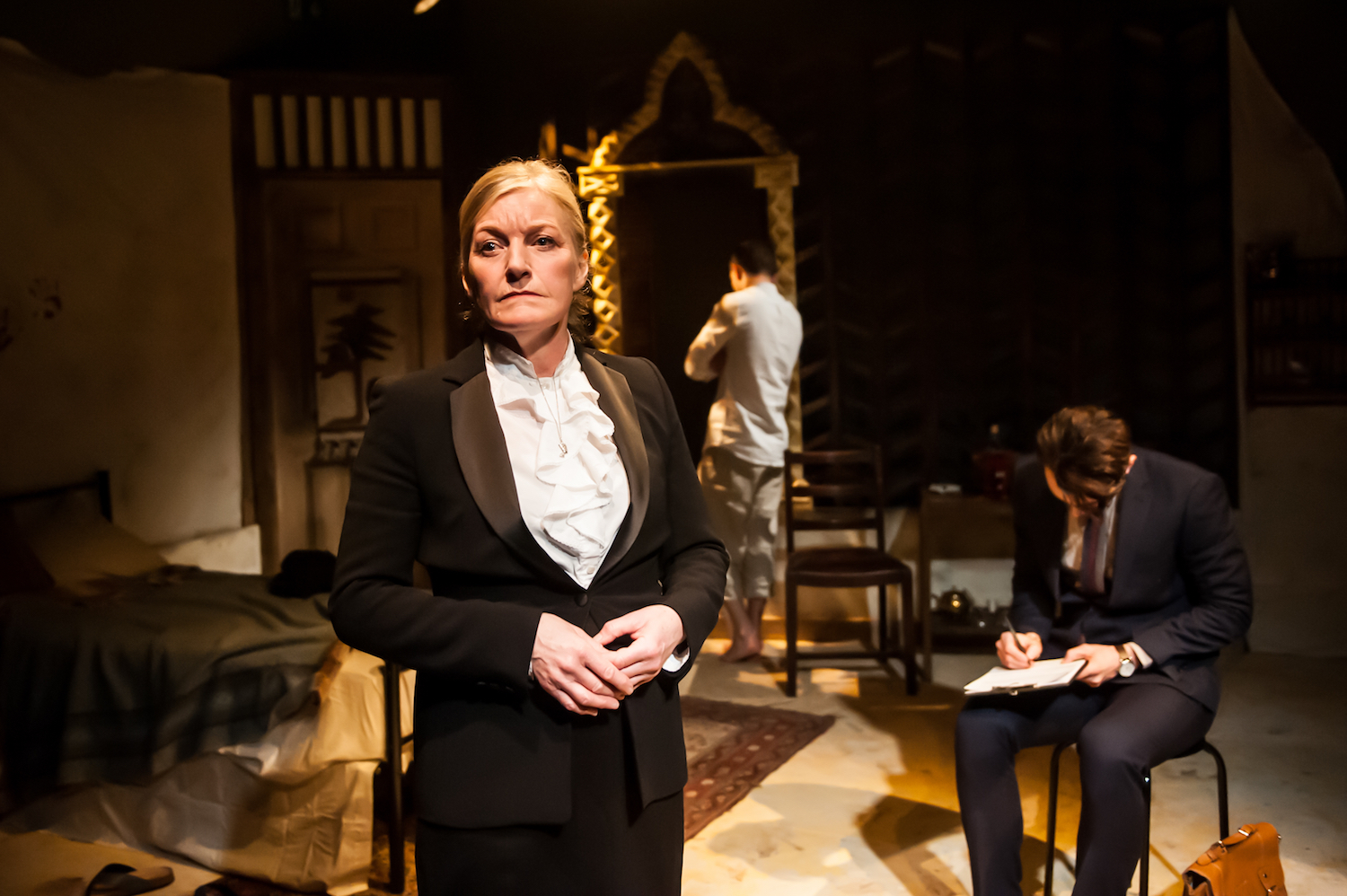
It’s no coincidence that against all logic, the play often feels more like Nicholas’ story than Mohammed’s. The Brit’s tone-deaf response to his lover’s plight places him firmly at centre stage, and consistently reveals a lack of awareness or respect for the country that’s been his home for the past six months. It never occurs to him until the play’s dramatic climax that Mohammed might not want to flee Egypt, or that he might prefer to stay and fight for a better future. Similarly, Nicholas’ slightly surreal encounters with embassy official Ms Nevers (Karren Winchester) have very little to do with the absent Mohammed, and very much to do with their own personal values and motivations.

Though he may be misguided, however, Nicholas isn’t a bad guy; his actions reveal his sense of privilege, but they’re clearly prompted by genuine affection and concern, and as a character he remains very likeable despite his faults. The relationship between the two men is believably played by James El-Sharawy and Marc Antolin, their conversations in Mohammed’s bedroom revealing the intimacy and happy memories they share. But the bruises on Mohammed’s face and the bandage on his hand – along with the recurring question: “What is your relationship with this man?” – are a constant reminder of the prejudice and brutality waiting just outside. For those of us lucky enough to live in a more tolerant society, the idea that a young man can be arrested and beaten just for being gay is difficult to accept – and in that sense, perhaps Nicholas’ reaction isn’t so unreasonable after all.

Photo credit: Lidia Crisafulli

Under Pamela Schermann’s skilled direction, the play’s relatively short scenes run smoothly from one to the next through simple black-outs. Though the embassy scenes take place away from Mohammed’s flat, it’s always there in the background, with the focal point of Emily Bestow’s set a pair of bloody handprints on the wall behind the bed. These are not, as we and Nicholas first assume, a sign of violence but of religious devotion – just one more cultural misunderstanding in a play that’s full of them.

Cry Havoc is a far quieter and more contemplative play than its title suggests; with the exception of its penultimate scene there’s little drama, and the closest we get to dogs of war are the ones barking outside Mohammed’s building. That said, there is a sense of building tension throughout as the two lovers find themselves repeatedly at odds over their future, and this discord shines a new light on the well-worn subjects of immigration and asylum. It’s a thoughtful, challenging and extremely well acted play, and definitely worth a visit.

Review: Fiddler on the Roof at Playhouse Theatre

Earlier this year, only a few weeks into the Menier Chocolate Factory run of Trevor Nunn’s critically acclaimed Fiddler on the Roof, its West End transfer was confirmed. Yesterday, a mere couple of days after the show opened at the Playhouse Theatre, it was announced that booking has been extended to September. And it’s not hard to see why.

Photo credit: Johan Persson

Set in 1905, Fiddler on the Roof tells the deceptively feel-good story of Tevye (Andy Nyman), a Jewish patriarch in the Russian shtetl of Anatevka, whose determination to abide by tradition is repeatedly tested by the insistence of his strong-willed eldest daughters (Molly Osborne, Harriet Bunton and Nicola Brown) on choosing their own husbands. But as Tevye himself explains in the show’s opening monologue, the lives of the Jewish community in Anatevka are as precarious as a fiddler on a roof; no spoilers here, but let’s just say anyone hoping for a happy ending to the show is in for a bit of a shock.

And yet, in a way, it’s not such a shock. This is a story that shouldn’t strike any kind of chord for a supposedly enlightened 21st century audience – yet tragically (and incredibly), it still feels all too relevant, and the final scenes all too inevitable. The production very deliberately immerses us in the life of Tevye and his community, with Robert Jones’ stunning set design wrapped all the way around the theatre, and the actors frequently walking among the audience to enter and exit the stage. Having joined them for the Sabbath, for a wedding and a joyous, alcohol-fuelled celebration of life, the show’s heartbreaking conclusion becomes all the more impactful, not least when you acknowledge it’s based on historical fact.

Andy Nyman is an absolute natural as Tevye; from the moment he arrives on stage, he has such energy, wit and warmth that it’s impossible not to like him. Tevye as a character provides plenty of opportunities for humour – always quick with a witty retort, not afraid to give God a good talking to, and amusingly full of bluster while he secretly lets his wife and daughters walk all over him. But as the show goes on the role calls for much greater emotional depth, and Nyman is absolutely on the money on both fronts. Alongside him, Judy Kuhn is similarly captivating as his wife Golde, and the two have touchingly believable chemistry as a husband and wife who may not have married for love, but have discovered it together over the past 25 years.

Jerry Bock and Sheldon Harnick’s score is one that most people will be familiar with, even if you’ve never seen the show, and it boasts some excellent tunes. Despite their catchiness, though, the musical numbers shouldn’t be dismissed as simply a singalong opportunity, and seeing them performed – without exception, brilliantly – in the context of the production lends them layers of new meaning. The choreography, by Jerome Robbins (who directed and choreographed the original Broadway production) and Matt Cole, is sensational to watch and performed with such enthusiasm and joy by the whole cast that it becomes utterly infectious.

Photo credit: Johan Persson

Oh, and did I mention the production is gorgeous to look at? Robert Jones’ set overflows from the stage to take in the whole of the Playhouse (now starting to get a bit of a reputation for its incredible transformations) – and it’s exquisite in every detail, from the dim, smoky atmosphere that envelops you as you walk in, to the simple rustic homes of Anatevka and the trees silhouetted dramatically against the subtly changing light as day turns gradually to night.

Funny, heartwarming, fascinating, tragic and devastating, Fiddler on the Roof is an unusual but hugely powerful musical, and this production brings out the very best in it. The previous run at the Menier was a sell-out, and this one looks set – and deserves – to go the same way. So get yourself a ticket while you can; this triumphant revival is not to be missed.

Fiddler on the Roof is now booking to 28th September at the Playhouse Theatre.

Review: Mary’s Babies at Jermyn Street Theatre

A true story based on real events, Maud Dromgoole’s two-hander Mary’s Babies was inspired by Mary Barton, the founder of a London fertility clinic whose work resulted in the birth of an estimated 1,500 babies – many of whom were fathered by Mary’s own husband, Bertold Wiesner. The play imagines what would happen if some of those children found each other, and in doing so reflects on the true nature of family, legacy and what really makes us who we are.

Mary's Babies at Jermyn Street Theatre
Photo credit: Robert Workman

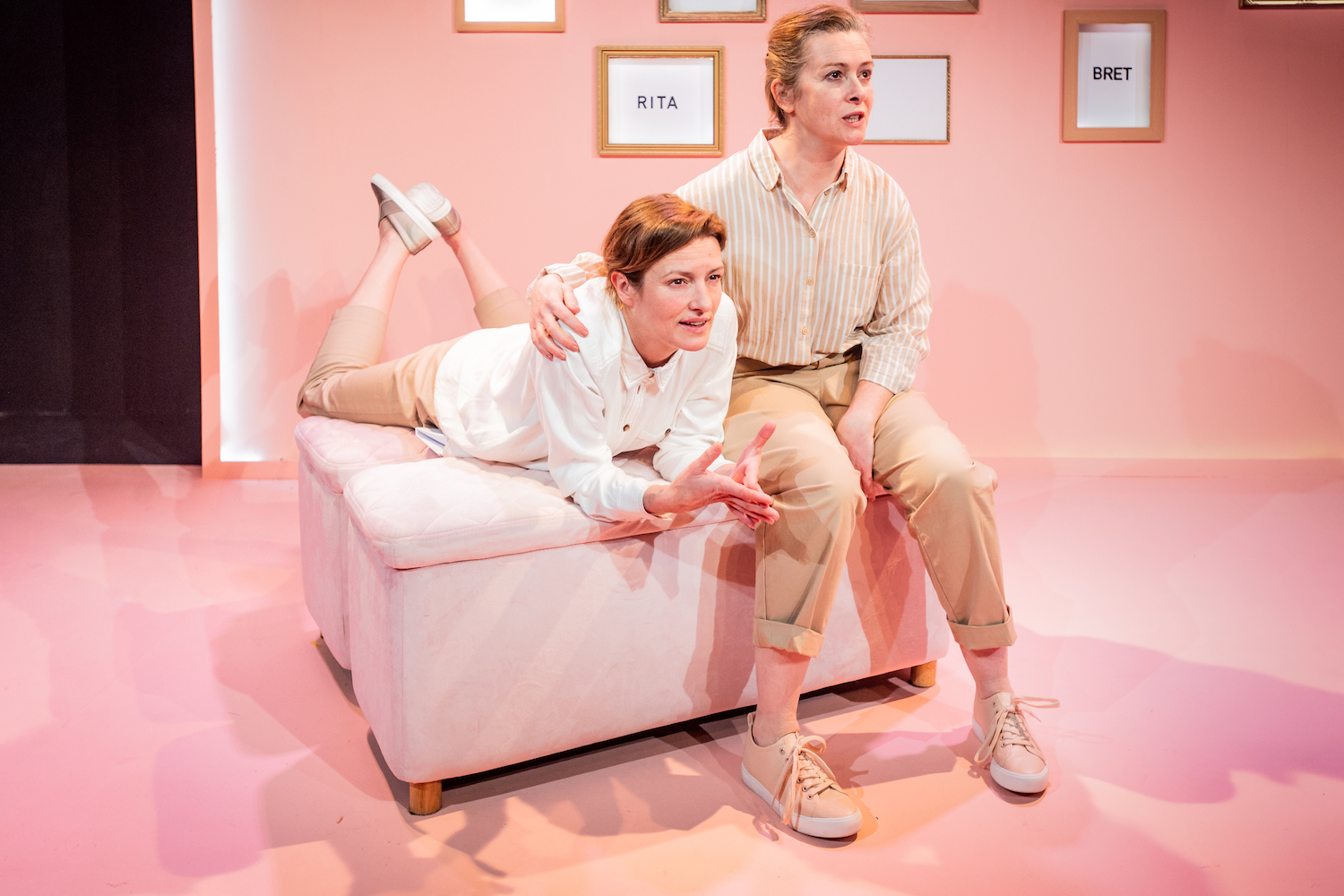
Two actors – Emma Fielding and Katy Stephens – heroically play 39 characters over 90 minutes in this fast-moving and often very funny production directed by Tatty Hennessy. Both handle the multitude of male and female roles with apparent ease, getting the balance just right between keeping each character unique and recognisable to the audience, and simultaneously demonstrating the half-siblings’ genetic similarities to each other. For the avoidance of doubt, however, for each scene the names of the two characters involved are illuminated in picture frames hanging on the wall behind them. This helpful feature of Anna Reid’s minimalist set allows us to quickly identify who we’re looking at, and certainly makes the play much easier to follow as more characters are introduced – though it can easily be overlooked at first, particularly as the first scene draws our attention away from that part of the set.

Most of the 39 characters appear only once, the majority in a single particularly chaotic party scene. The play focuses its attention primarily on just six people, whose reactions to the startling discovery of their heritage cover a broad spectrum. For some of them, the revelation of where they come from is welcome news; for others, it’s devastating. Some view their new-found siblings as an instant family, while others can’t help but continue to see them as strangers. One character, who isn’t – as far as she knows, at least – a member of the Barton Brood, is envious of her partner’s new “sibs”, her relationship with her own recently deceased father having brought her little happiness. Another discovers to his horror that he’s both father and uncle to his unborn child, after unwittingly marrying his half-sister.

Even with this limited number of central characters, there’s a lot going on, and the play’s relatively short running time of 90 minutes means we never get to delve in depth into any of the individual stories. We do, however, get some interesting questions to take away and think about in our own time. Questions like: what makes someone family? Do our genes or our upbringing have more impact on the person we become? And is it necessarily a good thing to know where you came from, or is it better to remain blissfully ignorant?

Mary's Babies at Jermyn Street Theatre
Photo credit: Robert Workman

There are a few scenes scattered throughout the play that feel superfluous and rather left-field (even after re-reading it, I’m still confused by the one about the chickens), and consequently distract from the main narrative. Some moments feel unnecessarily flippant, like the Catherine Tate-esque registrar who definitely shouldn’t be allowed to deal with bereaved customers. And it’s not a production for the easily distracted; each scene lasts on average about three minutes, with some significantly shorter, so it’s literally possible to blink and miss a crucial detail.

For the most part, though, Mary’s Babies is enjoyable and witty, and surprisingly easy to follow despite its complicated structure. A thought-provoking play, and an impressive feat of endurance and versatility from two talented performers.