Review: Equus at Trafalgar Studios

Peter Shaffer’s Equus begins with a disturbing image: a seventeen-year-old boy, Alan Strang, has been referred to the care of renowned child psychiatrist Martin Dysart after blinding six horses at the local stables. And things don’t get much easier from there in this intense drama; Dr Dysart slowly pieces together what led the young man to commit such an act, but questions as he does so if treating Alan will actually help him, or only condemn him to a life as empty and meaningless as the doctor’s own. Touching on themes of religion, sexuality and more than one form of mental illness, the play asks some difficult questions and frequently makes for unsettling viewing, and yet Ned Bennett’s production remains utterly compelling from start to dramatic finish.
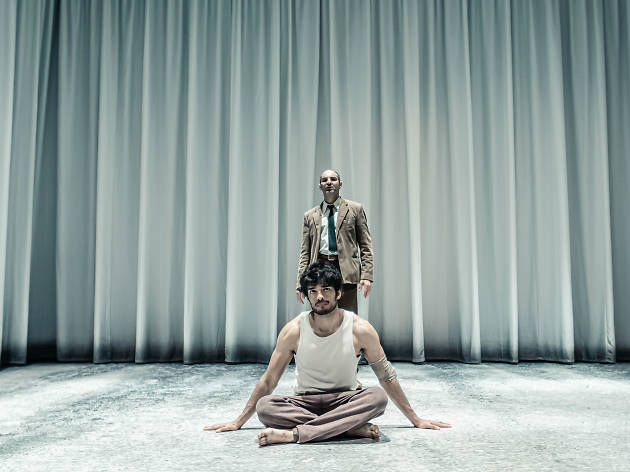
Photo credit: The Other Richard

The cast of eight are left completely exposed on Georgia Lowe’s barren, starkly lit stage (though don’t let its simplicity fool you – it still produces a few surprises later on). Fortunately, the performances of all involved are engrossing enough that the audience’s attention never wanders, despite more than one lengthy monologue. Ethan Kai and Zubin Varla take centre stage as patient and doctor – the former a picture of wild and confused defiance, the latter of quiet, building desperation – locked in a battle that both know neither can win. Though the play’s core plot is to solve the mystery of Alan’s crime, there’s just as much to unpick in Dysart’s surprising response to the latest in a seemingly endless line of troubled adolescents.

Alongside the two excellent leads, there are strong performances across the board, with Ira Mandela Siobhan particularly mesmerising as Alan’s favourite horse, Nugget. The detail, power and physicality in his portrayal, combined with Shelley Maxwell’s exquisite choreography, is such that there’s no need for any masks or costumes to convince us we’re looking at a magnificent stallion – and by dispensing with these, Bennett further blurs the lines surrounding Alan’s confused sexual desires.

Photo credit: The Other Richard

Though the play at times leans towards becoming text-heavy, with Dysart in particular reflecting at increasing length on his own misery, in fact the production strikes a good balance that prevents it ever becoming dry or losing its energy. More than once a character’s monologue is punctuated by light and sound effects that have obviously been designed (by Jessica Hung Han Yun and Giles Thomas respectively) to unsettle our minds and, occasionally, our nerves. The tension creeps up as we draw closer to the play’s climax, and although the actual blinding of the horses is enacted without a trace of gore, the moment of impact still hits powerfully home, both on and off stage.

And besides – it’s not such a trauma to listen to Shaffer’s words, especially when they include such hauntingly evocative gems as, “A child is born into a world of phenomena all equal in their power to enslave… Moments snap together like magnets, forging a chain of shackles.” Lines like this one, a potent reminder of how easily and arbitrarily mental illness can strike, ensure that despite being close to 50 years old, Equus continues to have plenty to say.

Equus is at Trafalgar Studios until 7th September.


Can’t see the map on iPhone? Try turning your phone to landscape and that should sort it. I don’t know why but I’m working on it… 😉

Review: Katheryn Howard at Brockley Jack Studio Theatre

When it comes to Henry VIII’s wives, the key fact that most people learn at school is how he disposed of them. In the case of Katheryn Howard, his fifth wife, this was at the executioner’s block, after she was accused of adultery with one of the king’s favourite courtiers.

Written by Catherine Hiscock, the debut production from Goose Bite Theatre picks up the story of Queen Katheryn close to the end, as an all-female cast portray a court filling with rumours – not just regarding her reported liaisons with Thomas Culpepper whilst married, but also previous sexual relationships with her music teacher Henry Mannox and secretary to the Dowager Duchess, Francis Dereham. Once these well-documented facts have been established, the play takes us back to the start to give us Katheryn’s account of these events, and a very different picture emerges.

Photo credit: Georgia Harris

The first piece of information I don’t remember learning in primary school is that Katheryn Howard was only a teenager at the time of both her marriage and her death, and each of the men with whom she was reported to have been involved – including her husband – were more than twice her age. The second little-known fact is that she could have saved herself by confessing that her relationship with Dereham was consensual, and yet despite the possibility of salvation, she continued to insist that he had raped her. The Katheryn we meet in this production (Catherine Hiscock) is not the adulteress we know from the history books, but a naive, terrified teenager who’s repeatedly found herself flattered and seduced into unwanted sexual relationships with predatory men. Seen through fresh eyes, and particularly from a 21st century perspective, her story is not just tragic but horrifying.

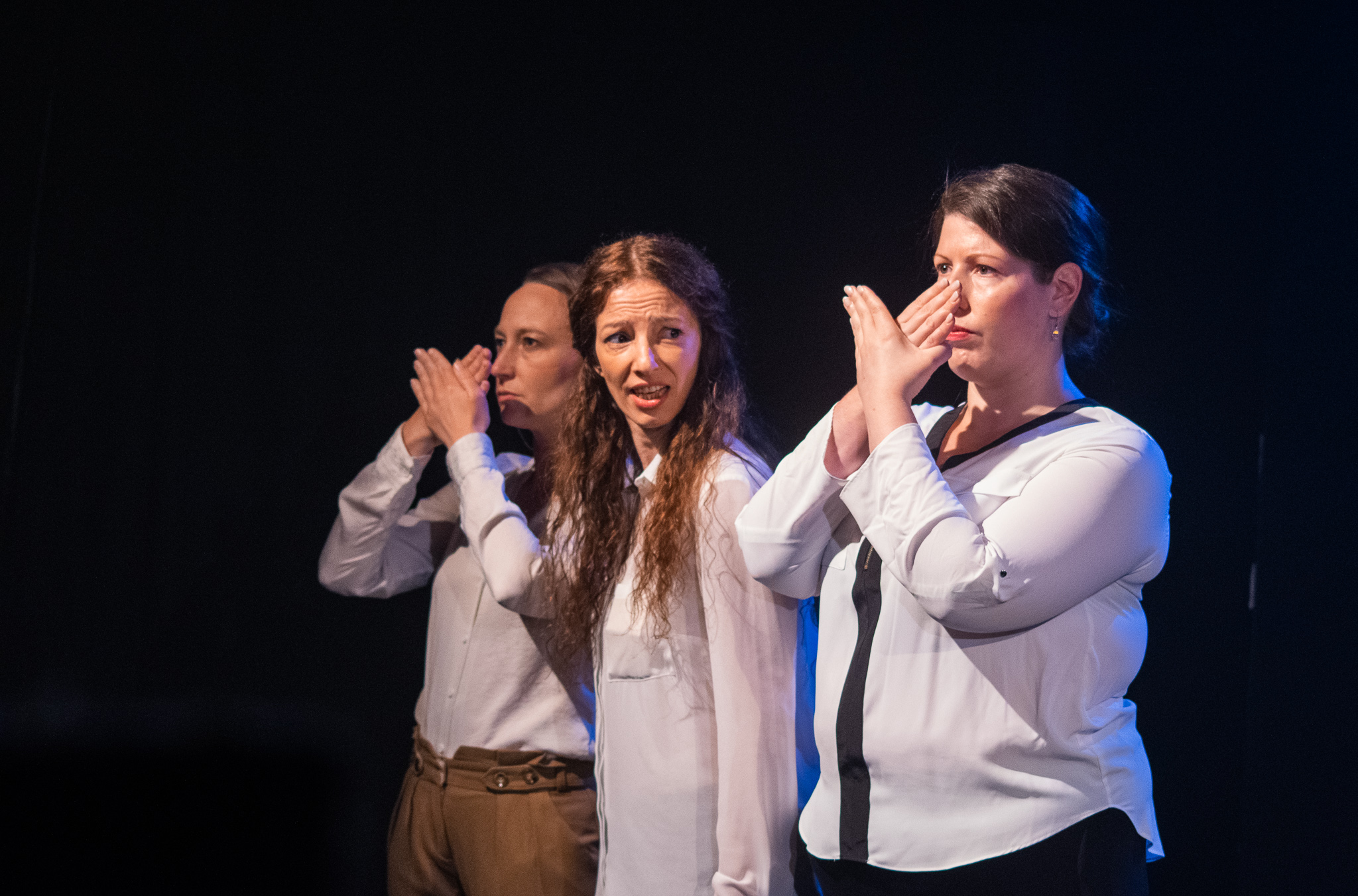
Surrounding Katheryn are her friends and ladies-in-waiting: Joan Bulmer (Francesca Anderson), Katheryn Tilney (Emmanuela Lia), Isabelle Baynton (Srabani Sen) and Jane Boleyn (Natalie Harper) – Anne Boleyn’s former sister-in-law, who allegedly aided and abetted Katheryn’s adultery and was executed immediately after her. The interactions between these characters paints a picture of life both at Lambeth, where Katheryn spent her childhood and early teenage years, and at court, where everyone’s number one concern is to protect their own position. Though it covers a relatively brief time period, the production captures very well the stark contrast between the giggling girls of Lambeth, for whom it’s common practice and seemingly harmless fun to welcome young men into their sleeping quarters, and the anxious ladies of court, who quickly realise that the queen’s downfall could also spell their own doom. This atmosphere of paranoia, suspicion and political manoeuvring is portrayed by the cast in the form of a chorus, who pace the stage with hands to their mouths as if whispering secrets.

Photo credit: Georgia Harris

You perhaps need to know a little bit more of Katheryn’s back-story than simply “beheaded” to follow everything in the text, but on the whole the play does a good job of untangling a complicated story in which many of the characters have the same name (to the point where it becomes something of a running joke) and/or are related to each other. And Catherine Hiscock gives a great performance as the young queen; her pleas for mercy and forgiveness as the play comes to an end are heartfelt and deeply poignant. It’s no surprise that women were second-rate citizens in Henry’s court, but it’s frustrating that even now we still only really know Katheryn by the manner of her death. This play sets out to right that wrong, and the result is a strong debut production that’s both historically interesting and emotionally impactful.

Katheryn Howard was performed at the Brockley Jack Studio Theatre from 30th July to 3rd August. For more details about Goose Bite Theatre, follow them @GooseBiteTC.

Quick Q&A: Pericles, Prince of Tyre

Where and when: Upstairs at the Gatehouse, Highgate – August 28th-31st

What it’s all about… Pericles is a Shakespearean epic —an exciting and exotic adventure of mystery, marvels, and mayhem— now brought to life in a bold new production by Idle Discourse.

Having discovered a dark secret in the court of Antiochus, Pericles is forced to wander a world filled with captivating characters. It’s an odyssey of life and death, morality and depravity, civility and barbarity, and, most of all, of the everlasting endurance of love.

You’ll like it if… If you love your Shakespeare brought to you with irreverence, humour, and maybe just a little bit of silliness, then you’ll love this production! Idle Discourse brings Shakespeare’s storytelling to the fore -presenting his grandest epic adventure in an energetic, accessible interpretation that is suitable for all. Audiences of our previous production of The Comedy of Errors called our production “Brilliantly bonkers!” and “Super-fast and super funny!”

You should see it because… this show will allow you to go on a journey around the ancient Mediterranean alongside Pericles, to discover the magical, mysterious lands of Tarsus, Ephesus, Antioch, and Pentapolis… all from the comfort of your theatre seat!

Anything else we should know… after our run Upstairs at the Gatehouse late in August, this production will transfer to the Baroque castle theatre at Valtice, in the Czech Republic. In 2018, Idle Discourse became the first English company in over 200 years to perform at the venue, and we’re delighted to have been invited back this year!

Where to follow:
Facebook: @idlediscoursetheatre
Twitter: @idle_discourse
Instagram: @idlediscourse

Book here: www.upstairsatthegatehouse.com/pericles

Got a show opening soon? Visit Promote your show and tell us more!

Review: 10 Things I Hate About Taming of the Shrew at Greenwich Theatre

It is a truth universally acknowledged (if you’ll pardon the mixing of literary references) that Shakespeare’s The Taming of the Shrew is, at best, problematic. It’s the story of a man torturing his wife into submission, after all, and to be honest there’s not really any easy way to sidestep that fairly significant plot point without completely rewriting the play.

While most of us would probably be willing to admit that Taming of the Shrew is far from Shakespeare’s best, Canadian actor, writer and comedian Gillian English has gone a step further and made a list of everything that’s wrong with it. And I give you fair warning: that list will take down not only Taming of the Shrew but also beloved teen romcom 10 Things I Hate About You (in spite of the manifold and much-missed charms of Heath Ledger, which are acknowledged more than once). Also A Midsummer Night’s Dream. Shakespeare in general. Friends. Big boobs. Justin Trudeau. In fact there are very few people, places or things that make it out of this very funny but also very angry show unscathed.

And that’s because while Taming of the Shrew may be the starting point, it actually opens the door to a much wider conversation – about our obsession with reviving Shakespeare plays, even the bad ones, just because of who wrote them. About the damaging impact of romanticising misogyny and turning it into a Hollywood teen movie or a banging rock anthem. About the dangers of pitting women against each other, or telling little girls that boys are only mean to them because they like them. In a show peppered with hilarious personal anecdotes, self-defence classes and a demonstration of the opening number from Get Over It – which I’ve never seen but now desperately want to – it turns out there’s also a lot of serious stuff for both women and men in the audience to unpack and peruse at our leisure.

As a performer, Gillian English quite literally roars on to the stage, making no secret of her anger not just that Taming of the Shrew exists, but that everything bad within this 500-year-old play still needs to be discussed in 2019. She’s loud, in your face, and not afraid to be a bit confrontational, and yet there’s something about her enthusiasm and frank acknowledgment of her own failings that makes her irresistibly likeable (at least I thought so – I can’t speak for how the men in the audience felt about being taught the best way to rip off a penis). Add to that the fact that what she’s saying – even, or perhaps especially, the shoutiest bits – makes a huge amount of sense, and you’ve got the recipe for a show that’s a lot of fun to watch in the moment, but that also stimulates an ongoing discussion and a desire for change going forward.

Not everyone will love it; die-hard Shakespeare fans will no doubt take offence at the way their idol’s work is dismissed, and ironically the kind of men – and women – who most need to hear the show’s messages will probably steer well clear. But for those willing to open their minds, and who are okay with witnessing one of their favourite teen movies being ripped brutally to shreds, this is definitely one to see if it passes through a town near you.

10 Things I Hate about Taming of the Shrew is touring the UK, including heading to Edinburgh – for full dates, and details of Gillian English’s other shows, visit gillianenglish.com.

Really Want to Hurt Me: Q&A with Ben SantaMaria

In 2017, a School Report study published by Stonewall found that almost half of all LGBTQ pupils still face bullying, half regularly hear homophobic insults, and many suffer low self-worth, self-harm and attempt suicide. Writer and director Ben SantaMaria understands this all too well, having experienced it for himself growing up as a gay man in 80s Britain. Realising that these problems haven’t gone away for young people today, he wrote the autobiographical show Really Want to Hurt Me as a way to explore what has – and more importantly, hasn’t – changed since his own teenage years.

Following sold-out dates last year in London and Edinburgh, where it was shortlisted for the Brighton Fringe Award for Excellence, Really Want to Hurt Me recently embarked on a tour of the UK, performed by Ryan Price. As the tour got underway, we chatted to Ben about the show’s journey so far and the impact he hopes it will have for audiences over the coming months and beyond.

Can you sum up briefly what Really Want to Hurt Me is all about?

It’s a bittersweet and dark comedy with dance sequences that gives the audience an intimate sense of what it was like to grow up gay in the ‘80s. The story has a lot of parallels with the same challenges that young LGBTQ people are experiencing today. It follows the life of a schoolboy in Devon from 1984-86, as he lives through all the upheaval and self-discovery of his teen years, having to hide and repress his identity to survive the pressures of being bullied and being forced to conform. He escapes into the pop and indie music of the 80s era, which promises a more liberated life ahead for him, and into theatre to enjoy playing other characters instead of the false self he has been made to be in real life.

Why was this a story you wanted to tell, and why is now the right time to tell it?

It’s an autobiographical play, so I’d reached a point where something in my mind was telling me I needed to explore my past and work out how much what happened in my formative years is still affecting me. Short answer: it shaped me more than I even realised! But with all of the arguments about expanding education to be inclusive of LGBTQ people’s lives, and research still revealing how many young LGBTQ people continue to be bullied and hear negative messages about themselves that lead to isolation, low self-esteem and self-harm, the loneliness and traumas I experienced clearly haven’t vanished into the past as some relic of a bygone era. I think we need to honour and keep revisiting LGBTQ history to see what’s changed and what still needs to change for further progress.

What do you hope audiences will take away from seeing the show?

We’ve already taken the show to Exeter, the Edinburgh Festival Fringe and in London to Soho Theatre, Theatre503 and the Old Red Lion. Audiences there have responded so positively and openly to the show, either LGBTQ people of my generation saying “that’s my story” or younger people telling us it reflected their lives. It’s also been brilliant to have non-LGBTQ people say that the show made them understand at an emotional level what their friends and family went through. I’d love audiences of all kinds to feel immersed in the schoolboy’s world and through that to reconnect with their own teenage years and any time they overcame feeling like an outsider.

What’s the show’s journey been to this point, and how have audiences responded to it so far?

It started out as a short scratch piece in 2017 when I was invited to contribute something for the Monday Club’s showcase at the Rosemary Branch Theatre in London, commemorating 50 years since the partial decriminalisation of male homosexuality in England and Wales. So many of the acts there, whether spoken word, dance or film, all touched on the same issue of surviving school traumas, which just reinforced how much remains the same today. An Arts Council grant was the lifeline that led to all of those other show dates we clocked up last year. As the play’s so grounded in small-town life, away from the London stories we hear more often, it was important for me to take it on tour around the UK this year, back to the South West and all around.

What have been the biggest highlights and challenges since you began writing the play?

The highlights have been all of the venues we’ve visited and the ones on our tour this year. It’s absolutely incredible to me that my personal story has gone on this journey around the UK and had such beautiful responses from our audiences. The biggest challenge has been staying true to my Devon adolescence, making the boy’s story as intimate and honest for the audience as possible, and developing and redeveloping it until only the essential remains, to make it speak from the heart.

What are you most looking forward to about taking the show on tour?

I love visiting new venues and because the play’s partly about the huge importance of so-called ‘regional’ theatre, amateur dramatics and those drama teachers who give so many outsiders a sense of purpose when they’re growing up in their small towns, it’s really satisfying to be bringing it to lots of towns and cities where people can hopefully feel that their lives are reflected in this story. We’re also running free LGBTQ writing workshops at some of the venues – in Sheffield, Exeter, Harlow, Cheltenham and Nottingham. Anyone aged 14+ can book a place by contacting the venue and come along to try writing from their own life experiences, whether they’ve written before or not.

In your view, what can we as both a society and individuals do to combat the bullying and intimidation still faced by the LGBTQ community?

My experiences growing up tell me that what’s needed is a healthy sense of community to support those who are targeted as ‘other’ and ‘different’. Inclusive education that acknowledges the realities of everyone who’s in the classroom. Normalising peer protection – again, through education – instead of normalising bullying as something you just have to get through as a young person. It seems to me, having grown up in a period when bullying was even more pervasive, that we’re at a point now where great advances in inclusivity and diversity are smashing against another catastrophic surge in fascism and monoculture. Reaching out collectively, whether it’s helping others whenever it’s safe to or joining a larger group to tackle hate, is always the answer. As my play illustrates, you can’t thrive alone.

Really Want to Hurt Me is on tour around the UK until October – for details of dates and venues, visit flamingtheatre.co.uk.

Writer and director: Ben SantaMaria

Performed by Ryan Price