Review: Screwed at Theatre503

For a lot of people, 30 is the milestone age when we start to think about our ‘life plan’: to consider who we are, who we want to be, and how we’re going to get there. But what if you don’t have a life plan, and you don’t even know where you’ll end up tomorrow, let alone in five years’ time?

Kathryn O’Reilly’s debut play, Screwed, introduces us to Charlene and Luce, two friends in their early 30s whose only goal is to lurch from one drunken night out to the next, filling the hours in between at their mind-numbingly boring factory job and popping caffeine pills to get through the day. Shrugging off the attempts of friends and family to set them straight, the two girls stumble down the path to self-destruction – but then one night things go too far, putting their dysfunctional friendship to the test, and changing several lives forever.

Photo credit: Sophie Mutevelian

Samantha Robinson and Eloise Joseph are a perfect team as eternal teenagers Charlene and Luce. O’Reilly’s produced a choppy, off-beat script that allows the friends to fall into a familiar routine and bounce off each other in a way that’s both funny and oddly touching; you get the feeling they’ve had the same conversation many times before, and know each other back to front. And yet there’s a bitchiness underlying almost all their banter that establishes the power balance early on in the play: the brash, confident Luce (Eloise Joseph) calls the shots, while vulnerable, self-loathing Charlene (Samantha Robinson) falls in line, often at the expense of her own happiness. Consequently the friendship becomes both uncomfortable and frustrating to watch, as we not only see both girls wasting the potential they undoubtedly possess, but also find ourselves willing Charlene to break free of Luce’s damaging influence.

If the girls are often difficult for us to like, the other two characters in the play fall at the opposite end of the spectrum; in fact, if anything, they’re a bit too good. The girls’ work colleague – and Charlene’s love interest – Paulo (Stephen Myott-Meadows) is endlessly patient and idealistic, while Luce’s trans parent, Doris (Derek Elroy), is a shining example of someone who saw what they wanted from life and made it happen, against the odds and whilst single-handedly raising a difficult and ungrateful daughter. Both the male characters are admirable and likeable enough, but next to the complexities of the central characters, they do feel just a little one-dimensional.

Photo credit: Sophie Mutevelian

Sarah Meadows’ production is slick and energetic, and leaves plenty to the audience’s imagination. Much like a drunken night out, some of the most significant events are blacked out, and we (and others) are forced to rely on the girls’ memories – which are unreliable at best, downright dishonest at worst – to piece the story together. The set, designed by Catherine Morgan, is simple yet multifunctional, adapting easily to become everything from factory to hospital, nightclub to kebab van. The concealed mirrors are a nice touch too, allowing for an increasing amount of self-examination from the characters as the play goes on… though whether it does anyone any good is questionable.

Screwed is a hard-hitting play, and not always that enjoyable to watch, though it certainly has its moments. Underneath the bawdy humour lies a cautionary tale about wasted opportunities – in love, work, and life in general – and the party culture that, much like Luce and Charlene’s friendship, does far more harm than good. Kathryn O’Reilly’s decision to explore this social trend with a focus on female characters is refreshing, if a little bit depressing, and while the play doesn’t offer a lot in the way of answers, it certainly paints a vivid picture.


Can’t see the map on iPhone? Try turning your phone to landscape and that should sort it. I don’t know why but I’m working on it… 😉

Interview: Owen Calvert-Lyons, Ovalhouse

Owen Calvert-Lyons was recently appointed as the new Head of Theatre and Artists’ Development at Ovalhouse Theatre in South London. The former artistic director of The Point and The Berry theatres in Hampshire joins the Ovalhouse team as they prepare to move to a new home in Brixton in 2019.

Owen Calvert-Lyons

So what does a Head of Theatre and Artists’ Development actually do? “My role is to ensure that art and artists are at the centre of everything that we do,” explains Owen. “I want to give a voice to a new generation of artists, particularly those from South East London. I will programme the mainhouse (Downstairs) and studio (Upstairs) theatres, commission artists to create new works and I’ll build an artist development programme which supports, nurtures and champions artists.

“My first season of programming will be Spring 2017, which will see a really exciting mix of new and familiar artists presenting bold and innovative productions. Before that, in July we have Seiriol Davies’ How to Win Against History, which is a hilarious, anarchic new musical.”

The new Head of Theatre is full of plans for audiences and artists alike: “I want to grow our audiences. I want people from across London to see Ovalhouse as a place that they can come to enjoy performances by the most exciting artists around.

“And I want us to be an artist’s first port of call when they have a great idea. A place where they can make their vision a reality. Ultimately, artists want to create great work and audiences want to see great work. We are creating an environment in which artists and audiences can come together to explore new ideas.

“Ovalhouse is a special venue, with a long history of radicalism. This has meant something different for every decade: feminist theatre, LGBT theatre, political theatre, performance as protest etc. This has meant that Ovalhouse has been a space for new ideas and new voices, which is always where the most exciting work comes from. We are in the process of defining what we think radicalism means for 21st century artists and audiences.”

Owen joins fellow new recruits Stella Kanu (Executive Producer) and Gary Johnson (General Manager) at a huge moment in the theatre’s history, as plans get underway for the move to Brixton: “Stella and Gary are great. They are bringing new ideas and new ways of working. This has engendered a feeling of energy and optimism amongst the whole team, so that we are all working together to ensure that Ovalhouse has a really exciting future.

“The whole team is bubbling with excitement about the move. The new venue will be right in the heart of Brixton. One of the things that makes it distinctive is that it will have seven rehearsal rooms, so it will be a creation centre full of artists making extraordinary things.

“Many of the spaces will be rigged for aerial work, so we will be able to support the development of contemporary circus as well as theatre and dance. The two new performance spaces will be bigger than the existing Ovalhouse studios and better equipped, so we can make even more exciting work for even bigger audiences.” 

Find out more about How To Win Against History, and see what else is coming up in the Ovalhouse Spring/Summer 2016 season at www.ovalhouse.com.

Review: Ross and Rachel at Battersea Arts Centre

You know how we’ve all been demanding a Friends movie for years? Well, I changed my mind. In Ross and Rachel, James Fritz gives us a glimpse into the future of arguably one of TV’s most iconic couples – and it’s not pretty.

Presented as a rapid-fire duologue by solo performer Molly Vevers, and directed by Thomas Martin, the show explores what happens to the on-again, off-again couple after they finally get together, as doubts begin to creep in and an unexpected (and decidedly unfunny) crisis threatens the perfect future we all envisioned for them. Delicately constructed, with enough hints for any self-respecting Friends fan to feel at home, yet sufficiently vague that we could be listening to any couple, anywhere, Ross and Rachel is both a treat and a trauma for devotees of the TV show, taking us on a harsh reality trip outside the comfortable world of sitcom, and far beyond the happy ever after moment.

Photo credit: Alex Brenner
The ‘duologue for one person’ format takes a little while to get used to – like its characters, the two players in the drama blend into one unit, so it’s not initially obvious who’s saying what. Fortunately, through a combination of Fritz’s skilful writing and Molly Vevers’ spell-binding (and award-winning) performance, it takes a surprisingly short time to unravel the two voices from each other – and by the end of the play, it’s with a feeling of mild surprise you realise there’s only ever been one performer on stage.

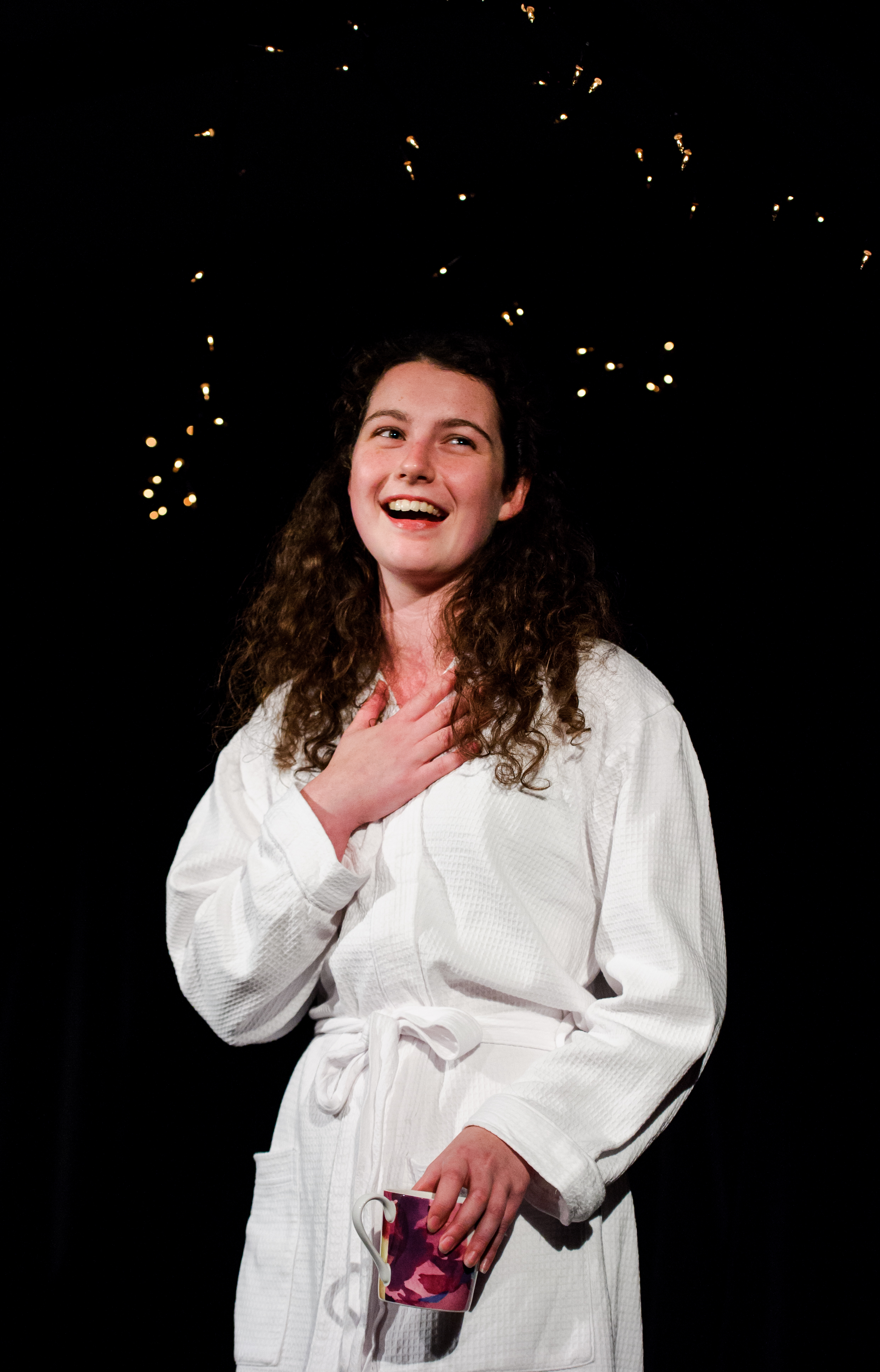
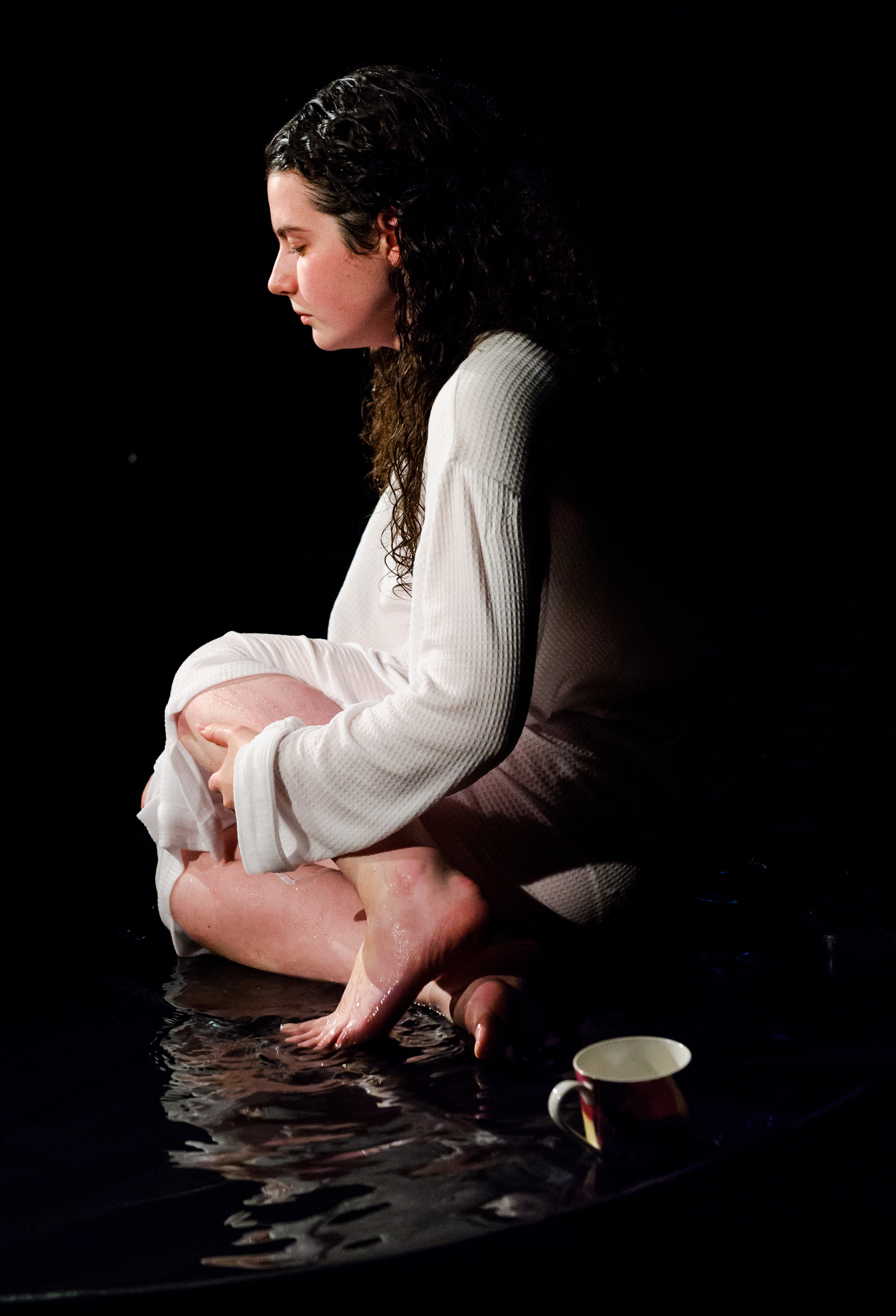
The fact that most audience members already know the characters inside out is a double-edged sword; on the one hand, no introduction is needed, and it doesn’t take much for us to invest emotionally in their story. On the other, taking apart this golden couple and revealing them to be two real, flawed human beings just like the rest of us is a huge challenge – but one to which Vevers rises magnificently. She has the audience’s undivided attention from the moment she appears on the dimly lit stage, perched on the edge of a shallow pool and nursing a cup of coffee (what else?). Effortlessly embodying both roles, she delivers Fritz’s lines with passion, emotion and boundless energy, making us laugh and cry almost in the same breath.

Photo credit: Alex Brenner
Ross and Rachel isn’t really about Ross and Rachel, of course – it’s about the idea of relationships that popular culture sells us. We’re raised on a diet of romcoms and happy endings to believe that meeting ‘The One’ should be our goal in life, and that once we’ve found them, our lives will somehow freeze forever in that beautiful moment. This play exposes the sad reality – that sometimes a perfect ending is just the start of an imperfect next chapter. And if you think that sounds depressing… well, it is a bit. But sometimes the truth hurts.

There’s no doubt Ross and Rachel is a brilliantly written and impeccably performed play. I’m glad I saw it – but unlike every episode of Friends, I’m not sure I’d want to watch it again (or indeed 10, 20, 30 times… I lost count a long time ago). There’s nothing wrong with a dose of reality from time to time – but nobody looks to sitcoms, fairy tales or romantic movies for reality. They provide us with an escape from the challenges and mundanities of everyday life, and exposing their flaws – however affectionately – feels just a little bit cruel and unnecessary.

But hey, it’s nothing a Friends binge won’t fix…


Can’t see the map on iPhone? Try turning your phone to landscape and that should sort it. I don’t know why but I’m working on it… 😉
Interview: Teresa Burns, How It Ended

“The little gardener worked very hard but he was just too little to make a difference. One night, he makes a wish ‘for a little bit of help’ and as he sleeps the local children, inspired by his beautiful flower, help bring his garden to life.”

Photo credit: Eva Sampson

So begins the story of Emily Hughes’ The Little Gardener, adapted by How It Ended, in association with Scamp Theatre. Dramaturg and co-artistic director Teresa Burns explains what drew the company to the story:

“We’re big fans of Emily Hughes so we were very excited about the book’s release last year. The Little Gardener felt like perfect subject material for adaptation, particularly outdoor theatre – not only because of its setting but because of its message about community. The story beautifully illustrates the impact an act of kindness can make on a person’s life and how it can inspire them to carry on.

We’d love our audiences to take away a sense of community; a feeling that by working together you can make something really special.”

The play, which is currently touring and free to attend, is set in a greenhouse, containing a real garden. “The greenhouse is interactive in the sense that it can be opened up to allow children inside. Inside the greenhouse sits a large tree (wherein the Little Gardener sleeps) and flower beds – ready for planting! The set is designed and built by James Lewis, who’s done a remarkable job. The set breaks down into 28 pieces and we tour with over 100 flowers.”

Photo credit: Rachel Ferriman

It’s not the company’s first collaboration with author Emily Hughes. “Last year, we worked with Emily on the stage adaptation of her debut book Wild and we conducted a really successful period of research and development.  We’re hoping to bring Wild to theatres in 2017.

“Emily is such a joy to work with. From day one she has been so warm and encouraging. She isn’t precious about her work and pushes us to delve deeper or go darker, which is really freeing.” 

The fact that The Little Gardener is an interactive show does bring with it an element of unpredictability: “Every audience is different, so we’ve tried our best to prepare for every perceivable eventuality. But of course audiences will always surprise you! Some children are very comfortable with handling plants and getting their hands dirty, whilst others are understandably more hesitant, so it’s about making those children feel at ease. For each performance we have a lovely team of Production Assistants/Gardeners who are there to make sure the audience are happy.”

How It Ended’s goal is to excite young audiences and inspire the next generation of theatre makers. The honesty and responsiveness of children is fantastic. They certainly let you know how they feel about the show whether it be positive or negative – you know where you stand! But making work for young children is boundlessly rewarding, they give back in ways older audiences don’t.

“When we opened the show last week at The Lyric we had lots of children linger around the greenhouse with their parents after the show. They wanted to make comments on the show and ask questions about the flowers and the greenhouse – which was wonderful. It’s great to see them discussing the show, as it hopefully challenges their expectations of what theatre can be.”

Photo credit: Eva Sampson

Catch The Little Gardener at Greenwich and Docklands International Festival (25th – 26th June), Watford Palace Theatre (2nd – 3rd July), Latitude Festival (17th July) and Stockwood Discovery Centre (29th – 30th July). All performances are free to attend and are non-ticketed. Ages 3+.

Review: Happy to Help at Park Theatre

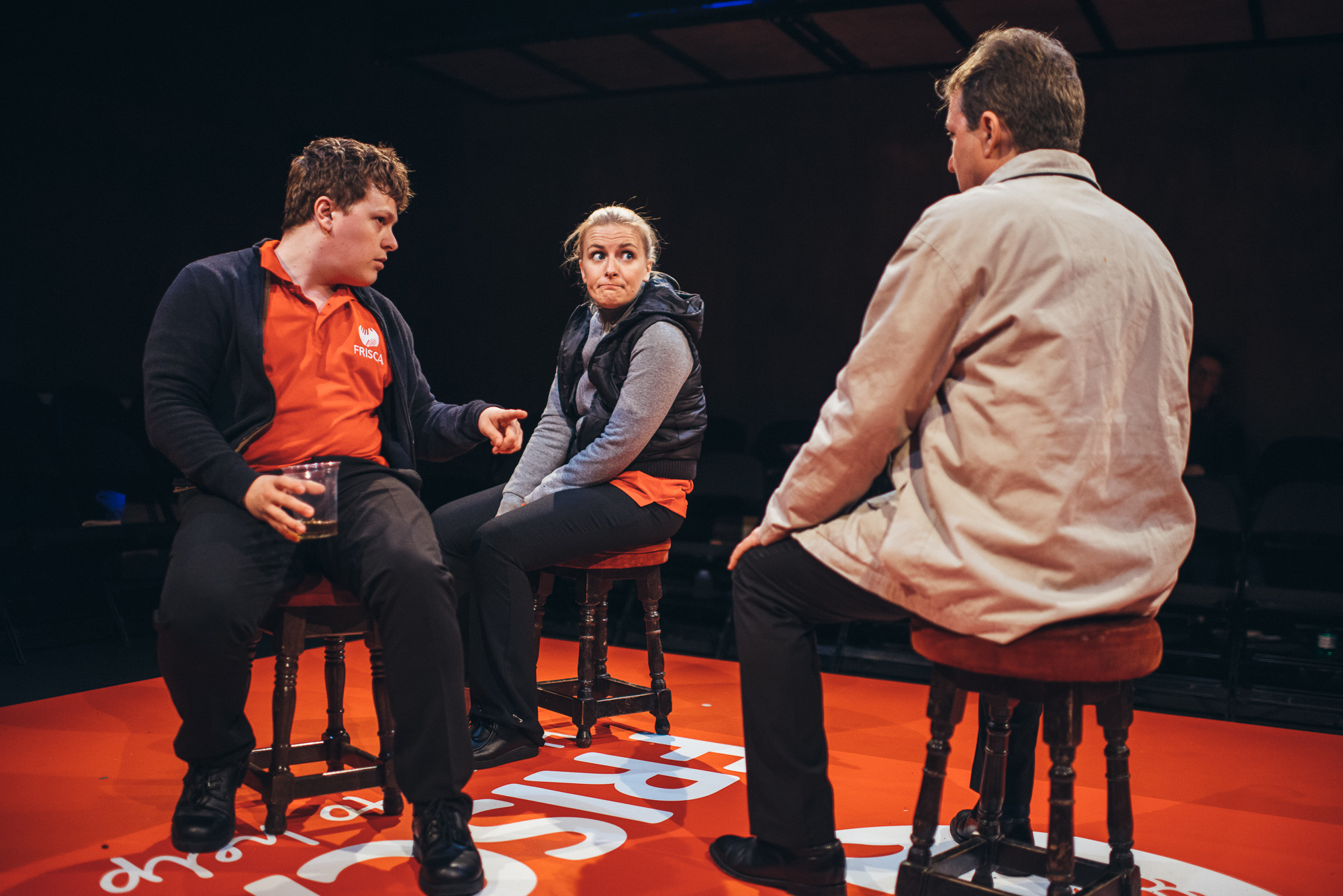
If you thought a supermarket was nothing more than a place to pick up a pint of milk, think again. Happy To Help by Michael Ross opens the door to Frisca, the UK’s biggest supermarket chain, and takes us behind the scenes for one dramatic week, to reveal the internal politics and daily power struggles hidden behind the brand’s cheerful public face. It’s a sharp, clever comedy but with a serious message, in which the huge corporation is likened to an autocratic state, where speaking out against the regime can have dire consequences.

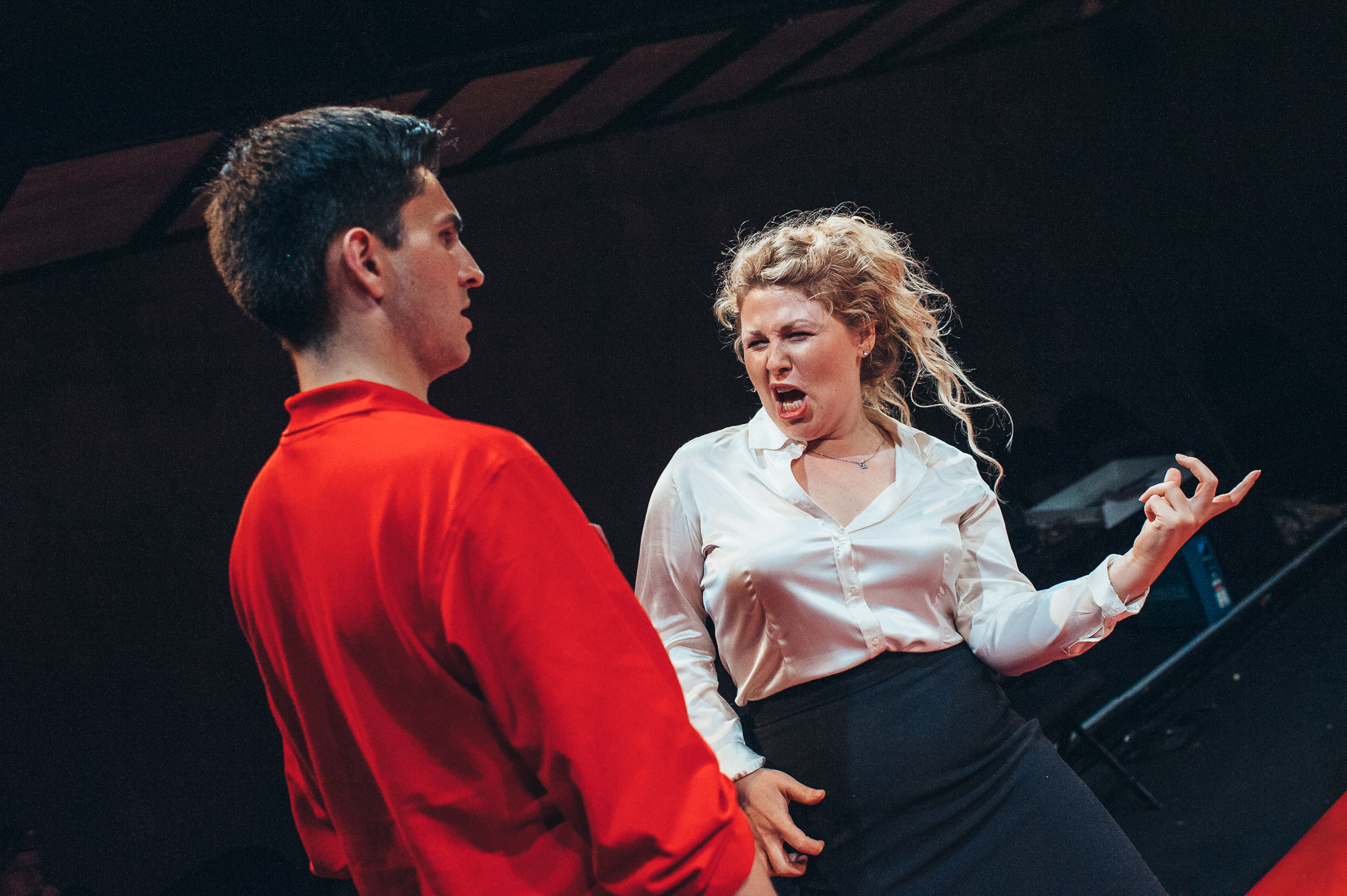
UK managing director Tony (Charles Armstrong) is doing his Secret Millionaire bit, on the advice of American boss Huck (David Bauckham), going behind the scenes at a Frisca branch to mingle with the workers. But little does he know that store manager Vicky (Katherine Kotz) has her own agenda… Meanwhile disgruntled employees Elliott (Jonny Weldon) and Myra (Rachel Marwood) are whispering about unions, and wannabe rockstar Josh (Ben Mann) has no intention of sticking around for long, even if he is everyone’s favourite shelf-stacker. For Frisca’s customers, it’ll be just another week, but behind the scenes everything’s about to change as a hilarious, shocking and unsettling chain of events is set in motion.

Photo credit: David Monteith-Hodge

In a fantastic cast, Katherine Kotz gives a stand-out performance as the manipulative Vicky; with a sunny smile that never reaches her eyes, she prowls the stage, a figure of absolute authority and control – but with a slightly manic air that suggests she could lose it at any moment. Ben Mann also shines as the brashly confident Josh, who thinks he’s got it made by being teacher’s pet. The confrontation between Vicky and Josh at the end of Act 1 is masterfully constructed and performed; much like Josh, we don’t realise what’s happening until it’s too late.

Perhaps the biggest personality on stage, though – both literally (the brand name is emblazoned across Emma Tompkins’ set) and figuratively – is Frisca itself, a business so wildly successful that it’s come to dominate every area of our lives, without ever pausing to consider who might be suffering as a result. Directed by Roxy Cook, the play skilfully contrasts Frisca’s shiny public image with the less than glamorous reality, in which employees are devalued, dissatisfied, and anything but ‘happy to help’. Each scene change is punctuated by a soundtrack of till beeps and monotonous store announcements, and there’s even a perky (and frustratingly catchy) Frisca song. It’s a world governed by ridiculous rules and regulations, whose absurdity is hammered home by Tony – the man who wrote them – now having to abide by them.

Photo credit: David Monteith-Hodge

But Happy To Help, which was shortlisted for the Liverpool Hope Playwriting Prize in 2015, is also a stark warning about the power that big businesses are allowed to wield over both us as consumers and the smaller firms that get in their way. As much as we may laugh watching the play, it actually paints a pretty bleak picture, and though the twist in the tale isn’t difficult to see coming, it still makes a powerful point. And it may make you think twice about ever setting foot in a supermarket again… at least until the next time you run out of milk, anyway.


Can’t see the map on iPhone? Try turning your phone to landscape and that should sort it. I don’t know why but I’m working on it… 😉