Review: Russian Dolls at King’s Head Theatre

Kate Lock’s Russian Dolls, winner of the 2015 Adrian Pagan award for new writing, brings together two unlikely companions – Hilda, blind, elderly and struggling to maintain her independence, and Camelia, who’s just got out of a young offenders’ institution and wants nothing more than to go back there. When she robs Hilda, a surprising connection is forged, and the two discover that their lives are actually not all that different.

Exploring as it does some difficult themes – abuse, loneliness, gang violence and addiction, among others – it would be easy for the play to become a bleak picture of two isolated souls just trying to survive. And while there’s certainly plenty in Hamish MacDougall’s production to shock and dismay, this brilliant two-hander is far from one-dimensional. Both Hilda and Camelia are strong-willed and proud, and they quite literally speak different languages, so the resulting clash of personalities allows for a good deal of humour alongside some genuinely heart-warming moments.

Russian Dolls at King's Head Theatre
Photo credit: Andreas Grieger
Playing these complex characters are two perfectly cast actresses, who each begin alone on stage with a soliloquy direct to the audience. Stephanie Fayerman’s Hilda is determined and stubborn, refusing to stop living her life or to give up the things she loves, and discussing the sudden total loss of her sight with a levity that only thinly masks her devastation. Meanwhile, Mollie Lambert takes Camelia, a character many would be all too ready to write off as a lost cause, and reveals her to be an affectionate, warm and funny girl, who loves her family and dreams of a better future. Like Hilda, her bravado hides an intense vulnerability, and her ambitions become all the more poignant as she’s inevitably drawn back into the repeating patterns of the world she’s left behind.

Becky-Dee Trevenen’s set takes in the whole width of the intimate space, encompassing Hilda’s front door, living room and kitchen. We never see outside the flat, only hearing second-hand about characters and events, and this heightens the sense of isolation for the two women. In fact the only time the story doesn’t feel completely natural is on the one occasion the outside world briefly enters their safe space, when Camelia arrives home with a gun she’s stolen from her brother and his gang. This results in a mildly chaotic scene in which she runs around the flat behind Hilda’s back, hiding the weapon somewhere new, only to pick it up again moments later and move it somewhere else – and finally putting it back where it was in the first place. When the gun then disappears in the following scene, it feels like a bit of an anticlimax, and we only learn its true significance much later.
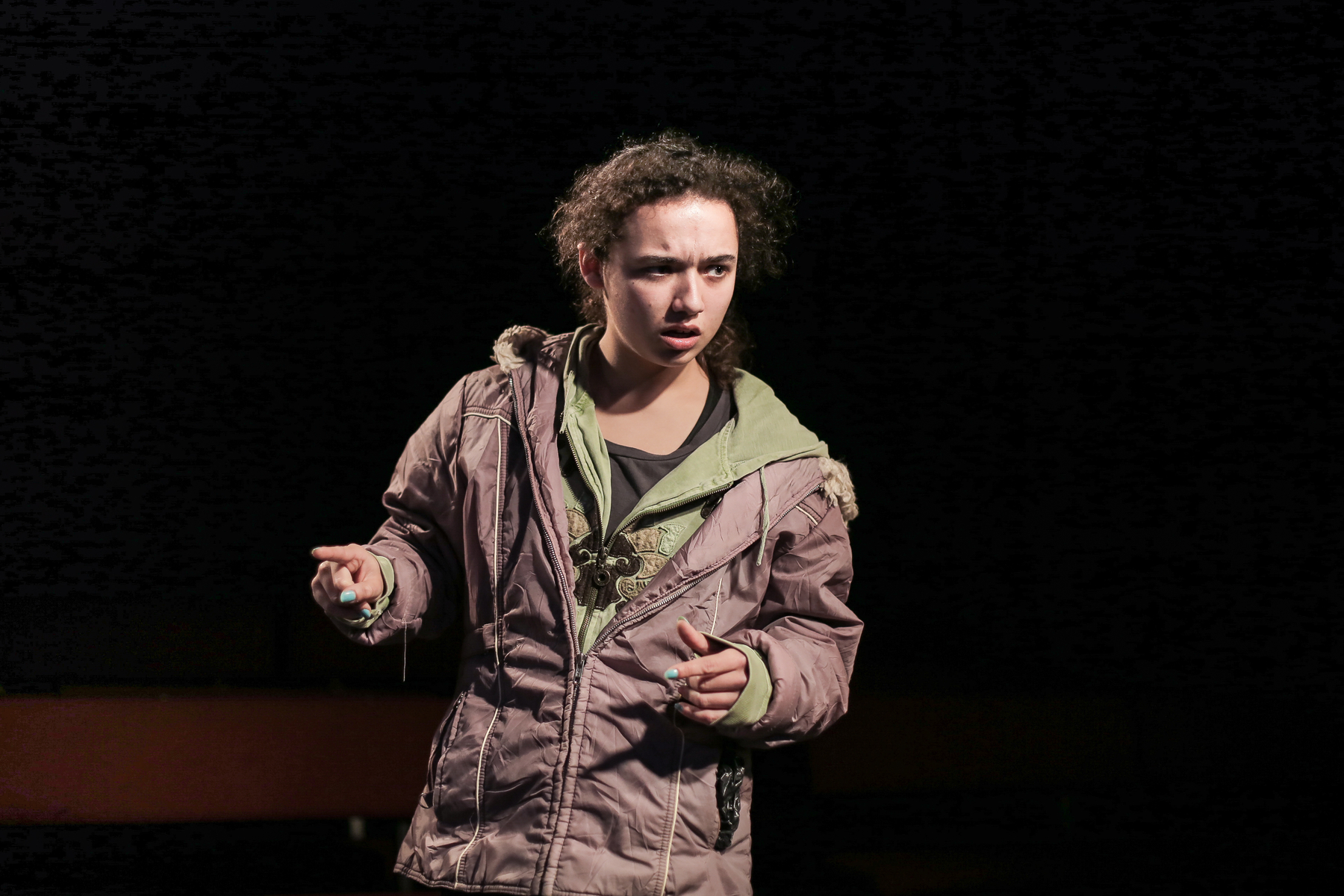
Russian Dolls at King's Head Theatre
Photo credit: Andreas Grieger
This thoughtful and moving play ends rather abruptly, with no clear resolution, but still manages to leave us feeling uplifted, despite some of the horrors that take place within it. Camelia and Hilda’s relationship begins as a practical arrangement – Camelia acts as Hilda’s eyes, while Hilda provides the authority and discipline Camelia’s never had from her own mother – but grows into one of genuine affection. This, along with the open-ended final scene, encourages us to go away considering how society needs to change before such stories can possibly have a happy ending.


Can’t see the map on iPhone? Try turning your phone to landscape and that should sort it. I don’t know why but I’m working on it… 😉

Review: The Long Road South at King’s Head Theatre

Paul Minx was inspired to write The Long Road South in tribute to Carney, a man who worked for his family in Indiana for almost 15 years, and became a ‘shy second father’ to the young boy. And yet despite this close relationship, Minx knows very little about Carney’s personal life, because he was advised ‘not to pry, particularly with “the help”‘.

This contradiction is recreated in the play through a brief glimpse into the lives of the white Price family and their black ‘help’. Andre and Grace are preparing to leave for Alabama to join the civil rights movement – but as Andre fights for the courage to ask for his final wages, the Price’s teenage daughter Ivy tries anything to make him stay, and her mother Carol Ann heads towards a breakdown, it seems increasingly unlikely that they’ll ever be able to get away.

The Long Road South, King's Head Theatre
Photo credit: Truan Munro

A truly excellent cast, directed by Sarah Berger, draw us into the complex relationships between the family members and their employees, revealing deep personal issues on both sides, where nothing is quite as it seems. Andre (Cornelius Macarthy) is mild-mannered and deeply religious, but fighting an endless battle against the demons who nearly destroyed him, whilst trying to be the man aspiring writer Grace (Krissi Bohn) wants him to be. Ivy (Lydea Perkins) seems like a self-centred brat, until we realise she’s just seeking the attention she doesn’t get from her parents. And Carol Ann (Imogen Stubbs), far from being a bored housewife, is actually a depressed alcoholic, missing her absent son and desperate for her bullying husband Jake (Michael Brandon) to take the pain away.

The drama created by putting these five damaged individuals together is fascinating, with the Prices singled out as, while maybe not the villains, definitely not the heroes of the piece. (They also get most of the laughs – of which there are many – but always at them rather than with them.) Meanwhile Andre and Grace, though far from perfect themselves, behave with a dignity that only serves to highlight the failings of their employers. It’s quite clear which side we’re expected to be on, and it’s pretty easy to oblige.

Photo credit: Truan Munro

Though it’s often unexpectedly funny, at its heart The Long Road South, at King’s Head Theatre until 30th January, is a serious and heartfelt depiction of race, religion and family values in 1960s America. Maybe it doesn’t bring any startling new insights to the discussion of these well-worn issues – but that’s not really the point. The play is intended to pay personal tribute to a man the writer loved but never truly got to know, and it does so in fine and truly entertaining style.


Can’t see the map on iPhone? Try turning your phone to landscape and that should sort it. I don’t know why but I’m working on it… 😉

Review: Big Brother Blitzkrieg at King’s Head Theatre

Could Adolf Hitler win Big Brother?

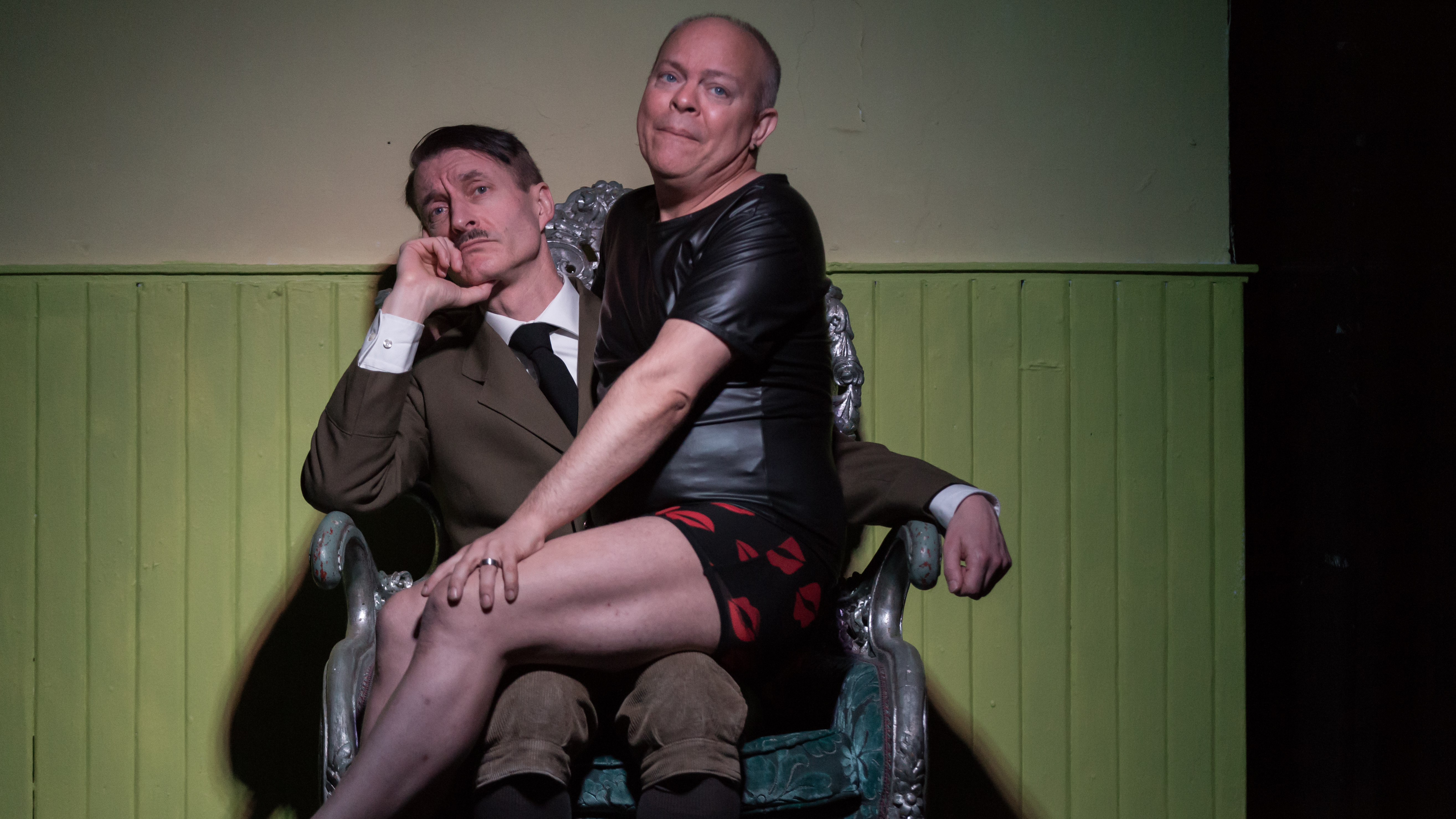
Yes, you read that correctly. Big Brother Blitzkrieg, at King’s Head Theatre until 30th January, is a satirical play by Hew Rous Eyre and Max Elton, in which a confused Hitler wakes up to find himself the newest contestant on the infamous reality TV show. Bemused by the pointless tasks and petty squabbles, and with an instant hatred for mum of three, Rachel, it’s not long before Hitler begins to subtly manipulate his fellow housemates – and the British public – with alarming ease.

Big Brother Blitzkrieg, Bitter Pill
Photo credit: Jack Fisher

The idea is bizarre, and the show takes arguably a little too long to make its point – though there’s certainly plenty of fun to be had along the way. But in the end the message, encapsulated in the powerfully visual final scene, is quietly horrifying. We’d like to say that the rise of Hitler could never happen again, that we’ve learnt our lesson – but the truth is, whether it’s a Big Brother contestant or Donald Trump, it turns out human beings can still be that easily led.

Stephen Chance is brilliant as Hitler, with a seemingly limitless range of facial expressions and a flawless accent. His performance brims with the charisma that won over so many, and yet also highlights the character defects – temper tantrums, stubbornness, petulance – of this legendary historical figure, who at the end of the day was just a man, and a pretty ridiculous one at that.

He’s joined by an eccentric cast of housemates, each of whom is necessarily a bit one-dimensional, a ticked box on the reality TV checklist: gay guy (Neil Summerville), young rapper (Kit Loyd), feminist (Hannah Douglas) and PR superwoman (Jenny Johns). The only one who doesn’t seem to fit is Rachel (Tracey Ann Wood), who just seems like a nice person, without any particular ‘angle’ – and is consequently derided by her fellow housemates as boring and weak.

Big Brother Blitzkrieg, Bitter Pill
Photo credit: Jack Fisher

Leaving aside Hitler for a moment, the parody of Big Brother (who’s represented by the calm, unflappable voice of George Smith) is great fun, whether you’re a fan of the show or not. But it’s also, depressingly, not a parody at all; in fact, if anything, it’s pretty tame compared to some of the things that actually go on – just look at the bizarre mix-up on CBB this week over David Bowie’s death. And even though the play’s housemates openly admit that the show’s rubbish and nobody watches it any more, they all still desperately want to win. Never mind Hitler – what does that say about the human race?

Big Brother Blitzkrieg is almost like two plays in one, taking on Hitler and Big Brother simultaneously. It’s great fun and quite, quite bonkers – the image of a Marigolds-clad Hitler clutching a feather duster is one I won’t soon forget. But Bitter Pill’s production also has a serious message, which – once it becomes clear – is unsettling and should give any modern audience pause for thought.


Can’t see the map on iPhone? Try turning your phone to landscape and that should sort it. I don’t know why but I’m working on it… 😉
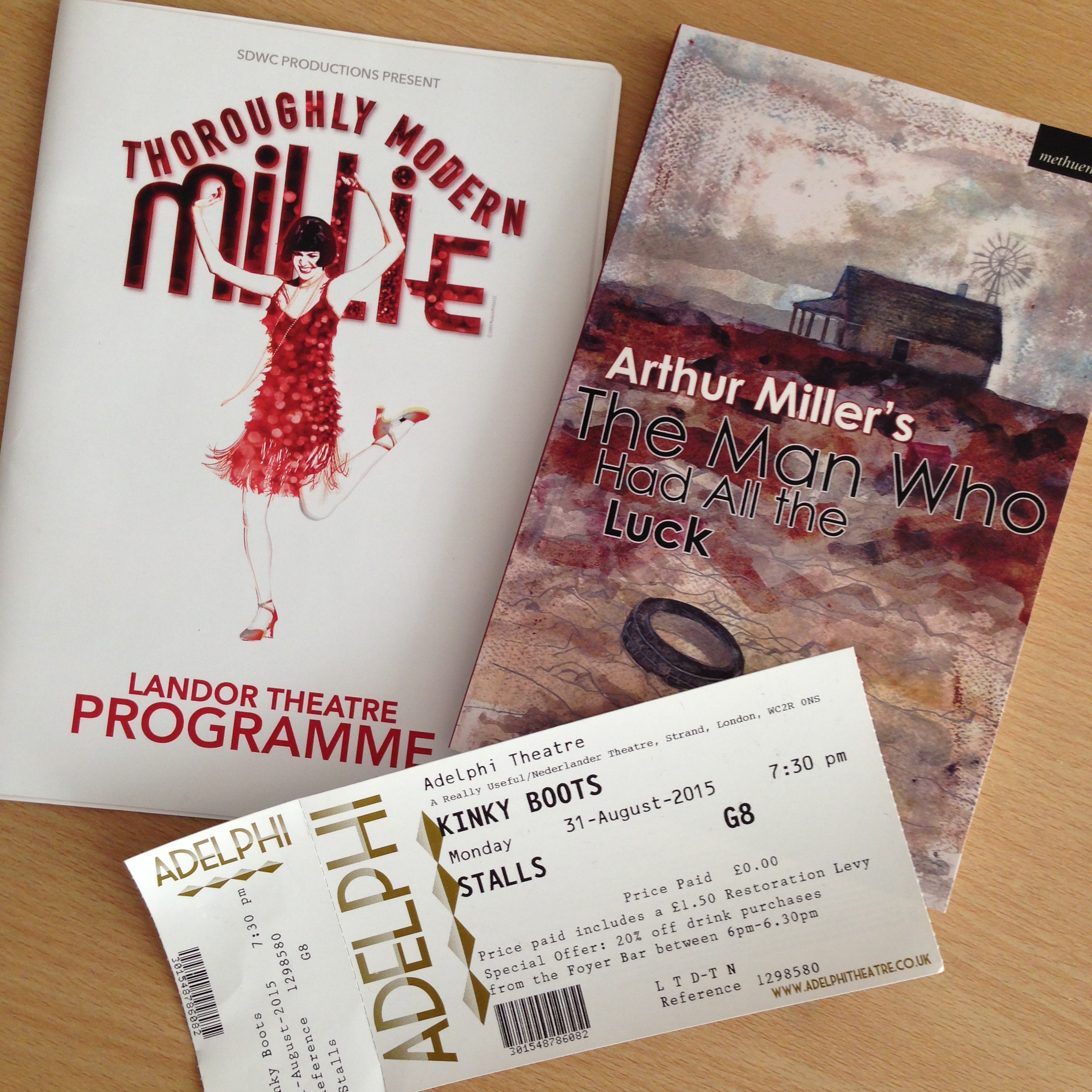
Theatre round-up: 7 Sept 2015

In the week that London got kinky, here’s my theatre round-up:

Kinky boots

I went to a preview of Kinky Boots last week, and basically haven’t shut up about it since (apologies to my friends, family and Twitter followers). I haven’t seen the movie, so didn’t really know what I was letting myself in for – I figured it would be good fun, but wasn’t expecting to be so totally blown away. Kinky Boots is based on real events and tells the story of Charlie Price, who teams up with new friend Lola (a.k.a. Simon) to create a range of fabulous footwear for men. With star performances from Killian Donnelly, Amy Lennox and Matt Henry, and some truly sensational dance numbers, Kinky Boots is ridiculously good fun; you can’t help but leave the theatre smiling. I already want to see it again (and then again).

Kinky Boots review for London Theatre Direct

Thoroughly Modern Millie

A lively and high-spirited revival based on the 1967 movie, in the intimate setting of the Landor theatre. Thoroughly Modern Millie is the story of a Kansas girl who arrives in 1920s New York determined to make a new life for herself by getting a job and then marrying her boss. Simple, right? Ironically, a lot of the attitudes are actually not very modern at all (and the show also features a bizarre and very un-PC sub-plot about a woman pretending to be Chinese). But the show brings to life the spirit of the 1920s, particularly during the fantastic dance numbers, which are worthy of a much bigger production, and impeccably performed by the small, hard-working cast. Credit also to the brilliant five-piece band, who were great despite being a four-piece for half the show because their bass player got stuck on the Northern Line.

Thoroughly Modern Millie review for Carn’s Theatre Passion

The Man Who Had All the Luck

Arthur Miller’s first play to be produced is a fable about a man who seems to get everything he wants in love, business and life in general. But as his friends and family all lose out on the thing they want most in the world, he starts to wonder when his own luck will change. This revival by End of Moving Walkway, to coincide with the centenary of Miller’s birth, features a strong cast, with one actor playing no fewer than four parts, and a minimalist set with a hidden secret. Sometimes funny, sometimes heartbreaking, with characters the audience can really relate to, the play invites us to consider where our luck comes from, and the role of each individual in creating our own destiny.

The Man Who Had All The Luck review for Carn’s Theatre Passion

Theatre round-up

Next week’s theatre

Jane Eyre – National Theatre

The Christians – Gate Theatre

And Then Come The Nightjars – Theatre503