Interview: John Risebero, Henry V

John Risebero is co-director and designer of award-winning theatre company Antic Disposition, along with co-founder and director Ben Horslen. Next month they’ll be reviving their acclaimed production of Henry V; previously performed in France, with two London runs and a 2016 national tour, the show is taking to the road once more, giving audiences another chance to see what British Theatre called “one of the most impressive revivals of a Shakespeare play that I have seen in recent years”.

Photo credit: Scott Rylander

Founded in 2005, Antic Disposition have become known for their innovative interpretations of classic texts, particularly the works of Shakespeare – and the timing of this particular production was no accident. John explains: “We’d wanted to stage Henry V for several years but because we always tour our Shakespeare plays in France, we could never see a way to do it without being insensitive to our French hosts. But then we realised that not only was 2015 the 600th anniversary of the Battle of Agincourt, it was also the centenary of the Great War, which gave us the opportunity to create a production that reflected on the change in the relationship between England and France in those five centuries – from mortal enemies to loyal allies. So our production is set in a military hospital in France, where wounded British and French soldiers work together to stage their own production of Henry V. It’s really a play within a play – Henry V meets Oh, What a Lovely War.

In addition to Shakespeare’s text, the play also includes original songs and live music inspired by the poetry of A E Housman. “We knew we wanted to include music in the show but using period songs seemed too obvious and we weren’t comfortable writing new ones,” says John. “Then we discovered George Butterworth’s musical setting of ‘The Lads in Their Hundreds’ from A Shropshire Lad and found that Housman had acknowledged he was inspired by Shakespeare. Although Housman’s work predates the Great War, so much of it reads like he knew what was coming. Our brilliant composer, Christopher Peake, set six more poems to original music for our show but we still use Butterworth’s version of ‘The Lads in Their Hundreds’ – it’s our tribute to him, as he died on the Somme in 1916.

“The music is completely integral. Soldiers have always used song to lift spirits or celebrate victory. As well as poetry, the Great War gave us so much music that’s still with us, songs like ‘Pack Up Your Troubles in Your Old Kit-bag’. In our production, we use music at key moments to bring the two sides together and remind the audience that war is a shared experience. It’s emotional shorthand.”

Photo credit: Scott Rylander

Although the play may be set in the past, John believes it still has a powerful message to share with a modern day audience: “Absolutely. War is a huge gamble, often taken too lightly. The French massively outnumbered the English at Agincourt but still lost the battle. In 1914, everyone thought the Great War would be over by Christmas, but it turned into one of the most destructive conflicts in history. It’s easy to open Pandora’s box, but the consequences can never be fully foreseen.”

Antic Disposition have also developed a reputation for staging productions in historic buildings and unusual non-theatre spaces, and this tour is no exception; Henry V will visit eight cathedrals around the UK, including Ripon, Lincoln, Peterborough, Ely, Norwich and Southwark. “We started out working in theatres but haven’t staged a play on a conventional stage for six years now,” John explains. “We find working in unusual buildings more exciting. There’s a special kind of magic when you are performing Henry V with the tomb of King John in the front row of the audience, as we did at Worcester Cathedral. It can be challenging from an acoustic perspective – many of our venues weren’t designed for this kind of performance, but we feel that those challenges are more than made up for by an atmosphere you can’t get in a regular auditorium.”

The 2017 tour of Henry V opens at Southwark Cathedral on 2nd February – and it’s not only audiences who are looking forward to its return. “We had a wonderful experience touring cathedrals last spring and wanted to bring the show to new venues and new audiences,” concludes John. “We think it’s the best work we’ve done as a company, and we’re very proud of it.”

Antic Disposition’s Henry V visits eight cathedrals around the UK from 2nd to 22nd February.

Interview: John Stanley, The Monkey

Next month, Battersea’s Theatre503 plays host to Homecomings, a festival of new plays by prisoners and ex-prisoners about getting out and going home. Produced in partnership with the Synergy Theatre Project, the festival runs from 21st February to 18th March and will feature two of the winners of Synergy’s third national prison scriptwriting competition – Glory Whispers by Sonya Hale and The Monkey by John Stanley.

John, a lifelong Londoner, describes The Monkey as “a dark, comic contemporary drama of criminality, addiction and money owed”. The four characters he’s created, he explains, offer “a brief glimpse of the many diverse and varied people I met during my life’s erratic and unusual journey”.

the-monkey-by-jon-stanley

Until he joined the Synergy project, John never imagined a future as a playwright: “The short answer is no, although I’ve always dabbled in poetry. Recently I completed a book about my life, but the truth is that until I completed the Synergy playwriting course I never had an interest in theatre.”

The Synergy Project, founded in 2000, seeks to build a bridge from prison to social reintegration, prevent young people from entering the criminal justice system, and inspire change by capturing the imagination of participants and public. After learning about the project from a friend who worked at the Young Vic, John joined the Synergy playwriting course and went on to write The Monkey. He’s thrilled to have his first ever play selected as a winner, out of a record 134 entries.

“I was over the moon when I found out, truly elated. Synergy has had such an enormously positive impact on my life that it’s impossible to quantify in a few sentences.” His advice to others thinking about getting involved in Synergy is simple: “Don’t hesitate and don’t delay, take the opportunity and go for it immediately.”

John’s now looking forward to seeing his work come to life on stage: “It’s exciting and nerve-wracking to see it come to life. I wrote The Monkey in 2012 and when I finally got to hear it in its entirety at the rehearsed reading recently, it was somewhat unreal but it was really gratifying. I am a touch nervous as to whether people will like it or not, though my feeling is you either do or you don’t and that’s how it is. Some people will find it hilarious and some won’t, but I hope they at least find it funny. If they do that would be wonderful.

“I’m sure I portray a world that most people are unaware of, so I hope they go away educated in some degree to an underbelly that exists in their midst – but most of all I hope they find it funny and have a good laugh.”

Catch The Monkey and Glory Whispers at Theatre503 from 21st February to 18th March.

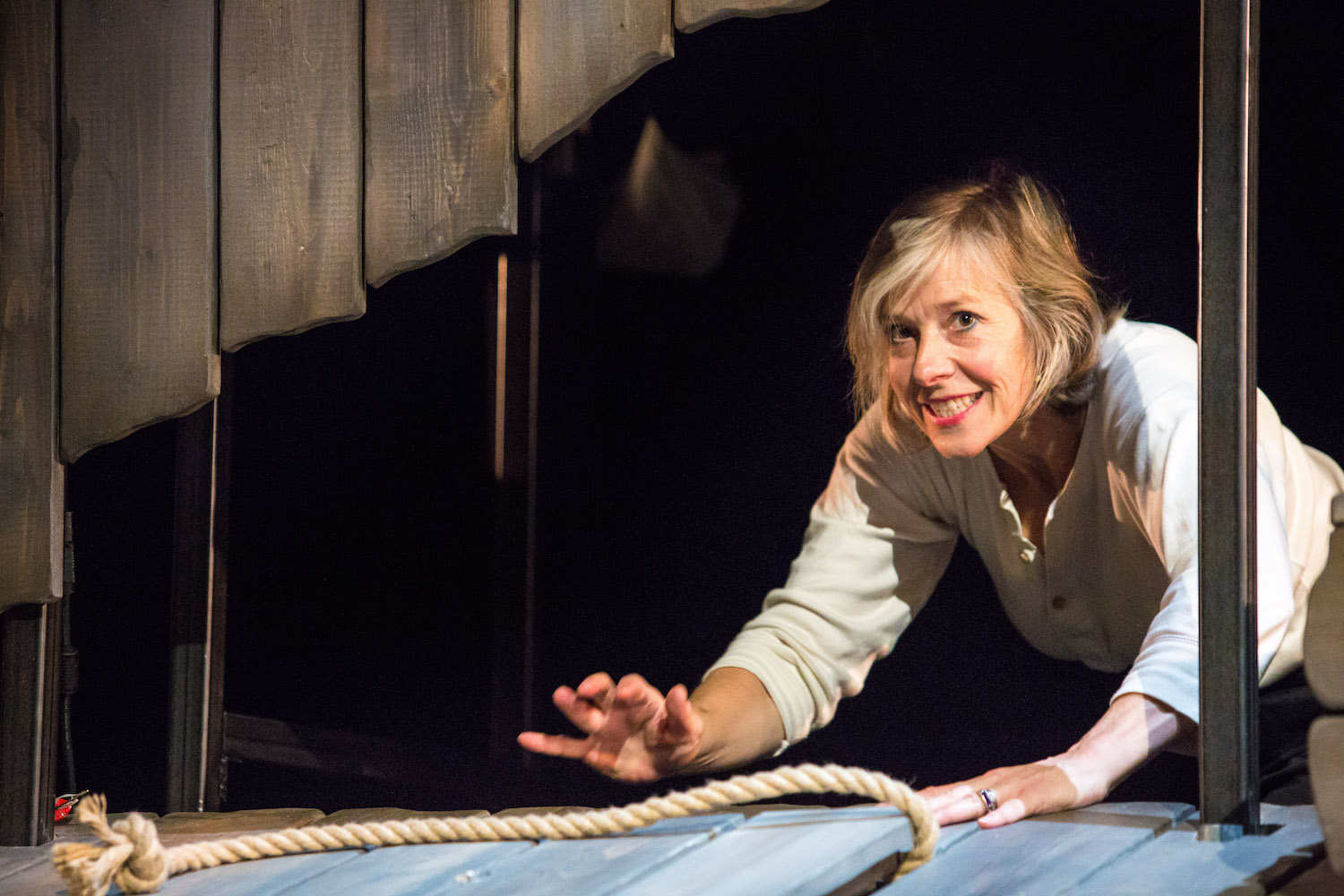
Interview: Danyah Miller, Why The Whales Came

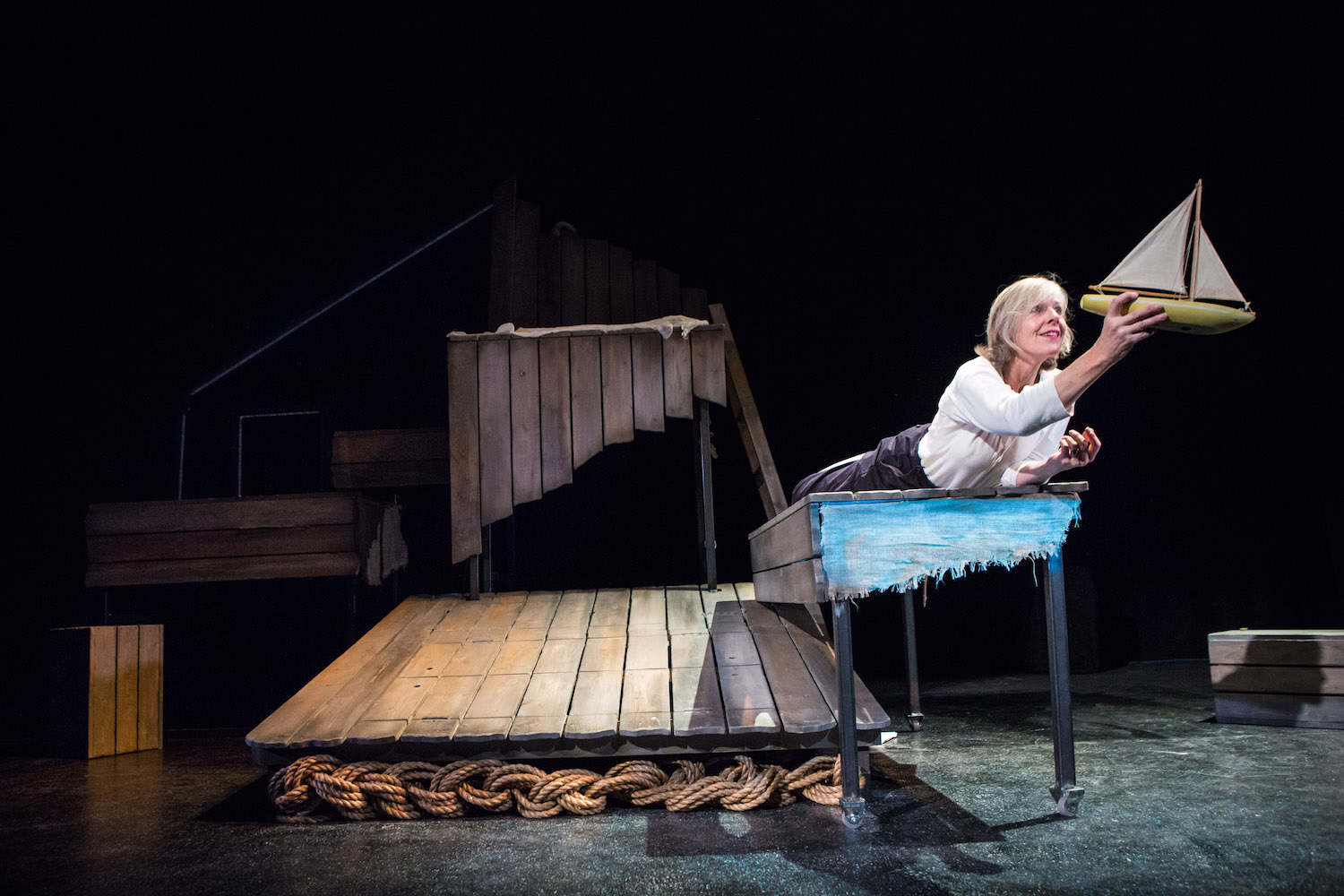
“I love how this story makes us think about others, about how we view difference and how sometimes we misjudge when we’re unsure or afraid,” says Danyah Miller, award-winning performer and storyteller, of Michael Morpurgo’s Why the Whales Came. “I would hope that the audience take away a sense of hope and joy and perhaps the feeling that one person can make a huge difference.”

Why the Whales Came sees Danyah again teaming up with director Dani Parr and designer Kate Bunce, following the success of their collaboration on I Believe in Unicorns – also by Michael Morpurgo. “I love working on Michael’s stories because they’re multi-layered and really gripping tales, based in truth,” she explains. “It is often said that he doesn’t patronise children in anyway and takes them, and us, to dark places and back again. I like that. I find his stories full of surprises, sadness, hope, joy. Above all, they’re about ordinary folk often doing extraordinary things during extraordinary times.”

Photo credit: Helen Murray

Their admiration is mutual; Michael Morpurgo describes Danyah as a “storytelling phenomenon”. What inspired her to take up performing as a career? “As long as I can remember I wanted to be a performer and I certainly ‘entertained’ my way through childhood! I have always been very chatty and there’s nothing I like more than spinning a good tale. How I became a storyteller is a long story…

“I suspect that the difference between being an actor and being a storyteller is a very fine line. As a storyteller we ‘hold’ a central point, as ourselves, and from there paint the world of the story, become characters, weave in and out of landscapes and people, but we always come back to the centre, as ourselves. As an actor we become another character and remain in that role (although of course sometimes actors are asked to multi-role too). Perhaps it’s possible to be both, I suspect that the best in our profession are both actor and storyteller. Stories are everywhere, aren’t they? We are storytelling beings and it’s what makes us human…”

Why the Whales Came is the story of Gracie and Daniel, who’ve been forbidden to go near the mysterious and seemingly dangerous Birdman – but then they find a message in the sand that suggests all is not as it seems. When they get stranded on the Birdman’s tiny island, the two friends begin to unravel his secrets…

Although it’s based on a children’s book, Danyah believes the show has something for everyone: “This is definitely not a show just for children – it is a ‘family’ show in the widest possible sense. We have people of all ages from 7 to 107 enjoying the show whether or not they have children with them. Good stories, good theatre can appeal across the ages and we hope that our show does this.

“I enjoy sharing the show with children who’ve never been to a theatre before or experienced any kind of live show – as an audience they are really responsive and truthful and often give me insightful feedback. I also really enjoy it when families of children, parents and grandparents come to see the show and all of them have been moved by the show in different ways.”

Photo credit: Helen Murray

As a solo performer, Danyah may be the only person on stage, but she’s far from lonely. “I really like performing solo, although I feel as if I have a collaborator when I perform on the set, in the ‘world’ that the creative team have produced… the set, projection, lighting and sound,” she says. “I also like to be able to see the audience, we have the lights set so I can do this – so I’m not alone. I think of what I do as a delicious triangle between the story, myself and the audience – every show is different because of this, and I’m never lonely. I do have to make sure that I’m always fit and ready though, as it’s down to me being on top form for every show!”

Why the Whales Came is at Ovalhouse until 31st December, with other one-off performances scheduled for early 2017.

Interview: Jimmy Walters, The Trackers of Oxyrynchus

Following his acclaimed production of John Osborne’s A Subject of Scandal and Concern, director Jimmy Walters returns to the Finborough Theatre in January with Tony The Trackers of Oxyrhynchus by Tony Harrison. Tom Purbeck and Richard Glaves star in the play’s first London staging for nearly 30 years as Bernard Grenfell and Arthur Hunt, two archaeologists sent to Egypt to dig up lost poetry and plays, who end up becoming part of a story they’ve discovered.

“It was a whole new challenge with this project,” explains Jimmy. “I thought, do I want to do the same thing again or do I want to make apples and oranges? I think if you constantly put yourself outside of your comfort zone then that’s a much more exciting place to be.”

Photo credit: Robert Boulton

Despite the weighty title, audiences won’t need an in-depth knowledge of Greek literature to appreciate the play: “It helps to know that the satyr play was staged deliberately after three tragedies in order to lighten the mood of the evening, and that satyrs are half man half goat creatures with large penises. Other than that you can just be entertained and learn a lot, which is great. I would say that this is not a dense academic play, despite the long title. It’s completely accessible with some laugh out loud moments put up against some real poignancy. This is our most entertaining play we’ve done yet but also the most powerful. Hands down.”

This is not the first play Jimmy’s directed that hasn’t been performed for many years; he co-founded his company, Proud Haddock, to celebrate unearthed stories from classical playwrights. What’s the appeal of unearthing these buried treasures? “I think it’s that great thing of taking a playwright who’s loved by many and unearthing a story of theirs people don’t know very well. If you just perform the classics then it becomes more about people wondering how you are going to approach each scene. ‘I wonder how they’ll do the balcony scene’, and everyone pre-empts ‘to be or not to be’. To tell a story people aren’t familiar with by someone they regard as a genius has a very strong effect.”

The Trackers of Oxyrhynchus was originally written for a one-off performance in the ancient stadium of Delphi, and was later seen at the National Theatre. Jimmy believes that the absence of any other recent adaptations makes his job as director easier: “It’s why if you talk to actors who play roles other actors have played before, they try and avoid watching their performances. It narrows your choices and you can run the risk of imitating. Also, if I had access to lots of adaptations I’d probably freak myself out and put so much pressure on myself. I think at the end of the day it must come from you. Those instincts you have from reading the script are yours and you should just go for it.”

the-trackers-of-oxyrynchus-3

Tony Harrison is an award-winning poet-playwright, who last year won the David Cohen Prize for Literature. What is it that makes his writing so special? “He loves contrast,” says Jimmy. “He’s a poet, so that gives the play a rhythm and the contrasts are everywhere. Contemporary v period, ancient Greek language against modern day slang, high art against low art, rich against poor etc. He doesn’t deal with any grey areas. He makes the familiar strange, and takes things you’re used to hearing in a certain way and turns them on their head. It’s punchy, unapologetic and deeply affecting. You have to be careful with this word because it gets thrown around too often – but he is a genius.”

Although The Trackers of Oxyrhynchus deals with ancient texts, and is set in the early 20th century, it still has plenty to say to modern audiences: “Oh, big time,” Jimmy confirms. “The last section of the play actually takes place in modern day London and with everything that’s happened recently with Brexit and the lack of unity in the country, this couldn’t be more relevant. It could have been written yesterday.”

The Trackers of Oxyrhynchus is at the Finborough Theatre from 3rd-28th January.

Interview: Dominic Hedges, The Doppel Gang

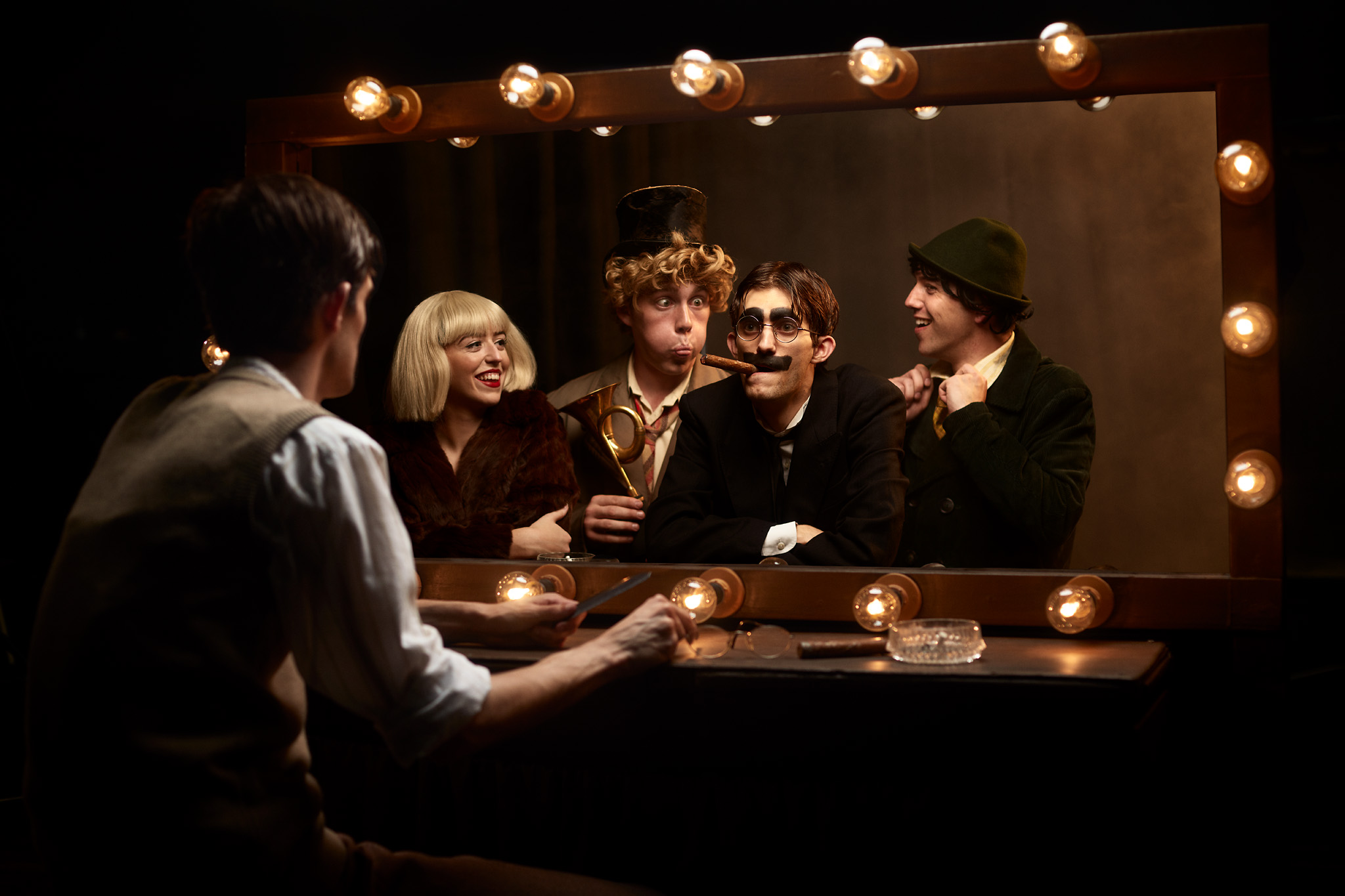
“The secret of good comedy is barking up the wrong tree,” says Dominic Hedges, a theatre and filmmaker from East London. His play, The Doppel Gang, is following up last year’s successful tour with a run at the Tristan Bates Theatre in the new year, presented by trio Just Some Theatre Company. Set in 1940s London, the play fuses the comedy of the Marx Brothers with classic British humour, against the all too serious backdrop of the Second World War and the Blitz. “Four conscription-dodging spivs try to save their crumbling theatre by impersonating the Marx Brothers, but naturally each party is in it for themselves,” summarises Dominic.

dominic-hedges-headshot-copy

The idea to write a play about the Marx Brothers came from Just Some Theatre Company: “They love the Marx Brothers! They approached me to write a piece for them and after a ton of knocking ideas about we decided that an out-and-out biography wasn’t what we wanted. So I took the floundering, double-dealing, British motley bunch route of old.”

So is this only a play for fans of the Marx Brothers? “No,” says Dominic. “It’s not a Marx Brothers tribute act. The show plays more as the recognisable British wartime drama-comedy where threads are pulled and twisted between characters, and misdirection and miscommunication lead to hilarious consequences, but then with this fat vein of Marx Brothers performance and wit bored through it.”

Generally considered to be among the most influential comedians of the 20th century, the popularity of the Marx Brothers continues to this day: “I think they tell jokes which we think we can write ourselves,” explains Dominic. “On paper they vary from rubbish Dad jokes to ingenious turns of phrase and wordplay. But when you hear the jokes delivered, especially when you watch them on film, each move of their comedy is unique and unmistakable. When U.S. film became more prevalent in the UK we lapped it up.”

Photo credit: Tom Barker

As a writer, Dominic has no qualms about handing his work over to a theatre company. “It’s exciting. The director Terence Mann is fantastic and we read from the same page more often than not. He knows what’s best for the show when they’re all in the room working and that’s something I had no interest in sticking my nose in! If it’s not as I envision it that’s probably a good thing. Having said that, if the zero-gravity scene on wires made the cut, I’ll be having words…

“My advice to a writer who’s just starting out would be: meet up with other writers, performers, artists, anybody you trust artistically, and read your work aloud. It’s the best thing in the world. Life is not a word processor. When I have serious doubts about my career choice it’s almost always because I’ve not heard my work aloud for a good while.”

And finally, who does Dominic think is funnier, Brits or Americans? His response is diplomatic: “Hmm… hard to say, but in a contest between the two, one of them is bound to win!”

The Doppel Gang is at Tristan Bates Theatre from 17th January-11th February.