Review: Dare Devil Rides to Jarama at the Bussey Building

In 1936, Clem Beckett, a young speedway rider from Manchester, travelled to Spain as a volunteer with the International Brigades. Joining the fight against Franco’s Nationalists, Clem and his friend Chris Caudwell tragically lost their lives in the Battle of Jarama.

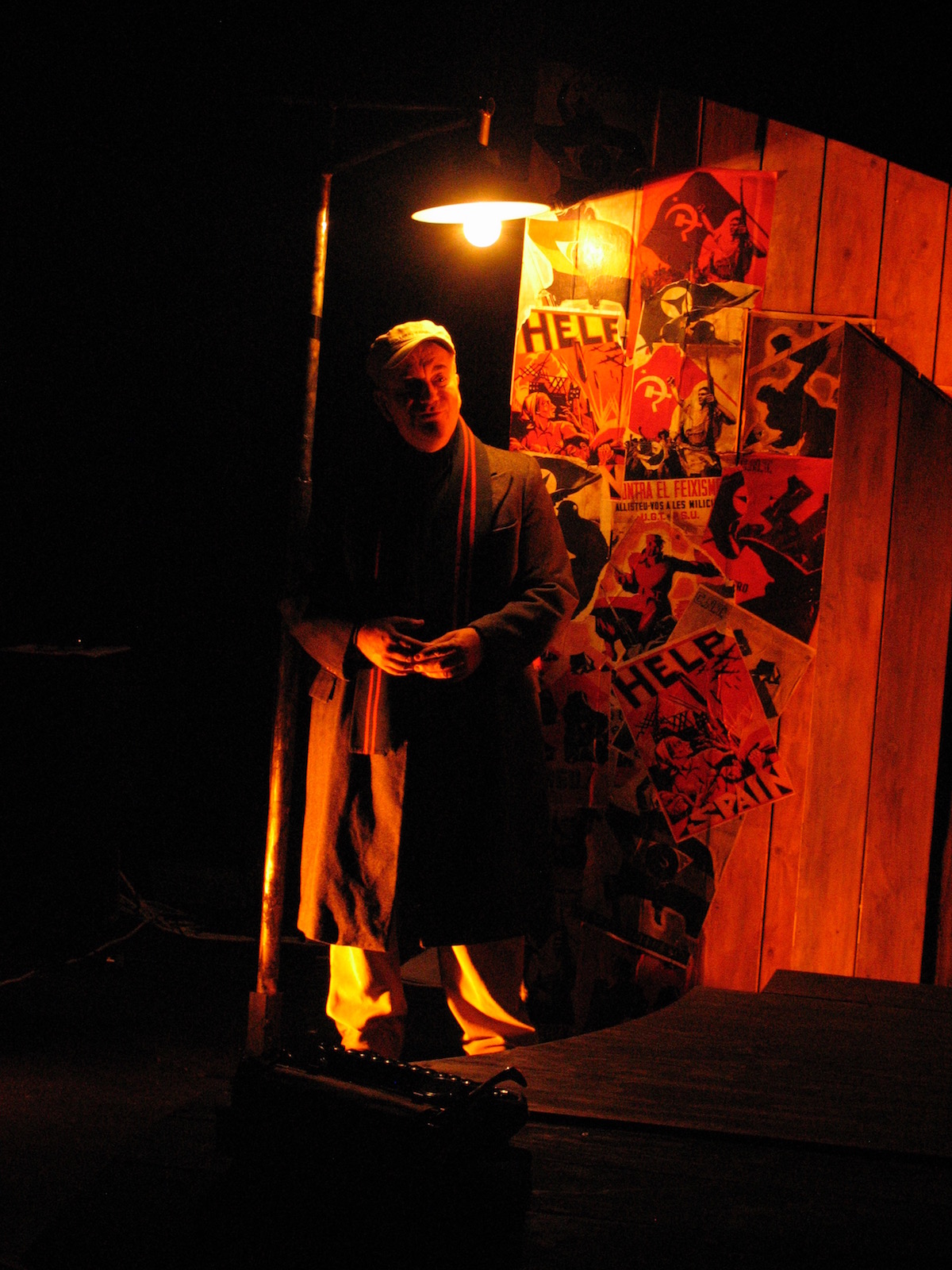
That’s the end of the story. But Neil Gore’s Dare Devil Rides to Jarama begins much earlier, in 1929, introducing us to a charming, confident young man on the brink of an impressive sporting career. This passion leads him into politics, speaking out against the exploitation of young riders and joining the Manchester Young Communist League. As the years pass, Clem becomes increasingly involved in the fight against fascism at home in Britain – and when the Spanish Civil War breaks out in 1936, he doesn’t hesitate to leave behind his home, career and new wife to go and fight for his beliefs.

It’s a sobering tale, but told with an infectious charm and humour that means we come to really care for the characters. David Heywood oozes charisma as Clem, in a passionate performance that sees him mature before our eyes from cocky stunt rider, risking his life for thrills, to grim soldier taking on the dark forces of fascism. Alongside him, Neil Gore is a joy to watch as he fills all the other roles, from grumpy bosses to drunken Scotsmen, and – most importantly – the writer and intellectual Chris Caudwell. His unlikely friendship with Clem is the beating heart of Act 2, with each helping the other in moments of doubt, and the banter and political discourse between them is as entertaining as it is fascinating.

Photo credit: Daniella Beattie

Neil Gore’s script brings together a delicious mixture of poetry, prose and music. The subject matter – with its talk of bikes, mechanics and politics – could easily have been a bit on the dry side, but the variety of styles and the engaging characters who tell the story constantly keep it lively and entertaining. The play is also, in places, very funny, with an audience participation element that sees us become part of the crowd roaring (and rattling…) Clem down the track, enthusiastically booing Oswald Mosley off the stage, and joining in with folk musician John Kirkpatrick’s melodic and catchy songs.

Though the set is intricate in design, with wooden panels that fold away to take us from the bike tracks of Manchester to the rainy streets of London (then undergoing a more dramatic transformation during the interval to shift the action to Spain), Louise Townsend’s direction has a simple charm that’s incredibly appealing. Hanging a sign that says Albacete means we’re in Albacete, and the cast of two do everything – acting, singing, operating the lights (stage and house) and even greeting and directing the audience at the door. This gives the production an intimate, slightly unpolished feel, and as a result the play’s message has far more impact than any fancy effects could provide.
dare-devil-9-neil-gore-credit-daniella-beattie
Photo credit: Daniella Beattie

Dare Devil Ride to Jarama was commissioned by the International Brigades Memorial Trust as a way to keep the memory alive of the volunteers who gave their lives fighting in Spain. But there’s something chillingly current about it as well; it’s difficult not to draw uncomfortable comparisons with the political situation across Europe – and beyond – right now. There might not be a need for us to physically go to war; it might not carry the same risk, but there’s still, and probably always be, a need for us to speak out and take a stand against fascism in all its forms. Neil Gore’s play honours the memory of Clem, Chris and all the volunteers of the International Brigades, by encouraging a new generation to follow their example. There’s no greater tribute than that.


Can’t see the map on iPhone? Try turning your phone to landscape and that should sort it. I don’t know why but I’m working on it… 😉
Review: Handbagged at Upstairs at the Gatehouse

Not having really lived through the Thatcher years, I’ve never been able to fully appreciate why’s there such an intensity of emotion – positive or negative – among the older generation each time her name comes up. In Handbagged, Moira Buffini attempts to shed some light for the “young people”, by pitting The Iron Lady against another iconic British woman – Queen Elizabeth.

Beginning at the newly elected prime minister’s first audience with the Queen in 1979, the play imagines what might have taken place at their weekly meetings over the next eleven years. It’s a political satire, charting key events including the Falklands, the Brighton hotel bombing and the Miners’ Strike, but ultimately focusing on the human relationship between the two women. The Queen’s baffled by Thatcher’s coldness and lack of humour, while the Prime Minister fails to understand her monarch’s love of the outdoors, and fears Her Majesty may secretly be a socialist. The stage is set for an epic clash of personalities, and that’s exactly what we get in the Tower Theatre’s production.

handbagged_3
Photo credit: Ruth Anthony

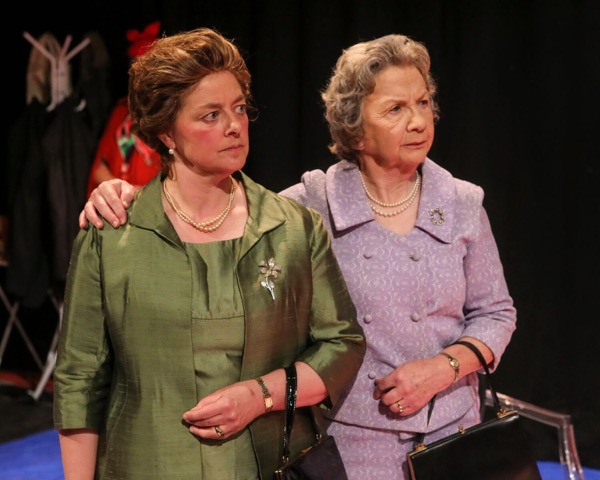
An easily recognisable older and younger version of each leader – playfully referred to in the programme as Q and T, Liz and Mags respectively – look back on events over tea and cake, bickering about what did and didn’t happen, while two increasingly dissatisfied (and disruptive) actors fill in all the other parts in the story, from Denis Thatcher to Nancy Reagan. Directed by Martin Mulgrew, Helen McCormack and Alison Liney’s Queen is warm and personable, with an occasional mischievous streak, and an urgent desire to be ‘useful’ to her country and people. In contrast, Anne Connell and Julie Arrowsmith both nail Margaret Thatcher’s icy facade, practised speech patterns and frozen facial expression – but not to such an extent that we can fail to see the vulnerability beneath, particularly towards the end of the play.

While the conversations between prime minister and monarch are often loaded with quiet sarcasm, Ian Recordon and Jonathan Wober provide much of the laugh out loud humour as they scramble to fill in all the other roles, adopting an impressive array of costumes and accents along the way and occasionally falling out over who gets the best parts. The fact that they’re hired actors in someone else’s narrative is openly acknowledged from the start, becoming increasingly significant as the play goes on, and they struggle to keep quiet about the conveniently gaping omissions.

handbagged_2
Photo credit: Ruth Anthony

For those of us born in the early 80s or later, Handbagged certainly fills in a few gaps in terms of British history and politics. Yet it never becomes dry or boring, and at times even feels surprisingly current; the description of how divided the country became over Thatcher, for instance, is very reminiscent of present tensions over Brexit. The play also helps explain some of the strong public feeling that still lingers today. The script quotes several of Margaret Thatcher’s most well-known and controversial statements, and even hearing them spoken by an actor, you can’t fail to pick up on the ruthlessness behind them (for good or evil, depending on your politics).

Don’t be fooled by the description of Handbagged as an amateur production – the Tower Theatre Company have done a fantastic job yet again on an enlightening, intelligent and, above all, thoroughly entertaining play.


Can’t see the map on iPhone? Try turning your phone to landscape and that should sort it. I don’t know why but I’m working on it… 😉

Review: How To Win Against History at Ovalhouse

I watched How To Win Against History after a very long day at work, hardly any sleep and okay, maybe a couple of glasses of wine. Perhaps that’s why looking back at this fast, frenetic and frankly quite bonkers little musical brings with it a slightly surreal, dream-like feeling – although I suspect had I been wide awake and stone cold sober it wouldn’t be much different.

Seiriol Davies’ show tells the little-known story of Henry Cyril Paget, the 5th Marquis of Anglesey, a cross-dressing aristocrat from the 1800s who blew his family’s fortune on an unsuccessful theatrical career, and died at the young age of 29 in Monte Carlo of an unspecified “lung thing”. His outraged family then erased all trace of him from history.

Photo credit: Rah Petherbridge

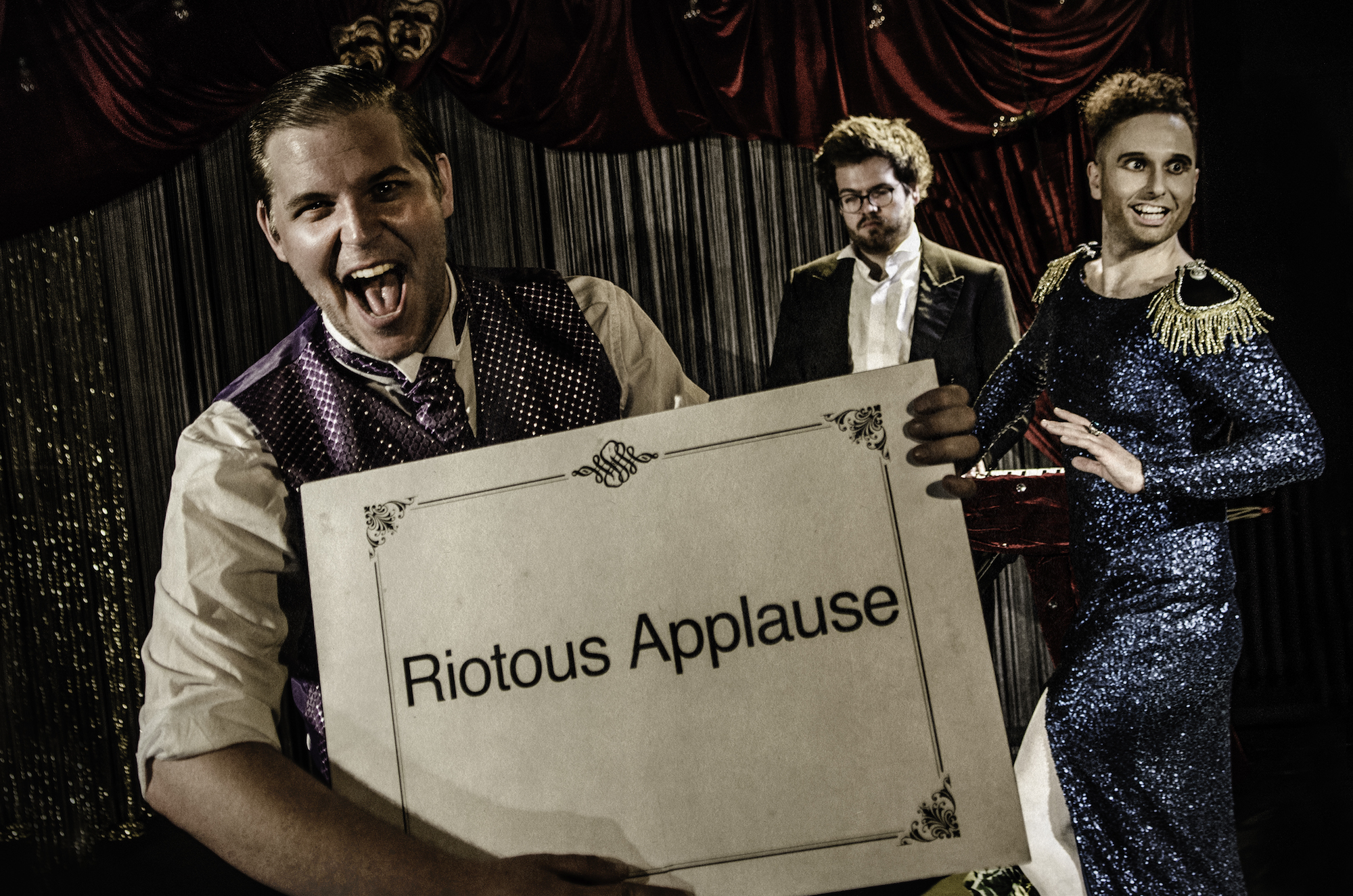
This tragic story makes for a surprisingly hilarious musical, directed by Alex Swift and performed by a cast of three: writer and composer Seiriol Davies as Henry, musical director Dylan Townley as The Band, and Matthew Blake as Mr Alexander Keith (and everyone else). These three are a dream team, bouncing off each other brilliantly and working in perfect harmony throughout to bring this bizarre story to life.

In the hottest week of the year so far, all three performers nonetheless give it their absolute all. The tiny stage brims with energy and an infectious enthusiasm that never lets up; this show is full on fabulous from start to finish. And though it’s only an hour long, it packs in a lot – so much so, in fact, that it becomes hard to keep up. Fortunately, as instructed by the actors themselves, we have the option to go away and Google anything we might have missed, and I’m willing to bet a significant proportion of the audience did just that.

Davies’ Henry is an ethereal being, so delicate that at times his voice barely rises above a whisper. He’s instantly appealing despite his many flaws, full of wide-eyed innocence and seemingly blissfully unaware that he might not be winning at life (“apparently,” he explains at one point, appearing genuinely surprised, “I treated Lilian [his wife] rather badly”). He’s joined by loyal friend and supporter Mr Alexander Keith – just one of many roles played by the multitalented Matthew Blake (another is Lilian, in case you were wondering) – and his band, played by the eccentrically wonderful Dylan Townley on piano.

Photo credit: Rah Petherbridge

The show acknowledges and addresses its audience, encouraging participation (at one point we found ourselves singing in German) with a witty script that includes several current political and cultural references; the Daily Mail joke went down particularly well. In keeping with its central character, the humour occasionally steers very close to the line – a couple of jokes drew audible groans from the audience – but never slips across it completely, and remains good, (almost) clean fun. The final message seems a bit muddled: on the one hand, Henry feels that he’s “sort of won” by being himself and living life his way, despite opposition and indifference from those around him; on the other, he also counts it as a win to convince the Daily Mail that he’s “normal” and enjoys wearing tweed.

How To Win Against History is undoubtedly an odd show (even without a glass of wine in your hand) – but like its hero, it’s also fabulous and fierce. And it does things its own way, no matter what anyone thinks, with a cast of three who seem to be having easily as much fun as the audience. Riotous applause is a fitting end to such an entertaining and brilliantly performed show.


Can’t see the map on iPhone? Try turning your phone to landscape and that should sort it. I don’t know why but I’m working on it… 😉
Interview: Palindrome Productions, Watching Glory Die

“Our major and abiding goal is giving voice to the dispossessed – those written out of history. Live performance has the ability to wake the dead and let them speak,” explains Lesley Ferris, director and co-founder of British-American company Palindrome Productions. “It’s always a highlight for us to witness the astonishment of audience members at seeing a living history about which they knew little if anything: the history of the British actress and suffrage, for instance, or the British history behind Palestine. Both of these still impact us today.”

The company’s latest offering, Watching Glory Die by Judith Thompson, was inspired by the true story of 19-year-old Canadian inmate Ashley Smith, who choked herself to death while her prison guards, on suicide watch, stood by and did nothing. Opening at Cockpit Theatre on 19th July, the play sees three women – prison inmate Glory, her mother and her guard – portrayed by a single performer, Victoria Fox.

Photo credit: Palindrome Productions

Both Lesley and dramaturg Penny Farfan – Professor of Drama at the University of Calgary and past editor of Theatre Journal – have long admired the work of Judith Thompson, a leading Canadian playwright, and seized the opportunity to work together on Watching Glory Die. “Thompson is a unique voice in Canadian theatre, renowned for her distinctive combination of poetic power and shocking brutality, as exemplified in Watching Glory Die,” says Penny. “She’s helped to shape modern Canadian theatre by staging aspects of society not typically seen on stage. In doing so, her work has found an international, as well as national, audience.

“Palindrome has a commitment to women playwrights, marginalized voices, and social justice. With its three female characters and its exploration of the tragic failure of the correctional system to serve the needs of one of its most vulnerable inmates, Thompson’s play is a perfect match for Palindrome. And the production offers a wonderful opportunity for London audiences to see a recent play by an important contemporary playwright.”

Palindrome’s co-founder Lesley Ferris has a long-standing passion for women’s writing: “Women have historically been marginalized and in some cases removed from history.  When I first began to study women playwrights, after I finished my degrees, I was horrified that no teacher or professor ever talked about or rarely included women’s work in their courses. Aphra Behn was a 17th century British playwright and the second most produced following the Restoration. She wrote amazing comedies that had feminist themes, and she was the first woman in Britain to write roles that women would actually perform. After her death her plays were still produced but by the time of the Victorian era she was quietly removed from sight – a woman who wrote comedies! Strong vibrant roles for women! Get rid of her!!

“History informs the present, so discovering Aphra made me think abut the present – and theatre is the art form of the present tense, so I’m committed to producing women writers and encouraging others to do so. In the USA a campaign for more women playwrights began a few years back: 50/50 in 2020 – 50% of plays produced by women by 2020, which is the centenary of the vote for women in the USA.  Scholars and theatre artists are tracking this, and there may be recently a bit of improvement but there’s still a long way to go.”

WFG_870x470

Why should audiences come and see Watching Glory Die? “Multiple reasons!” says Lesley. “The play addresses an aspect of our culture – incarceration of women – that has become more extreme and problematic in the 21st century. But it’s also an opportunity to see Judith Thompson’s work, and how she imagines a solo work that takes in three distinct roles. By making this a solo work instead of a three-hander, Thompson points out the links to be made between women.”

Penny adds one more reason: “Ashley Smith was Canadian, but the issues that Thompson’s play raises transcend national borders. As Thompson has said, ‘There are Ashleys all over the world.’”

Catch the UK premiere of Watching Glory Die from 19th-23rd July at Cockpit Theatre.

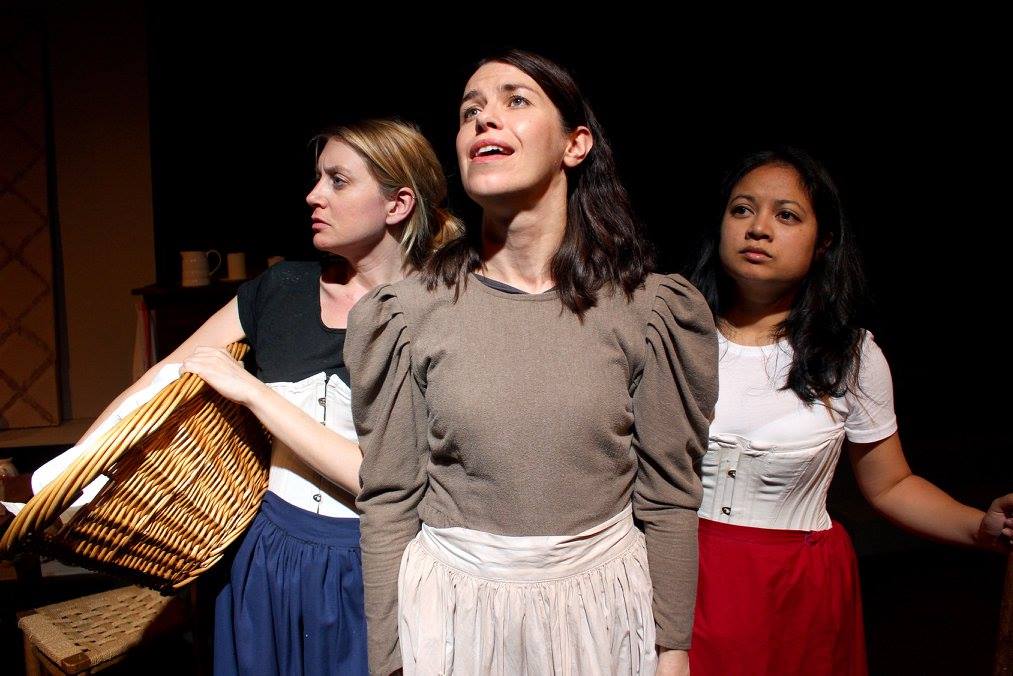
Review: Brontë at Upstairs at the Gatehouse

Start a conversation about English literature with just about anyone, and it probably won’t be too long before you arrive at the Brontë sisters. Best known as the authors of Jane Eyre, Wuthering Heights and The Tenant of Wildfell Hall, Charlotte, Emily and Anne are part of our national heritage, and yet most of us know far more about the lives of their characters than we do about the authors themselves. Polly Teale’s 2005 play Brontë aims to correct the balance, allowing us a glimpse into the remote rural life of the three sisters, and the complex family relationships that inspired the classic creations we know so well.

Photo credit: Robert Piwko

And it turns out there’s more than enough material here for a story all of its own. The personal and professional rivalry between Charlotte and Emily (in keeping with history, poor Anne doesn’t really get much of a look-in, and is relegated to the role of peacekeeper); the declining fortunes and eventual disgrace of their brother Branwell; the struggle to succeed as writers in a man’s world, and the sisters’ very different motivations for writing in the first place… There’s a lot to cover, and the play does so in a series of short scenes, jumping backwards and forwards in time from childhood to adulthood, and returning to somewhere in between. Each of these scenes is introduced by a change of lighting (effectively managed by Adam Taylor) and a burst of recorded string music, wherein lies my only real complaint about Tower Theatre’s production – after countless scene changes, the music does start to grate just a little bit.

That small gripe aside, the production, directed by Simona Hughes, is of the highest quality. The cast give compelling performances, in particular Joanna Nevin as the sensitive, publicity-shy Emily, and Tania Haq, who becomes more and more dishevelled as she brings to life two iconic characters – Cathy from Wuthering Heights and Bertha from Jane Eyre. The two male members of the cast also take on multiple roles with skill, and it’s here we begin to see the parallels between fiction and reality woven into Teale’s script, as the girls’ father (Martin South), whose love and approval Charlotte craves, morphs into Mr Rochester and her adored tutor Constantin Héger, while the increasingly abusive Branwell (Paul Willcocks) turns before our eyes into Heathcliff and the drunkard Arthur Huntingdon.

Photo credit: Robert Piwko

What’s most impressive about the production, though, is the way it recreates the isolation of the Brontës’ home on the moors. With the exception of the local curate, Arthur Bell Nicholls, we never see anyone from outside the family enter the house… and nor do we leave it until very late in the play (and then only briefly). Colin Guthrie’s sound design brings the countryside to life around us, as rain pours, birds cry and wind blows. And as the sisters repeat the same tasks, day in day out – folding laundry, baking bread and caring for their elderly father, all whilst knowing that the world expects nothing more of them because they’re only women – we get a sense of the stifling atmosphere that led them to find their escape through writing.

Brontë is a fascinating true life story that puts a human face on three literary legends, and makes you want to go back and read all the novels again to look for clues you might have missed the first time. Part documentary, part drama, it touches on gender issues, family relationships and the human need to be known and admired, to leave our mark on the world even long after we’re gone.

Much like the Brontë sisters’ famous novels, it’s not a particularly cheerful tale – but then as we all know, that doesn’t necessarily prevent a story from becoming a classic.


Can’t see the map on iPhone? Try turning your phone to landscape and that should sort it. I don’t know why but I’m working on it… 😉