Review: Idle Women of the Wartime Waterways at The Cruising Association, Limehouse

Before last night, my only knowledge of the boating world came from a long ago family holiday on the Norfolk Broads (and if I’m totally honest, I didn’t really learn a huge amount from that). Worse, I knew nothing at all about the Women’s Training Scheme or the so-called Idle Women, who left their comfortable homes and stepped up to take charge of the working boats during World War II. And I have a feeling I may not be the only one.

Fortunately, Alarum Theatre are setting out to change that. They’re embarking on a tour with their historic boat, Tench, and an all-female crew to mark the 75th anniversary of the Idle Women by recreating their route from London to Birmingham and back via Coventry, performing at waterside venues along the way.

The double bill consists of two solo performances by writer and storyteller Kate Saffin and poet and singer-songwriter Heather Wastie, who met on Twitter in 2016 and realised their two shows went rather well together. The first, Isobel’s War, is a fictional and often very funny depiction of the arduous training scheme through the eyes of one of the recruits, while Idle Women and Judies is a collection of poems and songs inspired by, and often directly quoting, the words of the women themselves. Both give us an insight into the hard work and less than comfortable living conditions on board – but also the friendships and sense of accomplishment that the women shared.

Though not exactly your typical night at the theatre, together the two pieces make for a simple, charming and informative evening. And though the performances are quite different in format, they have one important thing in common, and that’s the obvious affection and admiration not just for the Idle Women, but for all the women from boating families who’d been quietly doing the same work for generations before the war. The enthusiasm of both ladies, who come from boating backgrounds themselves, is infectious; even someone as averse to audience participation as I am couldn’t resist joining in with the final chorus (though I wish it hadn’t been quite so catchy – it’s a difficult one to forget once you’ve learnt it).

If you don’t already know the story of the Idle Women, Alarum’s show is a fascinating introduction. If you do, it’s an enjoyable retelling and great entertainment. But it’s also a powerful reminder of the crucial role women played in keeping the country running during the war – and let’s face it, nothing brightens a gloomy Monday like a bit of girl power.

But if it was such hard work on the boats, why were they called the Idle Women? You may well ask – but I’m not the one to answer. You’ll have to see the show to find out…


Can’t see the map on iPhone? Try turning your phone to landscape and that should sort it. I don’t know why but I’m working on it… 😉

Interview: Stephen Unwin and Colin Tierney, All Our Children

“People keep saying to me is it weird? But in a funny kind of way it isn’t – it’s rather wonderful,” says Stephen Unwin, writer and director of All Our Children, which opens at Jermyn Street Theatre this week. “It’s the first time that I’ve both written and directed a play, so that’s a whole new interesting experience for me.”

Set in Nazi Germany, All Our Children examines the barbaric programme that saw thousands of disabled children murdered by the state, and its effect on five individuals, each of whom is involved in a different way. It’s a very personal project for Stephen, whose 20-year-old son is profoundly disabled, and who was recently appointed chair of children’s charity KIDS.

“There are three aspects to it,” he explains. “My mum is German Jewish; she left Germany as a child in 1936. And then I was brought up in Catholicism, and now I’m the parent of a disabled child, so it’s a kind of perfect storm; it all came together. The idea came from when I was reading a brilliant social history of the Third Reich, and it suddenly started talking about the Nazi programme of murdering disabled people, but then the opposition of this highly conservative Catholic priest called Von Galen – played in All Our Children by David Yelland – who extraordinarily wrote these letters and delivered three very famous sermons. As a result of his power, passion and commitment, the programme was discontinued, and it’s pretty much the only record of someone standing up to Hitler from within Germany and actually changing policy.”
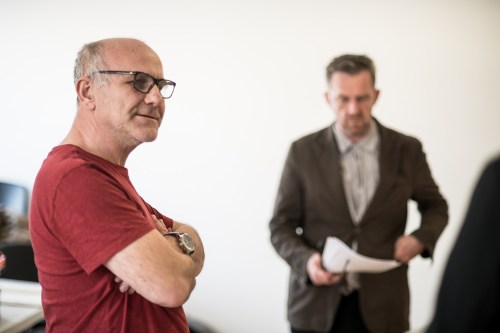
The story takes place in a hospital for severely disabled children, run by chief paediatrician, Dr Victor Franz. Colin Tierney, who plays the doctor, explains, “The Nazis have taken power and they’ve created this situation where children are being sent off to their deaths because they don’t conform to the new German ideal of what life should be. And the play is about my character’s struggle on one day to deal with what he’s doing, why he’s doing it and how he’s going to get out of it.

“Victor Franz was a children’s doctor, somebody who spent his life looking after people, who created this institution where disabled children could be looked after, and all of a sudden in this different new Germany, he feels as if he’s been taken over by this new force. This is what I’m trying to work out along the way – his struggle about what he’s doing and how he makes the decision not to do it. So he’s essentially a good man who’s been forced to do these terrible things, and that’s the complex dilemma I’m wrestling with.”

In getting to know his character and the crisis he’s facing, Colin’s worked closely with Stephen. “It’s quite a short rehearsal time, so I’ve been reading the play a lot and discussing it with Stephen, who of course is both writer and director, and is really inside the world of the play. He’s given me so much information, so much detail around the backstory of the world – and because Stephen has a disabled child of his own, I’ve been looking to him for lots of clues. I’ve done a bit of reading around the subject but the bulk of my work has been in the room with the script, with the actors, breaking down the moments, finding the detail and finding how deeply they resonate within me on a human level.

I’m just enjoying it a lot – even though it’s a serious subject matter, there’s a great sense of wanting to do justice to the work, so there’s a good attitude. People are working hard and committing in a really positive, honest way.”

Despite the heavy topic, both Stephen and Colin are keen to reassure audiences that the play is not as brutal as it sounds. “It’s not a heavy dirge of an evening,” says Colin. “It’s not light either, but it’s philosophical and incredibly well written.”

“You don’t see any children, you don’t see any violence, but you know it’s there,” adds Stephen. “It’s a drama of human beings in a ghastly world trying to work out how to be human beings again. It’s not brutal as a play, and I think maybe some people are worried that it’ll be really horrible, about kids with Down’s Syndrome being shot – but you don’t see any of that, that’s not what I’m interested in presenting. I’m much more interested in presenting why might somebody think that kids with Down’s Syndrome are a bad thing.

“One of the Nazis’ main reasons for their persecution of these people was that they said they’re so expensive, that keeping somebody with cerebral palsy cost a fortune and that money could be spent on better things. And of course although I don’t say that the lives of the disabled is the same as in Nazi Germany – that would be a grotesque thing to say – there are issues today about how do you value a human being in terms of their monetary worth. What do you do about people who will never pay tax, will never have a job, who are non-productive? And it’s a very big radical question, it challenges our priorities. And that’s what I’m really interested in.

“One of my characters, played by Lucy Speed, is the mother of a disabled child. As chair of KIDS, I’ve come into contact with lots of parents of profoundly disabled kids, and there’s a mixture of love for their children and intense love for their vulnerability, combined with absolute towering rage for a society that doesn’t value them properly. It’s really palpable – they’re very radical people.

“We also have Edward Franklin as Eric, a young, committed Nazi – but you discover that his antipathy to disability actually comes from his father having been disabled in World War 1, and he hates it because he’s so angry about that. So one of the things I’m interested in is the way that discrimination towards disabled people is actually towards people’s anxieties about their own weaknesses – and also fear. Our final character is the doctor’s maid Martha, played by Rebecca Johnson, who has an important line about this towards the end: that she used to be afraid of them, used to think they could infect her, but she’s not afraid of them any more. And that’s a great big important development that society needs to take on – how not to be afraid of people with profound disability.”

Colin agrees that even though we’ve moved on from the horrific events depicted in All Our Children, the play still carries important messages for a 21st century audience. “Hopefully it will make people think about our responsibility to others, and our responsibility as a society – how important love is and looking after people, especially those who have trouble looking after themselves. I think that’s the measure of a society, whether people who can help others should, instead of everybody thinking for themselves and doing their own thing and saying ‘screw you’. That’s where the heart of the play is. It’s not like we live in Nazi Germany now at all of course, but I think there’s a strong human resonance that people can tap into when they see this play.”

Book now for All Our Children, at Jermyn Street Theatre from 26th April to 3rd June.

Review: Four Thieves Vinegar at Barons Court Theatre

Guest review by Ross McGregor

Four Thieves Vinegar is a new play by Christine Foster, directed by Adam Bambrough for The 42nd Theatre Company at Barons Court Theatre. At times with the Fringe Theatre industry, grand ideas take place in tiny cramped arenas, but here we have a perfect unison of play and venue in that the subterranean vault-like gloom of the Baron’s Court Theatre is transformed into a 17th century prison cell and this genius venue choice complements the aesthetic of the tale perfectly. The most striking element of this production is its design. Sally Hardcastle and Will Alder deserve the highest of praise for their work on this production, as they have elevated it to something worthy of the West End. The lighting, props, costume and set decoration are simply flawless, creating a perfect, captivating world in which the actors can play in. From tiny details of amber window effects, to the dirt underneath the actors’ fingernails, it’s all done with an attention to detail that is staggering.

The plot revolves around three inmates of Newgate prison and their kindly jailer, in the time of the Black Death. The possibility of a cure is understandably on everyone’s minds, and fearful superstition of God’s wrath is heavy in the air, thicker than vinegar fumes and hot brick ash. Matthias Richards, played with grace and sincerity by Nick Howard-Brown, is an impoverished alchemist trying to cure the plague before time runs out. Kate Huntsman is a fiery ball of energy and pathos as Jennet Flyte, Richards’ romantic interest, an innocent young maid who is awaiting the noose once her baby is delivered. Hannah Jeakes is the third prisoner – a world-weary nurse, played with gravel-voiced anarchic glee by Pip Henderson. Simon Holt is their keeper, with Bruce Kitchener as the slow plodding but well-meaning jailer, the lesser of the four roles but one he absolutely nails the timing for, and gets the most laughs out of an understandably grim subject matter.

The plot is packed full of different strands, but without spoiling anything too badly, no one is quite who they say they are, and as the play goes on, and the Black Death closes in around them, each character must make their peace with their own personal inconvenient truth.

This production has the makings of something truly outstanding, but unfortunately the ratio of gold to liquid in the alchemy of the show’s different elements is off, and as it stands, they are failing to fully dissolve together. The biggest culprit is unfortunately the writing. There are simply too many storylines for a 90-minute play, and it’s down to the director and writer to now work out which to keep and which to cut, if the show is to have a future revival. The plague plot is present throughout but it’s often side-lined by bickering and innuendo that tire after a while. Huntsman and Howard-Brown have the most to do in terms of characterisation and arcs, and they’re the glue that hold the production together. Huntsman is perhaps the most watchable and fully-formed in terms of her performance, claiming the stage like a little tear-stained imp, whilst giving a clear intention with every single line she’s given, whilst Howard-Brown gives his best Hamlet The Science Nerd, injecting much-needed wide-eyed mania bordering deliciously on obsession. You’re never quite sure if Richards is telling the truth about claiming to have discovered a cure, and Howard-Brown plays this with mastery and a delicate toying with the text. Kitchener has a paternal heaviness that is kindly, genial and reassuring – a lighter moment in amongst the darkness, and much needed.

Four Thieves Vinegar is an interesting idea, that could do with being longer, slower, and more precise in its plotting and pacing. The director needs to be clearer about the placing of the different narrative elements, and the cast need a script that matches their abilities, and one that isn’t so overwritten. And somebody at the Almeida needs to hire the show’s designers immediately.


Can’t see the map on iPhone? Try turning your phone to landscape and that should sort it. I don’t know why but I’m working on it… 😉

Interview: John Risebero, Henry V

John Risebero is co-director and designer of award-winning theatre company Antic Disposition, along with co-founder and director Ben Horslen. Next month they’ll be reviving their acclaimed production of Henry V; previously performed in France, with two London runs and a 2016 national tour, the show is taking to the road once more, giving audiences another chance to see what British Theatre called “one of the most impressive revivals of a Shakespeare play that I have seen in recent years”.

Photo credit: Scott Rylander

Founded in 2005, Antic Disposition have become known for their innovative interpretations of classic texts, particularly the works of Shakespeare – and the timing of this particular production was no accident. John explains: “We’d wanted to stage Henry V for several years but because we always tour our Shakespeare plays in France, we could never see a way to do it without being insensitive to our French hosts. But then we realised that not only was 2015 the 600th anniversary of the Battle of Agincourt, it was also the centenary of the Great War, which gave us the opportunity to create a production that reflected on the change in the relationship between England and France in those five centuries – from mortal enemies to loyal allies. So our production is set in a military hospital in France, where wounded British and French soldiers work together to stage their own production of Henry V. It’s really a play within a play – Henry V meets Oh, What a Lovely War.

In addition to Shakespeare’s text, the play also includes original songs and live music inspired by the poetry of A E Housman. “We knew we wanted to include music in the show but using period songs seemed too obvious and we weren’t comfortable writing new ones,” says John. “Then we discovered George Butterworth’s musical setting of ‘The Lads in Their Hundreds’ from A Shropshire Lad and found that Housman had acknowledged he was inspired by Shakespeare. Although Housman’s work predates the Great War, so much of it reads like he knew what was coming. Our brilliant composer, Christopher Peake, set six more poems to original music for our show but we still use Butterworth’s version of ‘The Lads in Their Hundreds’ – it’s our tribute to him, as he died on the Somme in 1916.

“The music is completely integral. Soldiers have always used song to lift spirits or celebrate victory. As well as poetry, the Great War gave us so much music that’s still with us, songs like ‘Pack Up Your Troubles in Your Old Kit-bag’. In our production, we use music at key moments to bring the two sides together and remind the audience that war is a shared experience. It’s emotional shorthand.”

Photo credit: Scott Rylander

Although the play may be set in the past, John believes it still has a powerful message to share with a modern day audience: “Absolutely. War is a huge gamble, often taken too lightly. The French massively outnumbered the English at Agincourt but still lost the battle. In 1914, everyone thought the Great War would be over by Christmas, but it turned into one of the most destructive conflicts in history. It’s easy to open Pandora’s box, but the consequences can never be fully foreseen.”

Antic Disposition have also developed a reputation for staging productions in historic buildings and unusual non-theatre spaces, and this tour is no exception; Henry V will visit eight cathedrals around the UK, including Ripon, Lincoln, Peterborough, Ely, Norwich and Southwark. “We started out working in theatres but haven’t staged a play on a conventional stage for six years now,” John explains. “We find working in unusual buildings more exciting. There’s a special kind of magic when you are performing Henry V with the tomb of King John in the front row of the audience, as we did at Worcester Cathedral. It can be challenging from an acoustic perspective – many of our venues weren’t designed for this kind of performance, but we feel that those challenges are more than made up for by an atmosphere you can’t get in a regular auditorium.”

The 2017 tour of Henry V opens at Southwark Cathedral on 2nd February – and it’s not only audiences who are looking forward to its return. “We had a wonderful experience touring cathedrals last spring and wanted to bring the show to new venues and new audiences,” concludes John. “We think it’s the best work we’ve done as a company, and we’re very proud of it.”

Antic Disposition’s Henry V visits eight cathedrals around the UK from 2nd to 22nd February.

Theatre Things: 2016 highlights

Someone told me yesterday that they find New Year a bit of a confusing time, because they never know whether they should be celebrating the last 12 months or looking forward to the next.

Well. This year more than ever, I’m all about looking forward and making the best of the opportunities 2017 has to offer. But while there’s a lot about 2016 that we might like to forget, it did bring us a lot of great theatre. So I’d like to pause for a moment and take a look back at a few of my highlights from the last 12 months. (As always, these are in no particular order – ranking them from 1 to 10 requires a level of decisiveness that’s far beyond me.)

Anna Karenina (Arrows and Traps) at Brockley Jack Studio Theatre

It was inevitable that the Arrows would find their way into my top 10, but I’ve chosen Anna Karenina for this list, because it marked the moment I really fell in love with their work. Condensing Tolstoy’s epic novel into a drama as accessible as it was gripping, Anna Karenina bore all the hallmarks we’ve come to expect from an Arrows show: creatively staged, exquisitely performed and visually stunning.

Anna Karenina
Photo credit: The Ocular Creative

Transports (Pipeline Theatre) at the Pleasance

A heartbreaking and incredibly timely play, Transports never explicitly mentioned current events, but nonetheless offered a powerful statement about the emotional trauma faced by refugees every day. Based on the life of designer Alan Munden’s mother, Liesl, the interlocking stories of two girls were simply and lovingly staged in a powerful and thought-provoking production.

Cargo (Metal Rabbit Productions) at Arcola Theatre

It’s not really surprising that the experience of being a refugee has been a common theme in the theatre of 2016, but Tess Berry-Hart’s Cargo stands out as particularly powerful, because it turned the tables and forced us to not only imagine but actually experience what it might be like if we were the ones forced to flee our homes and seek refuge overseas. The result was a production that was disturbing, tense and unsettlingly authentic.

Blind Man’s Song (Theatre Re) at the Pleasance

This one was a surprise to me, because going in I had no idea what to expect and really wasn’t sure if I’d enjoy this combination of mime, dance, sound, illusion and original music. But Theatre Re’s Blind Man’s Song was a revelation; I was soon swept away by the beauty of the love story unfolding on stage, and by the reminder of how much emotion can be expressed without saying a single word.

We Live By The Sea (Patch of Blue) at Arts Theatre

Patch of Blue struck gold again this year with We Live By The Sea, a beautiful and sensitive portrayal of a young girl with autism. While the carefully researched production made no attempt to conceal the difficulties experienced by Katy and her family, it also challenged us to look beyond her autism – and our own assumptions – to celebrate the person behind it and everything she had to offer.

Photo credit: Scarab Pictures

Dare Devil Rides to Jarama (Townsend Productions) at the Bussey Building (on tour)

Commissioned by the International Brigades Memorial Trust, Dare Devil Rides to Jarama – which continues touring into 2017 – tells the little-known but fascinating story of Clem Beckett, a young speedway rider from Manchester who gave his life fighting against fascism in the Spanish Civil War. Despite its sad ending, the story’s told with charm and humour by writer Neil Gore in a script that combines poetry, prose, music, and an enjoyable bit of audience participation.

Pride and Prejudice (Two Bit Classics) at Greenwich Theatre (on tour)

As a fan of Jane Austen’s classic novel, I was either going to love or hate Two Bit Classics’ adaptation of Pride and Prejudice for two actors; it didn’t take long to decide it was the former. In an astonishing display of stamina, Joannah Tincey and Nick Underwood took on 21 characters between them, switching genders, costumes and accents at the drop of a hat in this funny and enjoyable show.

The We Plays at the Hope Theatre

Cyprus Sunsets, the first in this double bill of monologues from up and coming talent Andrew Maddock, just missed out on my top 10 last year… but it’s time to put that right. The We Plays combined Cyprus Sunsets with Irn Pru – two very different stories that nonetheless shared an ability to wrongfoot and shock us. Powerful writing and captivating performances ensured the double bill definitely made the list this year.

Scrooge and the Seven Dwarves (Sleeping Trees) at Theatre503

Who would have thought a panto would make it into my top 10? Not me – but Sleeping Trees’ mash-up of Dickens and Disney is such a brilliant, hilarious and above all original take on the classic format that I’m currently trying to decide if I can squeeze in a repeat visit before it closes next week. And I shall also be demanding that every panto I see from now on features a giant lobster…

Photo credit: David Monteith-Hodge

Her Aching Heart at the Hope Theatre

The Hope Theatre has had a great year, and it came to a triumphant, five-star end with Her Aching Heart, a lesbian gothic romance musical two-hander written by Bryony Lavery. A laugh out loud comedy, this unexpected delight of a show affectionately mocked the Mills and Boon genre on which it was based, while a modern day love story unfolding simultaneously introduced a more contemplative note.

And let’s not forget:

The Memory Show, All Male H.M.S. Pinafore, This is Living, How to Win Against History, TitanicHarry Potter and the Cursed Child, An Inspector Calls, A Midsummer Night’s Dream, Sunny Afternoon – and a couple that I didn’t review but still want to shout about: Jesus Christ Superstar and Imogen.

Now, let’s see what 2017 has in store…

Happy New Year!