Review: Tom Molineaux at the Brockley Jack Studio Theatre

Guest review by Lucrezia Pollice

Tom Molineaux is an extraordinary true story about boxing, gambling and friendship. About a man who fights his way to freedom, but remains trapped in the injustices of society. A boxing ring, two men and some period costumes; nothing more is needed to bring this narrative to life. Tom Green’s compelling writing flows fluidly in an extremely believable manner, bringing us back to London in the nineteenth century whilst never losing the audience’s attention. Directing with simplicity and beauty, Kate Bannister constructs an extremely pleasurable evening.
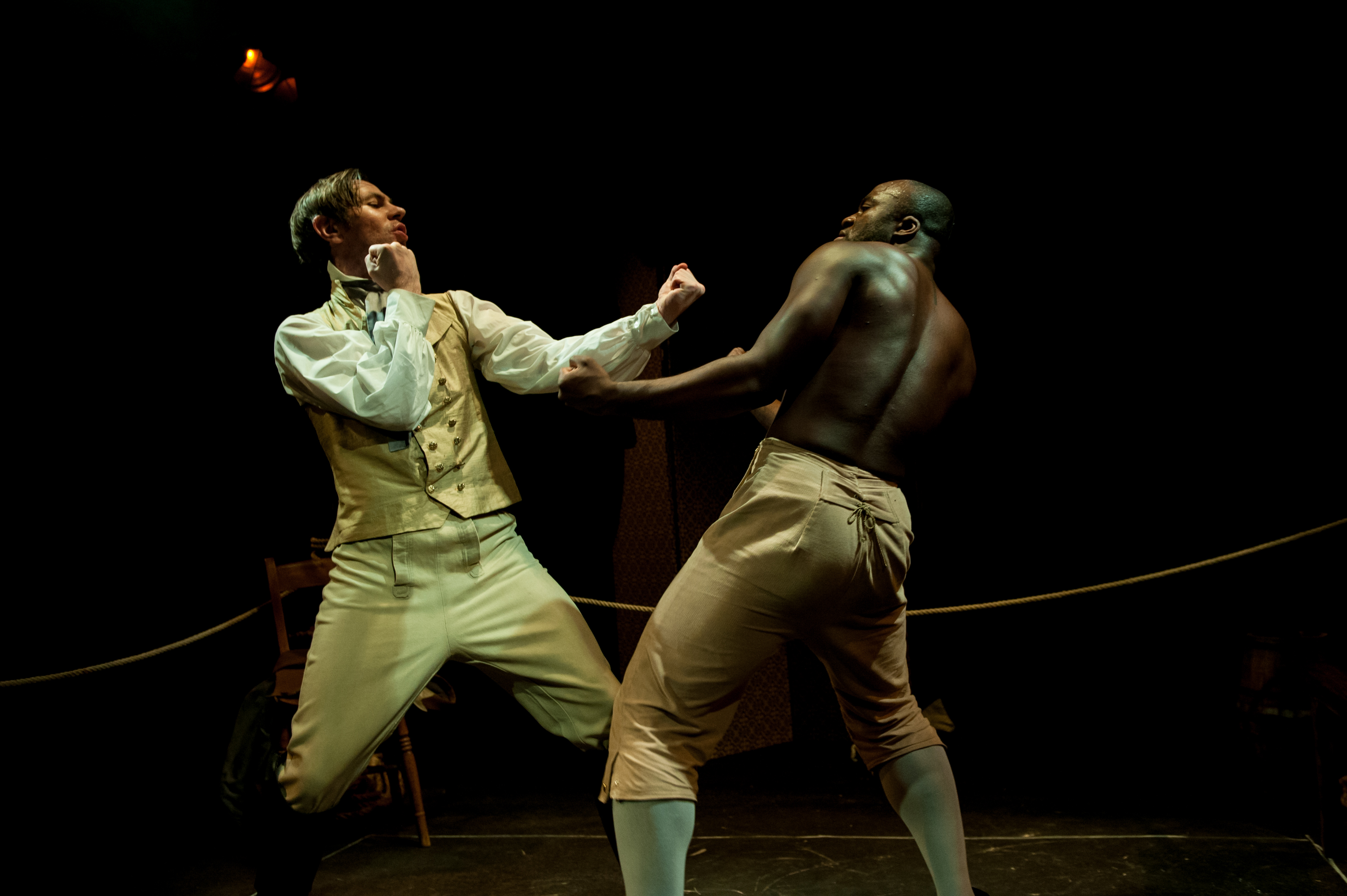
Photo credit: Timothy Stubbs-Hughes

Nathan Medina skilfully plays the part of an African American boxer, born on the plantation in Virginia, with incredible force, leaving spectators astounded. Tom Molineaux is strong, powerful and will not stop until he beats everyone. Before the play begins, Tom is cherished in America for winning his master a great deal of money, which releases him from slavery and wins him freedom. It seems like nothing will bring him down, his determination and ambition to become world champion is too strong. He manages to convince the English champion Tom Cribb, who is retired, to fight him.

However, the play is not only about boxing, it is about so much more. About injustice, prejudice, loyalty and addictions. The story is narrated by another incredibly talented actor, Brandon O’Rourke, who plays Pierce Egan, a sports journalist who befriends Tom when he arrives to London. Pierce allows us to see the honest emotional turmoil which is present under Tom’s muscles and strength. Unfortunately, this is not a happy story. It is a true story. Will the former slave manage to gain his victory and make millions, or will he be crushed to the bottom by society’s injustice and greed?
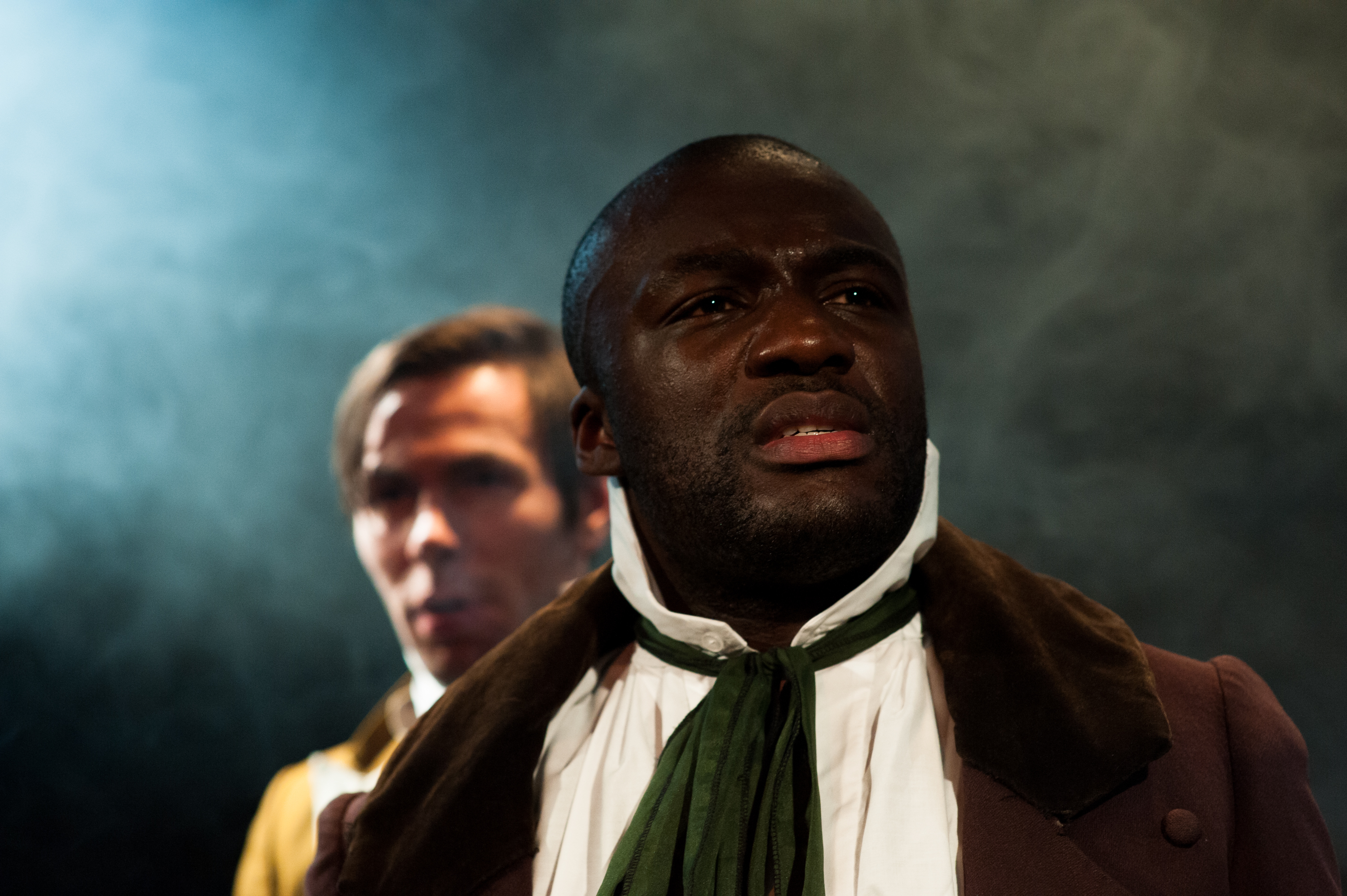
Photo credit: Timothy Stubbs-Hughes

The performance is highly physical. The set is dark and misty. A seriousness in tone is most commonly present, but lighthearted moments are present too. One of my favourite moments is when Tom and Pierce come back drunk from a night out in 19th century London. The atmosphere transports you and allows one to imagine the streets of London back then, thanks to the accurate descriptions. Unfortunately, Tom and Pierce’s friendship is put to the test. Molineaux fights Cribb but the match is flawed, and Pierce knows. Will Pierce decide to lose the money he has bet on Cribb; or will he convey the truth and tell the world that Molineaux is the world’s biggest champion? Will Pierce fight the system or will Molineaux be representative of our unjust post-colonial society?

Courageous, powerful and human, this brilliant play packs a punch in more ways than one.


Can’t see the map on iPhone? Try turning your phone to landscape and that should sort it. I don’t know why but I’m working on it… 😉
Review: Persuasion at the Royal Exchange Theatre

Guest review by Aleks Anders

Persuasion is Jane Austen’s last complete novel, and is set most definitely in the counties of Avon and Somerset in the early part of the 19th century. It is a tragi-romance, and although there is some humour to be found in the novel, it is essentially written in earnestness. In the main, the story concerns the 27-year-old daughter of an impoverished noble wanting, nay needing, to marry; and the travails this entails as she watches in horror and amusement her relatives’ follies and dalliances. Her life changes forever though, when she encounters the man she had been engaged to more than seven years ago, and has not seen in as many years.

“Other people will try to persuade you. You must listen to your heart.”

A classic British novel which tells of a time passed; when morals, ideologies, customs, behaviours and habits were all so very different from the present. Perhaps the appeal here is that this evokes a kind of nostalgia, or a wish for change; or perhaps we just like to look at and laugh at the folly of our ancestors knowing that our lives are infinitely changed. Whatever the case, we expect to see a production that mirrors and compliments the author’s intent… and thereby lies the rub.

Photo credit: Johan Persson

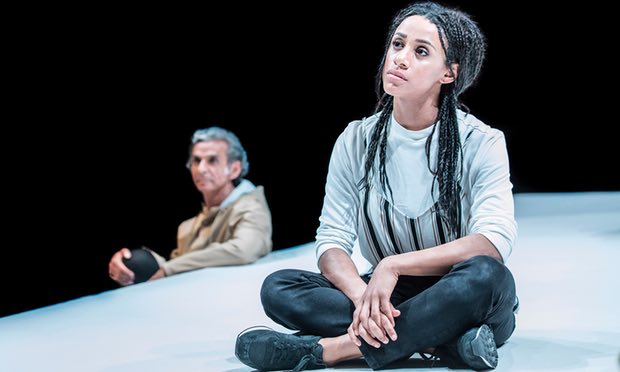
On walking into Manchester’s celebrated in-the-round theatre we are greeted with a huge, looming cream-coloured rectangle, taking up most of the stage area. Around this are positioned multifarious sound and lighting paraphernalia, and the whole is lit with a cold blueish wash. A body is lying face down on top of this oblong. It’s female, she has dreadlocks, in modern dress, and seems dead. The cast are seated on the front row of the audience, in costume, and even change their costumes in full view of us all. It’s all a little strange.

First, it was obvious where the budget for this show went. On this rectangle. The omnipresent block is on two levels and the top half is a turntable which moves round at various points in the play. There is no set, no props, and nothing else is ever brought on for a scene. The scenes change fast and furiously, completely seamlessly, and we are expected to keep up with this without being given any visual stimulae to aid us. There is even a point where one character finishes speaking in one scene, stays exactly where she is and continues speaking for the start of the second scene as a different character, without so much as voice or body language change. The costumes are modern, but really rather strange. None of the costumes really seem to signify the character in any way, and are obviously not meant to be completely realistic.

“The problem is it is impossible to know what will happen in the future.”

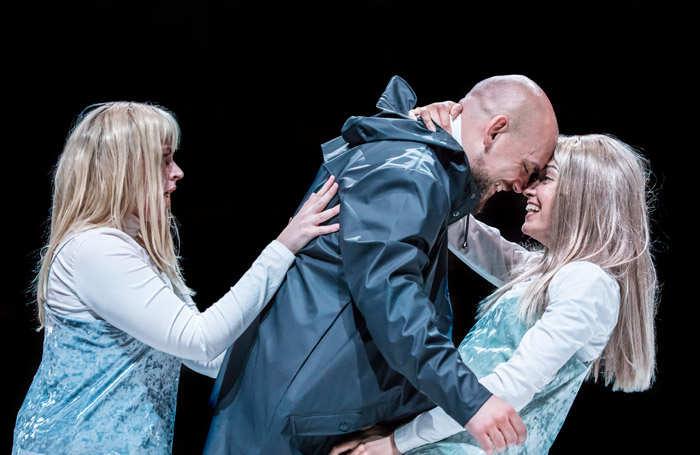
The only thing to change this monotony is towards the end of the first act, when the action moves to the seaside town of Lyme Regis. The cast strip off revealing sexy swimsuits underneath, and a seemingly never-ending flow of foam cascades from above onto this rectangular block. The cast slip and slide in it and across it much to the laughter and approbation of the audience. This is followed immediately by Louisa, who slips once too often and has ketchup poured over her by Anne, again to much laughter since this is funny. It is only afterwards that we learn that it was in fact tragic, and she fell over the edge of a cliff!

Photo credit: Johan Persson

The language of the play is also at odds with this highly modern vision from director Jeff James. It’s very similar to watching a Shakespeare play in modern costumes whereby the language and business (such as sending letters etc) simply do not befit the updating. And yet – out of nowhere – Anne suddenly half-way through the second act screams the line, “Shut the f&$! up!” It jars and is out of place with the rest of the dialogue. However, if all the dialogue had been modernised in this way, I may well have enjoyed the play more.

Basically, I think what I am trying to say is that I do not believe that this adaptation is true to the author, nor is it at all clear. A mixed production at best. It is at one and the same time ultra-contemporary in concept and execution, and yet firmly fixed in the early 1800s with the language and references.

Fortunately the saving grace of this play is that the acting is really very good. All the cast invested a huge amount into their roles and this paid its dividends. Lara Rossi is a rather moody and sullen Anne, whilst her more frivolous female peers are played excellently by Cassie Layton (Elizabeth and Louise) and Caroline Moroney (Mrs. Clay/Henrietta). In fact, there has been – and still is – much bemoaning that there are so few plays with strong female leads. This play is quite the opposite; there are many strong female characters here.

The male roles do seem less defined than the female ones, but Samuel Edward-Cook’s Captain Wentworth is true and grounded throughout and very believable.

“Love can save your life. But love is the problem.”

Persuasion is at the Royal Exchange Theatre, Manchester until 24th June.

Review: Eat the Poor at The Point, Eastleigh

Guest review by Edward Learman

Once, I toyed with the idea of performing at an open-mike night, and basically just talking “seriously” about my most humiliating and disturbing experiences: this would include recollections about diarrhoea, testicles, job interviews and GP visits, culminating with the crème de la crème topic of conversation: Brexit. This final part of the performance would simply involve me repeating (loudly!) the words “Europe”, “this country”, “capitalism”, “Tories”, “Labour”, “Tony”, “Donald”, “Margaret”, “freedom”, “Islam”, “bankers”, “immigration”, “unemployment” over and over again for as long as it took to get thrown out or the audience to start throwing things before leaving, thus illustrating the ridiculousness of any attempt at rational discussion.

I have yet to persevere with this concept, or to be at an open-mike night where I’m drunk enough. Jonny and the Baptists’ award-winning two-man show Eat the Poor takes a slightly more sanitised and friendly, but no less abrasive, approach to delivering their message on the state of the nation.

The two performers, Jonny Donahoe and co-star Paddy Gervers, explain early on that this show is not for everyone for the following reasons: 1. They talk about Brexit 2. They use the word “f***” a lot, except not in a sexual way 3. They’re both “socialists” who went to university. They also politely advise that they’ve had a lot of walkouts, and if there are any UKIP or Tories in the audience, they’ll likely hate the rest of the show and should go home immediately to count their money, or to reassess their priorities if they don’t have any.

Photo credit: Anna Soderblom

This sets the tone for the next 100 minutes. Not exactly a dissection of modern politics or British ideals, more a good-natured, self-effacing plea for sanity in the face of an election that will dictate whether things will stay exactly the same as they always have been or change slightly in favour of the poor who want a better future. To say the irony’s not lost on the two performers is obvious and they know it.

They’re middle-class, they’re artists, their parents own their own homes, they can afford to live in London and their chances in life are better compared to the vast majority of people working as low-paid labourers, nurses and teachers; however, there’s clearly no shortage of starving artists in this country.

Between the jokes, which are a brand of improvised comedy that riffs on how the audience responds – at one point Jonny pointed at a group in the audience and said something like: “I can see you’re already unhappy with this, but please please please don’t leave until the interval because it gets much, much worse, I promise you. Seriously, there’s a lot of jokes I haven’t done yet, and you might enjoy it” –  Jonny gives a brief explanation about their ideology, describing their work with the homeless and their contempt for the super-rich elite like Andrew Lloyd Webber (who gets mentioned a lot!), and it feels like they really mean it.

The antics range from songs about how difficult it is for liberals to admit Blair and New Labour were bad when instead we should all just dig up Thatcher and bury her again, to Jonny ditching Paddy and becoming a worldwide success who takes over from Murdoch and controls the media whilst resisting Andrew Lloyd Webber’s deadly seduction, to a song about what would happen if swans declared their independence from Queen Elizabeth’s reign and then conquered the world. This is all clearly meant to be metaphorical, and it’s very funny.

There were also some quite educational moments; at one point the team produce a magazine called The Tatler, a luxury lifestyle publication, where they read a list of the top wealthiest and most important people in England, and which includes such interesting pastimes as wearing hats and owning things. A slightly less absurd example is a song about the 2015 parliamentary vote on whether to abolish tax credits for the lower-income bracket. This consists of a list of names, including Andrew Lloyd Webber, David Cameron and Theresa May, conjoined with the phrase “Dickvalve. What a bunch of dickvalves!” repeated again and again, with Jonny descending upon the audience to high-five anyone who’s willing.

This is a very funny show, and I’m glad I got to see it – and that I’m not the only starving artist who thinks that politics (or power) is absurd.

Eat the Poor continues on tour until 27th May; check the website for dates and venues.

Review: Who’s Afraid of Virginia Woolf? (screening) at the Harold Pinter Theatre

Guest review by Edward Learman

“I’m not drunk enough to figure it out yet.” – George

There are many great lines in Edward Albee’s classic play about alcoholism, marriage and the failure of American virtues. Who’s afraid of Virginia Woolf? remains both a portrait of an era and one that has a truly timeless and universal appeal for audiences across the world.

The play is currently being performed at the Harold Pinter Theatre, and I was able to see a live screening at my local theatre, Thornden Hall. The venue is a 388-seat auditorium with a state-of-the-art sound system and digital facilities located on the Thornden School’s grounds, with the purpose of supporting the Performing Arts and Education in Eastleigh and Chandlers Ford. This is the first time I had visited the site, and I was impressed with the service, the speed at which I was given my ticket, but especially with their selection of beers, which were surprisingly cheap compared to most venues. For this event the middle rows were almost completely filled, so the venue must’ve sold at least 200 tickets.

It’s my personal theory that no performance of Albee’s play should be watched without being inebriated; this is to fully appreciate the nauseating maelstrom of hissing put-downs and devastating one-liners as the two couples go at it, engaging themselves in verbal sparring contest, cutting each other to the bone.

“Fun” is not exactly the word I would use to describe Albee’s play, unless by fun you mean some sort of psychological game in which all your darkest fears and skeletons are resurrected to be paraded for the horrible amusement of the younger guests, who aren’t quite sure what’s going on or why they can’t just leave. “I don’t mind self-flagellation as long as it’s done right,” Nick (Luke Treadaway), the young and handsome academic, quips as he attempts to find a common ground with George (Conleth Hill), the older, once aspiring history professor, who is appalled by the young man’s naivety and his wife Martha’s (Imelda Staunton) reasons for inviting him into their home.

There are many layers and twists to the play, and this allows the actors to explore the depths of their characters, wear many masks, and to flip from passiveness to anger to humour to pain to despair to insanity and then back to smiling indifference again. Like Beckett’s Waiting for Godot, it’s a real spectacle of drama and a masterful piece of staging where it seems as if Albee has challenged himself by asking: “How far can I push this?” It’s strange to think that when the play opened in 1962, the judges for the Pulitzer Prize chose not to have an award that year rather than give it to Albee, for they’d objected to use of profanity.

Interestingly, when I’d first come across the play as a teenager after watching Mike Nichol’s 1966 film adaptation, I couldn’t quite imagine Elizabeth Taylor and Richard Burton, despite their incredible performances, using language like “F*** you, motherf***er!” I suppose no one would expect their parents to say this, even during a blazing row.

And how does this cast fare against the one with two of the greatest film stars of the 1960s? Well, I wasn’t quite sure how the two-hour film, which is basically just one long argument, could possibly be performed on stage. For the film version, visually there were room changes and moments where the characters could take a breather. But here the director James Macdonald, who like Nichols is a veteran of the theatre (previous works include Sarah Kane, Caryl Churchill and David Mamet among others), chooses to restrict the action and drama to a single room, with one or two dialogue scenes kept intact in contrast to the adapted film version.

Critics have described MacDonald’s version as the “funniest and most high-energy version ever”; I don’t disagree with this since during the entire three-hour production there doesn’t appear to be a single quiet moment, except during the two brief intermissions. Quite how the cast, which boasts seasoned stage and screen actors Conleth Hill (Game of Thrones), Imelda Staunton (Gypsy) and Luke Treadaway (The Curious Incident of the Dog in the Night-Time) and West End newcomer Imogen Poots (28 Weeks Later), have managed to give such gut-wrenching performances since February just amazes me. But especially Staunton, who simultaneously channels Elizabeth Taylor’s spirit whilst bringing a sensitivity to the character which I never thought was there, and which moved many in the audience to tears, including myself.

Staunton’s performance as Martha reminded me of Heath Ledger’s scene-stealing role as The Joker in The Dark Knight  a part which any intelligent actor or critic would look upon as a monumental challenge after another great actor, in that case Jack Nicholson, had already made it iconic. Like Ledger, Staunton succeeds in the same way, which is to simply play the character slightly differently, and although at certain times, I felt I was watching Taylor and Burton, which was astonishing, here the actors can physically utilise the stage space, enhance their performances and somehow make the characters more three-dimensional. Staunton also screams louder than any actor or actress I’d ever seen in any live performance, and again, I can’t quite believe how she manages to give such an electrifying performance night after night.

Who’s Afraid of Virginia Woolf? is at the Harold Pinter Theatre until 27th May. For details of future events at Thornden Hall, visit http://www.thorndenhall.co.uk/.

Review: Care at the Courtyard Theatre

Guest review by Lucrezia Pollice

Funny, but is it?
It’s all lovely and nice to have children but what are the stories not told?

Care was first performed at the Royal Court Upstairs, with its first revival by the Angus Mackay Foundation at the Courtyard Theatre in Shoreditch. Set in a young couple’s living room, the play looks very intimately at the narratives of Terry and Cheryl, who seem to be dealing with something. It is this something that drives the narrative. An it – a she – something or someone hidden centre stage in a cupboard, which forces spectators to engage.

Terry, played by Marc Benga, is very charismatic and seems at first to be unaffected by the whole situation. Karen Mann’s Cheryl instead is distressed from the start. She is suffering from some pain of her own, trying to get attention from Terry and a love which is not given back. The TV glares throughout the scene as we watch their daily life over the course of a long weekend. The story is simple, but interesting; it gives actors more responsibility to deliver the script.

Throughout the performance, their friends David (Leo Shirley) and Cathy (Jaana Tamra) come round to the house. The relationships between the couples are strong, and create a comical scene in which Terry and Cheryl are in distress but cannot find the courage to tell Cathy and David to leave. The Polish stereotype of Cathy’s character is overly rude and sexual, and her lack of social understanding of the situation is made comical by the hilarious body language during the scene of her husband, who seems to have given up on her.

From what seems like a normal domestic, it escalates into what instead looks like an abusive relationship. Who is abusing who is unclear though. It begins as a physically abusive relationship from Terry’s part, to then shift to a loving relationship, to then seem like it is her who is abusing him. Slightly confusing, perhaps on purpose, who in the relationship was causing troubles. Terry seems to be innocent; he makes all the jokes and seems to be stuck in a house and situation he doesn’t want to be in. Or is Cheryl right in saying that he doesn’t respect her?

The playwright Roy Mitchell was a member of the National and Birmingham Youth Theatres, trained as an actor at the Manchester Polytechnic School of Theatre, and more recently has been participating in the creation of BBC1’s New Tricks drama. He touches upon very difficult topics in this play, making the audience work to understand the motifs behind the characters’ actions by not giving much away until the end.

Perhaps the simple narrative at times needs a bit more tension as this is lacking. Conveying a constant distress creates a slightly lamenting voice, which becomes uncomfortable after a while, and accents are slippery at times. The intentions between the two main characters are slightly unclear, and the grief of a baby’s loss is not conveyed as deeply as it could be in moments of despair. However, overall the performances are believable, and it was really lovely to engage with an ethnically diverse cast with such a powerful taboo topic which is death.

My favourite moment must be when Terry and Cheryl come back drunk from the pub and start watching a horror on TV. It is amazing to see how something so simple can be made into something so entertaining. The performance is overall touching upon very delicate topics, but is presented also with light moments of comedy and an obscurity as to what is happening, which might intrigue spectators.


Can’t see the map on iPhone? Try turning your phone to landscape and that should sort it. I don’t know why but I’m working on it… 😉