Review: Brontë at Upstairs at the Gatehouse

Start a conversation about English literature with just about anyone, and it probably won’t be too long before you arrive at the Brontë sisters. Best known as the authors of Jane Eyre, Wuthering Heights and The Tenant of Wildfell Hall, Charlotte, Emily and Anne are part of our national heritage, and yet most of us know far more about the lives of their characters than we do about the authors themselves. Polly Teale’s 2005 play Brontë aims to correct the balance, allowing us a glimpse into the remote rural life of the three sisters, and the complex family relationships that inspired the classic creations we know so well.
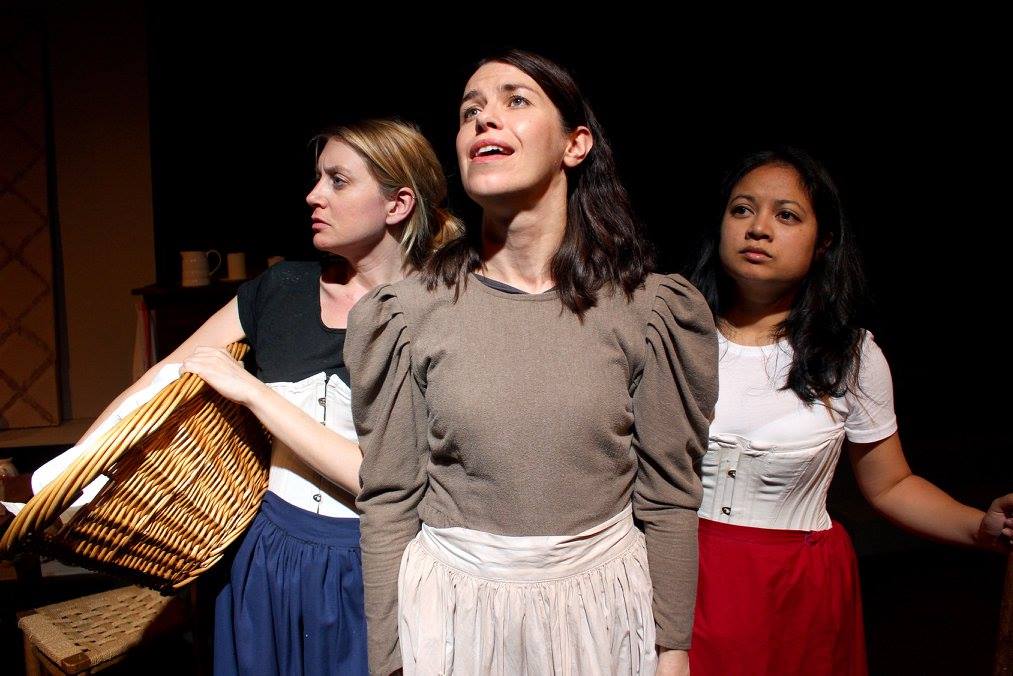
Photo credit: Robert Piwko

And it turns out there’s more than enough material here for a story all of its own. The personal and professional rivalry between Charlotte and Emily (in keeping with history, poor Anne doesn’t really get much of a look-in, and is relegated to the role of peacekeeper); the declining fortunes and eventual disgrace of their brother Branwell; the struggle to succeed as writers in a man’s world, and the sisters’ very different motivations for writing in the first place… There’s a lot to cover, and the play does so in a series of short scenes, jumping backwards and forwards in time from childhood to adulthood, and returning to somewhere in between. Each of these scenes is introduced by a change of lighting (effectively managed by Adam Taylor) and a burst of recorded string music, wherein lies my only real complaint about Tower Theatre’s production – after countless scene changes, the music does start to grate just a little bit.

That small gripe aside, the production, directed by Simona Hughes, is of the highest quality. The cast give compelling performances, in particular Joanna Nevin as the sensitive, publicity-shy Emily, and Tania Haq, who becomes more and more dishevelled as she brings to life two iconic characters – Cathy from Wuthering Heights and Bertha from Jane Eyre. The two male members of the cast also take on multiple roles with skill, and it’s here we begin to see the parallels between fiction and reality woven into Teale’s script, as the girls’ father (Martin South), whose love and approval Charlotte craves, morphs into Mr Rochester and her adored tutor Constantin Héger, while the increasingly abusive Branwell (Paul Willcocks) turns before our eyes into Heathcliff and the drunkard Arthur Huntingdon.

Photo credit: Robert Piwko

What’s most impressive about the production, though, is the way it recreates the isolation of the Brontës’ home on the moors. With the exception of the local curate, Arthur Bell Nicholls, we never see anyone from outside the family enter the house… and nor do we leave it until very late in the play (and then only briefly). Colin Guthrie’s sound design brings the countryside to life around us, as rain pours, birds cry and wind blows. And as the sisters repeat the same tasks, day in day out – folding laundry, baking bread and caring for their elderly father, all whilst knowing that the world expects nothing more of them because they’re only women – we get a sense of the stifling atmosphere that led them to find their escape through writing.

Brontë is a fascinating true life story that puts a human face on three literary legends, and makes you want to go back and read all the novels again to look for clues you might have missed the first time. Part documentary, part drama, it touches on gender issues, family relationships and the human need to be known and admired, to leave our mark on the world even long after we’re gone.

Much like the Brontë sisters’ famous novels, it’s not a particularly cheerful tale – but then as we all know, that doesn’t necessarily prevent a story from becoming a classic.


Can’t see the map on iPhone? Try turning your phone to landscape and that should sort it. I don’t know why but I’m working on it… 😉

Review: Russian Dolls at King’s Head Theatre

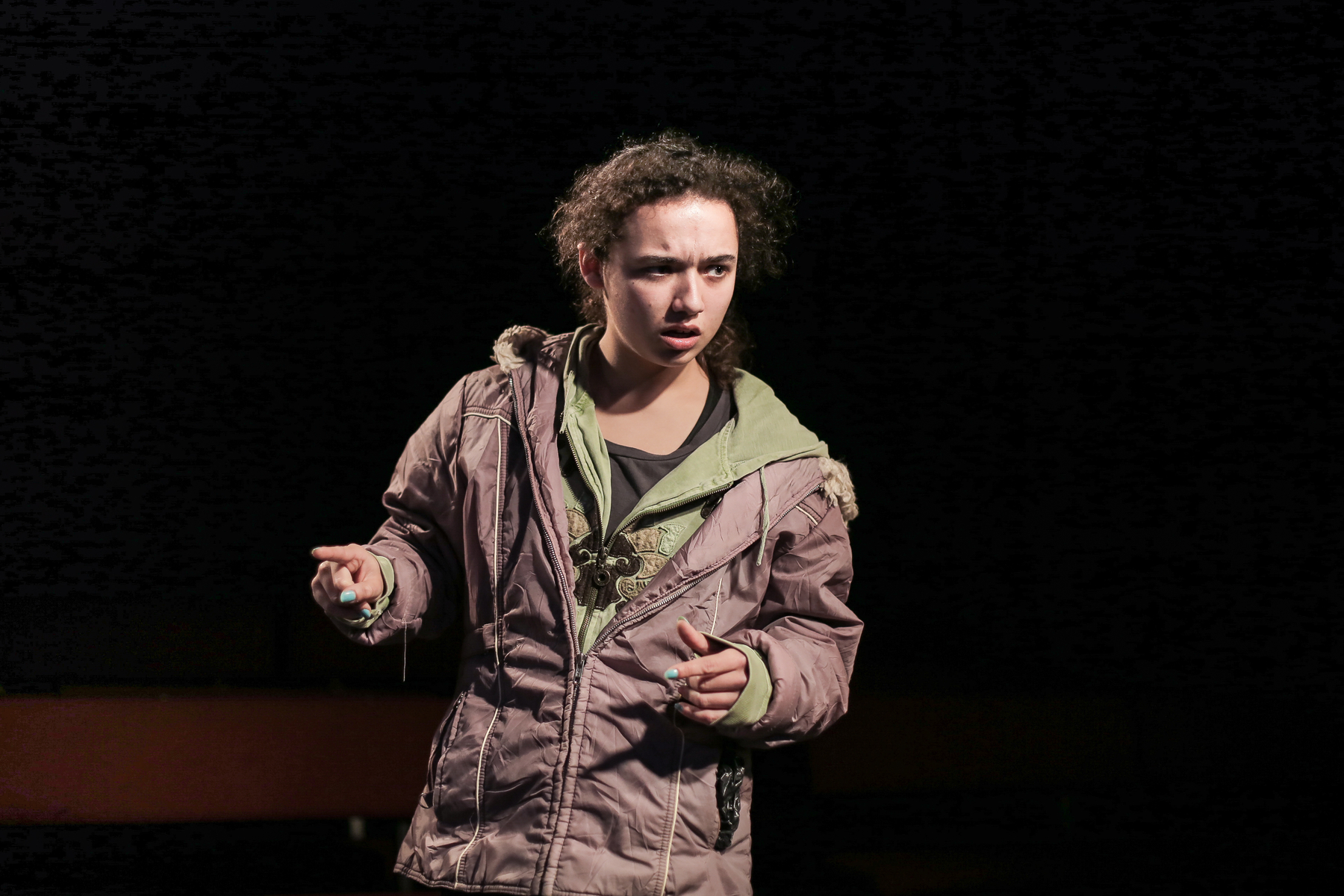
Kate Lock’s Russian Dolls, winner of the 2015 Adrian Pagan award for new writing, brings together two unlikely companions – Hilda, blind, elderly and struggling to maintain her independence, and Camelia, who’s just got out of a young offenders’ institution and wants nothing more than to go back there. When she robs Hilda, a surprising connection is forged, and the two discover that their lives are actually not all that different.

Exploring as it does some difficult themes – abuse, loneliness, gang violence and addiction, among others – it would be easy for the play to become a bleak picture of two isolated souls just trying to survive. And while there’s certainly plenty in Hamish MacDougall’s production to shock and dismay, this brilliant two-hander is far from one-dimensional. Both Hilda and Camelia are strong-willed and proud, and they quite literally speak different languages, so the resulting clash of personalities allows for a good deal of humour alongside some genuinely heart-warming moments.

Russian Dolls at King's Head Theatre
Photo credit: Andreas Grieger
Playing these complex characters are two perfectly cast actresses, who each begin alone on stage with a soliloquy direct to the audience. Stephanie Fayerman’s Hilda is determined and stubborn, refusing to stop living her life or to give up the things she loves, and discussing the sudden total loss of her sight with a levity that only thinly masks her devastation. Meanwhile, Mollie Lambert takes Camelia, a character many would be all too ready to write off as a lost cause, and reveals her to be an affectionate, warm and funny girl, who loves her family and dreams of a better future. Like Hilda, her bravado hides an intense vulnerability, and her ambitions become all the more poignant as she’s inevitably drawn back into the repeating patterns of the world she’s left behind.

Becky-Dee Trevenen’s set takes in the whole width of the intimate space, encompassing Hilda’s front door, living room and kitchen. We never see outside the flat, only hearing second-hand about characters and events, and this heightens the sense of isolation for the two women. In fact the only time the story doesn’t feel completely natural is on the one occasion the outside world briefly enters their safe space, when Camelia arrives home with a gun she’s stolen from her brother and his gang. This results in a mildly chaotic scene in which she runs around the flat behind Hilda’s back, hiding the weapon somewhere new, only to pick it up again moments later and move it somewhere else – and finally putting it back where it was in the first place. When the gun then disappears in the following scene, it feels like a bit of an anticlimax, and we only learn its true significance much later.

Russian Dolls at King's Head Theatre
Photo credit: Andreas Grieger
This thoughtful and moving play ends rather abruptly, with no clear resolution, but still manages to leave us feeling uplifted, despite some of the horrors that take place within it. Camelia and Hilda’s relationship begins as a practical arrangement – Camelia acts as Hilda’s eyes, while Hilda provides the authority and discipline Camelia’s never had from her own mother – but grows into one of genuine affection. This, along with the open-ended final scene, encourages us to go away considering how society needs to change before such stories can possibly have a happy ending.


Can’t see the map on iPhone? Try turning your phone to landscape and that should sort it. I don’t know why but I’m working on it… 😉
Review: Speaking in Tongues at Cockpit Theatre

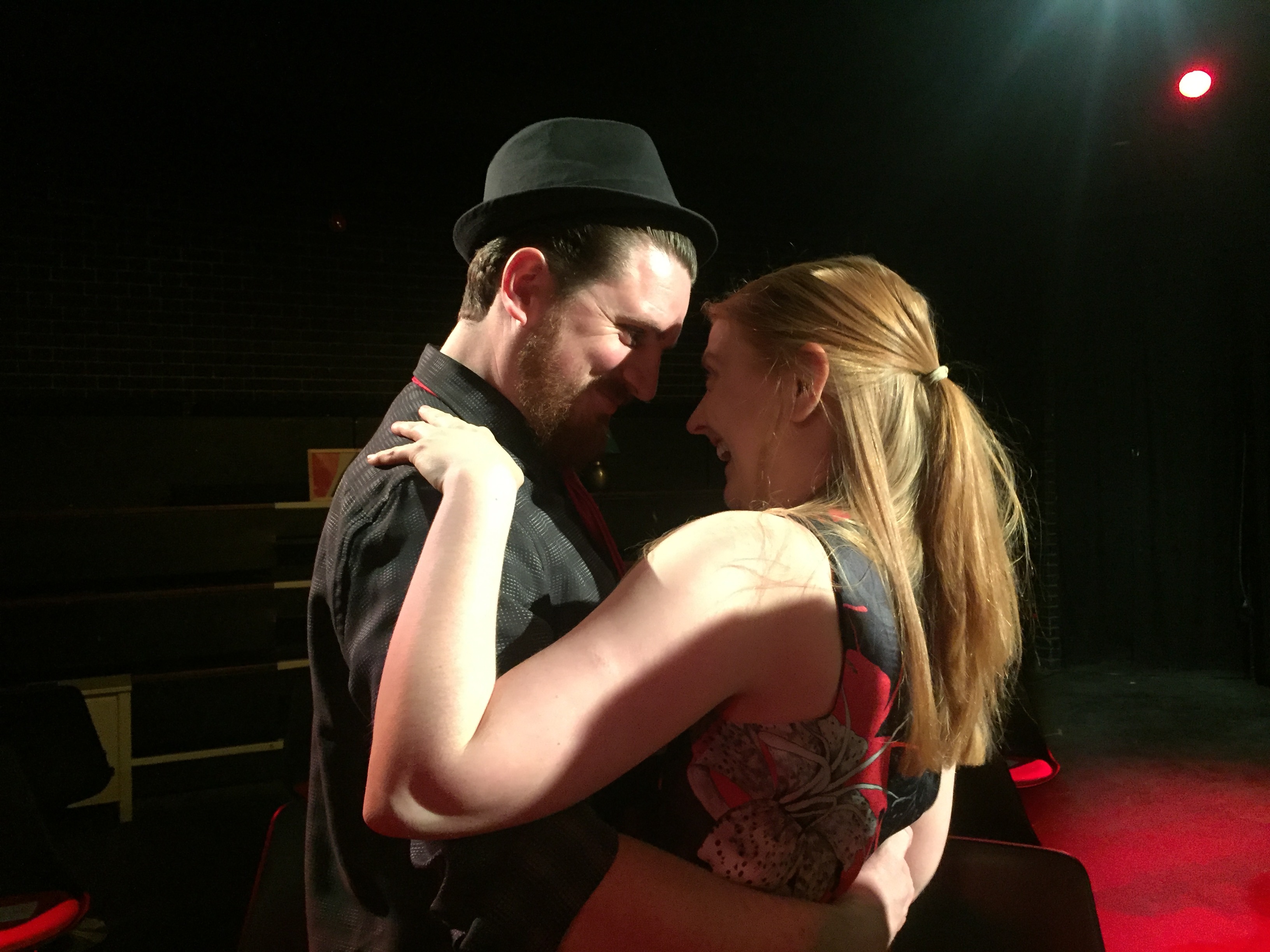
A man and a woman meet at a club and leave together. They’re both nervous… they’re also both married to other people. What they don’t know is that at the exact same time, their respective spouses are having a very similar encounter. But while their conversations mirror each other, sometimes word for word, ultimately the outcomes are different – only one couple actually goes through with it. The other, overcome with guilt, returns home to confess, only to discover their partners’ betrayal.

This all happens simultaneously – two couples, two rooms, two confessions, two marital breakdowns – within the first fifteen minutes of Andrew Bovell’s Speaking in Tongues. And that’s okay, because Doughnut Productions have more than one stage; in fact they have four. In a unique format, their productions take place predominantly around the sides of the room, while the audience watch from the centre, on chairs that swivel to face the action.

This is brilliant for many reasons: first, it means even if you’re stuck behind the tallest person in the room for one scene, they won’t be bothering you for long. Second, it allows for scenes like the one described above, where multiple events happen simultaneously but in different locations. And finally, it turns the play into a truly immersive experience; director Kathleen Douglas has the action literally taking place all around us, so it’s much easier to see how scenes mirror each other, and to get caught up in the drama.

Speaking in Tongues, Doughnut Productions
Photo credit: Doughnut Productions

And speaking of drama, there’s plenty to go around. In what initially seems an inexplicable twist, both couples reunite and share stories of odd encounters – one, with a man whose fiancée left him without explanation, the other with a neighbour who may or may not have murdered someone. It’s only in act 2 that these stories begin to make sense, as we meet another two couples and begin to truly appreciate the intricacy of Andrew Bovell’s script, where everything slots neatly together just in the nick of time… but still leaves us with enough unanswered questions to ensure we go away deep in thought.

Further emphasising how all the characters’ lives interconnect, a versatile cast of four play them all, switching roles at the interval, and each becoming the opposite of their act 1 self to the point where they’re almost unrecognisable. So Phil Aizlewood’s policeman becomes a murder suspect; Kate Austen’s betrayed wife a therapist. Most dramatic are the transformations of Georgina Periam, from ‘plain Jane’ to seductive therapy patient Sarah, and Andrew Seddon, the only actor to take on three roles – from the rambling but likeable Pete, he becomes fragile, obsessive Neil, and finally John, who seems oddly distant and unconcerned about the disappearance of his wife.

Speaking in Tongues is a tale of two halves – the first a reasonably straightforward, and frequently humorous, story about infidelity; the second a tense murder mystery. The common thread to both, though, is relationships: what it really means to love someone and what constitutes a betrayal. Interestingly, it also invites us to question our own response – why is it we’re prepared to laugh about adultery, but draw the line at murder? Is adultery now something we just accept without question, unless it brings with it darker consequences?

I’ll admit my primary reason for going along to this play was that I was intrigued by the swivel chairs. And don’t get me wrong, they’re great fun and work really well, especially with a story as segmented as this one. But the unusual format shouldn’t detract from the production itself, which is dramatic, compelling, and definitely left me wanting to see more from this innovative company.


Can’t see the map on iPhone? Try turning your phone to landscape and that should sort it. I don’t know why but I’m working on it… 😉

Review: Anna Karenina at Jack Studio Theatre

If, like me, you’ve often thought about reading Tolstoy but been put off just by looking at the list of characters, let alone the number of pages, help is at hand. In their first non-Shakespeare production, Arrows & Traps have pulled off the astonishing achievement of compressing a 1,000-page novel into a little under three hours, with a cast of just eight, whilst still remaining faithful to the plot.

Anna, the respected wife of provincial governor Karenin (Adam Elliott), abandons her duty and reputation when she’s swept into a passionate affair with the dashing Count Vronsky (Will Mytum). Meanwhile landowner Levin has money and power, and the freedom to do anything he likes, but is desperately in love with Kitty (Pippa Caddick), the woman he believes will give his life purpose. Anna and Levin’s lives fit together to make a whole, with each possessing what the other longs for, and Helen Edmundson’s adaptation, directed by Ross McGregor, highlights this synergy beautifully. The stories unfold in parallel, and though Anna and Levin have never met, from the outset each becomes the voice of reason for the other, the one they confide in and from whom they seek help and comfort. Their dialogue also serves a second, more practical purpose, filling in the gaps with regard to setting and context, so that each time one asks the other, ‘Where are you now?’ it’s as much for our benefit as theirs.

Anna Karenina

As a result, the production needs little in the way of set or props, and the story is carried almost wholly by the fantastic cast. Most of them take on multiple roles, but keep them perfectly distinct, so we always know who we’re looking at, and even the comparatively minor roles are memorable (I particularly enjoyed Hannah Wilder’s giggling, superficial Princess Betsy). The two leads, Ellie Jacob and David Paisley, each capture to perfection the essence of their character: Anna’s charm and quick wit, which enchant everyone she meets, have a similar effect on the audience, while Levin wins our sympathy as a good, honest man radiating quiet desperation at the lack of direction in his life.

A third plot thread involves Anna’s adulterous brother Stiva (Spencer Lee Osborne) and his long-suffering wife Dolly, who’s played by Cornelia Baumann in a truly heartbreaking performance. Of all the stories, Dolly’s is perhaps the most devastating, as she lets Anna convince her to remain in her unfaithful marriage, and consequently ends up feeling she’s never really lived at all.

What’s particularly impressive about Arrows & Traps’ production is the way it somehow manages to be both intimate and epic, getting right to the heart of the characters but also capturing the scale of the novel. There are a few moments – the ballroom, the races, and in particular Anna and Vronsky in the snow – that feel almost cinematic, which is quite an achievement on such a tiny little stage.

Anna Karenina

Anna Karenina has a bit of everything – romance, tragedy (by the way, the death scenes are brilliantly done, and in one case almost a bit too convincing), drama, social commentary, and even a few moments of comedy to lighten the mood. With 1,000 pages of text to condense down, it’s no surprise that this is an intense and gripping production – but one that I’d happily go and see again tomorrow.

It’s even made me consider reading the novel. Well, maybe…


Can’t see the map on iPhone? Try turning your phone to landscape and that should sort it. I don’t know why but I’m working on it… 😉

Review: Merit at Finborough Theatre

Merit, a two-hander by Alexandra Wood, begins with a bombshell. Against all the odds, recent graduate Sofia’s landed a job as PA to one of Spain’s richest bankers, but is appalled when her polite, middle-class mother, Patricia, questions what she had to give in order to get it.

And so begins the story of a complex mother-daughter relationship, against a backdrop of economic instability. It turns out the argument that opens the play is just one of many; these are two women with fundamentally different ideas on just about everything, not least money and social responsibility. Each scene moves us on a little in time and features a new disagreement, as Sofia’s fortunes improve, while those of her parents decline, and her mother’s driven to increasingly drastic action. Ultimately, the play ends on another bombshell, albeit one that’s somehow a bit predictable and yet still seems hard to believe.

Merit at the Finborough
Photo credit: Robert Workman
Merit tackles some interesting themes, though, and skilfully introduces a cast of unseen characters, each with their own attitudes towards the economic situation. Most prominent of all is Antonio, Sofia’s boss, who gives away much of what he earns but still manages to live comfortably, and in doing so gains Sofia’s unswerving devotion and Patricia’s equally resolute disdain. As the trigger for most of their arguments, Antonio becomes almost a third main character in the story, a representative of his class whose actions – for better or worse – have an impact on so many.

Karen Ascoe and Ellie Turner both give compelling performances as Patricia and Sofia; the tension between them is palpable throughout as the advantage swings one way and then the other. Neither is perfect, and yet both at different times earn the audience’s sympathy, though we naturally side with Sofia pretty much from the start. Some of the dialogue feels a little unnatural – I can’t imagine too many young women use the word ‘rapacious’ in everyday conversation – but flows well between the two.

Tom Littler’s direction sees each scene change punctuated by flashing lights and loud music, and the two women mirror each other’s movements as they dress – perhaps the one and only time they’re in sync with each other. It’s almost like this is their time to prepare for the next battle, but who will emerge the victor each time remains in doubt. Meanwhile Phil Lindley’s set features a door at either side – one for home, one for work – with an open space in between providing an arena for Sofia and Patricia’s clashes.

Merit is an intriguing play, drawing on themes we’re all familiar with, but setting the story in a country where the economic crisis was much deeper, which enables the plot to go to greater extremes; the only problem is it’s so extreme it becomes hard to believe or relate to. Perhaps with a little more personal background, we could better understand how the mild-mannered Patricia ends up taking the path she does. Nevertheless, this is a thought-provoking piece, skilfully staged and performed, with plenty to think about after you leave the theatre.


Can’t see the map on iPhone? Try turning your phone to landscape and that should sort it. I don’t know why but I’m working on it… 😉