Review: Handbagged at Upstairs at the Gatehouse

Not having really lived through the Thatcher years, I’ve never been able to fully appreciate why’s there such an intensity of emotion – positive or negative – among the older generation each time her name comes up. In Handbagged, Moira Buffini attempts to shed some light for the “young people”, by pitting The Iron Lady against another iconic British woman – Queen Elizabeth.

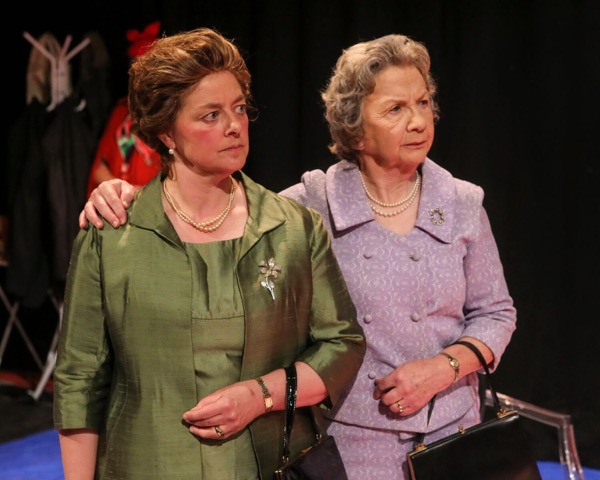
Beginning at the newly elected prime minister’s first audience with the Queen in 1979, the play imagines what might have taken place at their weekly meetings over the next eleven years. It’s a political satire, charting key events including the Falklands, the Brighton hotel bombing and the Miners’ Strike, but ultimately focusing on the human relationship between the two women. The Queen’s baffled by Thatcher’s coldness and lack of humour, while the Prime Minister fails to understand her monarch’s love of the outdoors, and fears Her Majesty may secretly be a socialist. The stage is set for an epic clash of personalities, and that’s exactly what we get in the Tower Theatre’s production.

handbagged_3
Photo credit: Ruth Anthony

An easily recognisable older and younger version of each leader – playfully referred to in the programme as Q and T, Liz and Mags respectively – look back on events over tea and cake, bickering about what did and didn’t happen, while two increasingly dissatisfied (and disruptive) actors fill in all the other parts in the story, from Denis Thatcher to Nancy Reagan. Directed by Martin Mulgrew, Helen McCormack and Alison Liney’s Queen is warm and personable, with an occasional mischievous streak, and an urgent desire to be ‘useful’ to her country and people. In contrast, Anne Connell and Julie Arrowsmith both nail Margaret Thatcher’s icy facade, practised speech patterns and frozen facial expression – but not to such an extent that we can fail to see the vulnerability beneath, particularly towards the end of the play.

While the conversations between prime minister and monarch are often loaded with quiet sarcasm, Ian Recordon and Jonathan Wober provide much of the laugh out loud humour as they scramble to fill in all the other roles, adopting an impressive array of costumes and accents along the way and occasionally falling out over who gets the best parts. The fact that they’re hired actors in someone else’s narrative is openly acknowledged from the start, becoming increasingly significant as the play goes on, and they struggle to keep quiet about the conveniently gaping omissions.

handbagged_2
Photo credit: Ruth Anthony

For those of us born in the early 80s or later, Handbagged certainly fills in a few gaps in terms of British history and politics. Yet it never becomes dry or boring, and at times even feels surprisingly current; the description of how divided the country became over Thatcher, for instance, is very reminiscent of present tensions over Brexit. The play also helps explain some of the strong public feeling that still lingers today. The script quotes several of Margaret Thatcher’s most well-known and controversial statements, and even hearing them spoken by an actor, you can’t fail to pick up on the ruthlessness behind them (for good or evil, depending on your politics).

Don’t be fooled by the description of Handbagged as an amateur production – the Tower Theatre Company have done a fantastic job yet again on an enlightening, intelligent and, above all, thoroughly entertaining play.


Can’t see the map on iPhone? Try turning your phone to landscape and that should sort it. I don’t know why but I’m working on it… 😉

Review: Vanities: the Musical at Trafalgar Studios

We’ve waited ten years, but it’s finally here. ‎The London debut of Vanities: the Musical has been hotly anticipated, and it’s easy to see why. David Kirshenbaum’s show, which in turn is based on a 1976 play by Jack Heifner, has all the ingredients of a smash hit: an uplifting story, a catchy, toe-tapping score, a stellar cast of West End stars, and direction and choreography from American Idiot’s Racky Plews.

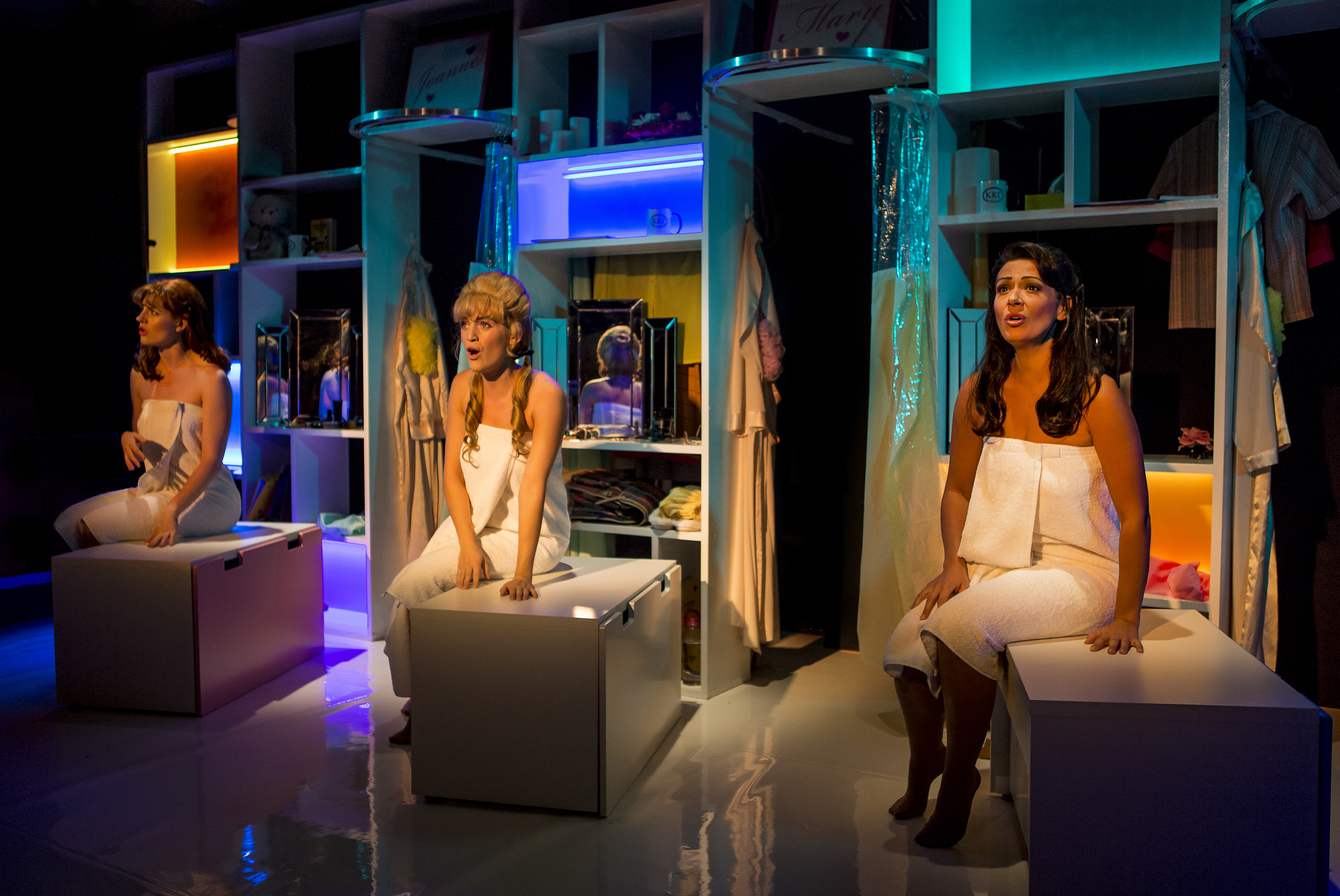
Kathy (Ashleigh Gray), Mary (Lauren Samuels) and Joanne (Lizzy Connolly) are cheerleaders from Dallas, Texas, preparing to graduate high school in 1964. Life’s been kind to the three best friends, who are used to being pretty and popular, and generally getting what they want. They have their whole lives planned out – but as the years pass, reality intrudes on their insular, superficial world, and the young women begin to realise things don’t always turn out quite like you thought they would. Can their friendship survive?

Photo credit: Pamela Raith

It’s essentially the plot of every classic American chick flick we’ve ever seen, and certainly doesn’t stand up to scrutiny in terms of realism. But those movies are wildly popular for a reason, and as cheesy and predictable as Vanities is, it’s also very easy to relate to. We might not all have been cheerleaders or sorority girls (and we definitely don’t all own erotic art galleries), but we were all teenagers once, and it’s easy to recognise ourselves – albeit sometimes a bit reluctantly – in the characters at each stage of their lives.

Because of limited space at the tiny Trafalgar Studios, where the audience sit so close to the stage that there’s a very good chance of getting hit in the face by a flying pom-pom, Vanities needs to have more up its sleeve than dazzling song and dance numbers. Racky Plews’ necessarily restrained production means the cast have nowhere to hide (unless you count the curtained changing rooms into which they disappear occasionally to age a few years), and Lauren Samuels, Lizzy Connolly and Ashleigh Gray rise to the occasion magnificently.

Photo credit: Pamela Raith

Alongside strong vocal performances, the three manage to bring a depth to their characters, even in the fluffy opening scenes when all the girls care about is make-up, hair, and if the president getting shot will interfere with their football game. Lizzy Connolly is hilarious as the naive and often gloriously tactless Joanne; her champagne-fuelled antics bring some much-needed light relief to Act 2. Ashleigh Gray’s Kathy is wound so tight you feel she might snap at any moment, and her stunning performance of Cute Boys with Short Haircuts, a significant turning point for the character, is an emotional highlight. Finally, Lauren Samuels plays Mary, on paper the least sympathetic of the three, with a haunted vulnerability that constantly contradicts the abrasiveness of her words and actions.

Andrew Riley’s pastel-coloured set is another star attraction, allowing the action to continue flowing seamlessly despite the need for multiple costume changes. Unusually, these changes actually become quite enjoyable, and even exciting, because each time the girls emerge from their changing room, their choice of outfit and hairstyle gives us an initial glimpse into the direction their life’s taken in the intervening years.

Vanities is a fun and ultimately uplifting show, with an irresistible score that will get stuck in your head for days afterwards. And whatever your views on chick flicks, there’s no doubt that this production is a triumph – so while it might not change your life, it’ll certainly brighten it for a couple of hours.


Can’t see the map on iPhone? Try turning your phone to landscape and that should sort it. I don’t know why but I’m working on it… 😉

Review: The Gospel According to Philip, Theatre N16

For Arrows & Traps, known for their popular adaptations of Shakespeare and other classic works of literature, The Gospel According to Philip is unfamiliar territory. A brand new comedy written by Richard Melchior and Heidi Svoboda, the play couldn’t be more different to the company’s last two shows: a bloody and politically charged Macbeth, preceded by a gripping adaptation of Tolstoy’s epic novel, Anna Karenina.

So, a bit of a gamble perhaps for Arrows director Ross McGregor, but did it pay off? Absolutely.

Photo credit: Davor Tovarlaza
To be more exact, The Gospel According to Philip left me wondering why it took Arrows & Traps so long to tackle their first outright comedy. Not to mention giggling all the way home over the brilliantly bonkers dance routines. (If you need only one reason to see this show, make it the unforgettable sight of Jesus Irish dancing. You’re welcome.)

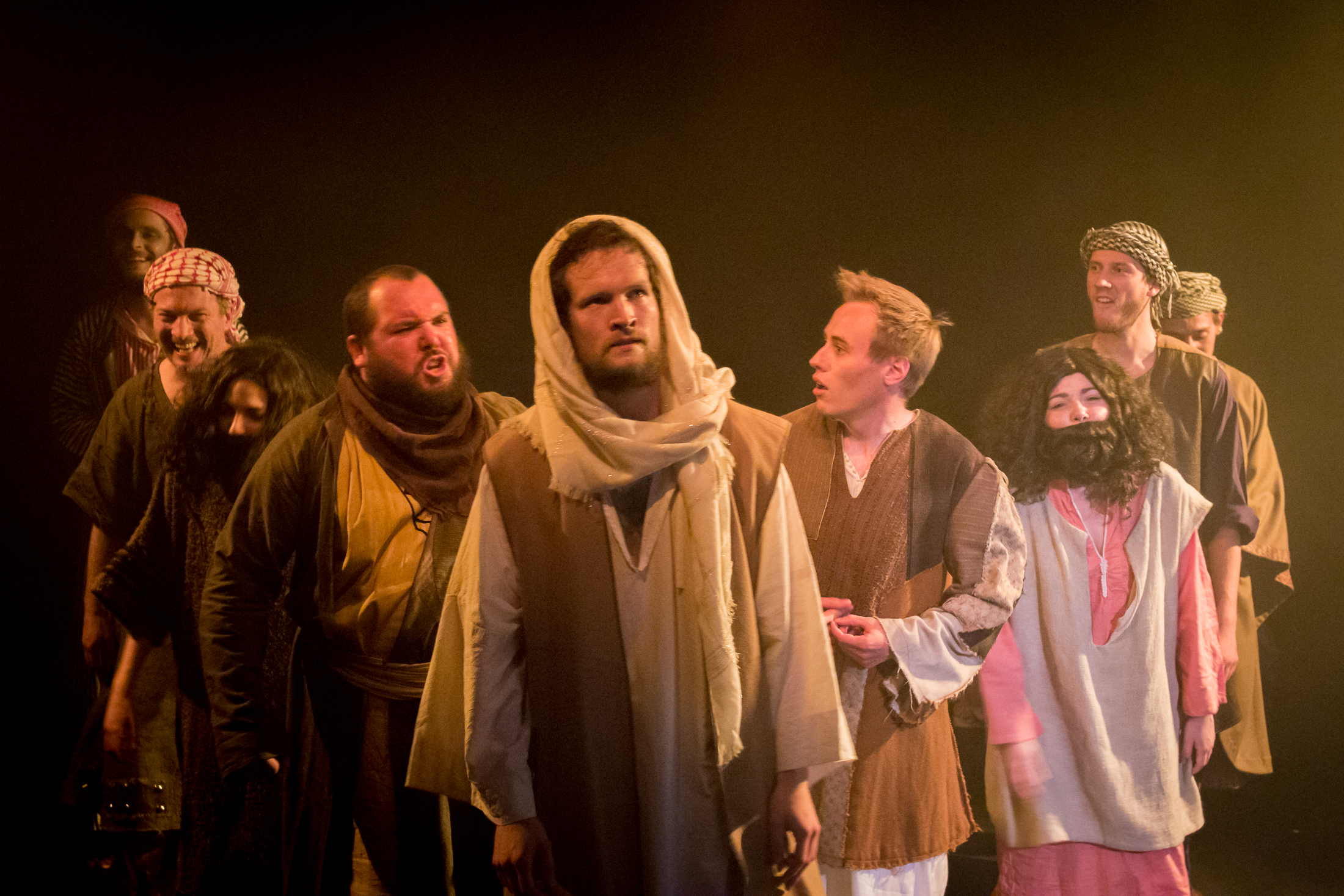
The play is an irreverent re-imagining of the story of Jesus and his disciples, leading up to the crucifixion, all set down in often quite unnecessary amounts of detail by Philip, the newest member of the gang. Will Mytum, who plays the eager apostle, is irresistible from the moment he steps on stage – even before he opens his mouth, he has us laughing with his earnest expression and childlike excitement… and he only gets more adorable as the play goes on.

As in previous Arrows productions, every member of the cast excels, with most of them taking on multiple roles, and all proving themselves to be gifted comedians. Adam Elliott is full of charisma as bad boy Judas, while Elle Banstead Salim is a whirlwind of energy as feisty chatterbox Mary Magdalene (and also puts in a couple of fantastic cameos as a bride upstaged by Jesus at her own wedding, and Pontius Pilate’s Catherine Tate-inspired receptionist). Alex Stevens has perhaps the most challenging role as Paul, whose wildly homophobic language only thinly veils his private confusion and vulnerability. And then there’s Jesus, played by Pearce Sampson, master of the beatific smile, albeit often through gritted teeth, who grows increasingly frustrated as the disciples persist in asking awkward questions he can’t answer.

Photo credit: Davor Tovarlaza
Which brings us to the message at the heart of a play that’s undoubtedly very funny, but has a serious point to make as well. In a scene that even the script acknowledges is a bit preachy and makes everyone uncomfortable, a smiley, likeable Devil (Olivia Hanrahan-Barnes) paints a vivid picture for Jesus of the bleak future ahead, in which human beings will commit acts of horrifying violence in the name of their faith – but even this can’t deter him from the path laid out for him. Later, Jesus asks Matthew Harrison-James’ Geordie-accented God (who has a few issues of his own to work out) why he has to die in such a horrific way, and – while clearly dissatisfied with the response – goes ahead and does it anyway, because that’s The Plan.

Perhaps it sounds like Melchior and Svoboda’s play is anti-religion, or out to cause offence. It’s true that it plays fast and loose with the Bible as we know it – although I must admit I quite enjoy the idea that the Last Supper might have consisted of crisps and rum instead of bread and wine. But ultimately, the unexpectedly sombre final speech of an older, wiser Philip is one of acceptance. Some people have faith; some don’t, and ultimately it doesn’t really matter – as long as we exercise caution. Believing something just because “it is written”, without question, is just as dangerous as believing nothing at all – and that’s a rule that could be applied to all kinds of things, not just religion.

The Gospel According to Philip is witty, cheeky, sometimes very silly and ultimately pretty challenging. And it’s been brought to life for the very first time by a company who, it seems, can turn their hand to just about anything. Including Irish dancing, apparently.


Can’t see the map on iPhone? Try turning your phone to landscape and that should sort it. I don’t know why but I’m working on it… 😉

Interview: The Two Bit Classics, Pride and Prejudice

It’s one of the world’s most popular love stories, the ultimate boy meets girl romantic comedy. Pride and Prejudice, written by Jane Austen in the early 19th century, has been adapted countless times for stage and screen, in many different ways – but perhaps never quite like The Two Bit Classics’ production, which is about to return for a second UK tour from October. Joannah Tincey’s adaptation features just two performers: Jo herself, and her husband, Nick Underwood.

Pride and Prejudice - UK Tour

The unique production was last staged in 2014, when it was described by A Younger Theatre as “a delightful little gem of theatre that pulses with comedy and energy”. As the company prepares to tour again, Nick explains, “We decided to bring the show back because people enjoyed it so much the first time! We had so many wonderful emails from people, many of whom wanted to see it again. We love playing the show, we enjoy working together. It’s a great fit all round.”

Pride and Prejudice has brought us some of literature’s most iconic characters, from the romantic to the ridiculous. “The characters are immediately recognisable, fallible, funny and engaging,” says Jo. “Austen creates these fully fleshed characters, full of strengths and weaknesses. We recognise ourselves in there somewhere, I think.”

But does a cast of just two actors mean we only get to enjoy two of these brilliant creations? “Definitely not!” says Jo. “21, in fact,” clarifies Nick.

Jo explains what inspired her unique adaptation: “I’d been doing a lot of work as an actor on various multi-role style productions – including some Shakespeare and Dickens. Each time I was involved in one, it struck me how clear the language becomes when you have to use it to tell an audience who you are and what you want (when you’re changing characters from moment to moment, that’s important!). I love Austen’s wonderful language and wit and it struck me that here was a way to bring it to life theatrically.

Pride and Prejudice is such a wonderful story and there are so many double-acts within it: Jane and Lizzy, Darcy and Lizzy, Mr and Mrs Bennet, Lydia and Kitty, Bingley and Darcy…”

“All the words we say are ones that Austen wrote herself,” adds Nick. “Jo didn’t need to invent dialogue. Characters use Austen’s text, we talk to the audience in character, and our job is to grow that relationship each night. It’s a really immediate and exciting way to work.”

Bringing to life so many characters with just two performers naturally presents quite a challenge. “An actor’s job is to find the truth in every character, otherwise we’re wasting an audience’s time,” Nick explains. “That doesn’t mean characters can’t be funny, but we aren’t sending them up in any way. If this was two hours of silliness, people would get bored. This is two hours of pure Austen. As for other challenges, well, you need to be pretty fit to play 21 characters between the two of you…”

Photo credit: Carrie Johnson

Unique it may be, but die-hard fans of the novel need not fear – The Two Bit Classics’ production remains completely faithful to Austen’s original. “The straightest form of the story is the novel of course, and any adaptation will offer a different experience from that,” says Jo. “Screen adaptations or more traditional stage adaptations usually need to invent dialogue – because Austen didn’t write a script! There’s always something new in there. Our take is two actors, but our language is as pure as it gets.”

Both Jo and Nick agree what excites them most about this second tour is new audiences for their show, and a fresh chance to play the story each night. “The audience are a part of the show, as it’s their imagination and response to our story-telling that brings the show alive,” says Jo. “We want them to go away having actively experienced the story of Darcy and Lizzy, having heard and felt the brilliance of Austen’s writing in a way that is really immersive.”

Nick concludes, “I hope they go away having laughed and having been moved by the brilliance of Austen’s story and characters.”

Pride and Prejudice opens at Preston Guild Hall from 6th-8th October and all tour dates can be found at www.pandptour.com.

Interview: Arrows & Traps, The Gospel According to Philip

“It’s a modern Life Of Brian, but with sharper knives,” explains Ross McGregor, Director of Arrows & Traps. Following their recent critically acclaimed production of Macbeth at New Wimbledon Studio, the company are turning their attention to something very different for their next project.

“The Gospel According To Philip is the story of a young man, Philip, who decides to join the Apostles, a secret club of men, and follow a new messiah called Jesus. The story is told from his perspective as it charts Jesus’s final weeks on earth, running to his crucifixion.”

The production began with an approach from one of the writers, Richard Melchior. “I’ve known Richard for about 10 years; we worked together early in our careers doing regional tours in East Anglia. He brought this script to me just after his co-writer, Heidi Svoboda, tragically passed away, and asked me if there was any way to get this performed, as he was really proud of it. Initially I was just interested in it from a personal level, as I’ve always been a fan of Richard’s work, but when I started to actually read it, I was blown away. The satire is wonderfully drawn and subtle enough to make you think, and these iconic, almost mythical people are so recognisable but also feel completely fresh.

“You have the different character dynamics at work in terms of the apostles, and what Richard and Heidi have done, in a stroke of genius, is to transform Jesus and his disciples into a weary primary school teacher trope trying to control a group of unruly children, which gives it so much life. You have Peter as the teacher’s pet, the smart alec filled with impossible questions in Matthew, Judas as the cool kid smoking at the back of the classroom, the remedial dunce in James, the closeted gay man in Paul, and Philip as the new kid at school. It’s a fantastic re-imagining of how the Bible should have gone.

“I was so impressed with the quality of the writing and the machine-gun-like frequency of the punchlines. It’s one of the best comedies I’ve read in quite a while – but then when the ending comes, the poignancy and sense of loss is devastating. When I realised this ending reflected Richard’s loss of Heidi after she died, and that this might be the only chance of her work being performed now – I knew I had to take it on myself.”

13891873_1141616572586829_2518341558948586424_n

Offie-nominated Arrows & Traps are known for their productions of classics, particularly Shakespeare, so the new show marks quite a departure from tradition. “This isn’t an Arrows show in the expected sense – it isn’t Shakespeare, there are no extended movement pieces, we’re not subverting a classic or switching genders – but hopefully we will retain enough of what has made the last six shows so successful and bring you a recognisable Arrows-shaped piece of entertainment – which I think means that I want to take characters that you think you know, and show you their humanity and vulnerability in a new way, whilst entertaining you senseless.

“In Arrows shows we normally try to take an old story and tell it in a new way, but with this, that exact action has already been performed by the writers before we got our hands on it. They took the Bible, spun it on its head and created The Gospel According To Philip. So the Arrows spin is done without an Arrow having to lift a finger. All we have to do now is bring it to life in the most fair and honest way possible. And make sure it’s funny, of course. Has to be funny.”

Staging a piece of new writing for the first time brings with it a new kind of pressure: “I’m wary of doing this one justice, as it’s the first time the script has ever been performed, and whilst we don’t have the shadows of hundreds of other past productions looming over us like we usually do with Shakespeare, this one seems even more important to get right because I really want this little show to have a great future, and go from strength to strength in years to come, whatever shape that might take. It’s a great piece, and deserves a long life.

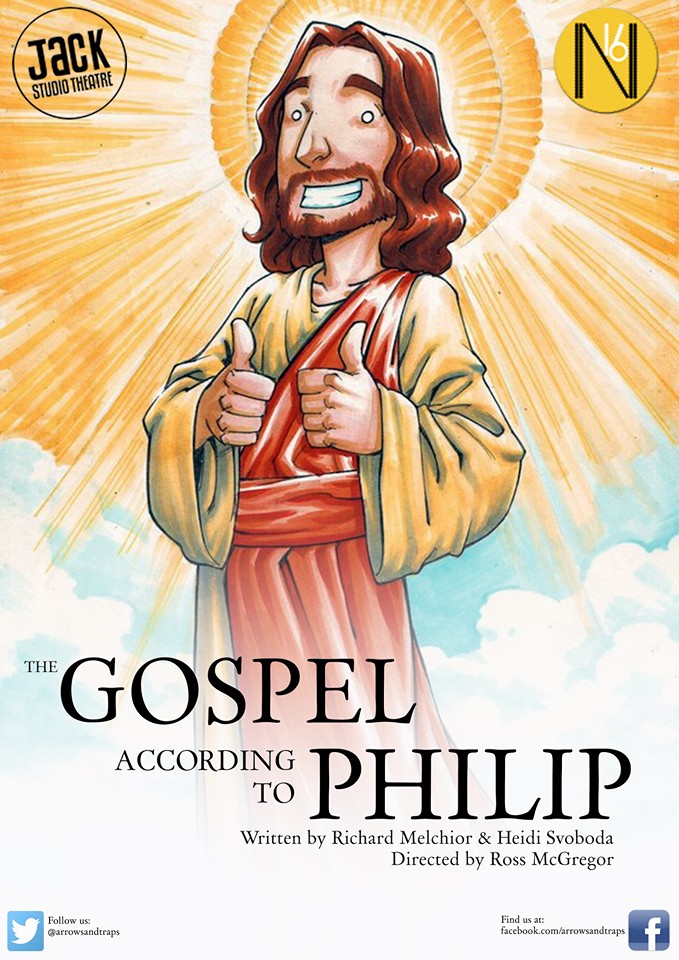
“On the other hand, there might be less pressure in terms of reviews and audiences, because with Shakespeare that’s always massive. On our last show, Macbeth, the vision and direction that the witches would take absolutely plagued me in the preparation stages, because they’re so iconic, everyone has their version of what they should be like… it was very hard to try to honour those views, honour the world of our play, serve the narratives that the text has, and also show something new with them. Lots of pressure. So Philip doesn’t have that. Or perhaps it does! I mean, doesn’t everyone kind of have a preconceived notion of what Jesus looks like? In the west, he’s a Brad Pitt-esque, blue-eyed, golden-haired white man. So I guess there’s always pressure.”

Arrows & Traps’ fanbase of “devoted trappers” will, as always, spot some familiar faces in the cast. “A massive part of what makes an Arrows & Traps show so special is the people in it. We are a repertory company in the sense that there’s a core base of people involved, but we always try to mix it up with new actors, so it stays fresh.

“We have Pearce Sampson playing Jesus, a very talented funny actor whom people may recognise as our Porter and Lennox from Macbeth, and bright young star Alex Stevens playing Paul – he was our Malcolm in Macbeth and our Demetrius in Titus Andronicus. The deliciously watchable Adam Elliott plays Judas; audiences at the Jack will remember him as Karenin, the husband in our Anna Karenina, and in the title role of Philip we have Will Mytum, a great actor renowned on the Off West End circuit, who previously played Vronsky in our Anna Karenina, and Chiron in Titus Andronicus. We have Elle Banstead-Salim playing Mary Magdalene, coming hot off of finishing her brilliant turn as Lady Macduff and Witch in Macbeth, and Gareth Kearns playing Matthew. Gareth has been involved in every Arrows show so far, and recently it was my honour to watch his 100th performance with us. There’s no-one I’d rather have on this project than Gareth, as he’s perfectly suited for it.

“And then lastly we have three new actors, Tom Telford, Matthew Harrison-James, and Olivia Hanrahan-Barnes, all of whom I’ve auditioned in the past and was impressed by – it was just about getting the right role at the right time, which we’ve now found. I guess that’s a lesson in perseverance for any actor out there feeling like it’s too tough in the industry right now. We do listen, and we do remember, and we always come back to you when the time is right. So really, this amalgamation of both old and new faces is perhaps the thing about the show that I’m most looking forward to, because there is literally no weak link in these guys.”

Why should audiences come and see The Gospel According to Philip? “A brilliant tagline a friend used when I told her about the show was Passion Of The Christ With Jokes. If that doesn’t make you want to buy a ticket, then you’re dead inside. Also, supporting brilliant and passionate fringe venues like the Brockley Jack and Theatre N16 is so important if we want places like this to keep offering their communities such diverse and arresting art on their doorsteps.

“The play might make you think, but it will definitely make you laugh. It’s a great night out at the theatre. And the themes that it raises are exactly the things that we should be talking about right now. The world is a scary place, and terrible machinations are threatening to pull us apart as a human race. Faith is often held up as a banner or scapegoat for cruelty and hatred, and really, for things as old as religion, we need to go back to the start and look at what happened and learn from it. There’s something terrifying about the way that all the different religions have become so ingrained in our culture, our faiths, and yet really – every single one of them started as a flawed, wobbly cult, a series of men meeting in dark rooms telling stories and writing down rules for life. I think this play has a lot to say about our modern world, about those of us who are lost, and about where we should draw our strength from.

“Don’t get me wrong, it isn’t a night of theological debate – there’s too many cock jokes in it for that. But as with the best of our satire, and I think Terry Pratchett may hold that crown for me, beneath the jokes and laughter there’s always a question, a poke in the ribs, something to argue about on the way home.”

Looking ahead, the rest of the season marks a return to more traditional fare, with the unique Arrows flavour that audiences have come to know and love. “The Broken Crown Season is epic. It’s massive. And it’s going to be the best work we’ve ever done. For me, the Broken Crown symbolises not just the fall of a king, but the breakdown and hollowness of responsibility, power and promise. It’s about ambition and the price that comes with it. It’s about kings, and gods, and leaders, but also relationships and trust. We’ve started things off with Macbeth, an obvious choice to get things rolling, now we’re tackling Jesus and the birth of Christianity, and after that we open our first true repertory double bill with Twelfth Night and Othello, performed simultaneously at Upstairs at the Gatehouse, on alternate nights over three weeks in November by the same cast. It’s going to be amazing fun, particularly on double show days where we do both texts.

“In the new year, we bring a modern horror-story vision of Frankenstein set in two different time periods, flicking in and out of a pair of narratives, and we finish with a thriller award-winning adaptation of Crime & Punishment, which has been boiled down into an action-packed, edge of your seat, 90-minute, three-hander, which I cannot wait to do, personally, as the script is electric. After that… watch this space.  The Arrows have plenty more stories to tell.”

Catch The Gospel According to Philip at Brockley Jack Studio Theatre from 30th August-3rd September, and Theatre N16 from 4th-8th September.