Review: The Doppel Gang at Tristan Bates Theatre

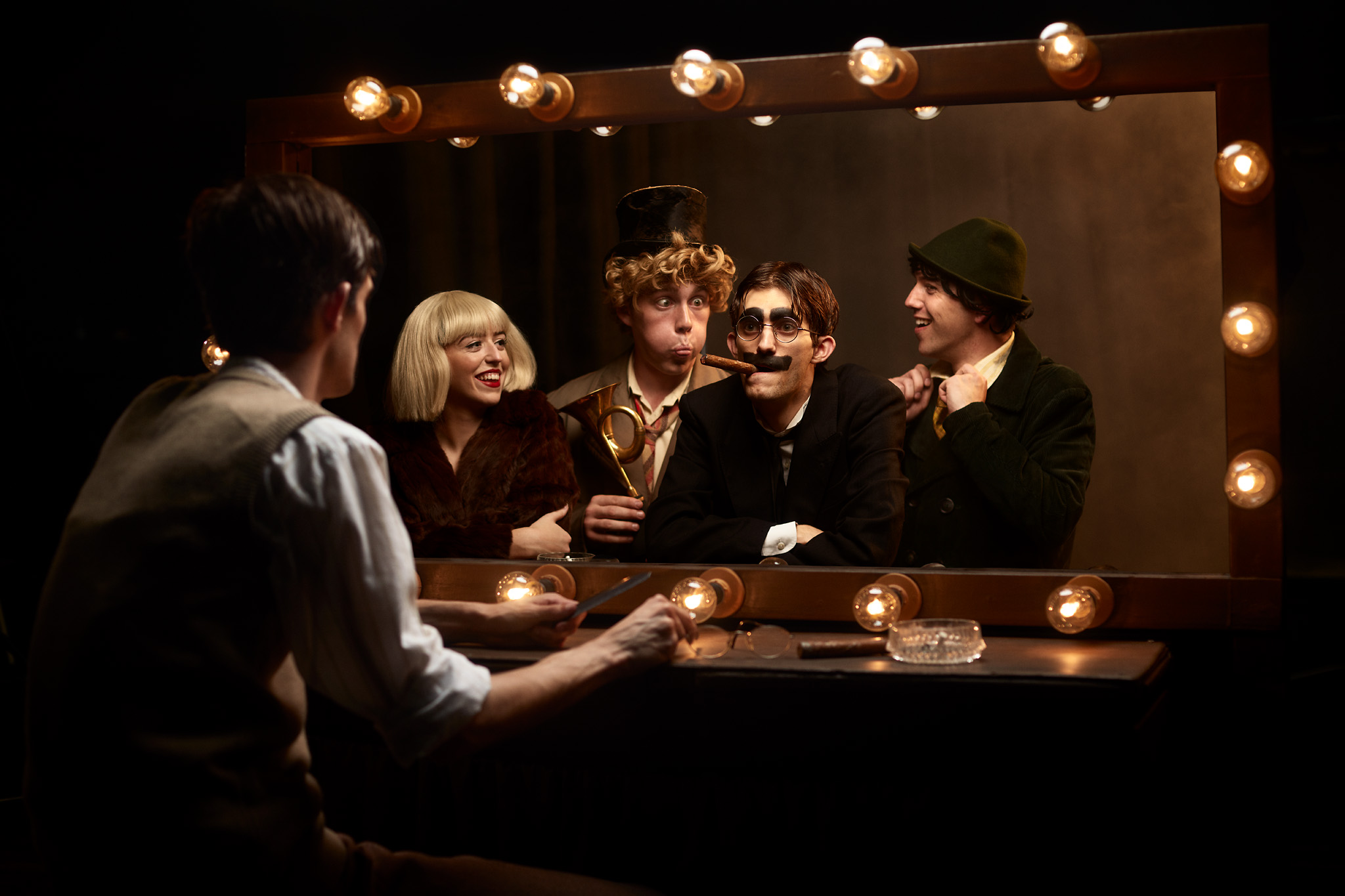
The Doppel Gang by Dominic Hedges introduces us to four mediocre performers attempting to save their cash-strapped theatre. After stumbling rather inexplicably on a stash of unproduced Marx Brothers material, they decide to try and pull off the ultimate con, impersonating the rising American stars in front of a London audience desperate to escape the horrors of the Blitz. Can they pull it off and make their escape with the cash, or will they be caught out?

It’s a fun idea, and the cast certainly seem to be enjoying themselves from the outset. The play opens with a Fawlty Towers-esque sketch scene, in which frustrated theatre owner Lombard has to deal with an incompetent workman up a ladder. Though it has little if anything to do with the rest of the story, it’s a well-fashioned salute to British humour, and sets up a nice contrast with the all-American comedy that dominates Act 2.

Photo credit: Mitchell Reeve

In fact, The Doppel Gang, directed by Terence Mann, takes great pleasure in lining up British and U.S. comedy alongside each other, and it makes the play very much one of two halves; Act 2 consists almost entirely of the group’s Marx Brothers act, whereas before the interval the focus is on establishing the characters and their often fractious relationships. Cyril (Jordan Moore) and Tommy (Peter Stone) can’t stand Lombard (Jake Urry), who they know full well is just using them for his own ends. And male impersonator Rachel (Rachel Hartley) is getting increasingly frustrated with the lack of respect she gets from the audience or her fellow performers – including her boyfriend Tommy.

The four characters’ constant sniping, and especially Rachel’s feisty disdain for the men she has to deal with, provided for me the funniest moments – although there are plenty of laughs to be found elsewhere too, especially for fans of the Marx Brothers. The cast’s enthusiasm for their subject is obvious, although not being an expert, I’ll leave it to those who know to judge the accuracy of their tribute act. And as the Brits, the four are just likeable and optimistic enough for us to overlook their conscription-dodging ways and wish them success.

There’s a subplot to all this, of course, in the threat of war that hangs over them all, and in the revelation of a secret that places one of the characters at even greater risk. The abrupt, subdued ending, coming so swiftly after half an hour of zany merriment, brings us back to earth with a bump, and out into the cold feeling slightly wrongfooted.
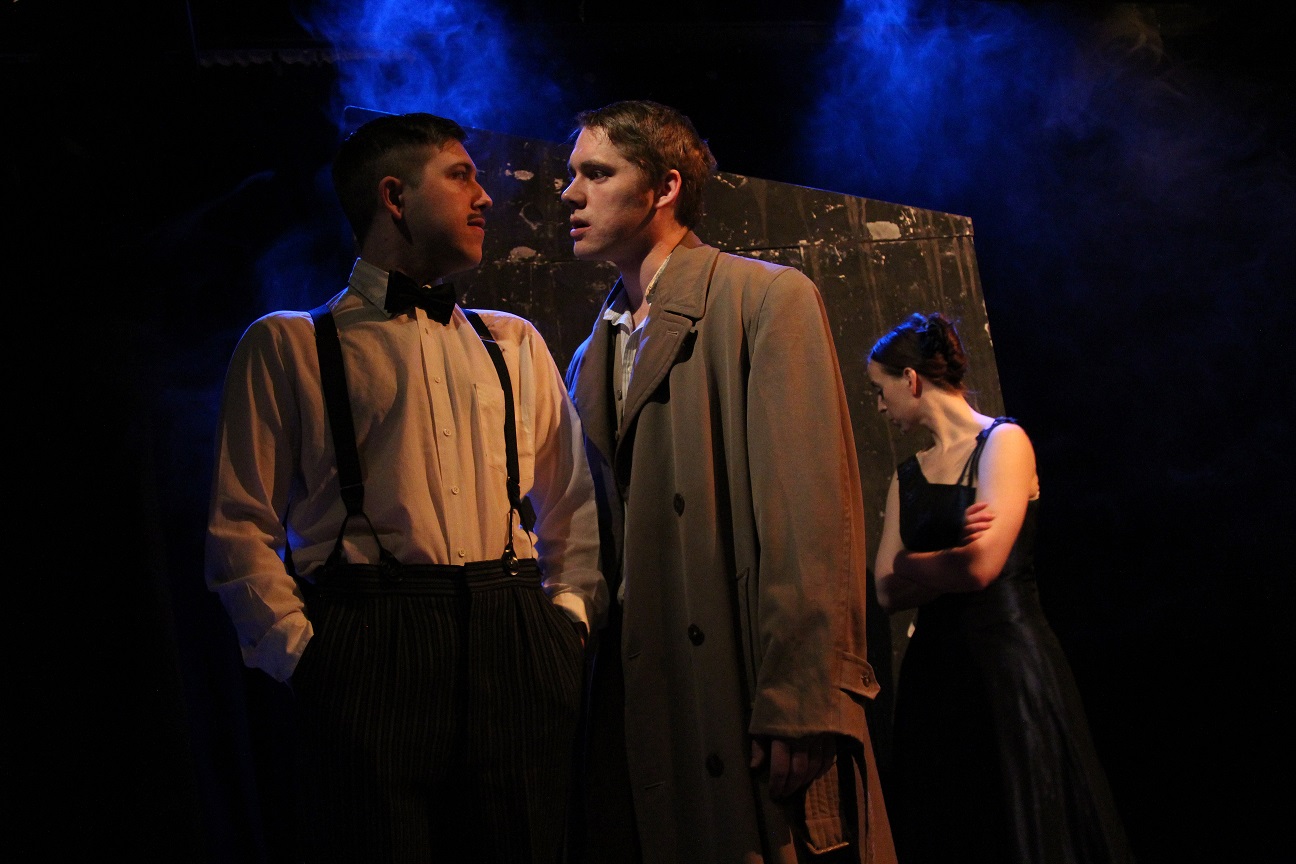
Photo credit: Mitchell Reeve

The set is really impressive for such a small space, with individual components – including a mobile proscenium arch – manoeuvred smoothly into position to take us on stage, off stage and on one occasion, underground. This gives the impression the stage is a lot bigger than it is, an idea backed up by Mitchell Reeve’s sound design, which recreates both the rumblings of war outside and the theatrical acoustics inside.

It’s a risky enterprise to make a comedy, because finding an approach everyone likes is practically impossible, but Just Some Theatre cover a couple of bases with The Doppel Gang, and do it well. I do feel that to fully appreciate this particular play you need to know and enjoy the Marx Brothers’ work (I was slightly in the dark at times during Act 2, if I’m totally honest), but nonetheless this is clearly a talented company with exciting times ahead.


Can’t see the map on iPhone? Try turning your phone to landscape and that should sort it. I don’t know why but I’m working on it… 😉

Review: The Hound of the Baskervilles at Jack Studio Theatre

Guest review by Ross McGregor

The Brockley Jack annual Christmas show is the stuff of Fringe Legend.  It sells out before it even opens, and the reasons for this incredible success are legion. The Brockley Jack is one of the most reputable and iconic venues in London, and it’s run by people who know what they’re doing and care passionately about the space. They pick good scripts, cast talented actors and produce the Christmas show themselves so audiences know it’s a sure thing. Added to this, the Jack does something other than panto – so it’s great marketing for those who are Cinderella-ed out.

This year’s offering is a comedic pastiche of Sir Arthur Conan Doyle’s The Hound of the Baskervilles. The plot is simple enough: Mr Baskerville has been murdered. People think it’s a huge hell-hound. Holmes goes up there with Watson to solve the mystery. He does. The End. The show is sold out now, so go and read the book, it’s great.

Photo credit: Tim Stubbs Hughes

The script owes a lot to plays like The 39 Steps or The Play That Goes Wrong, yet even those examples aren’t original ideas themselves, so this can be forgiven. Hound is a tight-paced physical comedy that has its three actors multi-roling rapidly between scenes, moving scenery and donning different hats, jackets and accents. It breaks the fourth wall constantly as the very conceit of the play is perpetually on the verge of falling apart, and the actors are forced to break character and become “themselves” more than once. Now, whilst I do have an issue with shows that try to do both a crappy play and make that funny (cod-accents and dodgy props), whilst doing a play crappily (falling down sets and scene changes going wrong), I have to admit the grace and tenacity with which this production was helmed completely won me over and had me giggling with glee. The highlight of the show for me was just after the interval when one of the actors gets irate with the audience after reading an interval tweet and forces his co-stars (and us) to go through the first half at triple speed to prove he was capable of a quicker pace. This moment of building chaos really sums up the production for me; it’s self-aware and tongue-in-cheek, it’s modern and humble, but it’s done with such slickness and panache that the audience are happy to be whipped through the same scenes again, like reading a York Notes Study Guide whilst on amphetamines.

Joey Bartram plays the Great Detective Sherlock Holmes – a role made difficult to make your own after so many iconic performances on screen recently (perhaps the 21st century’s Hamlet?), and this production sees Bartram striding about the stage dripping with confidence (sometimes sweat) and a faraway look, whilst whipping his dark locks about him like he’s modelling shampoo. It’s a boho, gin-drenched, Oxbridge kind of a take on the role, and it’s in keeping with the show, but it’s really the character actor side role/suspects where Bartram shines, teeth-gnashing, winking and scowling his way through scenes.

Adam Elliott plays the Doctor Watson role, which really, due to the absence of Holmes for a large section of the production, is promoted to leading man status. Watson is normally a dog of a part, if you pardon the pun, and yet Elliott does it, thankfully, with charisma and charm. Having seen Elliott perform on the Fringe multiple times now, I’m starting to think that there aren’t many things the actor cannot do. He is a great talent, and one that has a bright future ahead of him. He’s eminently watchable, has an almost flawless grasp of comedic timing, and handles the numerous roles he’s awarded with versatility and a sense of child-like glee. 

Photo credit: Tim Stubbs Hughes

Andrew Fitch completes the trinity with a wide-eyed and energised Sir Henry Baskerville – the next victim of the Hound that Holmes and Watson are trying to keep from becoming pedigree chum. Fitch has a mountain of roles to contend with (even some that have to be performed on the first floor of the building above the theatre), and he manages to distinguish each one clearly and without undue effort, and he more than gives the two heroes a run for their money in terms of acting chops.

Kate Bannister (director), Karl Swinyard (set design) and Michael Edwards (lighting design) deserve all the credit for turning the small acting space of the Jack Studio Theatre into dozens of different locations, flicking instantly between a foggy moor to a dining room to a train carriage to a horse and cart, all with simple props choices, movement direction, action set pieces, moveable scenery and some of the slickest and most inventive lighting operation I have EVER seen on the Fringe circuit, helmed by Stage Manager John Fricker who seriously deserves an Off West End Award by himself just for managing that many sound and lighting cues on a fringe theatre tech desk.

If not already clear, this play is hilariously funny.  The idea is not a new one, nor does it particularly care to strive for anything above an entertaining night out, but it doesn’t have to. It’s an incredibly well-directed, well-performed and well-constructed comedy, that’s firing on all cylinders and never lets up for a second. It’s a work of true skill, made by professionals who know their craft.

Fringe Theatre, at its best, transcends its limitations and is palpably made with love, passion, creativity and care. Kate Bannister and her team have done exactly that. I would say this should transfer somewhere bigger, but then perhaps it might lose some of the charm that makes it so impressive a feat of the face of their restrictions of space and budget. So perhaps I will say that the Jack Studio Theatre deserve and need all the support, investment and love that their community and fanbase can give them, for they really are a jewel in the London Theatre Crown. Edinburgh Festival 2017 Venue Managers, you better get this show booked in whilst you can…


Can’t see the map on iPhone? Try turning your phone to landscape and that should sort it. I don’t know why but I’m working on it… 😉

Theatre Things: 2016 highlights

Someone told me yesterday that they find New Year a bit of a confusing time, because they never know whether they should be celebrating the last 12 months or looking forward to the next.

Well. This year more than ever, I’m all about looking forward and making the best of the opportunities 2017 has to offer. But while there’s a lot about 2016 that we might like to forget, it did bring us a lot of great theatre. So I’d like to pause for a moment and take a look back at a few of my highlights from the last 12 months. (As always, these are in no particular order – ranking them from 1 to 10 requires a level of decisiveness that’s far beyond me.)

Anna Karenina (Arrows and Traps) at Brockley Jack Studio Theatre

It was inevitable that the Arrows would find their way into my top 10, but I’ve chosen Anna Karenina for this list, because it marked the moment I really fell in love with their work. Condensing Tolstoy’s epic novel into a drama as accessible as it was gripping, Anna Karenina bore all the hallmarks we’ve come to expect from an Arrows show: creatively staged, exquisitely performed and visually stunning.

Anna Karenina
Photo credit: The Ocular Creative

Transports (Pipeline Theatre) at the Pleasance

A heartbreaking and incredibly timely play, Transports never explicitly mentioned current events, but nonetheless offered a powerful statement about the emotional trauma faced by refugees every day. Based on the life of designer Alan Munden’s mother, Liesl, the interlocking stories of two girls were simply and lovingly staged in a powerful and thought-provoking production.

Cargo (Metal Rabbit Productions) at Arcola Theatre

It’s not really surprising that the experience of being a refugee has been a common theme in the theatre of 2016, but Tess Berry-Hart’s Cargo stands out as particularly powerful, because it turned the tables and forced us to not only imagine but actually experience what it might be like if we were the ones forced to flee our homes and seek refuge overseas. The result was a production that was disturbing, tense and unsettlingly authentic.

Blind Man’s Song (Theatre Re) at the Pleasance

This one was a surprise to me, because going in I had no idea what to expect and really wasn’t sure if I’d enjoy this combination of mime, dance, sound, illusion and original music. But Theatre Re’s Blind Man’s Song was a revelation; I was soon swept away by the beauty of the love story unfolding on stage, and by the reminder of how much emotion can be expressed without saying a single word.

We Live By The Sea (Patch of Blue) at Arts Theatre

Patch of Blue struck gold again this year with We Live By The Sea, a beautiful and sensitive portrayal of a young girl with autism. While the carefully researched production made no attempt to conceal the difficulties experienced by Katy and her family, it also challenged us to look beyond her autism – and our own assumptions – to celebrate the person behind it and everything she had to offer.

Photo credit: Scarab Pictures

Dare Devil Rides to Jarama (Townsend Productions) at the Bussey Building (on tour)

Commissioned by the International Brigades Memorial Trust, Dare Devil Rides to Jarama – which continues touring into 2017 – tells the little-known but fascinating story of Clem Beckett, a young speedway rider from Manchester who gave his life fighting against fascism in the Spanish Civil War. Despite its sad ending, the story’s told with charm and humour by writer Neil Gore in a script that combines poetry, prose, music, and an enjoyable bit of audience participation.

Pride and Prejudice (Two Bit Classics) at Greenwich Theatre (on tour)

As a fan of Jane Austen’s classic novel, I was either going to love or hate Two Bit Classics’ adaptation of Pride and Prejudice for two actors; it didn’t take long to decide it was the former. In an astonishing display of stamina, Joannah Tincey and Nick Underwood took on 21 characters between them, switching genders, costumes and accents at the drop of a hat in this funny and enjoyable show.

The We Plays at the Hope Theatre

Cyprus Sunsets, the first in this double bill of monologues from up and coming talent Andrew Maddock, just missed out on my top 10 last year… but it’s time to put that right. The We Plays combined Cyprus Sunsets with Irn Pru – two very different stories that nonetheless shared an ability to wrongfoot and shock us. Powerful writing and captivating performances ensured the double bill definitely made the list this year.

Scrooge and the Seven Dwarves (Sleeping Trees) at Theatre503

Who would have thought a panto would make it into my top 10? Not me – but Sleeping Trees’ mash-up of Dickens and Disney is such a brilliant, hilarious and above all original take on the classic format that I’m currently trying to decide if I can squeeze in a repeat visit before it closes next week. And I shall also be demanding that every panto I see from now on features a giant lobster…

Photo credit: David Monteith-Hodge

Her Aching Heart at the Hope Theatre

The Hope Theatre has had a great year, and it came to a triumphant, five-star end with Her Aching Heart, a lesbian gothic romance musical two-hander written by Bryony Lavery. A laugh out loud comedy, this unexpected delight of a show affectionately mocked the Mills and Boon genre on which it was based, while a modern day love story unfolding simultaneously introduced a more contemplative note.

And let’s not forget:

The Memory Show, All Male H.M.S. Pinafore, This is Living, How to Win Against History, TitanicHarry Potter and the Cursed Child, An Inspector Calls, A Midsummer Night’s Dream, Sunny Afternoon – and a couple that I didn’t review but still want to shout about: Jesus Christ Superstar and Imogen.

Now, let’s see what 2017 has in store…

Happy New Year!

Review: The Mechanicals’ Twelfth Night at St Giles in the Fields

I last saw Scena Mundi Theatre Company performing Twelfth Night at the stunning French Protestant Church in Soho Square earlier this year. This week they were back, in an equally beautiful venue, with a one night only performance of the same play… but a very different adaptation.

Billed as ‘the new masters of concise classics’, the Scena Mundi Mechanicals specialise in short versions of Shakespeare’s plays, inspired by the memorable amateur actors of A Midsummer Night’s Dream. It’s an intriguing and clever concept, which makes Shakespeare’s work very accessible and adds an original twist to a play many of us will have seen a good few times before. As the four actors – Masters Phil, Jack, Ned and Martin – divide up the roles between them, the stage is set for chaos and comedy, featuring a bearded lady, a dodgy wig, floating hats, and of course yellow stockings.

Photo credit: Jim Templeton-Cross

Given the complex storyline of Twelfth Night, director Cecilia Dorland has done well to cut the script down to almost exactly an hour in a way that still makes sense, and leaves us with a whistle-stop tour of all the key points and characters (well, almost – we’re forced to lose Maria, with Sir Toby Belch taking her place as the architect of Malvolio’s downfall). The performance too, with all its swift costume and character changes, is very skilfully executed by the four-man cast of Pip Brignall, Jack Christie, Edward Fisher and Martin Prest, with nicely understated musical support from flautist Emma Hall.

In fact if anything it’s a bit too well executed – the Mechanicals concept is introduced at the beginning but then seems largely forgotten during the play itself, and though there’s the occasional missing prop or actor’s tantrum, the production on the whole is extremely polished. It feels odd to complain that the acting in a play is too good, but what makes the Midsummer Night’s Dream Mechanicals fun to watch is the fact that their performance is so shambolic, and there’s potential in Scena Mundi’s adaptation for even more well-intentioned mayhem. This band of Mechanicals never get their lines wrong, forget which part they’re playing, or stop the performance to explain to the audience what’s going on; the director never has to intervene, and aside from one brief exchange at the beginning of the show, nobody tries to play all the parts. None of which is a bad thing – it just feels like the framing concept could be further developed for maximum comedy value.

scena-mundi-mechanicals-twelfth-night-rehearsals-091
Photo credit: Jim Templeton-Cross

All that said, this is already a highly original and entertaining production of a classic play. As a bite-sized introduction to Twelfth Night, it’s perfect for newcomers to Shakespeare, who might find the usual two-and-a-half or even three-hour stretch a bit much to take. And let’s be honest, it’s always fun to watch good actors acting badly. This one-off performance was the first in a series of events at St Giles in the Fields to launch Scena Mundi’s 2017 season, and I look forward to seeing more of them in the coming months.


Can’t see the map on iPhone? Try turning your phone to landscape and that should sort it. I don’t know why but I’m working on it… 😉

Interview: Dominic Hedges, The Doppel Gang

“The secret of good comedy is barking up the wrong tree,” says Dominic Hedges, a theatre and filmmaker from East London. His play, The Doppel Gang, is following up last year’s successful tour with a run at the Tristan Bates Theatre in the new year, presented by trio Just Some Theatre Company. Set in 1940s London, the play fuses the comedy of the Marx Brothers with classic British humour, against the all too serious backdrop of the Second World War and the Blitz. “Four conscription-dodging spivs try to save their crumbling theatre by impersonating the Marx Brothers, but naturally each party is in it for themselves,” summarises Dominic.

dominic-hedges-headshot-copy

The idea to write a play about the Marx Brothers came from Just Some Theatre Company: “They love the Marx Brothers! They approached me to write a piece for them and after a ton of knocking ideas about we decided that an out-and-out biography wasn’t what we wanted. So I took the floundering, double-dealing, British motley bunch route of old.”

So is this only a play for fans of the Marx Brothers? “No,” says Dominic. “It’s not a Marx Brothers tribute act. The show plays more as the recognisable British wartime drama-comedy where threads are pulled and twisted between characters, and misdirection and miscommunication lead to hilarious consequences, but then with this fat vein of Marx Brothers performance and wit bored through it.”

Generally considered to be among the most influential comedians of the 20th century, the popularity of the Marx Brothers continues to this day: “I think they tell jokes which we think we can write ourselves,” explains Dominic. “On paper they vary from rubbish Dad jokes to ingenious turns of phrase and wordplay. But when you hear the jokes delivered, especially when you watch them on film, each move of their comedy is unique and unmistakable. When U.S. film became more prevalent in the UK we lapped it up.”

Photo credit: Tom Barker

As a writer, Dominic has no qualms about handing his work over to a theatre company. “It’s exciting. The director Terence Mann is fantastic and we read from the same page more often than not. He knows what’s best for the show when they’re all in the room working and that’s something I had no interest in sticking my nose in! If it’s not as I envision it that’s probably a good thing. Having said that, if the zero-gravity scene on wires made the cut, I’ll be having words…

“My advice to a writer who’s just starting out would be: meet up with other writers, performers, artists, anybody you trust artistically, and read your work aloud. It’s the best thing in the world. Life is not a word processor. When I have serious doubts about my career choice it’s almost always because I’ve not heard my work aloud for a good while.”

And finally, who does Dominic think is funnier, Brits or Americans? His response is diplomatic: “Hmm… hard to say, but in a contest between the two, one of them is bound to win!”

The Doppel Gang is at Tristan Bates Theatre from 17th January-11th February.