Interview: Caroline Byrne, Blocked

Playwright Caroline Byrne returns to the Brighton Fringe this month with her new play, Blocked, which uses comedy to challenge society’s unspoken rules against talking about infertility. “A famous stand-up’s successful routine – sending up love, marriage and babies – falls apart as she melts down. It’s fast paced and delivered as a stand up routine throughout.”

Caroline explains that Blocked was inspired by her own experience of failed fertility treatment: “There’s a taboo around discussing infertility that society imposes on you and you get crap advice from people. I wanted to explore this and use dark humour to engage the audience, so that’s why I made the character a comedian.”

The show’s performed by Laura Curnick, and reunites Caroline with acclaimed director Scott Le Crass, following a previous collaboration at the Brighton Fringe 2015. “Scott directed my play In A Better Place, which was set in a hotel room, in the rock n roll themed Hotel Pelirocco,” she explains. “He is extremely creative and also very tactful and calm, so I was relieved when he agreed to direct Blocked because traditionally writers aren’t allowed in rehearsal – so you have to trust your director completely or you’d go mad. Scott has been nominated for many awards, and recently had a West End Transfer with Sid, a fabulous show.”

Blocked promises something of a mixed experience for Brighton audiences: “I want them to laugh out loud at the stand up, and then slap them in the face with the final dramatic act,” says Caroline. “You should come and see it because it’s a provocative standup routine within a piece of theatre. Two genres for the price of one!”

As the Brighton Fringe gets underway for another year, Caroline has plenty to look forward to. “I can’t wait to watch Laura Curnick perform the show for the first time!” she says. “But I’ll also be catching up with other theatre buddies and seeing their shows. In particular I’m looking forward to Nick Myles’ Trouble with Men, three great shorts. Also Goddess by Serena Haywood and Purged starring Orla Sanders.”

After Brighton, Caroline has several exciting projects lined up with her company Pure Fluke Theatre. “We write daring, comic roles for women over 35,” she explains. “I’ve just finished a new sitcom about working in fringe, with my co-writer Rachel Goth. The material writes itself. I’m also planning to tour my farce How To Make Money From Art in Ireland.”

Catch Blocked at Duke Box from 18th-24th May.
Interview: Iain Gibbons, The Performance

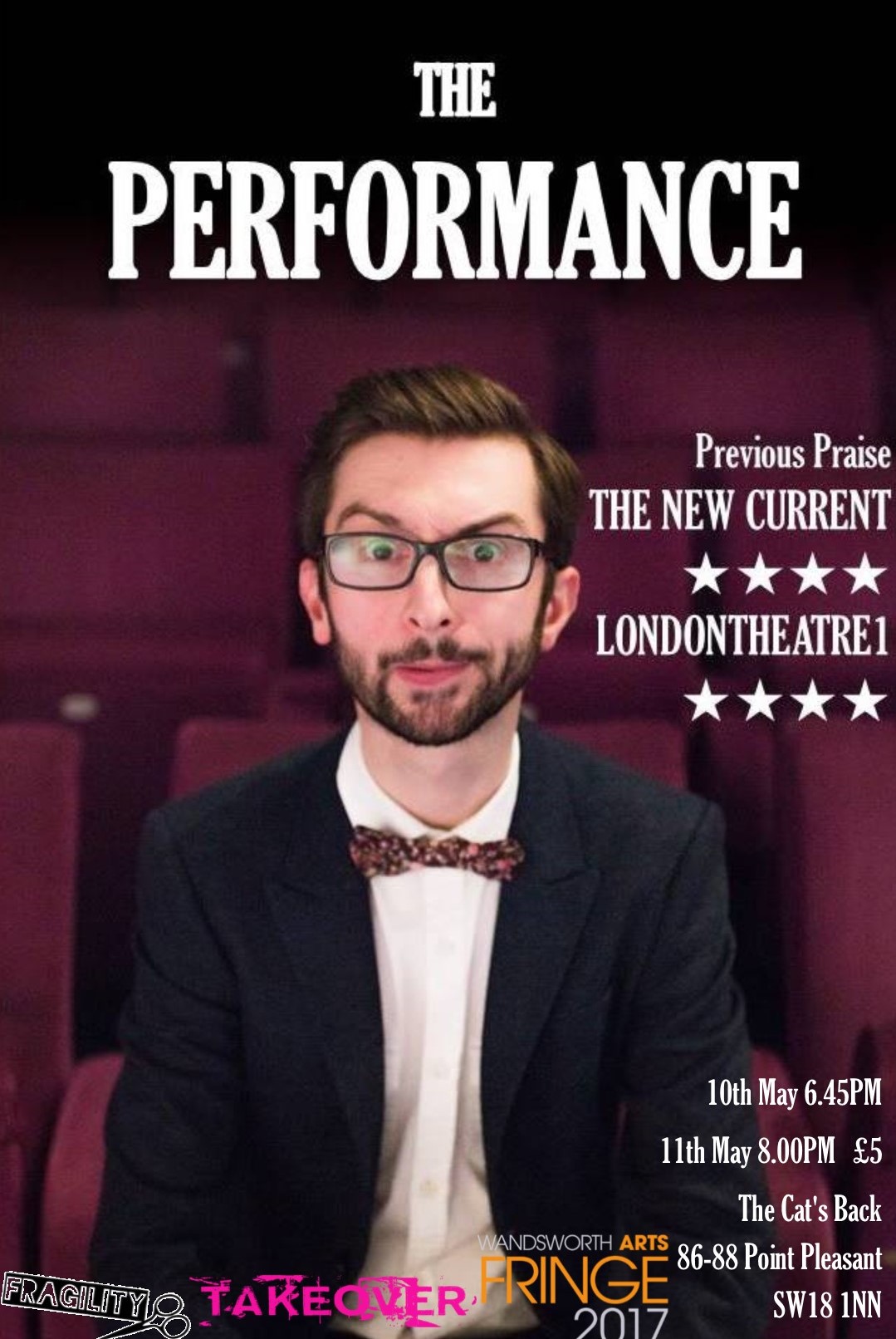
Iain Gibbons is a London-based actor, most recently seen as a stressed out junior doctor in Resuscitate Theatre’s Rounds at the Blue Elephant Theatre. But he’ll be taking on a rather more light-hearted role in his new solo show, The Performance, which previews at the Wandsworth Fringe on 10th and 11th May before heading to Brighton for its premiere.

The Performance is a sometimes sketch, sometimes clown, sometimes farcical comedy show about three men’s attempts to make the best of a bad situation,” explains Iain. “The performance must go ahead, no matter how silly things get.

“Originally, the idea came from a Charlie Chaplin quote that says, ‘Life is a tragedy when seen in close-up, but a comedy in long shot’. Also, after watching some of the later Jacques Tati films, where often you would see one eccentric figure in the giant canvas of the shot, I began to wonder what ‘giant canvas’ I could set a comic figure against. As I spend a lot of my time in theatre auditoriums, I decided to create a short experimental piece in 2012 where the audience sat on the stage and looked up at a lone figure eating his lunch in a sea of red seats. The idea was funny to me and remained in the back of my mind until I decided to develop it further late last year.”

Though The Performance is not his first one-man show, after working as part of a close-knit team on devising and performing Rounds, Iain admits to mixed feelings about performing solo again. “It’s absolutely terrifying. The key element of creating theatre for me, particularly comedy, is responding to an audience. You can only know if a show works when you’re physically there performing it with people. A lot of the work I’ve done for this show has been alone in a room trying to work out how to physically get from one place to another – but I have a supportive group of people I can draw reaction and ideas from, which has been invaluable in ensuring the practicalities remain fun to perform.”

As a performer, Iain takes a lot of his inspiration from classic comedy: “I watched sketches from the likes of Charlie Chaplin, Jacques Tati, Rowan Atkinson, Fry and Laurie, Monty Python and Tommy Cooper, amongst others. I think you can see a lot of these influences in the mix of the show. They were particularly essential for working out the structure of the sketches and guiding my approach to the timing. Timing will also be affected by the audience present on the night.

“I studied with master clown Philippe Gaulier, who emphasises the child-like playfulness of the moment, while listening and responding to the audience present. His master insults will be ringing in the back of my head as I discover how this show really works at the two festivals I’m attending this summer. You may also recognise influence from early Stoppard, Ionesco and Pirandello. These are all hugely successful idols to work from, which I feel is important when you’re trying to create something successfully wonderful yourself.”

In The Performance, Iain plays “the most annoying audience member you could ever wish to sit next to”. As an actor, he’s seen his fair share of bad theatre etiquette – but what bugs him the most? “From noisy eating to stage invaders, I’ve seen quite a bit of distracting activity in the theatre stalls,” he says. “However, what most irritates me are those ‘seasoned’ audience members who believe that they have a right to disrespect the audience and theatre staff. The theatre is a shared space, so we should *ahem* share the space…”

So what would his number one piece of advice be to an inexperienced theatregoer? “Have fun. Enjoy the experience of being with people presenting ideas live in front of you – or indeed in any direction. Anything could happen, so be open to the possibilities.

The Performance is like most other theatre shows, in that there will be a performer, an audience and an usher on the door. The only twist is that I’ll be playing all three. If you recognise the theatre setting, you’ll connect with the world I’m creating instantly; if you’re new to theatre, I hope I can show you how much fun we can have in a space that still appears daunting to outsiders. Come and see why I find people sharing a theatre setting fascinating to watch. But most of all, come to have fun!”

Catch The Performance at The Cat’s Back, Wandsworth on 10th and 11th May, and at The Warren: Studio 3, Brighton on 25th-27th May.

Interview: Henry Maynard, Flabbergast Theatre

“I’d like our audiences to walk away with aching sides and a slightly bemused expression, secure in the knowledge that they had a jolly good time, even if they weren’t always convinced that they had a hold on what was happening…”

Henry Maynard is a former War Horse puppeteer, Amused Moose Laugh Off finalist and founder of Flabbergast Theatre, who are bringing two of their favourite shows to Wilton’s Music Hall in London next month. One sees the return of Balkan bad boys and stars of the Edinburgh fringe, Boris and Sergey; the other is a solo show about one man’s quest for a friend, performed by Henry himself.

Photo credit: Richard Grubby

“Tatterdemalion is an hilarious one-man, silent-ish, physical comedy with silliness in abundance, to a backdrop of Victoriana and otherworldliness with a dash of pathos,” he summarises. “And Boris & Sergey’s Astonishing Freakatorium is the Balkan bad boys of puppetry’s homage to the travelling freak shows of the 1930s, featuring escapology, wild animals and a live séance… Hilarity will ensue.”

All Flabbergast’s shows are the result of an ongoing development process in which both company members and audience play a vital role. “We work with a highly collaborative devising process,” explains Henry. “I come up with the stuff… they do it.

“I’m being facetious. Normally we get in a room with our ideas and keep what makes us laugh. Then we bring it all together in a mostly coherent way.

“All our shows develop in front of the audience; the things that work stay in and the things that don’t we keep flogging away at until eventually we realise we’d be better doing something else. I like the organic way our shows grow.”

Unsurprisingly, this means that audience interaction is an important part of Flabbergast’s productions. “All live theatre relies on participation, the shame is that audiences are often unaware of it,” says Henry. “I blame Stanislavski and his cursed ‘fourth wall’. He was like an earlier version of Trump – ‘I’m gonna build a wall and the performers will pay for it!’

“If you come to a Flabbergast show you are involved and that’s what is great about live theatre – otherwise you might as well stay at home and watch Gogglebox.”

Henry founded Flabbergast back in 2010 to make uncompromising and exciting physical theatre. “I was inspired to set up Flabbergast by Puppetry, Clown, Commedia dell’arte and all the other avant-garde theatre styles that make no money… anywhere… ever,” he explains. “I wanted to perform, learn, direct and teach them. As a company, we aim to make theatre that is sweaty and engaging, physical and alive, and we want to promote puppetry and clown specifically as valid and important art forms in theatre.”

Currently, the company’s focus is on Bunraku puppetry, and particularly on how this can be used to reach an adult audience. “Bunraku is like distilled humanity,” says Henry. “We can sometimes become hardened to real adult people, callous and uncaring – but puppets get through to us like children and animals do, we sympathise with them more. They’re magical and draw the spotlight, they call to our innate desire to personify and humanise everything; we delight in their play as children delight in the antics of their toys.”

Photo credit: Claudine Quinn/Lens On Legs

Both shows have proved a hit so far, with a host of four and five star reviews, and Henry’s looking forward to sharing them with a London audience: “Bringing the shows to London and specifically to Wilton’s Music Hall is going to be incredible. It’s another feather in the Balkan bad boys of puppetry’s cap as they march towards inevitable world domination, and the beautiful theatre is the perfect backdrop for Tatterdemalion. If you’ve never been to Wilton’s Music Hall you must come to the shows just to see it. It’s the oldest grand music hall in the world.”

So of the two shows, which one does Henry recommend? “I’m in Tatterdemalion so that one…” he suggests. “But seriously, I’m proud of both the shows and they are great for different reasons. If you’re a puppetry fan, Boris & Sergey is pure puppetry fun, whereas Tatterdemalion has a sprinkling but will appeal more to physical theatre fans. Neither are pretentious though, we take a tongue in cheek approach to our art and work.” 

Then again, with a 20% discount for multiple booking, we could just see both…

Catch Boris & Sergey’s Astonishing Freakatorium and Tatterdemalion at Wilton’s Music Hall from 9th-13th May (for dates and times of each show, visit the website).

Review: Miss Nightingale at The Vaults

Matthew Bugg’s acclaimed WW2 musical Miss Nightingale may just have found its spiritual home at The Vaults. Entering the warren of dimly lit underground tunnels, we’re handed a chocolate bar and a programme designed to look like a ration book before stepping into the auditorium, which could very easily be an air raid shelter. As trains rumble in and out of Waterloo Station above our heads, it’s not a huge stretch to imagine what we’re actually hearing is bombs falling, and it’s almost a surprise to emerge into Launcelot Street and find all the buildings intact and ourselves back in the 21st century.

Photo credit: Robert Workman
Miss Nightingale does many things all at once. It’s a touching story of forbidden love, a social commentary on gay and women’s rights, and a feel-good (and really quite naughty) musical. By rights it probably should feel like a bit of a jumble, and it’s true that some elements of the plot end up a little sketchy through sheer lack of time – yet it’s impossible not to get swept up in the charm and sheer joy of it all.

It’s 1942, and war hero Sir Frank Worthington-Blythe (Nicholas Coutu-Langmead) hires Maggie Brown (Tamar Broadbent), a feisty nurse from oop north, to perform in his new club. The two quickly grow close, but Maggie’s already in a relationship with dodgy wheeler-dealer Tom (Niall Kerrigan) – and besides, it’s her friend and songwriter George (Conor O’Kane), a Polish Jew still in mourning for both his lost family and his beloved Berlin, who’s secretly captured Frank’s heart.

Forced by the law and social expectations to keep their illicit love affair under wraps, the two men end up embroiling both themselves and Maggie in a complex tangle of broken hearts and false hopes – all the while maintaining a facade of determined jollity in order to keep up morale. This is Britain, after all, and the show must go on, whatever dramas may be unfolding behind the scenes.

And there’s no doubt Miss Nightingale‘s outrageous comedy numbers know how to lift the spirits. Laden with every innuendo you can think of – and a few that you might not – they provide welcome light relief from the intensity of Frank and George’s tempestuous love affair, and particularly from the disturbing realisation that less than 100 years ago, gay couples still risked social ruin or even prison just for the chance to be together. (And worse – there’s a moment in Act 2 when George reflects on the unfairness of being persecuted in the country he came to seeking refuge; as recent events have shown all too clearly, these words could just as easily be spoken today.)

Photo credit: Robert Workman
The whole cast of actor-musicians are clearly in their element during the rude bits (and let’s be honest, who wouldn’t get a bit of a buzz out of a song whose main lyric is, “You’ve got to get your sausage where you can”?) but Matthew Bugg’s score demands a softer side too, particularly from the show’s three main stars, all of whom impress with their powerful vocals. Though best known as a comedian, Tamar Broadbent reveals she can do serious just as successfully, while Nicholas Coutu-Langmead and Conor O’Kane maintain an ideal balance in their blossoming on-stage relationship, with Frank’s timidity and stiff upper lip perfectly countered by George’s volatility and flamboyance.

This is the fifth production of Miss Nightingale, and it’s not hard to see why the show keeps returning – it really is the best of British, in more ways than one. Yes, it’s a huge amount of fun, but there’s a more serious point to all this. We might not be at war any more, but that doesn’t mean there aren’t still battles to be fought – and in an increasingly troubled world, this show reminds us that it’s as important as ever to stand up and be counted.


Can’t see the map on iPhone? Try turning your phone to landscape and that should sort it. I don’t know why but I’m working on it… 😉

Review: Chinglish at Park Theatre

Bad Chinese to English translations are the stuff of internet legend. My personal favourite sign – ‘Do not Disturb, Tiny Grass is Dreaming’ – sadly doesn’t make it into David Henry Hwang’s Chinglish, but there are still plenty of hearty belly laughs to go around in this comedy with hidden depths about an American businessman trying to make it in China.

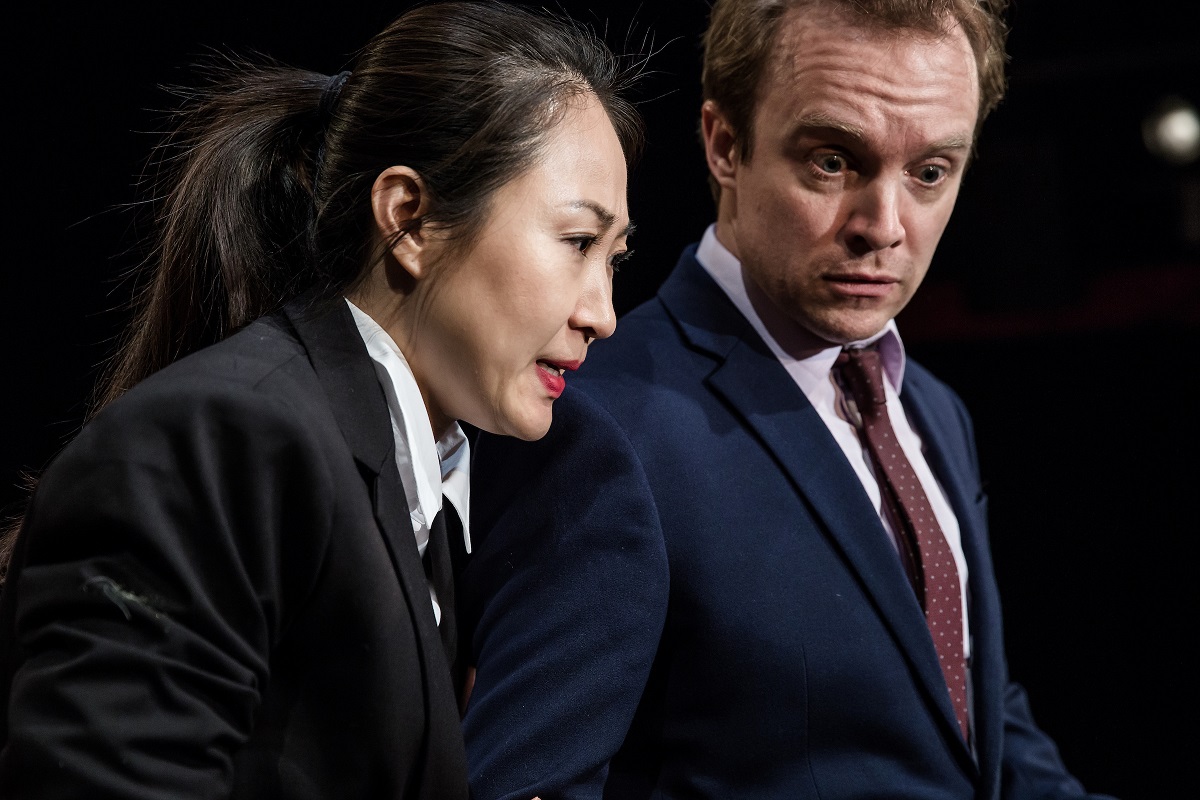
Daniel (Gyuri Sarossy) has spotted an opportunity for his Cleveland-based firm – supplying signage for a new arts centre in Guiyang. The only problem? He doesn’t speak the language or understand the culture. Employing the services of Peter (Duncan Harte), a fluent Chinese-speaking British “consultant”, Daniel pitches his proposal to a government minister (Lobo Chan) and finds himself getting along a little too well with vice-minister Xi Yan (Candy Ma). Chaos, confusion and rumours of corruption ensue… but who really has the upper hand – and why?

Photo credit: Richard Davenport for The Other Richard

A strong cast, directed by Andrew Keates, handle the bilingual script with ease, with Candy Ma and Duncan Harte particularly impressive as they slip effortlessly from Mandarin to English and back again. Gyuri Sarossy, meanwhile, hits exactly the right note as the bewildered Daniel, his early cockiness fading rapidly as he begins to realise what he’s got himself into, and his later scenes with Ma are loaded with an unexpected emotional intensity.

Though a good proportion of the script is in Chinese, the audience never feels lost in translation, thanks to the provision of surtitles throughout (though this does sometimes mean turning away from the actor who’s speaking in order to keep up with what they’re saying). This gives us an advantage over most of the characters, who only speak either English or Chinese, and allows us to appreciate the humour in both the hilariously inept efforts of the Chinese interpreters and Daniel’s fumbling attempts to speak Mandarin himself. There’s no question of taking sides; the good-natured humour targets both East and West equally, warding off any accusations of prejudice in either direction.

Ironically, from our privileged position of bilingualism, one of the hardest scenes to follow is mostly in English (in fact it’s so tricky that we share the characters’ jubilation and relief when they finally understand each other). And it’s here that Hwang moves away from light comedy, and into something altogether more complex. This isn’t just an opportunity for us all to have a good laugh at people making language mistakes – and just as well; as funny as these undoubtedly are, a solid two hours of them might be a bit exhausting.

Where the play really gets interesting is in its exploration of the fundamental difference in business, political and cultural practices between East and West. As business consultant Peter discovers to his cost, sometimes even being able to speak the local lingo like a native isn’t enough; in such vastly different cultures, a word that’s directly translated from one language to another can still mean something completely different.

Photo credit: Richard Davenport for The Other Richard

Just as fascinating as the script is Tim McQuillen-Wright’s set, which begins as a simple panelled wall but then unfolds like origami (yes I know, wrong country) to reveal hidden doors, windows, a restaurant kitchen and even a bedroom. As a result, each scene change offers an intriguing opportunity to see what it’ll do – and where it’ll take us – next.

Chinglish is a lot of fun, with some great comic performances and a few unexpected twists and turns that prove worth waiting for. But it’s also a genuinely interesting play to watch, from both a linguistic and business perspective. Not everyone ends up getting what they want (in fact, make that hardly anyone), but the bittersweet conclusion comes with some important lessons for everyone involved – and lends new meaning to Daniel’s own top tip to “always bring your own translator”.

And if you just enjoy laughing at funny Chinese signs – well, it’s got plenty of those too.


Can’t see the map on iPhone? Try turning your phone to landscape and that should sort it. I don’t know why but I’m working on it… 😉