Interview: Liam Joseph, PLUTO

Liam Joseph and Callum O’Brien met when they were working Front of House together at the Harold Pinter Theatre. Now co-founders of their own company, Moonchild Theatre, this month they return to London with their acclaimed first production, PLUTO.

PLUTO tells the story of the titular former planet during the period in which he finds out he is no longer a planet,” says Liam, who plays Pluto. “We follow his story as he battles with an identity crisis and his moon Charon tries her best to keep his spirits high. The show is an allegorical examination of LGBT issues that are still rampant in the world today.”

Liam explains that the story of PLUTO was inspired by the now notorious anti-LGBT laws passed in North Carolina last year, which required transgender people to use the restrooms that matched their birth certificate. “On the surface this would seem an unlikely source to inspire a play about the former planet Pluto,” he admits. “However, the story of a governing body dictating the personal identity of others and actively doing harm in the process, upon closer inspection, does in fact bear a remarkable similarity to that of our fallen cosmic comrade. The toilets of North Carolina have been exchanged for the constellations of the night sky. In lieu of the transgender population there is a distant planet battling with his identity.

Photo credit: Dave Bird

“Although our story is not limited specifically to transgender struggles, these ongoing issues – and many like it – helped develop the themes of identity, labelling and loneliness that form the emotional crux of PLUTO. This play is a marriage of two enormous but previously unrelated themes; the LGBTQ+ experience in today’s society and the beautiful, incomprehensible mysteries of space.”

The show was last performed in April at Baron’s Court Theatre, where Millennial London called it “an impressive first production of a new play that captures many important issues in today’s world”. Now returning as part of the Camden Fringe, the show’s undergone some changes: “As we’re now performing as part of a festival run, the show had to be adapted to suit the new working environment,” explains Liam. “With strict get in and get out times, it was necessary for us to cut the run time of the play from eighty minutes to one hour. It used to be bookended by a prologue and epilogue of human characters, to bring the audience back down to earth – literally – but that’s completely gone now.

“It’s much more streamlined and serious, focusing more on the effect of labels and the issues that labels cause in society. And it also opens up a whole new level to the relationship between Pluto and Charon, the icy twins who live in the furthest reaches of the solar system. Completely removed from the solar system, one wants to escape their one-billion-year solitude and the other wants to stay in their ‘safe oasis of anxiety’. Naturally this causes catastrophic tension…”

Despite these changes in structure, the message and spirit of the piece has remained intact: “The show is generally aimed at a millennial/queer audience whose experiences we hope the show manages to capture,” says Liam. “We are a theatre company composed of relatively young individuals and so it was in our interest to create theatre that appealed to us as audience members.

“I think Callum would agree in saying it’s a fable for the millennial; understand that this story is happening now in London as we speak. So many young millennials struggle with being labelled something by ‘words on a page’ and it affects them deeply. We can all do something by accepting each other for who we are: human beings. Simple as that.”

Photo credit: Dave Bird


The foundation of Moonchild Theatre came about when the two friends and colleagues realised they’d rather be on the stage than in front of it. “I wanted to be on stage so I asked Callum to write me a play – that’s it!” says Liam. “Over time, we’ve seen PLUTO and ultimately our ethos grow and change, but our aim is to create ‘Now Theatre’, dealing with issues that society’s happy to brush under the rug. We don’t want to solve them, we want people to be aware of them and be able to engage and debate these issues.

“The whole process has been a huge surprise. We only wanted to put a play on and now it’s turned into a successful theatre company with fans and regulars. We were surprised about how many people wanted to see PLUTO at the Baron’s Court and how well it was received by the reviewers.

“All in all, to be able to perform at the King’s Head Theatre, the most prestigious gay theatre in the world, and The Cockpit this summer, we’ve done and achieved a lot more than we’d ever hoped for. The future is ours!”

See PLUTO tonight (1st August) at the King’s Head Theatre or book for the Cockpit Theatre from 14th-17th August.


Interview: Jemma Burgess, Beautiful Little Fools

“We want audiences to leave the performances asking questions. To be even more curious. To spark debate. To think about their own beliefs and other people’s beliefs and ask why…”

Jemma Burgess, the founder of Optic Theatre, makes her playwriting debut at the Cockpit Theatre next month with Beautiful Little Fools, a piece inspired by recent political events. “Beautiful Little Fools is an all-female, new writing piece exploring how media can manipulate the human mind,” she explains. “With Trump, The Iron Lady, Mrs Strong and Stable, The Bush and more. We see if three girls can be brainwashed to adhere to the government’s demands. In today’s turbulent times, this couldn’t be more relevant.”

Perhaps unsurprisingly, when Jemma outlines her inspirations for the show, the recent UK general election and the rise of Donald Trump top the list. “But also documentaries and programmes such as Hypernormalisation by Adam Curtis,” she adds. “The Handmaid’s Tale. Big Brother. Black Mirror. Books: The Great Gatsby and 1984. Social experiments: Pavlov’s Dog. MK ULTRA and The Stanford Prison Experiment. Lastly, just listening and observing people that I know. Their views on the world and why they believe what they believe.”

Jemma set up the company with a clear goal in mind: “Optic Theatre was founded to give more opportunity to women within the Industry, without writing a play specifically for women or revising a play and gender swapping the roles,” she explains. “At the end of the day, we are all human; raw, messy, caring, beautiful humans. I want to make theatre that is both challenging and exhilarating to perform. Stories that come from our guts and our impulses.”

True to that vision, Beautiful Little Fools is presented by an all-female team. “Our director Anna Marshall recently graduated from the Ecole
Internationale de Theatre de Jacques Lecoq in Paris, and also has a BA Hons from the Royal Central School of Speech and Drama in Puppetry. With a vast and outstanding CV, we are so chuffed to have her directing Beautiful Little Fools,” says Jemma, who trained at the Academy of Live and Recorded Arts, and will also perform as SUBJECT A in the production. “Sophia Hannides, who plays SUBJECT D, trained alongside me and went on to sign with Cole Kitchen after graduating; she’s recently appeared in Doctors. 

“After graduating from Guildford School of Acting, Izzy Goldby-Briggs, who plays SUBJECT C, moved to London and is hoping to set up a writing group for actors, mainly looking into short films that could be used for show reel material. And lastly is Jessica Collins, who plays SUBJECT B. Jessica has trained at the BRIT school since she was fourteen and has gone on to perform in programmes such as the BBC’s Silent Witness and Doctors.”

Beautiful Little Fools doesn’t only mark Jemma’s debut as a writer – it’s also her company’s first time at the Camden Fringe. “We’re all looking forward to pretty much everything,” she says. “It’s an exciting process and we are constantly learning. It’s a fantastic festival and we hope that it can open opportunities for future development of the play.

“Ours is a show for anyone interested in all-female work and female equality. Physical theatre lovers. Anyone who’s curious about how the world is run. From students to your grandma, if you have an opinion on the ‘system’, then come and see our show.”

See Beautiful Little Fools at the Cockpit Theatre on 7th and 8th August.

Review: Suddenly…! at the Cockpit Theatre

I always imagine it must be pretty terrifying making theatre for children. Grownups will (usually) at least pretend to look interested, but with kids there’s no such guarantee. Fortunately, Really Big Pants Theatre’s Suddenly…! had its young audience at the Cockpit Theatre spellbound from the start… and the adults had a pretty good time too.

Photo credit: ID Photography

Suddenly…! takes elements from different fairy tales and mixes them together in an original, exciting and heartwarming story about the importance of friendship. Red Riding Hood, Mr Wolf, a faulty genie and a wicked stepmother all make an appearance, as a young boy’s well-intentioned attempt to get his dad’s attention goes horribly wrong, and we set out on a quest to recover three special items and help Grandma save the day.

The show’s written and performed by Really Big Pants’ Joe Bromley and Willow Nash, who play all the characters with the help of assorted interesting headwear and a variety of accents, not to mention boundless enthusiasm and obvious enjoyment. It’s thoroughly entertaining, but there’s also a strong educational element to the show; besides its core message about how friendship and spending quality time together are more important than having lots of stuff, there are also brief lessons in history and science, a bit of feminism (no princesses waiting around for a man to rescue them in this story, thank you very much), and – to my delight – a tribute to the late great Roald Dahl. Afterwards, children can take away worksheets and even enter a story-writing competition for a chance to see their work published in the Ham & High newspaper.

Not surprisingly for a kids’ show, audience participation is encouraged, but in a gentle, positive way that means nobody feels singled out or uncomfortable – and it’s a testament to how enjoyable it all is that everyone’s more than happy to join in (yes, even I was up on my feet doing the genie dance). Judging by the enthusiasm of our relatively small audience at the Cockpit, I can only imagine the noise levels when the show’s performed in a school hall full of excited children.

Photo credit: ID Photography

The show is also very funny, and like any good kids’ story contains jokes for both children and adults, so everyone stays engaged and entertained throughout. But the humour isn’t the only thing that works on two levels – as the story itself points out, it’s not just children who need to be reminded that material possessions aren’t everything, or that we should put down our phones once in a while and spend some time with the people we care about.

Suddenly…! is a great story and a lot of fun for the whole family, performed with an infectious energy and enthusiasm by two ladies who clearly love what they do. It’s educational but never boring, and enjoyably silly without being patronising. And because Really Big Pants encourage their audience – young and old – to go away and write their own stories, the fun doesn’t have to stop when the show ends.

Really Big Pants Theatre perform at theatres, festivals, schools and community venues. For all upcoming dates or to book them for an event, visit reallybigpants.co.uk or follow them on Twitter @reallybptheatre.


Can’t see the map on iPhone? Try turning your phone to landscape and that should sort it. I don’t know why but I’m working on it… 😉

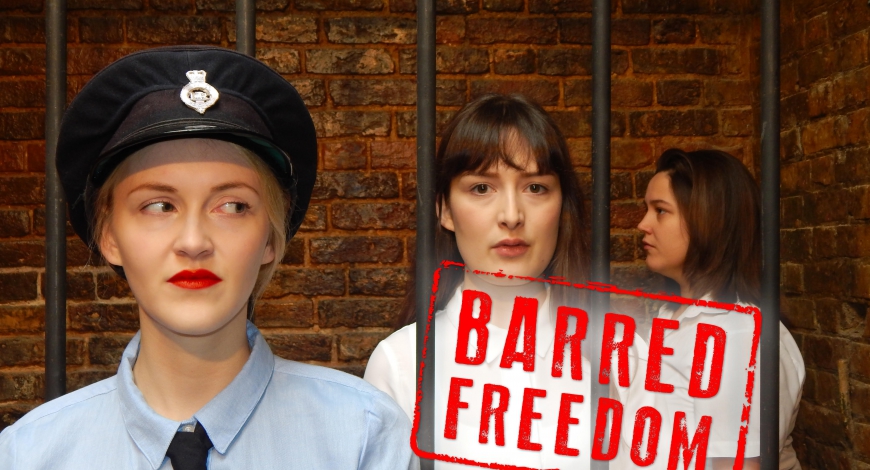
Review: Barred Freedom at the Cockpit Theatre

Barred Freedom is the ambitious first project from producer and actor Matthew Hawes. Written by Eugene Ambrose, the play has two casts, one male and one female, who’ll take to the stage on alternating nights throughout this week’s run at the Cockpit Theatre. It’s an interesting idea – the play examines not only the experience of being in prison for each set of characters, but also the developing friendship between them, both of which I imagine could play out quite differently for men and women – and it’s a pity that limited time allows only one viewing.

Anyway, for the purposes of this review, let’s discuss the boys, who are directed by Asia Osborne (while writer Eugene Ambrose directs the female cast). Set in a prison in the 1970s, the story introduces us to well-spoken, educated and – let’s be honest – insufferable know-it-all Wentworth (Adam Sabatti), who’s a new arrival in prison having murdered his spouse (one downfall of the gender neutral approach is that this unlikely word keeps coming up in conversation). His cellmate Dawson (Matthew Hawes) is the polar opposite – he’s been in and out of prison for years, can’t read or write, and spends most of the time having to decipher his Cockney rhyming slang for Wentworth, who unsurprisingly prefers Latin. The two men have been locked in their cell for an indefinite amount of time because of a riot in another wing, and try to alleviate the boredom by talking and playing games, before turning their attention to plotting an escape.

Both Matthew Hawes and Adam Sabatti – along with Mark Loveday, who plays thuggish prison guard Deacon – make their professional theatre debuts with enthusiastic and reasonably polished performances; Hawes is particularly engaging as Dawson, a cheeky chappy with hidden depths and a kind heart. Even so, there are times when the play could use a bit of action. The conversation between the two prisoners takes some interesting twists and turns, but confined as they are to one place (with only their bunks, a table and chairs, and a bucket – which fortunately never gets used – to work with), the story doesn’t really go anywhere and meanders along from one subject to the next, ending on a sweet but rather subdued note instead of the explosive twist ending I’d hoped for.

There’s definitely potential here, though; there are a few almost-incidents that could be developed, and with a bit of pruning (we probably only needed one alphabet game, for instance) the play could be a really interesting one-act piece exploring the true nature of freedom, which ultimately emerges as the story’s central theme. More could also be made of Deacon’s character; his appearances are few and far between, and seem to serve primarily as bonding opportunities for the two cellmates. He’s a bit of a stereotype – bullying prison guard who thinks the prisoners’ lives belong to him – but right at the end, Mark Loveday’s performance reveals a hint of uncertainty that could be explored further. Maybe the prisoners aren’t the only ones looking for a way to escape their grim reality? 

For a debut production, Barred Freedom is off to a promising start, with solid performances and some thought-provoking questions to take away and mull over. It needs a bit of honing, but I’ll be interested to see how the play develops from here.


Can’t see the map on iPhone? Try turning your phone to landscape and that should sort it. I don’t know why but I’m working on it… 😉

Interview: Palindrome Productions, Watching Glory Die

“Our major and abiding goal is giving voice to the dispossessed – those written out of history. Live performance has the ability to wake the dead and let them speak,” explains Lesley Ferris, director and co-founder of British-American company Palindrome Productions. “It’s always a highlight for us to witness the astonishment of audience members at seeing a living history about which they knew little if anything: the history of the British actress and suffrage, for instance, or the British history behind Palestine. Both of these still impact us today.”

The company’s latest offering, Watching Glory Die by Judith Thompson, was inspired by the true story of 19-year-old Canadian inmate Ashley Smith, who choked herself to death while her prison guards, on suicide watch, stood by and did nothing. Opening at Cockpit Theatre on 19th July, the play sees three women – prison inmate Glory, her mother and her guard – portrayed by a single performer, Victoria Fox.

Photo credit: Palindrome Productions

Both Lesley and dramaturg Penny Farfan – Professor of Drama at the University of Calgary and past editor of Theatre Journal – have long admired the work of Judith Thompson, a leading Canadian playwright, and seized the opportunity to work together on Watching Glory Die. “Thompson is a unique voice in Canadian theatre, renowned for her distinctive combination of poetic power and shocking brutality, as exemplified in Watching Glory Die,” says Penny. “She’s helped to shape modern Canadian theatre by staging aspects of society not typically seen on stage. In doing so, her work has found an international, as well as national, audience.

“Palindrome has a commitment to women playwrights, marginalized voices, and social justice. With its three female characters and its exploration of the tragic failure of the correctional system to serve the needs of one of its most vulnerable inmates, Thompson’s play is a perfect match for Palindrome. And the production offers a wonderful opportunity for London audiences to see a recent play by an important contemporary playwright.”

Palindrome’s co-founder Lesley Ferris has a long-standing passion for women’s writing: “Women have historically been marginalized and in some cases removed from history.  When I first began to study women playwrights, after I finished my degrees, I was horrified that no teacher or professor ever talked about or rarely included women’s work in their courses. Aphra Behn was a 17th century British playwright and the second most produced following the Restoration. She wrote amazing comedies that had feminist themes, and she was the first woman in Britain to write roles that women would actually perform. After her death her plays were still produced but by the time of the Victorian era she was quietly removed from sight – a woman who wrote comedies! Strong vibrant roles for women! Get rid of her!!

“History informs the present, so discovering Aphra made me think abut the present – and theatre is the art form of the present tense, so I’m committed to producing women writers and encouraging others to do so. In the USA a campaign for more women playwrights began a few years back: 50/50 in 2020 – 50% of plays produced by women by 2020, which is the centenary of the vote for women in the USA.  Scholars and theatre artists are tracking this, and there may be recently a bit of improvement but there’s still a long way to go.”

WFG_870x470

Why should audiences come and see Watching Glory Die? “Multiple reasons!” says Lesley. “The play addresses an aspect of our culture – incarceration of women – that has become more extreme and problematic in the 21st century. But it’s also an opportunity to see Judith Thompson’s work, and how she imagines a solo work that takes in three distinct roles. By making this a solo work instead of a three-hander, Thompson points out the links to be made between women.”

Penny adds one more reason: “Ashley Smith was Canadian, but the issues that Thompson’s play raises transcend national borders. As Thompson has said, ‘There are Ashleys all over the world.’”

Catch the UK premiere of Watching Glory Die from 19th-23rd July at Cockpit Theatre.