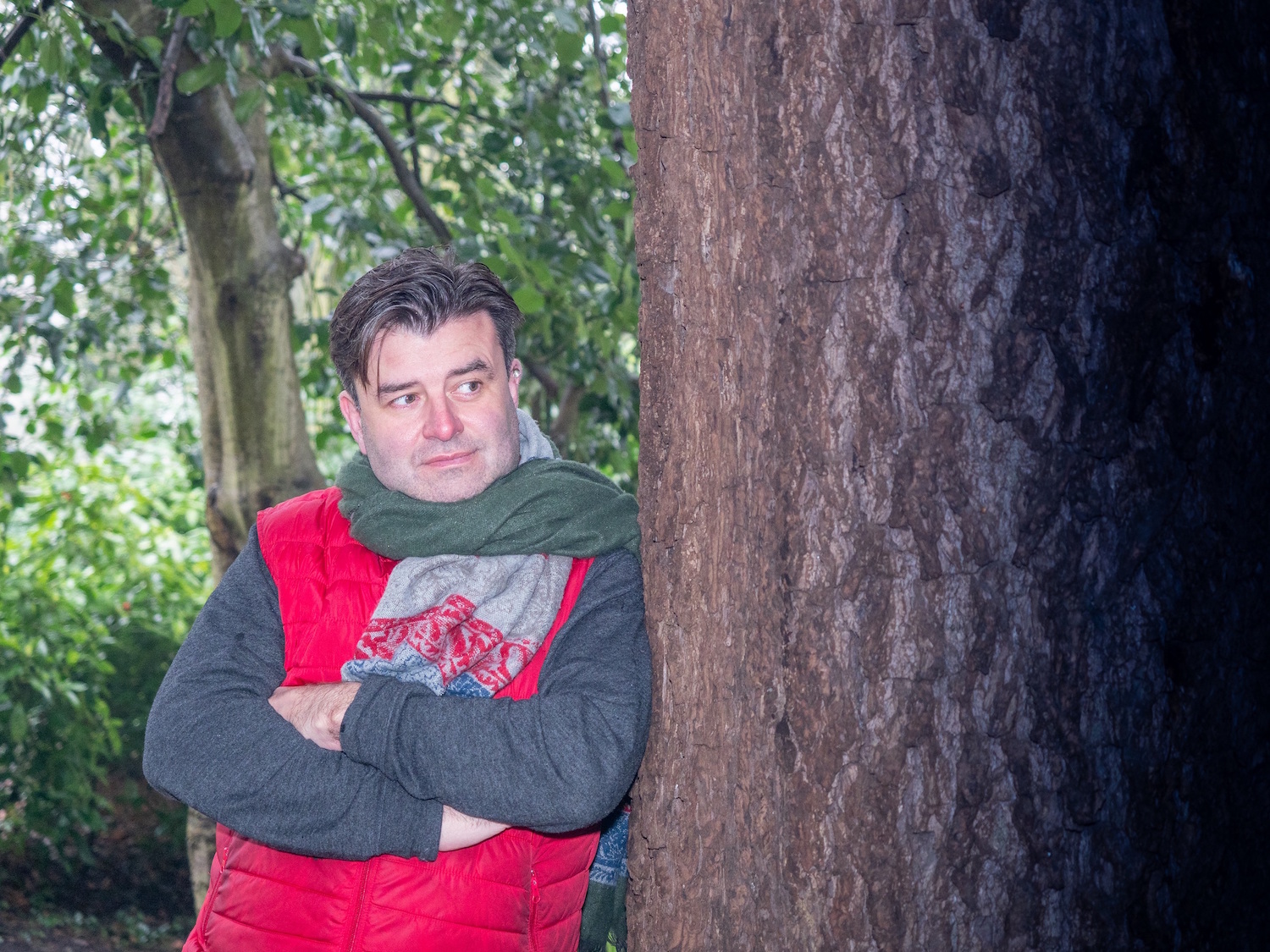
Interview: Miriam Gould, Empty Room

Miriam Gould is a theatre-maker, performer, musician and writer. In August her first solo show, Empty Room, comes to the Camden Fringe, drawing on Miriam’s own experience and family history, and exploring the many ways in which music can help us survive.

Empty Room is about a family unit – a mother, father and daughter, who each, in their way, are struggling with life and using music to cope,” she explains. “In a wider sense, it’s about parenthood,  childhood, and music. The parents are jazz musicians and the daughter is obsessed with the Soviet neo-classical composer Shostakovich. All three are using music in different ways in order to survive. In their own ways, they’re all trying to find coping mechanisms for the absurdity of existence.”

Empty Room is a very personal project for Miriam, and was inspired by her parents, who were both jazz musicians: “The music in the show, some live, some recorded, is either written or played by my parents or Shostakovich – with whom I am genuinely obsessed,” she says. “My mother wrote some incredible songs which describe what was going on, with a poetry that gets to the heart of things in a way simple text could never do. I have always been struck by the power of music to communicate a depth of experience and emotion that we otherwise struggle to convey.

“From the age of 6, it was just me and my Mum, and the fact that she managed to be a parent as well as a jazz singer still baffles me. But mostly it inspired me to make my own way. My father died – spoiler alert! – and the amount of love and respect for him in the jazz community makes me proud even though I had nothing to do with it. So I guess, to give a really boring answer, my parents have inspired me. Perhaps, more specifically, it’s my mother’s compassion and forgiveness that infuse the show.

“Oh, and Shostakovich. He was amazing. He lived in a place and time where writing a symphony was a life or death scenario. And still he made the music he needed to make. Even though he was censored in every other possible way, and at times showed real cowardice in order to survive, he spoke the truth in his music. So, yeah. Did I mention I love him?”
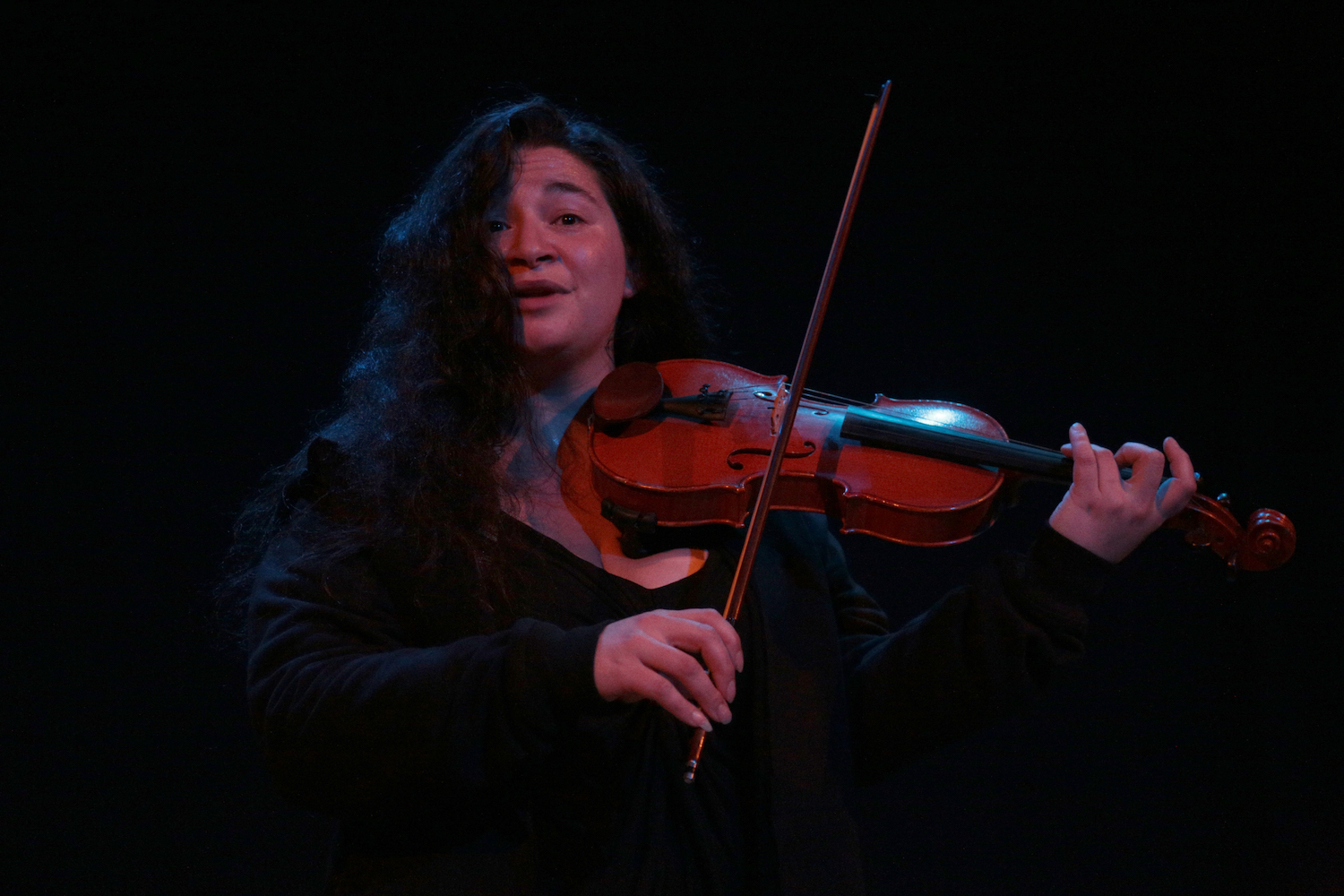
Empty Room by Miriam Gould at Battersea Arts Centre
Photo credit: India Roper-Evans

Miriam started work on Empty Room all the way back in December 2014, and the following August performed a few works-in-progress in London and Canterbury. “It was just me, working in a room on my own. I’d never made my own work before. Then I got busy with other projects until November last year. I’d been wise enough to film the performances in 2015 and was able to show this to Alex Scott, the Artistic Director of Little Bulb Theatre, whom I very much wanted to be my dramaturg. I needed to not be on my own in a room for all the rest of the process.

“I’m currently in my last few days of tweaking the show based on feedback and how it felt to perform it in June when I had a couple of showings at Battersea Arts Centre. I really believe that sharing your work when it’s not finished, but you’re ready to share it, is so incredibly valuable. Especially with the right audience. BAC’s audiences are primed for scratch performances, so it’s such a great place to work and not be afraid of failing.

“When I first started working on the show, it was a revelation to me to perform as my mother and my father. I learnt so much about them by trying to get into their skin. It changed my life in a big way at the time. Now, I’m able to be more detached from the very close material. It’s obviously still important to be aware of how I’m doing emotionally throughout the performances, but the processing of the material happened in the rehearsal room.

“I love telling this story, more and more because of what it’s really about, and not because it’s autobiographical. I love sharing the idealism in it, the love and compassion, the passion and humour. I want to start a conversation with the audience. I always make a point to talk to as many people as possible after the shows, not to hear more about the performance, but much more to hear what it sparked in people’s minds or bodies.”

Although Empty Room is a very personal story, Miriam believes it will resonate with a lot of people: “I hope it allows people to rethink their relationship with their parents or children, especially if that relationship is strained. The younger version of myself in the show is very passionate and pretty awkward, so I think this will be familiar to how a lot of people feel even if they don’t show that side of themselves on a daily basis. I suppose I want it to be cathartic for the audience, that a space is created where they can have all the feelings and maybe connect with a younger, more naive part of themselves.

“On a less emotional level, I also hope that people will love the music, not just the jazz but also the Shostakovich. After the sharing in June someone said how rare it is for them to see someone play classical music. I have a massive bee in my bonnet about the (perceived?) elitism in classical music and I hope that by sharing some of the music I’m passionate about, some members of the audience might be tempted to seek it out for themselves.”
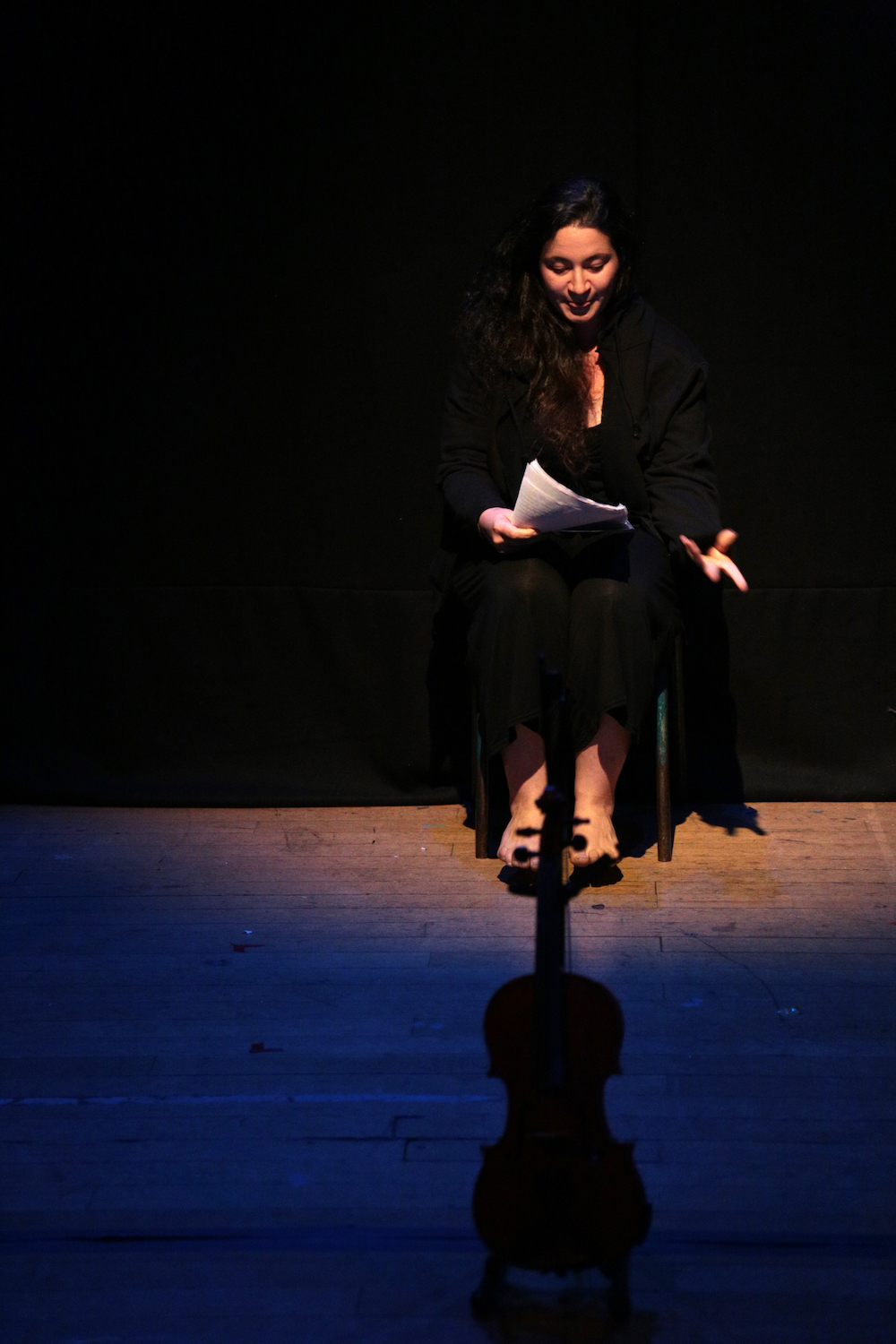
Empty Room at Battersea Arts Centre
Photo credit: India Roper-Evans

A unique feature of the show is The Survival Playlist. “Basically, each audience member is given a slip on which to write a song that has helped them get through a difficult time at some point in their life,” says Miriam. “If they want to share more about this, they are welcome to do so. There is also a Twitter handle – #SurvivalPlaylist – through which I have gathered some gorgeous submissions already. To begin with, it will be published and continually added to on my website with links to the songs. Eventually I would like to make this playlist available on other platforms as well, through Spotify and hopefully a podcast.

“I think the most interesting thing about the Survival Playlist is not the actual playlist itself, but the conversations and memories that it sparks, as well as the simple fact that music means so much to us, especially when we’re hitting rock bottom, and the playlist is a celebration of music as a survival tool.”

As well as making work on her own, Miriam is also an Associate Artist with Little Bulb Theatre and the co-founder of female theatre duo Double Trouble Theatre, whose work focuses on real-life events through soundscapes, poetic imagery and story-telling.

“In a lot of ways, the idealism of Empty Room echoes my own belief in the arts,” she says. “I am convinced that we have evolved to make art for a reason, it’s not just some frivolous thing to keep us busy in between the important stuff like shopping. At the same time, I wish we as a culture would view artists more like craftspeople, less like it’s some martyr’s calling, and more like an occupation. Which it is.

“I want the work I make to draw people in, so it must be entertaining, but I don’t just want to tell people what they know already, or even worse, not tell them anything at all. Finding the balance between communicating something deeper and meaningful and making work that doesn’t empty theatres, I guess that’s something most artists are trying to achieve.

“I see art as socially cohesive, which surely must be even more important now that we’re all constantly being divided and pitted against one another. I don’t want my audience to agree with me. I want them to engage in the work and respond, in whatever way is best for them.”

Review: Into The Woods at the Cockpit Theatre

Once upon a time… Stephen Sondheim and James Lapine got together to write a musical based on classic fairy tales, including Cinderella, Rapunzel, Jack and the Beanstalk and Little Red Riding Hood. But there’s a twist to this tale: the happy ending comes halfway through, and on reflection in Act 2 turns out to be not quite so happy after all – mostly because none of the characters is satisfied even after they get their wish. A lot of the show’s appeal lies in that simple fact: after listening to their stories all our lives, it’s oddly comforting to discover our favourite fairy tale characters are just as flawed as the rest of us.

In this revival of his 2014 adaptation, Tim McArthur takes that idea one step further, bringing the characters out of their fairy tales altogether and into a world inspired by 21st century reality TV. TOWIE, Jeremy Kyle and Made in Chelsea are all recognisable influences – although interestingly, the Baker and his Wife seem to hail more from Greggs than from Bake Off.

Photo credit: David Ovenden

It’s a clever concept, and works reasonably well in terms of entertainment value as the various characters are introduced, although it doesn’t really go anywhere after that. The story – and some of the characters – remain very much rooted in a world of myth and magic, where it jars slightly that even these very modern characters can’t just whip out their phones and Google how to get what they want.

For lovers of fairy tales, the musical itself is an enchanting blend of familiar and original. The story centres around a childless Baker (Tim McArthur) and his Wife (Jo Wickham), who have to collect four obscure items to break the curse put on them by the Witch (Michele Moran) so they can have a baby. Into the woods they go, where they stumble into the paths of Jack (Jamie O’Donnell), Cinderella (Abigail Carter-Simpson), Rapunzel (Louise Olley) and Red Riding Hood (Florence Odumosu) – who just happen to have all the things they need. All seems well, until in a considerably darker Act 2, a giant starts terrorising their village and the characters are forced back into the woods to fight for survival.

This production is staged in the round, which both works and at the same time, really doesn’t. On the plus side, it does mean that the audience feels surrounded by the action; you never quite know where an actor is going to pop out of next. On the other, even from my relatively high vantage point, I couldn’t see or hear much of what was happening on the other side of Joana Dias’ impressive but complicated set of many ladders, and consequently felt like I was missing out on half the action. This wasn’t helped by the score, which frequently has actors speaking or singing over each other, and to make matters worse, there were also a few technical problems with the sound system at this particular performance.

Photo credit: David Ovenden

In spite of these issues, the cast are generally very good, with standout vocal performances from Michele Moran and Abigail Carter-Simpson as the Witch and Cinderella respectively. Meanwhile Ashley Daniels and Michael Duke bring the house down with their hilariously posh rendition of Agony (yah), and Jamie O’Donnell and Madeleine MacMahon are good fun as Glaswegian Jack and his chain-smoking, beer-swigging Mother – although their accents are at times so thick, particularly in the musical numbers, that it can become tricky to make out what they’re saying.

Though not without some problems, Into The Woods is nonetheless an ambitious and entertaining show, which puts an interesting new spin on a classic whilst retaining the wit and charm of the original. Worth a visit for fairy tale family fun.

Interview: Tim McArthur, Into The Woods

Stephen Sondheim’s Into The Woods gets a 21st century makeover this week at the Cockpit Theatre, as All Star Productions join forces with Trilby Productions to revive Tim McArthur’s adaptation of the popular musical. First seen in 2014, the show returns with an ensemble of seventeen larger-than-life characters, all drawn from modern day Britain.

“By transporting the traditional fairy tales into the 21st century, the story resonates with and reflects society as it is now,” explains Tim, who both directs and performs as the Baker in the new production. “The characters will be familiar to reality TV viewers of shows ranging from Jeremy Kyle to TOWIE and Made in Chelsea. Another unique quality is that it’s staged in the round – I want the audience to feel they are part of the story. This also gives scope within the staging to convey better the sense of journey.”

Into The Woods draws on popular fairy tales including Rapunzel, Cinderella, Jack and the Beanstalk and Red Riding Hood to tell a cautionary tale about being careful what you wish for. “Into the Woods is about loss, wanting things that you maybe shouldn’t want, taking things for granted, wanting to be happy, realising that maybe what you have is better than wishing for more,” says Tim. “It’s about dysfunctional families and more importantly how an action you make may have consequences on someone else. This is of course all told through the traditional format of well-known fairy tales, which are interwoven with each other into the simple main story of a baker and his wife. They’re desperate for a child but the witch has put them under a curse, preventing them from having a baby unless they find unique and unusual items which will reverse the witch’s curse. Their future happiness depends on their search.”

Tim directed the show on its initial run in 2014, and says he’s thrilled to return four years later in the role of the Baker. “In 2014, the producers originally asked me to direct the piece and play the part of the Baker, but because I wanted to create a new fresh vision for the show I knew it would be a challenge to both direct and perform. So, I decided to just focus my attention on the direction. Now we have in a way tested the look and feel of the show, I know it works. I have loved and known this show for nearly 30 years, so it’s a dream come true to play the Baker – one of the best male roles in musical theatre.”

The show’s cast also includes Jo Wickham, who was a member of the 2014 company and reprises her role as the Baker’s Wife, alongside several new faces. “About 80% of the cast are new and weren’t in the 2014 production, so it’s exciting to create the characters with the new actors’ energy and ideas and see how that dynamic interacts with the interpretations of the returning actors,” says Tim. “The main factor for me as a director when casting is to bring together a group of actors who are comfortable with who they are, so we can create a safe space in rehearsal to be able to play and experiment. Particularly with an ensemble piece it’s vital that there are no dominant egos. The show is the ego and that’s it. This cast are nice and talented people who care about the production and are excited to be in the rehearsal room.

“They are a mix of performers with whom I have worked as a director and/or fellow actor plus new people, so we have a creative blend of familiarity and new impetus as we come together as a group for the first time and go ‘into the woods’. Our ensemble includes a range of ages and diversity of background and experience – performers with extensive West End pedigrees, including the Rapunzel from the original London production of Into the Woods (Mary Lincoln) who returns as Cinderella’s stepmother, to performers early in their careers.”

But the cast isn’t all that’s new this time around: “Both personally and as a director, my life has changed a lot in the past four years. I very much believe that we continue to learn, grow and develop as people and you naturally bring those life experiences into the creation of the show. One of the greatest aspects of Stephen Sondheim’s work is that you continually find new meanings and emotions within both the text and music of the story.

“My first Sondheim show was a production of Follies at the Shaftesbury Theatre in 1988. I instantly fell in love with his music and lyrics, and the love affair began. Into the Woods was the third Sondheim show I saw; I was 15 years old and I saw it three times. The structure of the show is so clever, and the story is so relevant in today’s world where commerciality drives everything and encourages us to always want more and to never be happy with what we have.”

Tim isn’t only an actor and director; he’s also a singer and presenter, who can currently be heard every Friday presenting The Curtain Up Show on Resonance 104.4 FM. With so many strings to his bow, choosing highlights proves a tough challenge: “That is a really difficult question. I trained to be an actor, and since leaving drama school I have been given so many wonderful opportunities in so many different areas of the entertainment industry. I never originally wanted to be a director or a producer, or perform my solo show or even be a TV/radio presenter. But highlights are probably performing my solo show Mountains in New York at Feinstein’s 54 Below earlier this year, and playing Sam Byck in a production of Stephen Sondheim’s Assassins a few years back – and of course the chance to revisit this fabulous show.”

Review: Pluto at the Cockpit Theatre

Who among us didn’t feel a little bit sad when Pluto lost its planetary status back in 2006? Partly because it messed up the mnemonic we all learnt at school (mine was Some Men Very Easily Make Jam Sandwiches Under No Pressure, which just doesn’t work without the P) but mostly because it just all seemed a bit unnecessarily harsh. Poor old Pluto’s up there minding his own business, doing what he’s always done, and down here on Earth someone’s tweaked a few rules and suddenly he no longer makes the grade. And to add insult to injury, he didn’t even ask to be part of our solar system in the first place.

This is the premise for Moonchild Theatre’s debut show, in which a depressed Pluto (Liam Joseph) struggles to come to terms with his sudden change in status, despite the best efforts of his devoted and kind-hearted moon Charon (Charlotte Price) – and the stripper she “forgot” to cancel (Thomas Lovell) – to cheer him up. Why is there a stripper there, you may ask? Well, because Neptune, Pluto’s next door neighbour, tricked him into having a party to celebrate what he thought was going to be an exciting announcement from NASA. And then didn’t show up. Along with all the other planets.

Photo credit: Dave Bird
Writer and director Callum O’Brien’s idea of presenting Pluto and friends as people with unique personalities, emotions and even sexualities presents plenty of comic opportunities (I particularly enjoyed the shared obsession with Sigourney Weaver). But it also makes their plight a lot easier to relate to, and the play has some really moving moments – largely due to the fact we’re not just talking about planets here. The show was inspired by the ongoing controversy in the USA over transgender bathroom laws, and from this very specific starting point explores the more general theme of individuals being labelled according to someone else’s world – or in this case, solar system – view, and the damaging effects this can have on their mental health and relationships.

The three characters complement each other well, in a story that balances Pluto’s persistent gloom against Charon’s energy and perkiness, and then throws in the Stripper to mix things up. The first outsider to visit in, presumably, a really long time, he brings with him all the prejudices they feared, but also a new, different energy that affects the two friends in contrasting ways and leads the play to a somewhat subdued and ambiguous conclusion.

Perhaps in a nod to their relative youth within Earth’s view of the solar system (Pluto was only discovered in 1930), both Liam Joseph and Charlotte Price bring a childlike energy to their roles – he’s pouting and petulant; she’s full of enthusiasm and a touching innocence – she has, we learn, been rescuing the dogs sent up on test missions by Russia because she couldn’t bear to see them die. They’re a likeable, if dysfunctional, pair with a genuine, irresistible fondness for each other – but heartfelt monologues from both reveal there’s considerably more going on behind the party games and comedy dance moves.

Equally enjoyable is Thomas Lovell’s decidedly un-childlike Stripper, who certainly knows how to make an entrance, and holds nothing back as he camps it up to the max. But this character also has hidden depths, and ultimately it’s he – not Charon – who finds a way to get through to Pluto.

Funny and thought-provoking, Pluto is an exciting debut from Moonchild Theatre. Being an astronomy fan (and having a pre-existing fondness for Pluto) will help but isn’t essential; at heart this is a story about the importance of not letting others’ prejudices define how you see yourself. And that makes it a lot closer to the human experience than its distant setting would suggest.


Can’t see the map on iPhone? Try turning your phone to landscape and that should sort it. I don’t know why but I’m working on it… 😉

Review: Beautiful Little Fools at the Cockpit Theatre

Beautiful Little Fools is the debut production from all-female company Optic Theatre – and it’s clear they mean business. Intense, brutal and with a conclusion that’s genuinely quite traumatic, the show takes an everyday situation to the ultimate horrifying extreme, showing what human beings are capable of when exposed to a relentless stream of hatred and lies.

Three young women wake up in a room, with no idea of how they got there or even who they are. There’s no way of leaving, and each of them is wearing an electric ankle bracelet that delivers a painful shock every time they step out of line. Every day they’re forced to listen to disembodied voices – which we recognise as those of public figures including Margaret Thatcher and Donald Trump – discussing the danger posed by immigrants. And then a new girl arrives…

I’d love to say this story is far-fetched – and of course it is, in the sense that the British government doesn’t really have bunkers full of terrified prisoners who are being slowly radicalised (or at least let’s hope not). But the way in which the girls are manipulated in their torture chamber/Big Brother house is unnervingly familiar, and with people like Katie Hopkins advocating “final solutions” in the mainstream media, the play’s shocking climax doesn’t seem like such a wild stretch of the imagination.

Anna Marshall’s production successfully depicts the passing of time (though exactly how much is hard to tell), with movement sequences between scenes that demonstrate the captives’ mind-numbing routine. Each time we come back to them, they’ve lost a little more of their humanity, as they play mind games, form alliances and turn on each other in their desperation to survive the ordeal. In 60 gripping minutes, Jemma Burgess (who also wrote the play), Sophia Hannides, Isabel Goldby-Briggs and Jessica Collins take us on a rollercoaster ride through shock, fear, anger, hysteria and hatred – but also some deeply moving moments of vulnerability that remind us these young women are human beings just like us, whatever they may find themselves driven to do.

The play unflinchingly exposes its audience to the same treatment as its characters. We listen to the same abhorrent recordings at least three or four times, and endure flashing lights, high-pitched tones and crackling electricity (courtesy of sound designers Dan Bottomley and Davide Vox). It’s deeply unsettling, even for just an hour, and makes it easy to believe that after days, weeks or even months of this treatment, the girls might be willing to do just about anything to gain their freedom.

Beautiful Little Fools is an exciting debut from Optic Theatre, a thrilling and disquieting reminder of the power of words to change hearts and minds, for better and for worse. It would perhaps have been easy to dismiss as impossible a couple of years ago – but with hate crimes on the rise, Brexit going ahead and Trump in the White House, the play is not only timely; it’s terrifying.


Can’t see the map on iPhone? Try turning your phone to landscape and that should sort it. I don’t know why but I’m working on it… 😉