Review: The State of Things at Jack Studio Theatre

My theatregoing habit began, more years ago than I like to admit, with a love of musicals – and even now if you put a gun to my head and made me choose a favourite type of theatre, they’d probably still come out on top. So it’s no great surprise that the words “a new musical” always give me a little bit of a thrill – especially when said new musical is coming from The AC Group, whose previous productions have earned widespread acclaim.

So, did The State of Things live up to expectations? Absolutely. It’s got everything – catchy songs, talented actor-musicians, and a story that’s easily relatable for anyone who’s ever felt frustrated by politics (or indeed ever been a teenager).

Photo credit: Headshot Toby

Written by Thomas Attwood and Elliot Clay, The State of Things is about seven friends who discover the A Level Music class they were all planning to take next year is being axed because of lack of funds. Unable to convince their headteacher (“Maggie”) to reinstate the course, they decide to take matters into their own hands and raise the issue with their local MP. But unfortunately they’re teenagers, so not only is their political experience and knowledge a bit sketchy, but other things keep getting in the way, like exam revision, raging hormones and, in one case, a serious family situation.

Ultimately, though, it all circles back to politics, and that’s the core of the story: the frustration of young people who have the necessary understanding but zero power to influence decisions about the future they’ll have to live with. While some of the friends know little about politics (“I looked it up, the Tories are the ones in power”), others are surprisingly knowledgable and passionate about issues affecting not just their school but the local area as a whole. If anything at times they’re a bit too eloquent to be believable – but the show has a point to make, and in the absence of any grownups on stage, it has to fall to the teenagers, however unlikely this might feel.

As if to balance this out, the exceptional cast of actor-musicians bring their teenage characters to well-rounded life, with all the confusion and embarrassment that’s a painful but inevitable part of growing up. There’s a lot of humour, particularly in their various romantic fumblings – Jaz (Rosa Lukacs) gets jealous when boyfriend Beefy (Toby Lee) talks to his French teacher; Adam (Elliot Clay) can barely bring himself to say a word to his crush Ruth (Hana Stewart), and then when he does he says all the wrong things. Class clown Will (James William-Pattison) is secretly totally confused about whether he’s gay or not, while laid back Aussie Sam (Peter Cerlienco) barely notices gender at all. And then there’s Kat (Nell Hardy), the only member of the group who remains single-mindedly focused on their cause – largely because she has nowhere else to go to pursue her passion.

Photo credit: Headshot Toby

The score features a nice mix of upbeat toe-tappers and stirring ballads, all apparently written by the young musicians. Perhaps because of this, they all fit very naturally within the flow of the production (directed by writer Thomas Attwood), and fulfil the dual purpose of driving the story forward and showcasing the talent that could be squandered as a result of cancelling the music course.

If you love a good musical and want to be entertained for an evening, I recommend The State of Things. If you’re interested in the uncertain future of arts education, I recommend The State of Things. If you’re a young person frustrated by the decisions made for you by older generations… well, you get the idea. Basically, this is a thoroughly enjoyable new musical from a talented team – but with an important point to make as well. What’s not to love?


Can’t see the map on iPhone? Try turning your phone to landscape and that should sort it. I don’t know why but I’m working on it… 😉
Review: Tom Molineaux at the Brockley Jack Studio Theatre

Guest review by Lucrezia Pollice

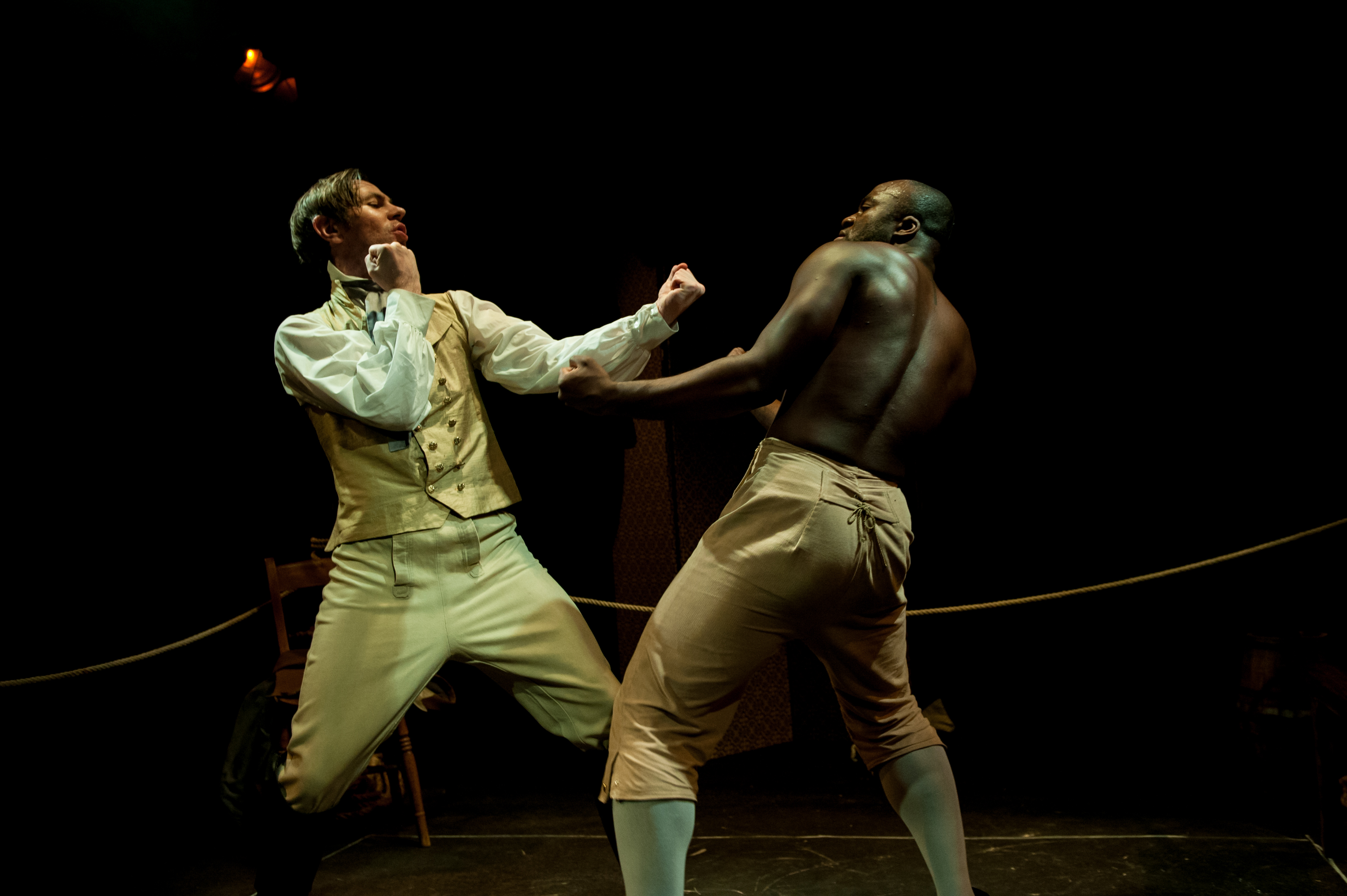
Tom Molineaux is an extraordinary true story about boxing, gambling and friendship. About a man who fights his way to freedom, but remains trapped in the injustices of society. A boxing ring, two men and some period costumes; nothing more is needed to bring this narrative to life. Tom Green’s compelling writing flows fluidly in an extremely believable manner, bringing us back to London in the nineteenth century whilst never losing the audience’s attention. Directing with simplicity and beauty, Kate Bannister constructs an extremely pleasurable evening.

Photo credit: Timothy Stubbs-Hughes

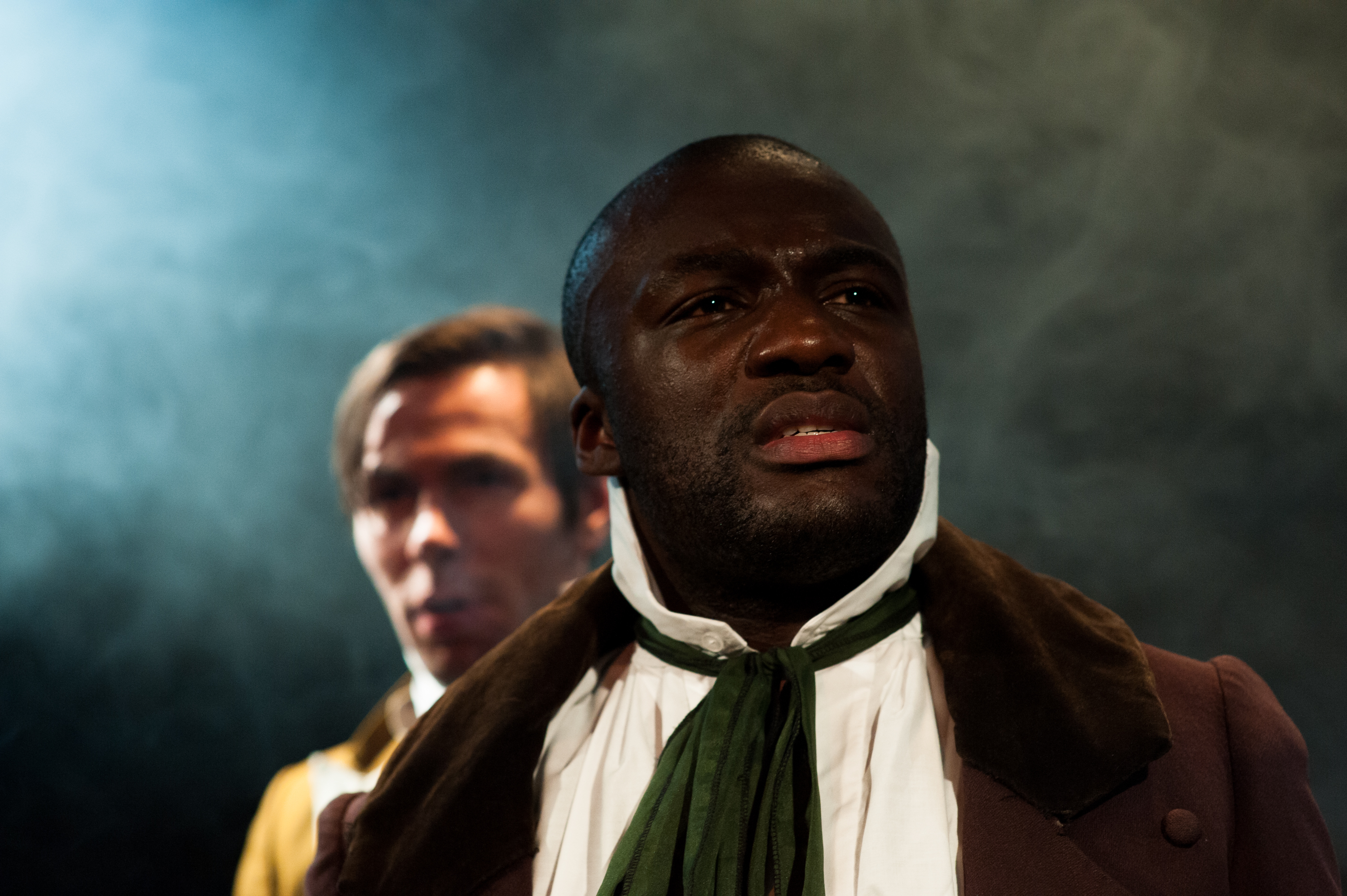
Nathan Medina skilfully plays the part of an African American boxer, born on the plantation in Virginia, with incredible force, leaving spectators astounded. Tom Molineaux is strong, powerful and will not stop until he beats everyone. Before the play begins, Tom is cherished in America for winning his master a great deal of money, which releases him from slavery and wins him freedom. It seems like nothing will bring him down, his determination and ambition to become world champion is too strong. He manages to convince the English champion Tom Cribb, who is retired, to fight him.

However, the play is not only about boxing, it is about so much more. About injustice, prejudice, loyalty and addictions. The story is narrated by another incredibly talented actor, Brandon O’Rourke, who plays Pierce Egan, a sports journalist who befriends Tom when he arrives to London. Pierce allows us to see the honest emotional turmoil which is present under Tom’s muscles and strength. Unfortunately, this is not a happy story. It is a true story. Will the former slave manage to gain his victory and make millions, or will he be crushed to the bottom by society’s injustice and greed?

Photo credit: Timothy Stubbs-Hughes

The performance is highly physical. The set is dark and misty. A seriousness in tone is most commonly present, but lighthearted moments are present too. One of my favourite moments is when Tom and Pierce come back drunk from a night out in 19th century London. The atmosphere transports you and allows one to imagine the streets of London back then, thanks to the accurate descriptions. Unfortunately, Tom and Pierce’s friendship is put to the test. Molineaux fights Cribb but the match is flawed, and Pierce knows. Will Pierce decide to lose the money he has bet on Cribb; or will he convey the truth and tell the world that Molineaux is the world’s biggest champion? Will Pierce fight the system or will Molineaux be representative of our unjust post-colonial society?

Courageous, powerful and human, this brilliant play packs a punch in more ways than one.


Can’t see the map on iPhone? Try turning your phone to landscape and that should sort it. I don’t know why but I’m working on it… 😉

Review: Crime and Punishment at Jack Studio Theatre

In the centenary year of the Russian Revolution, Arrows & Traps have got in early with their production of Dostoyevsky’s Crime and Punishment. But put aside any off-putting thoughts of epic 600-page novels; this short, sharp adaptation by Marilyn Campbell and Curt Columbus cuts straight to the heart of the story and is all over in a gripping hour and a half.

Focusing less on either the crime or the punishment, instead this adaptation gives us a disturbing insight into the mind of a murderer during the days between the two. By the time the play begins, the murder – of an elderly pawnbroker and her sister – has already been committed, and Raskolnikov (Christopher Tester) finds himself drawn into a cat and mouse game of psychological warfare with police inspector Porfiry (Stephen MacNeice), who’s convinced of his guilt. In desperation Raskolnikov turns to Sonia (Christina Baston), a virtuous young woman forced into prostitution to save her family, who offers his only chance of redemption.

Photo credit: Davor Tovarlaza @ The Ocular Creative

Flashbacks give the audience an opportunity to piece together the events that preceded the murder, as well as the crime itself – but also demonstrate the fractured state of mind of the killer, who himself looks back in an attempt to justify his actions. In the present, Raskolnikov explains to Porfiry that he believes some crimes – including this one – are necessary for the greater good. This is the debate at the heart of Dostoyevsky’s novel, and Campbell and Columbus’ adaptation gets straight down to it, mercilessly axeing several additional characters and plotlines, without losing any of the essence of what the story’s all about.

Director Ross McGregor has assembled a brilliant new cast for this production. Stephen MacNeice is an affable Porfiry, a self-confessed “freeform” investigator whose complex relationship with the suspected murderer begins to feel more like that of father and son than detective and criminal. As Sonia, Christina Baston has a physical fragility that contrasts with the spiritual and moral strength that sustain her – before transforming in flashbacks into the hunched, sneering old pawnbroker who’s about to meet a messy end. But this is ultimately Raskolnikov’s story, and Christopher Tester is captivating as the tormented killer. Despite being a violent criminal driven by his own arrogance, he’s also charming, articulate and capable of great kindness… and so like the biblical Lazarus who’s referenced throughout the play, we desperately want to believe he has the potential for salvation.

Anyone who’s seen Arrows & Traps in action before knows that they have a signature style – but they’re also not afraid to take a risk and step into new territory. Crime and Punishment is the company’s 10th production, and in a lot of ways is quite different to anything they’ve done before, with a cast of just three actors and a running time of only 90 minutes. Yet this is also recognisably an Arrows production, not just in its strong acting performances, but in the use of contemporary music, atmospheric lighting (courtesy of Karl Swinyard) and a dreamlike quality, particularly in movement director Will Pinchin’s exquisite slow-motion murder scene. (I never thought I’d be able to describe watching two old ladies get bludgeoned with an axe as beautiful, but there we go.)

Photo credit: Davor Tovarlaza @ The Ocular Creative

So what we really get with this production is a super-concentrated Arrows experience, stripped back to basics but bearing all the hallmarks of a company and director who know exactly what they’re doing. An intense psychological drama, the play has the entire audience holding our breath throughout, and asks some very real, and relevant, questions about the nature of crime and whether there’s actually any such thing as good and evil.

Think you know Crime and Punishment? Think again.


Can’t see the map on iPhone? Try turning your phone to landscape and that should sort it. I don’t know why but I’m working on it… 😉

Review: The Hound of the Baskervilles at Jack Studio Theatre

Guest review by Ross McGregor

The Brockley Jack annual Christmas show is the stuff of Fringe Legend.  It sells out before it even opens, and the reasons for this incredible success are legion. The Brockley Jack is one of the most reputable and iconic venues in London, and it’s run by people who know what they’re doing and care passionately about the space. They pick good scripts, cast talented actors and produce the Christmas show themselves so audiences know it’s a sure thing. Added to this, the Jack does something other than panto – so it’s great marketing for those who are Cinderella-ed out.

This year’s offering is a comedic pastiche of Sir Arthur Conan Doyle’s The Hound of the Baskervilles. The plot is simple enough: Mr Baskerville has been murdered. People think it’s a huge hell-hound. Holmes goes up there with Watson to solve the mystery. He does. The End. The show is sold out now, so go and read the book, it’s great.

Photo credit: Tim Stubbs Hughes

The script owes a lot to plays like The 39 Steps or The Play That Goes Wrong, yet even those examples aren’t original ideas themselves, so this can be forgiven. Hound is a tight-paced physical comedy that has its three actors multi-roling rapidly between scenes, moving scenery and donning different hats, jackets and accents. It breaks the fourth wall constantly as the very conceit of the play is perpetually on the verge of falling apart, and the actors are forced to break character and become “themselves” more than once. Now, whilst I do have an issue with shows that try to do both a crappy play and make that funny (cod-accents and dodgy props), whilst doing a play crappily (falling down sets and scene changes going wrong), I have to admit the grace and tenacity with which this production was helmed completely won me over and had me giggling with glee. The highlight of the show for me was just after the interval when one of the actors gets irate with the audience after reading an interval tweet and forces his co-stars (and us) to go through the first half at triple speed to prove he was capable of a quicker pace. This moment of building chaos really sums up the production for me; it’s self-aware and tongue-in-cheek, it’s modern and humble, but it’s done with such slickness and panache that the audience are happy to be whipped through the same scenes again, like reading a York Notes Study Guide whilst on amphetamines.

Joey Bartram plays the Great Detective Sherlock Holmes – a role made difficult to make your own after so many iconic performances on screen recently (perhaps the 21st century’s Hamlet?), and this production sees Bartram striding about the stage dripping with confidence (sometimes sweat) and a faraway look, whilst whipping his dark locks about him like he’s modelling shampoo. It’s a boho, gin-drenched, Oxbridge kind of a take on the role, and it’s in keeping with the show, but it’s really the character actor side role/suspects where Bartram shines, teeth-gnashing, winking and scowling his way through scenes.

Adam Elliott plays the Doctor Watson role, which really, due to the absence of Holmes for a large section of the production, is promoted to leading man status. Watson is normally a dog of a part, if you pardon the pun, and yet Elliott does it, thankfully, with charisma and charm. Having seen Elliott perform on the Fringe multiple times now, I’m starting to think that there aren’t many things the actor cannot do. He is a great talent, and one that has a bright future ahead of him. He’s eminently watchable, has an almost flawless grasp of comedic timing, and handles the numerous roles he’s awarded with versatility and a sense of child-like glee. 

Photo credit: Tim Stubbs Hughes

Andrew Fitch completes the trinity with a wide-eyed and energised Sir Henry Baskerville – the next victim of the Hound that Holmes and Watson are trying to keep from becoming pedigree chum. Fitch has a mountain of roles to contend with (even some that have to be performed on the first floor of the building above the theatre), and he manages to distinguish each one clearly and without undue effort, and he more than gives the two heroes a run for their money in terms of acting chops.

Kate Bannister (director), Karl Swinyard (set design) and Michael Edwards (lighting design) deserve all the credit for turning the small acting space of the Jack Studio Theatre into dozens of different locations, flicking instantly between a foggy moor to a dining room to a train carriage to a horse and cart, all with simple props choices, movement direction, action set pieces, moveable scenery and some of the slickest and most inventive lighting operation I have EVER seen on the Fringe circuit, helmed by Stage Manager John Fricker who seriously deserves an Off West End Award by himself just for managing that many sound and lighting cues on a fringe theatre tech desk.

If not already clear, this play is hilariously funny.  The idea is not a new one, nor does it particularly care to strive for anything above an entertaining night out, but it doesn’t have to. It’s an incredibly well-directed, well-performed and well-constructed comedy, that’s firing on all cylinders and never lets up for a second. It’s a work of true skill, made by professionals who know their craft.

Fringe Theatre, at its best, transcends its limitations and is palpably made with love, passion, creativity and care. Kate Bannister and her team have done exactly that. I would say this should transfer somewhere bigger, but then perhaps it might lose some of the charm that makes it so impressive a feat of the face of their restrictions of space and budget. So perhaps I will say that the Jack Studio Theatre deserve and need all the support, investment and love that their community and fanbase can give them, for they really are a jewel in the London Theatre Crown. Edinburgh Festival 2017 Venue Managers, you better get this show booked in whilst you can…


Can’t see the map on iPhone? Try turning your phone to landscape and that should sort it. I don’t know why but I’m working on it… 😉

Review: Anna Karenina at Jack Studio Theatre

If, like me, you’ve often thought about reading Tolstoy but been put off just by looking at the list of characters, let alone the number of pages, help is at hand. In their first non-Shakespeare production, Arrows & Traps have pulled off the astonishing achievement of compressing a 1,000-page novel into a little under three hours, with a cast of just eight, whilst still remaining faithful to the plot.

Anna, the respected wife of provincial governor Karenin (Adam Elliott), abandons her duty and reputation when she’s swept into a passionate affair with the dashing Count Vronsky (Will Mytum). Meanwhile landowner Levin has money and power, and the freedom to do anything he likes, but is desperately in love with Kitty (Pippa Caddick), the woman he believes will give his life purpose. Anna and Levin’s lives fit together to make a whole, with each possessing what the other longs for, and Helen Edmundson’s adaptation, directed by Ross McGregor, highlights this synergy beautifully. The stories unfold in parallel, and though Anna and Levin have never met, from the outset each becomes the voice of reason for the other, the one they confide in and from whom they seek help and comfort. Their dialogue also serves a second, more practical purpose, filling in the gaps with regard to setting and context, so that each time one asks the other, ‘Where are you now?’ it’s as much for our benefit as theirs.

Anna Karenina

As a result, the production needs little in the way of set or props, and the story is carried almost wholly by the fantastic cast. Most of them take on multiple roles, but keep them perfectly distinct, so we always know who we’re looking at, and even the comparatively minor roles are memorable (I particularly enjoyed Hannah Wilder’s giggling, superficial Princess Betsy). The two leads, Ellie Jacob and David Paisley, each capture to perfection the essence of their character: Anna’s charm and quick wit, which enchant everyone she meets, have a similar effect on the audience, while Levin wins our sympathy as a good, honest man radiating quiet desperation at the lack of direction in his life.

A third plot thread involves Anna’s adulterous brother Stiva (Spencer Lee Osborne) and his long-suffering wife Dolly, who’s played by Cornelia Baumann in a truly heartbreaking performance. Of all the stories, Dolly’s is perhaps the most devastating, as she lets Anna convince her to remain in her unfaithful marriage, and consequently ends up feeling she’s never really lived at all.

What’s particularly impressive about Arrows & Traps’ production is the way it somehow manages to be both intimate and epic, getting right to the heart of the characters but also capturing the scale of the novel. There are a few moments – the ballroom, the races, and in particular Anna and Vronsky in the snow – that feel almost cinematic, which is quite an achievement on such a tiny little stage.

Anna Karenina

Anna Karenina has a bit of everything – romance, tragedy (by the way, the death scenes are brilliantly done, and in one case almost a bit too convincing), drama, social commentary, and even a few moments of comedy to lighten the mood. With 1,000 pages of text to condense down, it’s no surprise that this is an intense and gripping production – but one that I’d happily go and see again tomorrow.

It’s even made me consider reading the novel. Well, maybe…


Can’t see the map on iPhone? Try turning your phone to landscape and that should sort it. I don’t know why but I’m working on it… 😉