Review: Three Sisters at the Brockley Jack Studio Theatre

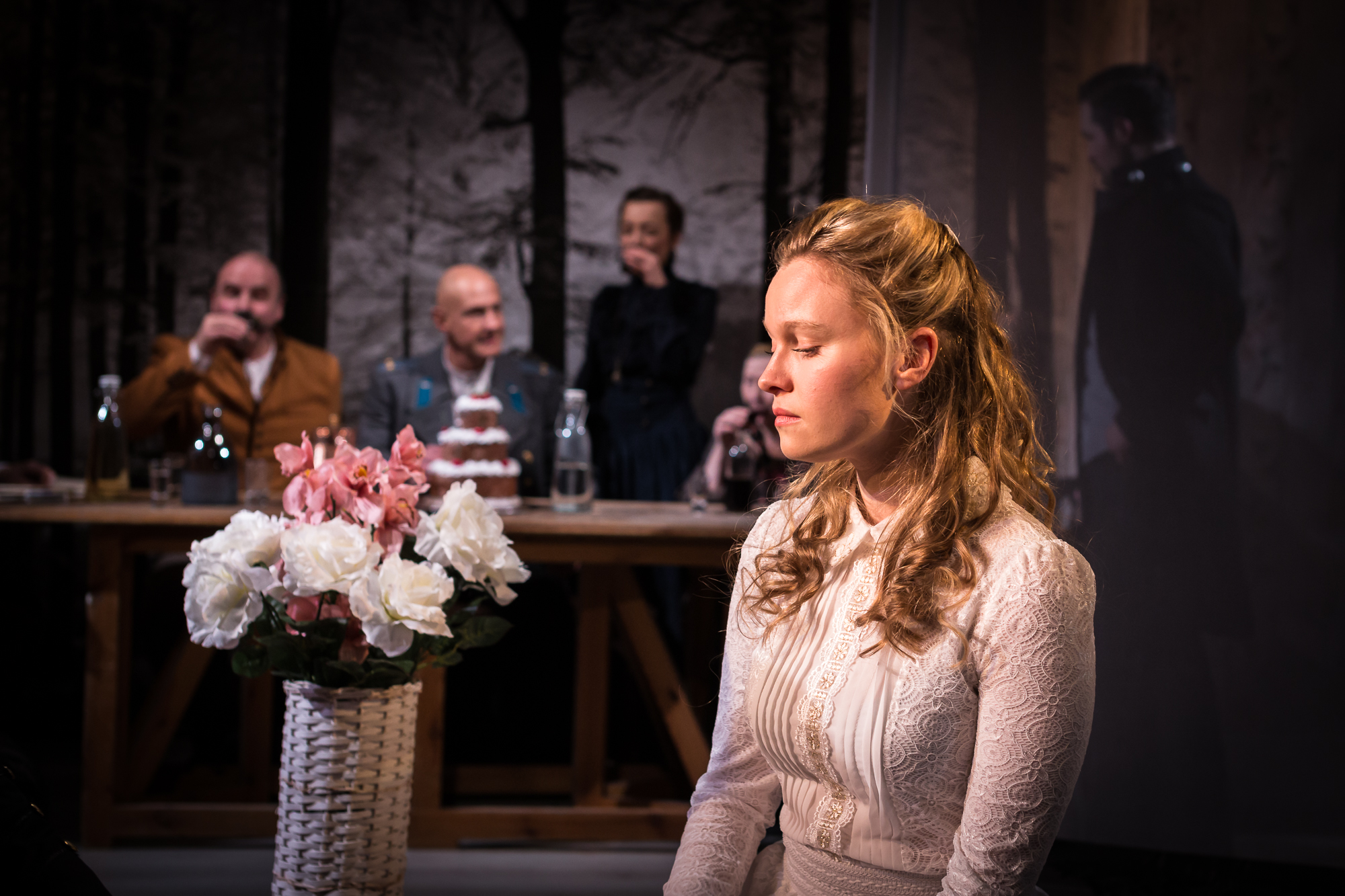
It only takes one look at Odin Corie’s set – a light, sophisticated and immaculately decorated family room, which makes the intimate Brockley Jack Studio look far bigger than it is – to understand that with their third foray into the Russian classics, Arrows and Traps mean business. Following the success of their Anna Karenina and Crime and Punishment in 2016 and ’17 respectively, the multi-Offie nominated company has now turned its attention to Chekhov, with a new adaptation of Three Sisters written and directed by Ross McGregor.

Photo credit: Davor Tovarlaza

Set in a Russian garrison town, the play immediately introduces the eponymous three sisters: Olga (the responsible one), Masha (the passionate one) and Irina (the romantic one). One year on from the death of their father, all three yearn to find some joy and purpose in a life that’s become relentlessly dull and ordinary. They believe the answer lies in their long-held dream of returning to Moscow – and yet, four years later, we find them exactly where they began, having moved precisely nowhere. This inertia means that not only have they not found happiness; they’re also significantly worse off, thanks to their brother Andrei (Spencer Lee Osborne). He’s led them into ruin with his gambling habit and disastrous marriage to Natasha (Hannah Victory) – a local girl they all once looked down on, but who now rules the roost with an iron fist and has, little by little, driven them out of their own home.

The substantial cast of fourteen is uniformly excellent. Cornelia Baumann never disappoints, and she hits the target again with her fragile and lonely Olga, trapped in a public service job she never wanted because she’s too nice to say no. At the other end of the scale, Claire Bowman is full of uncompromising fire as the sharp-tongued Masha; her disdain for her comically ridiculous husband Fyodor (Stephen MacNeice, whose plaintive insistence that he’s a happy man becomes harder and harder to believe) is matched only by her passion for the equally unhappily married Colonel Vershinin (Toby Wynn-Davies). Somewhere in the middle, Victoria Llewellyn balances the two out as the youngest sister Irina, soaring from ecstatic highs to desperate lows in her search for an idealistic true love that seems doomed to end in tragedy.

Photo credit: Davor Tovarlaza

The production also makes interesting use of music, with musical director Elliot Clay combining sweeping orchestral tracks with a more modern twist provided by guitar-toting soldiers Vladimir and Alexei (Freddie Cambanakis and Ashley Cavender), and – in a rare moment of joyful abandon – a traditional Russian singalong that might just have you reaching for the vodka, and will almost certainly get stuck in your head, possibly forever. (Just to make sure, they sing it twice.)

At 2 hours and 45 minutes it’s not a short play, but we easily become invested enough in the characters that the story remains compelling, and under Ross McGregor’s direction it never feels like the pace is too slow – all the more impressive when you consider this is, by its very nature, a play where the characters talk a lot but don’t do much. Five years of consistent excellence from Arrows and Traps have set the bar incredibly high – but while Three Sisters perhaps lacks a little of the cinematic grandeur we’ve seen in the company’s earlier work, this is still without doubt a stylish and beautifully acted piece of storytelling.


Can’t see the map on iPhone? Try turning your phone to landscape and that should sort it. I don’t know why but I’m working on it… 😉

Review: Frankenstein at the Jack Studio Theatre

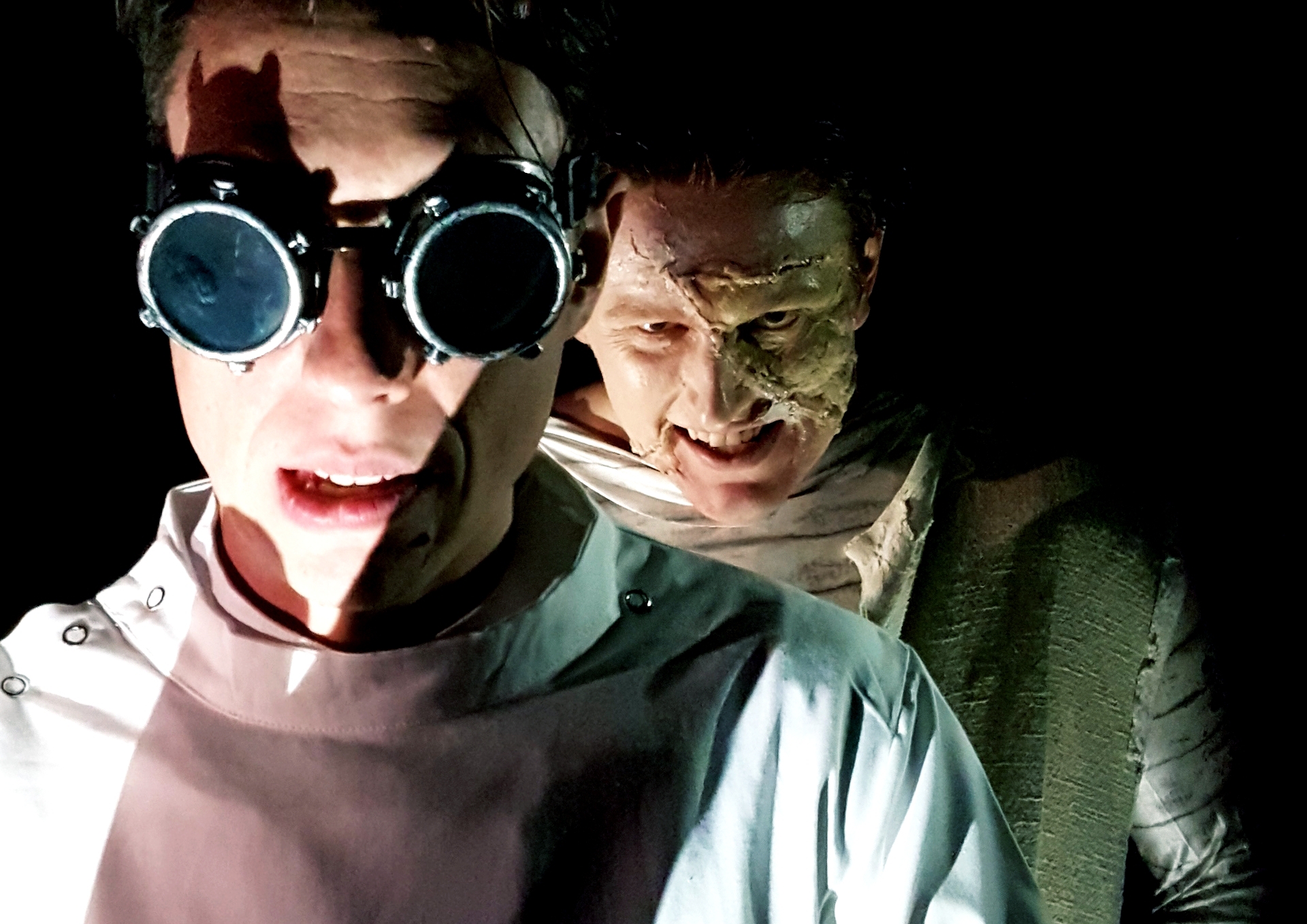
It’s quite a feat to breathe new life into one of the world’s most popular and iconic novels – but there’s no doubt Arrows & Traps’ Ross McGregor has succeeded with his adaptation of Frankenstein. Like the novel, it tells both Frankenstein’s and the Creature’s story, but reframes these within a fascinating insight into the life of their creator, Mary Shelley. The result is thrilling, poignant, often surprisingly funny and – unsurprisingly – visually beautiful, and it allows us to consider the themes of the novel in a whole new way.

Photo credit: Davor Tovarlaza @ The Ocular Creative

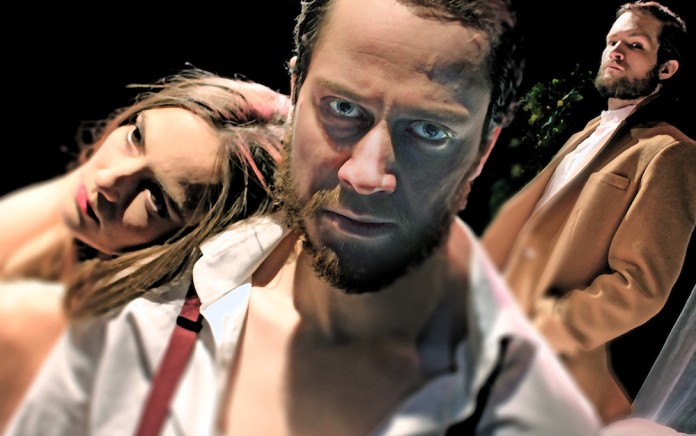
In fact, this is much more Mary’s story than it is Frankenstein’s, and the always brilliant Cornelia Baumann leads the cast with a moving portrayal of the troubled writer, now older and suffering with ill health and bad memories. Drawn into a passionate romance with the poet Percy Bysshe Shelley when she was still a teenager, despite the disapproval of society and the attempts of her father William Godwin to keep them apart, she went on to face the tragic loss of three of her four children, a near-fatal miscarriage and then the death of her husband in a shipwreck not long afterwards. In light of all this, it makes sense that the adaptation of her novel focuses primarily on the relationship between parent and child, and invites us to question what it is that makes someone a parent in the first place.

A real highlight of the show is seeing Will Pinchin – the Arrows’ Movement Director – take to the stage for the first time as the Creature. Having admired his work in many previous productions, it’s great to see it in the flesh, and his performance proves to be worth the wait. Unlike the classic Hollywood portrayal of Frankenstein’s Monster who was “born” evil, this Creature starts out as a gentle soul, a frightened, child-like figure eager to learn and play. It’s the rejection of those he loves that creates the monster, and Pinchin’s cold fury and sharp intellect in the play’s later scenes are far more chilling than any lumbering movie depiction. Christopher Tester’s Frankenstein, meanwhile, undergoes a similar transformation from a likeable, earnest young geek to an obsessive genius, capable of creating life but not appreciating its true worth.

With three interwoven stories, all taking place at different times and in different locations and a lot of historical information to digest, there are occasions when it becomes a little hard to follow; some knowledge of the novel is also probably an advantage to help pinpoint where we are in the chain of events. But the skill of the actors (and a few swift wardrobe changes) ensures that despite some significant multi-roling – particularly from Oliver Brassell, who plays no fewer than four major characters – we can always identify who we’re looking at.

Photo credit: Davor Tovarlaza @ The Ocular Creative

Another bonus is the presence of some strong female characters. Shelley’s novel is dominated by men, but here we have not only Mary herself but also her two sisters Fanny and Claire – as well as Agatha, the young blind woman who teaches the Creature to speak and read. Played by Zoe Dales, she’s enjoyably feisty and sarcastic, but also a rare source of compassion in a world that’s far too quick to reject them both just because they’re different.

As in all Arrows productions, there’s also a lot going on visually – from Odin Corie’s steampunk-inspired costumes to Ben Jacobs’ lighting design, which combined with sound from Alistair Lax creates some striking moments. Most impressive is the sequence in which the Creature first comes to life; it never fails to amaze how this company can create such drama on such a small stage.

Frankenstein is the first Arrows show written by artistic director Ross McGregor, who must be feeling a certain sympathy for Mary Shelley seeing his baby come to life on stage every night. But I don’t think this ingenious creation will be turning on its parent any time soon.


Can’t see the map on iPhone? Try turning your phone to landscape and that should sort it. I don’t know why but I’m working on it… 😉

Interview: Ross McGregor, Frankenstein

Arrows & Traps were last seen at the Brockley Jack Studio Theatre in February with their acclaimed production of Dostoevsky’s Crime and Punishment. Now they’ve turned their attention to another classic novel: Mary Shelley’s Frankenstein.

“It’s the 200 year anniversary of Mary Shelley’s original novel, so it seemed a great time to tackle the piece,” says director and writer Ross McGregor. “Frankenstein is so iconic as well, it’s ingrained in our literary and cinematic history, and there’s been over 100 different adaptations both on stage and screen. It’s such a flexible and deep piece of literature – I found the ideas that Shelley talks about in the novel to be fascinating and worthy of dramatic exploration. Plus, it’s just so much fun to do. There’s literally a scene when a monster made of dead people comes to life. You don’t get that in Alan Ayckbourn.”

Frankenstein is the eleventh show from Arrows & Traps, known for their innovative adaptations of literary classics – and it could be their most ambitious project yet. “In many ways, it has all the hallmarks of an Arrows show: the tight ensemble work, the physical pieces, the fluid staging and the excitement of seeing a classic story told in a new, and hopefully interesting, way,” says Ross. “What makes Frankenstein different from anything we’ve done before is that we’re telling three stories at once. Victor’s, The Creature’s, but also Mary Shelley’s. It’s a triple narrative all being told simultaneously, which makes for some exciting viewing.

“Also, this is the first production that I’ve actually written myself, as well as directing it, so rehearsals have been a voyage of discovery in terms of staging the piece, finding what works, what needs clarifying, and how best to tell the stories we want to tell. It’s been a fascinating and gruelling process of vision and revision. I’m slowly learning the importance of being able to kill your darlings.

“There are moments when it is as though the ghosts in my head are literally manifesting in front of me, which is very moving and humbling, and there is always a great relief when a particular bit or a specific scene is rehearsed and it ‘works’. So often what might look acceptable on paper doesn’t then work in performance, so it’s always lovely to see something that translates and makes the leap. The cast is bringing an awful lot to the roles though, and I’m constantly surprised by all the new layers they’re discovering. It’s been a joy to be involved in.”

Ross explains that in his research for the show, he became fascinated by the story of Mary Shelley: “Her world was filled with characters such as Lord Byron, Percy Shelley, her father William Godwin, her mother Mary Wollstonecraft, her sisters Jane and Fanny, Shelley’s wife Harriet – all of these people would have made a great play in their own right – but what principally struck me was the notion of all the strange parallels in her own life to Frankenstein. Now Mary Shelley wrote Frankenstein when she was nineteen, and although there were definitely things in her childhood that inspired her to write the book, her subsequent life after the novel’s publication shared many strange links to the book, almost as though she cursed herself by writing it. The more I delved into the real story around Frankenstein, the more I wanted to include it in the play.

“So yes, Mary is a main character in the show. And not just as a narrator, she has a part to play in it. She’s older now, suffering from a terminal brain tumour in fact, and is tormented by something that happened in her youth. Something that ties directly into Frankenstein. And so as we see the story of Victor and his Creature unfold, we also see Mary relive her past, with the cast playing roles in both worlds, leaping from one timeline to the other. It’s something of a rollercoaster to watch. I’m very excited about it.”

In adapting the novel, Ross encountered various challenges – one of which was sidestepping the traditional Hollywood image of Frankenstein’s monster. “Initially, I was very faithful,” he explains. “I had always seen the Creature as this lumbering, bolts in the neck, flat-headed lummox that groaned at people, but in the novel, he’s very graceful and agile. The Creature in the novel is very eloquent and possibly as smart as his creator. I wanted to try and mimic that, because I hadn’t found a version where that had ever been attempted.

“In the novel also, there’s no motivation for Victor’s need to create this monster – he just does it because he can. So I knew I wanted to humanise Victor and make him more sympathetic, more flawed, more human, more understandably motivated. So it’s been about balancing those two things. Also, the novel itself isn’t very dramatic and doesn’t lend itself easily to being dramatised. The iconic bits that you probably think of when you think of ‘Frankenstein’ are not from the novel. There’s no ‘IT’S ALIVE!’, there’s no character called Igor, there’s not even any mention of the Creature being scarred or covered in stitches or bolts. All of that is from the films.

“The novel concerns itself with ideas of nature versus nurture, of the perils of parenthood and the isolation caused by abandonment. The hubris of genius. So in adapting it, I have tried to stay true to Mary Shelley’s vision, whilst constructing something that stands on its own two feet as a piece of theatre. And from being in rehearsal, I can certainly tell you we’re making something inherently theatrical.”

The show’s cast includes a mix of Arrows veterans and new recruits: “The brilliant Christopher Tester plays Victor Frankenstein; Arrows fans may recall his recent performance as Raskolnikov in our last production Crime and Punishment, for which he was nominated for an Off West End Award for Best Male. We have the incredibly talented Cornelia Baumann returning to play Mary Shelley, after her recent turn as Olivia and Emilia in our repertory Shakespeare season of Twelfth Night and Othello last year, and we are honoured to have our resident movement director genius Will Pinchin playing the Creature, which I’m so excited about as I’ve wanted to get Will on stage in one of our shows for years. 

“We have Philip Ridout, of this year’s festival circuit hit Dogged fame, playing William Godwin, and recent Oxford School of Drama graduate Victoria Llewellyn playing Elizabeth Lavenza. I recently had the honour of directing for Fourth Monkey Theatre Company as part of their One Year Actor Training program so we’ve got three of their very talented graduates involved: Zoe Dales playing Agatha, Beatrice Vincent playing Fanny Imlay and Oliver Brassell playing Henry Clerval. It is an honour to have all these guys involved and the benefit of knowing who the cast were when the script was still under construction was that I could write it with them in mind and tailor it to them.”

With Halloween just around the corner, theatregoers in search of something a bit scary are likely to have plenty of options – so why should we book to see Frankenstein? Over to the writer: “It’s a gothic steampunk horror set in two different timelines, playing just before Halloween, in one of London’s most iconic and welcoming fringe venues, by a company that cares greatly for the source material and has spent the last three years working to hone their skills and push fringe theatre to the limit of what it can do in terms of ensemble, spectacle and excitement. Frankenstein is quite scary, quite funny, quite sad, and very very exciting. I’d definitely go, and I’m rubbish with scary things.”

Frankenstein opens at the Brockley Jack on 26th September, continuing until 21st October, followed by a brief run at Yvonne Arnaud Theatre in Guildford from 2nd-4th November.

Interview: Ross McGregor, Crime and Punishment

Next month, the Brockley Jack Studio will play host once again to Offie-nominated Arrows and Traps for their tenth production. Following the company’s critically acclaimed Anna Karenina in 2016, director Ross McGregor is taking on another Russian classic in Dostoyevsky’s Crime and Punishment, adapted by Marilyn Campbell and Curt Columbus.

Crime and Punishment is the story of Raskolnikov, a young law student who commits a double murder, and the effect that this act has on him,” explains Ross. “But it’s also the story of the police detective trying to catch him, and the woman trying to save him. It’s very psychological, and in modern terms comes across as a crime thriller. What makes it different is that we see almost everything from the perspective of the murderer, as opposed to the policeman. So a nice inversion on the Agatha Christie formula. It’s not really a whodunnit’, but a ‘willhegetawaywithit’.

“To sum up, it’s an engrossing psychological journey into the mind of a killer, adapted from a book that you’ve heard of but never read, thus enabling you to sound clever afterwards with your friends whilst still being done and dusted by 9:15pm.”

crime-and-punishment-696x436

The fact that the Arrows’ first show of 2017 is based on a Russian novel isn’t a coincidence: “This year is the centenary of the Russian Revolution, so Russian literature and drama is going to be big this year. We thought we’d get in early before you’re all drowning in Sisters, Seagulls and Orchards. I had such immense joy doing another Russian adaptation last year, with our Anna Karenina, and this is very much in a similar style, to suit the space and aid with telling a massive story in a short space of time.

“There’s something wonderfully captivating about Russian literature. It’s so passionate and tense, everyone’s got these huge sweeping emotions, men fight duels and go to war rather than apologise, it’s all hubris and unrequited loves, and illicit passions, outbreaks of sudden war, and wounded egos, and lost fortunes, it all makes for wonderful drama. You open a Russian novel, and you can almost immediately taste the snowflakes and vodka.”

Marilyn Campbell and Curt Columbus’ award-winning adaptation condenses Dostoyevsky’s 600-page novel into a 90-minute three-hander. “This adaptation is impeccably strong, and was very striking back at the first read, so that’s really why I wanted to do it,” says Ross. “It’s an incredible take on an iconic piece of literature. It’s won various new writing awards in New York, and been performed all over the world. With so many play adaptations of famous novels – and I’ve read a lot – they try to cram the novel into a play format, writing countless little quick scenes that do little more than capture the plot, but rarely the nuance of the authorial voice or even the characters themselves. This adaptation, similar to the Anna Karenina we did last year, takes the novel as a starting point but constructs something new that is inherently theatrical. It uses devices that wouldn’t work in a novel, and stands on its own two feet. You don’t need to have read the book to enjoy this. In fact, it manages to capture the main character Raskolnikov, at times, dare I say it, better than Dostoyevsky did.”

This production has plenty to look forward to for the Arrows’ devoted fanbase – and it also has a few surprises in store: “It’s an entirely new cast, primarily,” reveals Ross. “They’re all stunning additions to the Arrows team. I still adore the established Arrows team, they feel like my family, but I thought it was important to keep things fresh – and particularly since last year was so busy for our core members, it’s good to change things up from time to time.

“Returning audience members will be greeted with some familiar touches, however. It’s still an Arrows show, so I like to include some Easter eggs for the fans of previous productions. Ten shows in, and I think we have a certain in-house style when it comes to theatre, that will still be there, of course.”

Working with a cast that’s not only much smaller than on previous productions, but also entirely new, presents Ross with an exciting challenge – but it’s not without its risks. “It’s incredibly scary. And exciting. I think those are very symbiotic sensations,” he admits. “After the rep season at the end of last year, I felt I’d painted myself into a bit of an artistic corner. We’d done two massive Shakespeare shows (Othello and Twelfth Night) in rep with the same cast on alternate nights and received a lot of critical success for the project, and so for me the answer to ‘What next?’ didn’t come easily.

“In some ways, we’d grown too big, or were in danger of being ‘that company known for the spectacle Shakespeares’. Which is lovely, and fine, but I realised that I had to change tack quickly if I was going to keep things interesting for audiences and for myself. I had to step away from my Shakespeare comfort blanket, I had to strip away all the history and artifice and just have three actors in a room with a table for 90 minutes – and see if I could still make it interesting, could I still make the old Arrows magic without all my usual tricks. I wanted to get back to a theatre that was more raw, more honest.

“So what a challenge it’s going to be. It’s one of the most famous books of all time. It’s a massive story. The adaptation is blisteringly unforgiving on its performers. As an actor there’s nowhere to hide. As a director there’s no safety net. This is our tenth production in three years, and I think it’s going to be the hardest one yet. I’m honoured to be a part of it.”

Book now for Crime and Punishment at the Brockley Jack Studio Theatre from 7th-25th February.

Review: Othello at Upstairs at the Gatehouse

Othello forms part of the Arrows and Traps repertory season, alongside Twelfth Night (read more about that show, and the double bill as a whole, in my review). The two shows are both directed by Ross McGregor and performed by the same cast on the same set, but there the similarities end. While Twelfth Night is a riotous comedy full of romantic mischief, Othello is a dark, dramatic and gripping thriller, with a stunning climactic scene that I’d willingly watch over and over again.

In a modern day setting, army general Othello (Spencer Lee Osborne), known by most as the Moor, has married Desdemona (Pippa Caddick) against her father’s wishes. The couple’s happiness is set to be shortlived, however, thanks to the machinations of Othello’s ensign Iago (Pearce Sampson), who was recently passed over for promotion in favour of Cassio (Adam Elliott). In revenge, and with the unwitting help of his wife Emilia (Cornelia Baumann), Iago convinces Othello that Desdemona has been unfaithful with Cassio, setting in motion a dramatic and ultimately tragic chain of events.

Photo credit: The Ocular Creative

While Arrows and Traps have proved they can turn their hand to pretty much anything, it seems tragedy is where they really excel. Othello, like their recent blood-soaked Macbeth, is intense, powerful and utterly compelling from start to breathless finish. And as in Macbeth, the production draws on the talents of movement director Will Pinchin, particularly in the murder scene, a dream-like montage of music and movement that’s quite spine-tinglingly beautiful to watch.

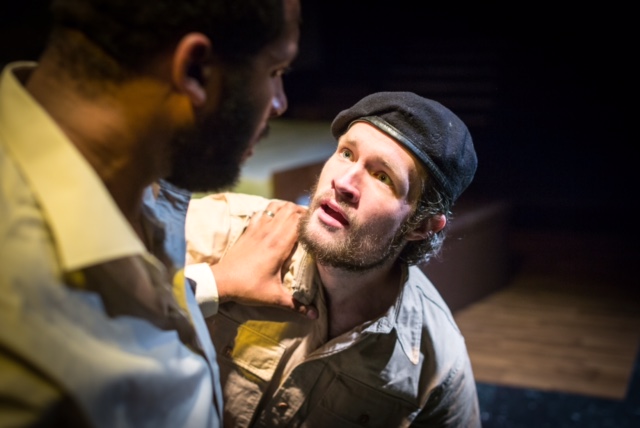
Unlike Twelfth Night, which draws on the cast’s talents as an ensemble, this play primarily focuses on three central characters: Othello, Iago and Desdemona. As the duped Othello, Spencer Lee Osborne shows us the insecurity of a man who’s always been an outsider, and can’t quite believe his luck that the woman he loves should return his feelings. My problem with Shakespeare’s play has always been in believing that a loving husband could be so quickly persuaded of his wife’s betrayal – but this Othello, though powerful in stature, has an emotional fragility that makes him easy to manipulate, and his willingness to believe Iago’s lies becomes therefore much more convincing for the audience.

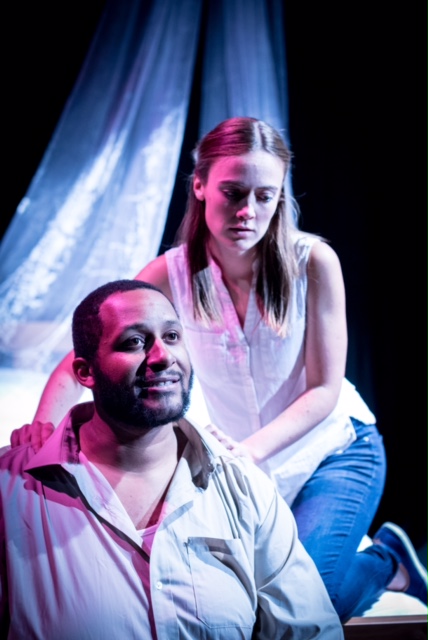
Pearce Sampson, fresh from playing Jesus in the Arrows’ last production, here skilfully turns his hand to an altogether different role as the villainous Iago, his twinkly northern charm disguising his evil intentions. This is a bad guy who gets – and deserves – no sympathy from us. On the other hand, we feel nothing but sympathy for Pippa Caddick’s Desdemona, a devoted wife and kind-hearted, loyal friend, with an independence of mind and playful, ever so slightly flirtatious nature that unknowingly hasten her downfall at Iago’s hands.

Photo credit: The Ocular Creative

The Gatehouse has a much larger stage area than many fringe theatres, and the production takes full advantage of the space, with actors appearing from all directions and even on the balcony above the stage. The set’s divided into three parts, which removes the need to break up the action with scene changes, but more importantly allows scenes to unfold simultaneously, heightening the drama and creating the familiar cinematic effect seen in previous Arrows productions.

Othello is a deliciously dark flip side to the madcap comedy of Twelfth Night, but it also stands alone as an intense and thrilling drama about human weakness. In addition, it makes a powerful statement about the way we treat those we see as different to ourselves, a topic that could hardly be more relevant at this moment in history. And it’s confirmed my view that Arrows and Traps are one of the best companies producing Shakespeare in London right now. Check them out if you can; you won’t regret it.


Can’t see the map on iPhone? Try turning your phone to landscape and that should sort it. I don’t know why but I’m working on it… 😉