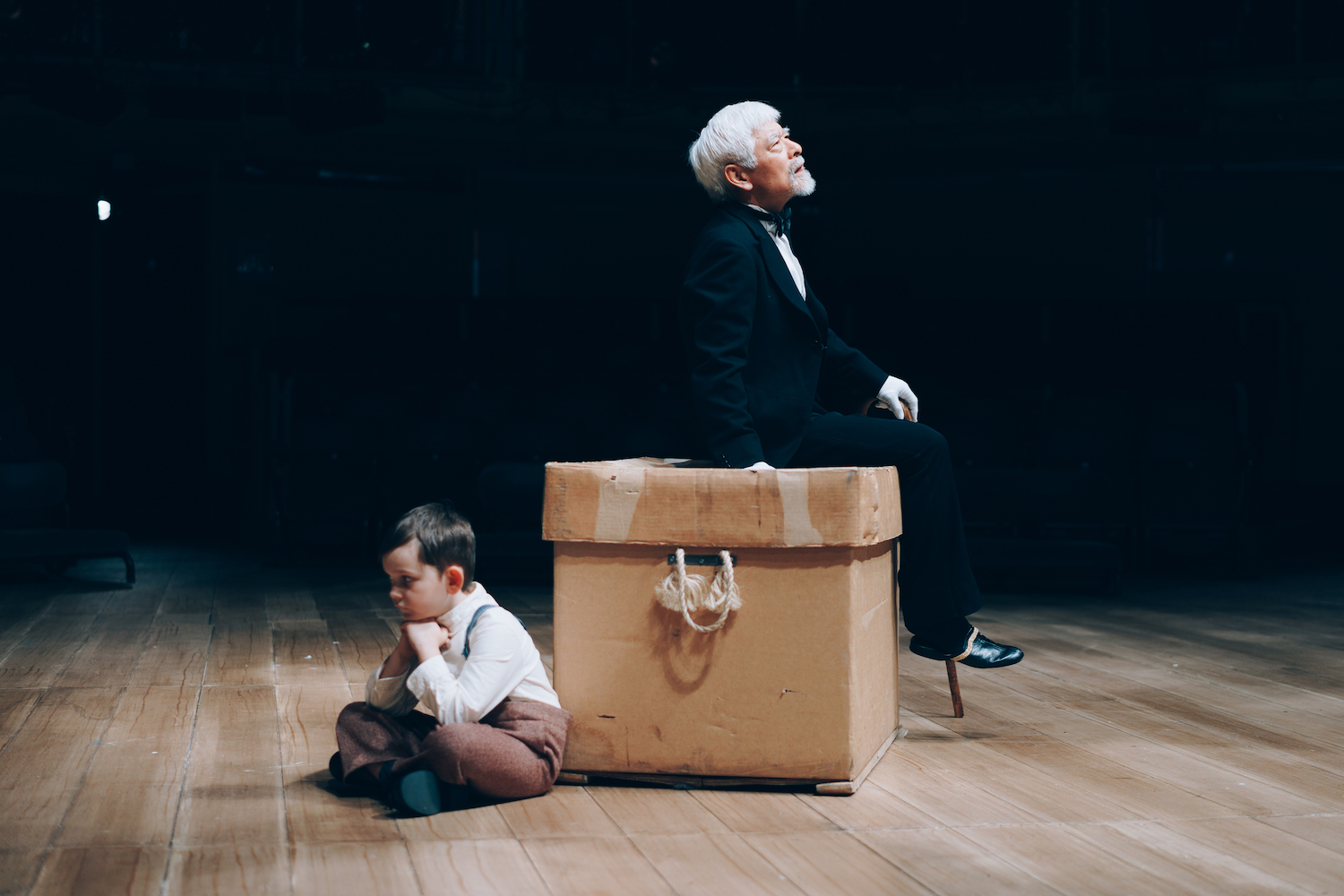
Review: Citizen at The Space

Just a few days after another British-Iranian citizen – Abbas Edalat, a professor of computer science and mathematics at Imperial College in London – was arrested on spying charges in Tehran, Suitcase Civilians’ show Citizen strikes very close to home. Simultaneously a celebration of the country’s proud culture and a condemnation of its political repression, the show brings together a collection of news and personal stories that explore what citizenship really means, and invites us to ponder why the simple question “Where are you from?” is increasingly fraught with complications and potential dangers.

Alongside well-known news stories like that of Nazanin Zaghari-Ratcliffe, the British-Iranian project manager detained in 2016 while on a family visit with her 22-month-old daughter, writer and director Sepy Baghaei also includes deeply personal anecdotes like that of a family forced to flee their country at a moment’s notice, and a young man who avoided death by seconds when his office building was hit by a bomb – but whose friends weren’t so lucky.

Nor is the focus only on Iran’s controversial treatment of its citizens; one of the first stories we hear is that of Behrouz Boochani, an Iranian refugee detained on Manus Island since 2013, because he attempted to reach Australia by sea. And let’s not forget Donald Trump’s travel ban, preventing citizens of seven nations – including Iran – to enter the USA, the byproduct of which has been countless people living in the States who are too afraid to travel home to see their families, in case they can’t get back.

There are lighter moments too, however. In one scene a filmmaker narrates a social interaction between two women, describing in hushed tones the unique customs on display, and in another two of the actors talk us cheerfully through “how to make an Iranian”, before handing out tea and dates to the audience.

Such a varied show – which also features music and poetry – presents a demanding task for its cast, but the actors rise to the occasion admirably, moving seamlessly from one persona and accent to another. David Djemal is particularly moving in an emotional portrayal of Behrouz Boochani as he describes the trauma of his detention on Manus Island, and Nalân Burgess stands out as a young woman who reminisces about growing up in Britain whilst trying to remain connected to her Iranian heritage.

Ending on a quietly reflective note that looks ahead to an uncertain future, Citizen is a thought-provoking piece of theatre that doesn’t hold back with regard to the ongoing political issues in Iran. That said, the picture it paints is far from simplistic; unlike those politicians quoted in the show, Beghaei and Suitcase Civilians recognise that the country you come from – while it may have a profound impact on how you live your life – doesn’t necessarily define who you are. The show focuses on Iran as an example, and is a fascinating insight into a culture that many Londoners will know little about, but its message is far broader, and feels uncomfortably relevant in a society that continues to make sweeping judgments about other human beings based on race and nationality.


Can’t see the map on iPhone? Try turning your phone to landscape and that should sort it. I don’t know why but I’m working on it… 😉

Review: Tumble Tuck at the King’s Head Theatre

The King’s Head Theatre’s Who Runs The World? season is both a celebration and showcase of female playwrights, produced in response to a suggestion last year by the Artistic Director of the Hampstead Theatre, Edward Hall, that there a) aren’t many of them around, and b) nobody will pay to hear what they have to say anyway.

Headlining the season is Tumble Tuck by Sarah Milton, which proves both arguments wrong in one fell swoop. It also turns out that not only will people pay good money to see a play written and performed by a woman, they might even – gasp – have a great time doing it. Appropriately, in light of the comments that inspired the season, the play examines the true meaning of success, as seen through the eyes of Daisy, a young swimmer about to take part in her first race.

Photo credit: Alex Brenner

As her big moment approaches, all Daisy – played by Milton – can think about is her wobbly bits, her imperfect swimming style, and how flawless the other girls on the team are in comparison. Worn down by her mum’s off-hand comments about her “big daughter”, and tormented by the thought that if she’d only let her boyfriend have sex with her he might not have ended up in prison, she ultimately finds solace in the water and her love of swimming – not for medals, but for the simple pleasure of doing something she’s good at.

Milton’s solo performance is a fast-moving tour de force, which sees her bring to life and engage in conversation with the various unique characters in Daisy’s life: her mum, ex-boyfriend, best friend, swimming coach, teammate… each entirely distinct and with their own personality and mannerisms. It’s as Daisy herself, however, that Milton really shines; her chatty, confessional and very funny style – not to mention her unapologetic love of cheese and KitKats – means that we quickly consider her a friend, and when the story later takes a darker path, we have no hesitation in following to see where it leads.

Directed by Tom Wright, the show fully immerses us in Daisy’s world, moving Milton around the intimate stage area and converting the simple space into her local swimming pool so effectively through the use of light and sound that you can practically smell the chlorine. It’s in the pool also that we’re treated to some lovely slow-motion movement sequences, as Daisy embraces the freedom to be completely herself that she only finds underwater.

Photo credit: Alex Brenner

Tumble Tuck is an uplifting and often hilarious study of a young woman as she comes to the realisation that true empowerment comes from within, not from the validation of others. It’s a message that will resonate with everyone, not only women, and as such is a great choice to headline a season that specifically sets out to prove female writers can – and do – have universal appeal.

Can’t see the map on iPhone? Try turning your phone to landscape and that should sort it. I don’t know why but I’m working on it… 😉

Review: The Cherry Orchard at the Royal Exchange Theatre

Guest review by Richard Hall

Few plays have arguably resonated at the Royal Exchange Theatre more profoundly than those by the Russian writer, Anton Chekhov. His plays benefit enormously from being performed in the round and this superb production is no exception.

This version of The Cherry Orchard, co-produced with the Bristol Old Vic, comes to the Exchange garlanded with four and five star reviews. Directed by Michael Boyd, former Artistic Director of The Royal Shakespeare Company, this is a production that shows off Chekhov’s naturalistic masterpiece to great effect. The setting for the production appears to have been updated to a period that is placed somewhere between the mid 1930s and the lead up to the Second World War. It features a multinational cast that clearly delight in Boyd’s assured, fresh and modern interpretation.

Photo credit: Liam Bennett

Facing financial ruin, Luba Ranyevskaya, a beautiful and spirited widow, returns home after a self-imposed exile brought on by the deaths of her husband and young son. At her family estate she is welcomed back by Lopakhin, a wealthy local businessman who offers to buy it and her beloved cherry orchard.

This being Chekhov, social, personal and political concerns collide and although Lopakhin, the son of a former family servant, believes that the old aristocratic order must change, his unrequited love for Ranyesvskaya and gratitude for her family’s past kindnesses makes it hard for him to contemplate splitting up the estate. Whilst Ranyevskaya agonises over the sale, disaffected servants, for which Boyd has interestingly chosen to cast BAME actors, look forward to the demise of the gentry, anticipating changes that in time will have unparalleled consequences not only for Russia but all of the Western World.

Boyd’s production is stripped bare of any artifice. For the whole performance the auditorium lights are dimmed, making the audience clearly visible, and only essential period props and furniture are used. The wooden panelled floor makes the actors appear as if they are performing on a concert stage and there is indeed something operatic about this production. As Ranyevskaya, Kirsty Bushell is captivating and hauntingly moving; it is impossible not to share in her grief and pain. She is oblivious to all the change around her and only wakens out of her dreamlike state when she briefly sees the spirit of her dead child come alive in front of her eyes.

Photo credit: Liam Bennett

The relationship between Ranyevskaya and Lopakhin is at the very heart of the play; it drives the narrative, creates tension and as Boyd points out in a fascinating programme interview, serves to underline the gulf that exists between their respective classes. Jude Owusu as Lopakhin is excellent; his performance is nuanced and highly detailed. The scenes between him and Bushell are compelling and gripping.

Rory Mullarkey’s new and very modern translation helps to make Chekhov’s sub text clearer. Even though a century separates Mullarkey and the premiere of The Cherry Orchard, one senses that he keenly shares Chekhov’s view of the world and some of his sentiment. With this production, the Royal Exchange once again takes an important classic and makes it wonderfully accessible and relevant to the modern age. It is highly recommended.

Review: Spamalot at the Orchard Theatre

Guest review by Debika Cutts

Having grown up watching Monty Python on repeat, I was already smiling even before sitting down to watch this touring Selladoor production of Spamalot at The Orchard Theatre, Dartford.

On arrival, as a reviewer, I was handed a bag which contained… yes… a tin of Spam of course, and settled down to an evening of singing, dancing and much hilarity with fellow fans.

Was it going to be as funny as the real thing, was my main worry. Was it going to be like the time I watched Grease on stage, disappointed it wasn’t John Travolta and Olivia Newton John? How would the jokes compare if not said by the original six? And did I want it to compare?

I’m very pleased to say it certainly did not disappoint.

The antics of King Arthur, played by the fabulous Bob Harms, careering through the musical with his inept crew of Knights of the Round Table was gleefully silly and brought about a great night of laughter and nostalgia.

The quest for the Holy Grail took the audience along the journey with boundless energy and mishaps as the motley bunch of characters made fun of themselves, musical theatre,  topical news (yes, Donald Trump did make an appearance) and a fair share of camp humour. The one liner about Dartford’s infamous “Air and Breathe” nightclub drew a lot of laughs!

Rhys Owen’s performance as servant Patsy with the iconic coconuts was excellent, and the voice of the production certainly belonged to Sarah Harlington who played the Lady in the Lake (or the Watery Tart as described by Dennis). Songs such as “Whatever happened to my Part” and “I’m all alone” stood out. All the actors played their characters with enthusiasm and gusto, making them seem larger than life.

Firm favourites which drew laughs, whistles and cheers, such as the Knights who say “Ni”, The Black Knight (who won’t let you pass) and Bring me a Shrubbery felt effortlessly funny and the wonderfully familiar jokes hit the mark.

Monty Python lovers will note some off piste storylines to the original film – the most obvious being the significant promotion of Dennis The Repressed Peasant and an unlikely matrimony for Sir Lancelot (without wishing to give away the storyline!).

The choreography was excellent and the sequinned singing and dancing, including tap dancing on tins of spam, makes this a production for lovers of musicals as well as Monty Python fans like myself.  Elements of pantomime and slapstick humour permeated throughout the production. At times even the actors were having so much fun that giggles got the better of them and parts of the second half felt refreshingly unscripted.

This was Monty Python with a modern day spin, as well as a lot of spam!

Well done Spamalot – they ripped off the motion picture (as promised in the title) admirably. We were whistling “always look on the bright side of life” and grinning all the way home.

Review: One Flew Over The Cuckoo’s Nest at Chickenshed

Here’s an interesting piece of pub quiz trivia: One Flew Over The Cuckoo’s Nest was both a novel and a play over a decade before it became an Oscar-winning movie. In fact Dale Wasserman wrote the play just a year after the publication of Ken Kesey’s 1962 novel – long before Jack Nicholson and co got involved – and in doing so kept largely faithful to Kesey’s original plot. In taking on such a culturally significant story, Chickenshed and director Lou Stein have set themselves a daunting challenge. Having said that, this poignant and still relevant story about the way society treats those who don’t fit the mould feels like an appropriate choice for a theatre company that prides itself on making everyone welcome.

Photo credit: Daniel Beacock

In a psychiatric hospital in Oregon, the ward’s well-established and quietly humdrum routine is thrown into chaos by the arrival of Randall McMurphy, who’s managed to get himself committed in order to avoid a hard labour sentence for statutory rape. Almost immediately McMurphy clashes with the formidable Nurse Ratched, encouraging the other patients to have some fun and join him in rebelling against her reign of tyranny. At once harrowing and uplifting, you don’t need to have seen the movie (or indeed read the book) to appreciate why this story is hailed as a classic.

As ever at Chickenshed, a diverse cast brings Kesey’s characters to life, with an outstanding performance from leading man Olivier LeClair in particular. He’s got Jack Nicholson’s beanie hat and sly grin, but otherwise succeeds in making this iconic role completely his own, in a charismatic and energetic turn that has us on his side from the beginning. Belinda McGuirk’s Nurse Ratched is introduced more subtly, her seemingly compassionate manner gradually revealed to be a facade as she manipulates and belittles her patients – not to mention the ward doctor – into submission. There are moving performances also from Bradley Davis as Chief Bromden, a Native American patient who’s feigned being deaf and mute for years, and Finn Walters as shy, stuttering Billy Bibbit, who’s spent his whole life feeling like a disappointment, and just wants someone to love him.

Photo credit: Daniel Beacock

The production makes use of every little bit of space in the intimate studio theatre; characters often speak (or sing) from off stage, and the action even expands into the corridor outside at one point. Nor does everything happen at floor level – Robin Don’s set features a slanting roof window that opens skywards, offering the characters a way in… and potentially a way out, if they only have the nerve to take it. The fact that most of the patients are revealed to be on the ward voluntarily speaks volumes about a world where being different is so hard that they’d rather not even try. And while the clinical practices portrayed in the play may no longer be used today, society’s understanding of mental illness is still dangerously insufficient, making One Flew Over The Cuckoo’s Nest as relevant now as it was when Ken Kesey first put pen to paper.

In a rather unhappy coincidence, Chickenshed’s production of One Flew Over The Cuckoo’s Nest opened just a few days after the death of Miloš Forman, who directed the acclaimed 1975 movie adaptation. In the show programme, Lou Stein dedicates the production to Forman – and this unique, courageous and entertaining play makes a fitting tribute.


Can’t see the map on iPhone? Try turning your phone to landscape and that should sort it. I don’t know why but I’m working on it… 😉