Review: good dog at RADA

It’s almost eight years since the riots that spread across London, sparked by the fatal shooting of Mark Duggan by police in Tottenham. Arinzé Kene’s good dog tells the story of that summer, and – more importantly – of the years of building tension and disillusionment that preceded it. It does this through the monologue of an unnamed boy, played by Kwaku Mills, whose wide-eyed idealism gradually gives way to cynicism and violence as he realises being good isn’t necessarily enough to stop bad things happening. First seen in 2017 and now revived for a fresh UK tour, directed once again by Natalie Ibu, good dog is a gripping and superbly acted piece of theatre.
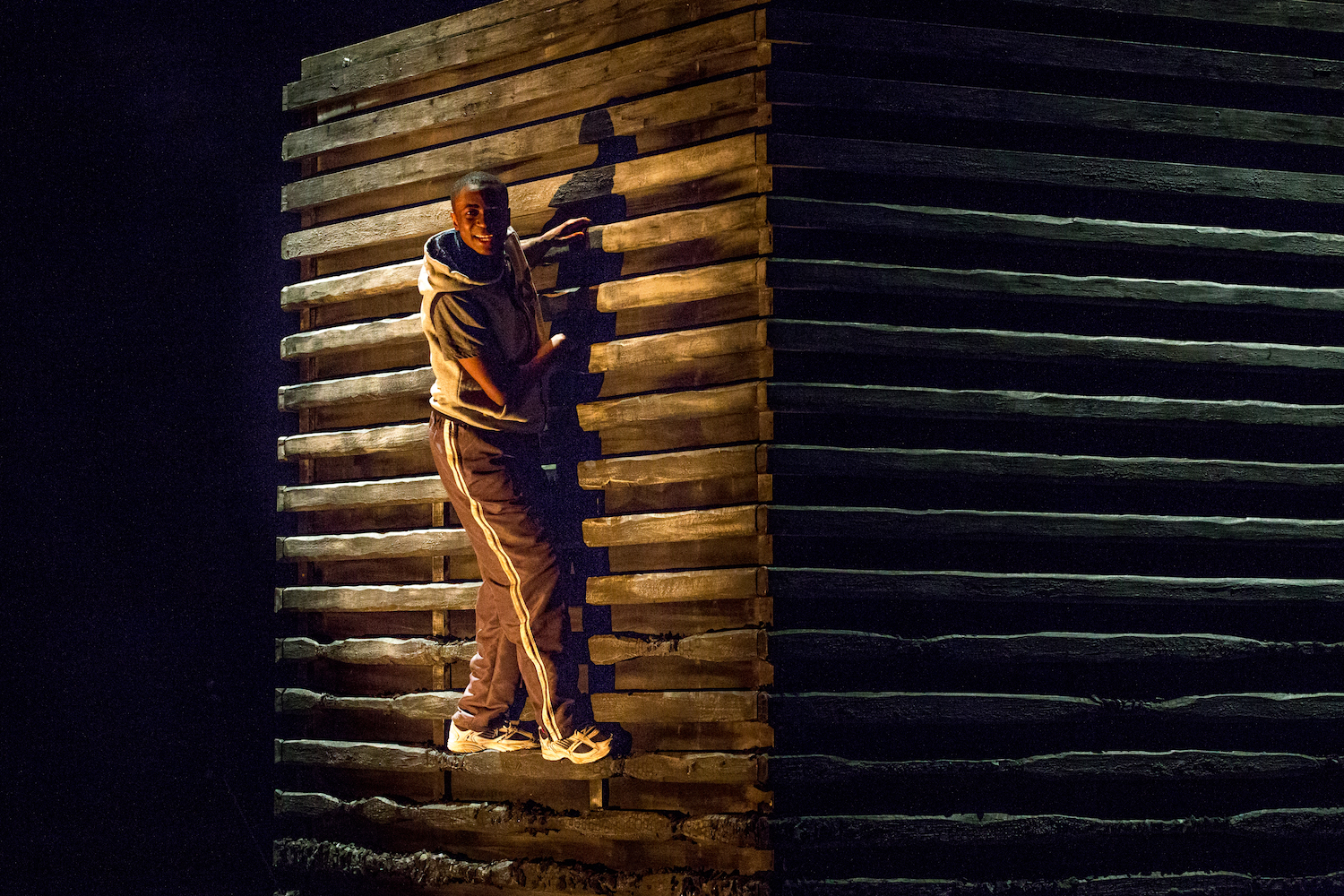
Photo credit: Wasi Daniju

The boy lives in a multicultural inner city community in London, and through his account we get to know all the familiar faces – this may be a solo show but it tells a multitude of stories. There’s Gandhi, the local shopkeeper, who won’t challenge the local “smoking boys” and “what what girls” who steal from him for fear of losing customers; Mrs Blackwood, the only person who doesn’t realise her husband’s cheating on her with their neighbour; Trevor Senior, who just wants to teach his son Trevor Junior how to play cricket in peace. And then there’s the boy – who, despite an absent dad, neglectful mum and merciless bullying at school, sincerely believes that if he’s good and never hits back, it’ll all pay off eventually.

The first thing to say is that Kwaku Mills is outstandingly good. From the moment he steps on stage and starts telling the story of Trevor Senior and the duppy, until the closing moments of the two and a half hour performance, he has our attention. His use of dialect always feels completely authentic, while remaining effortlessly accessible to audiences of any background; we may not know, for instance, what a duppy is, but the monologue is so well written that we can quickly understand without Boy needing to interrupt himself and explain.

Boy also very quickly earns our affection – the thirteen-year-old is enthusiastic, optimistic and funny (sometimes on purpose, sometimes not), and it’s hard to see him lose, little by little, the innocence and conviction that make him such an endearing character. By Act 2 he’s aged a couple of years, and though we can still recognise the boy we’ve come to know and care about, it’s clear that something’s changed – and given everything that happens in Act 2, that’s hardly surprising.

good dog is undeniably a masterpiece of personal storytelling, but there’s a bigger picture here too. Amelia Jane Hankin’s looming tower block set is the constant backdrop to Boy’s story, lit from within by a pulsing light (design by Zoe Spurr) that eventually becomes a roaring inferno as simmering anger explodes into violence. Act 1 paints a picture of a community made up of good people, living their lives the best way they know how. And yet somehow they always lose, so is it any wonder that at some point they decide to fight back?

Photo credit: Wasi Daniju

The 2011 riots may be long over, but you only have to turn on the news to understand that the issues that lay at the heart of them are as alive and urgent as they’ve ever been. Kene’s play is a captivating piece of theatre that both entertains and appals on its way to an explosive climax. It’s a cautionary tale about what can happen when whole communities are written off and ignored – but it’s also a celebration of those communities and everything that makes them such a unique and necessary part of British culture. Now more than ever, it’s a must-see.
Review: As A Man Grows Younger at Brockley Jack Studio Theatre

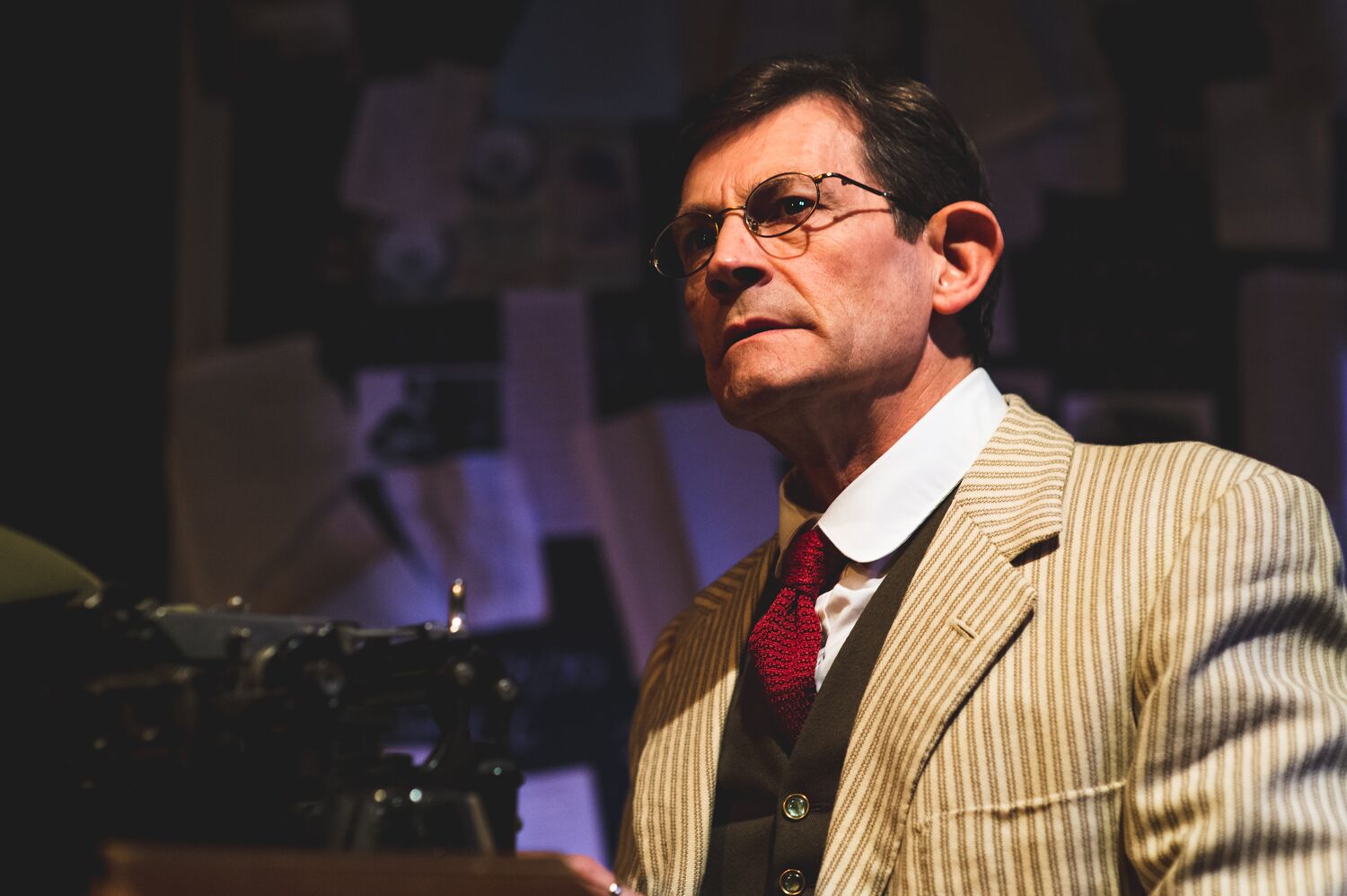
Waiting for reviews to come in after press night is, I imagine, a fairly nerve-wracking experience for a playwright. But what if the critics’ response to your work could mean the difference between life and death? Such is the case in As A Man Grows Younger, a dramatic monologue based on the life of Italian writer Italo Svevo who, seeing his country in the grips of Mussolini, has written a play discreetly mocking fascism. Now, the morning after opening night, he waits anxiously to see who arrives first – the newspaper boy or the blackshirts.

Photo credit: Tim Stubbs Hughes

In reality, this never happened; a foreword in the play text by the writer Howard Colyer explains that in fact Svevo died shortly after the play in question was completed, and he never saw it performed. This forgivable dramatic licence does, however, add a bit of intrigue, and sets the stage nicely for what follows: a rambling but thought-provoking monologue that tells us a lot about the writer himself (I admit to knowing nothing about Svevo before entering the theatre) but also asks some interesting questions about the nature of protest.

David Bromley gives a very polished and assured performance as Svevo, a contradictory and eccentric figure whose anxiety is palpable from the start as he paces the room, frequently checking at the window to see if anyone’s approaching. To keep his mind occupied he reminisces about his life and career, including some enjoyable turns as other characters including his wife, mother-in-law, and good friend James Joyce. There’s humour too in his various eccentricities – among them an obsession with interesting dates, a tendency to ribbit like a frog when nervous, and an absolute inability to give up smoking, which he seems to view more as a point of pride than a weakness.

At just 70 minutes long, the play packs in an enormous amount of detail about Svevo’s past and present, and because it hops very quickly from one subject to another it demands our full concentration at all times – not least because Svevo seems to have lived an extremely full and varied life. Despite this intensity in the writing, Bromley’s energetic performance, directed by Kate Bannister, means it never feels uninteresting or heavy, even in its darker moments. Karl Swinyard’s set is beautifully detailed in its portrayal of Svevo’s study, complete with a board full of dates and mementos that he frequently refers to throughout the piece, and Philip Matejtschuk’s sound design adds further detail, right down to the ticking of a clock.

Photo credit: Tim Stubbs Hughes

As A Man Grows Younger is an interesting and well performed historical play about a man caught between his distaste for fascism and his fear of speaking out. Despite knowing the very serious potential consequences of taking a stand, Svevo has chosen to use his new-found platform (he only became widely known, thanks to Joyce, in his 60s) to protest. Whether or not we like him as a man, we have to respect his courage as a writer – and with moments in the play that feel depressingly current, perhaps be prepared to follow his example.

Review: Call Me Vicky at The Pleasance

Based on a true story, Call Me Vicky is the debut play from sisters Nicola and Stacey Bland, following Vicky (Matt Greenwood) – born Martin – in her fight to transition and become the woman she’s always known herself to be. With the support of a loving circle of friends and family, she’s been scraping together the money for her op by working at Soho drag club The Golden Girl, which for all its seediness is one of the few places she can truly be herself free of judgment. Because this is London in the 1980s, and the wider society in which Vicky lives is far less accepting.

Photo credit: Fabio Santos

This warm, witty one-act play is often a lot of fun (there’s a hilarious drag routine that has to be seen to be believed) but don’t be fooled, it’s also a brutally honest account of Vicky’s world and the challenges she has to overcome just to be herself. Drugs, prostitution, prejudice and shocking violence all feature prominently – in fact, the only thing that’s glamorous about this story is Vicky’s fabulous outfits. Matt Greenwood is excellent in the lead role, capturing the character’s sassiness and defiance but also her intense vulnerability, and her generosity; despite her own problems, Vicky never loses sight of the fact that those around her may be struggling too, and her relationship with Stacey Bland’s troubled single mum Gabby is particularly moving.

Among universally strong performances from the cast of six, Wendi Peters is wonderful as Vicky’s no-nonsense mum Sylvie, whose fierce defence of her child against a stranger’s prejudice is one of the play’s most powerful scenes. And Ben Welch gives a brilliantly outrageous comedy performance as drag queen Fat Pearl, though as the play goes on we realise even this apparently one-dimensional character has hidden depths.

Victoria Gimby’s production is cleverly and immersively staged in a theatre that’s been transformed into The Golden Girl, right down to a stamp on the hand as you enter. With the action primarily taking place in two settings – the club and Vicky’s home – the versatile set, designed by Martha Hegarty (also responsible for the aforementioned fabulous outfits), is quickly and easily transformed so the action can continue to flow seamlessly. There are, however, a few issues with sightlines for audience members sitting at either end of the theatre, with some scenes blocked from view almost entirely by the curtain concealing the Golden Girl stage.

Photo credit: Fabio Santos

Call Me Vicky is a play that creeps up on you. Because most of the early action is set in spaces where Vicky feels at home, the events that take place in the second half of the play catch us completely off guard, and serve as a shocking reminder of what so many trans people have had to go through just to feel accepted. There are a number of moments where you feel Vicky might quite justifiably choose to give up on her transition; the fact that she never does only increases our admiration for her courage and resilience – and should also silence any suggestion that it’s a decision she’s taken lightly. A powerful, eye-opening debut from Nicola and Stacey Bland, Call Me Vicky is well worth a watch.


Can’t see the map on iPhone? Try turning your phone to landscape and that should sort it. I don’t know why but I’m working on it… 😉

Review: Monolog 2 at Chickenshed

Following the success of last year’s inaugural event, Chickenshed’s Monolog is back in 2019 for a second outing. Seven very different pieces of new writing, all for solo performers, have been split into two groups and will be performed on a rolling basis for the duration of the run. On press night, however, we were treated to the full showcase – a varied, thought-provoking and entertaining selection covering a broad range of themes, including pregnancy, prison life, mental health, race and identity, and political protest.

The seven monologues were selected from a wide range of submissions, and each stands out in its own way. In Barbara Bakhurst’s poignant The Hostel Angel, directed by Grace Coulson-Harris, fourteen-year-old Sunny (Sophie White) reflects on life in a hostel with her stepdad. Determined to make the best of their grim living situation, she decorates a chart with stickers and makes cups of tea for the neighbours, as she watches her stepdad quietly fall apart – all while clinging with heartbreaking optimism to the belief that one day her absent mum will come back to them and everything will be okay.

The Hostel Angel illustrated by Martha Vine

There’s more youthful optimism in Face The Strange by Matthew Patenall, directed by Sydney Burges and Bradley Davis. Lee (Alex Murtinheira), a young man with autism, seizes the opportunity to join the protests against Donald Trump’s visit to the UK – but the day doesn’t go quite as planned. The piece asks some searching questions about the nature and effectiveness of public protest, and taps into the growing political engagement of young people across Britain.

The shortest piece in the programme is Belinda and Wendy Sharer’s poetic Mirror Me, directed by Loren Jacobs and Belinda McGuirk. A young woman (Celie Johns Main) dreams of being a dancer, and of being admired by the audience for her talent and tenacity – but a cruel twist reveals those dreams can exist only in her mind. The piece blends words and movement in a beautifully wistful performance. And in We Are All In It Together by Peter Hastings, directed by Rachel Yates (assisted by Ashley Driver), a prisoner (Kieran Faye) sits in his cell, thinking about life behind bars and eagerly anticipating his wife’s visit the next day – even though she missed the last one, and she’s just sent him a letter… Written from first hand experience, this is a keenly observed account of prison life and all the emotions that come with it.

Even, Odd… Odd, Even by Hannah Smith, directed by Sarah Connolly, is set in a dystopian society where everyone’s required by law to wear a number rating their current emotional state from 1 to 100. For one young woman (Sabina Bissett), though, there’s a big difference between the number she displays and how she actually feels. This was one of my favourite pieces of the evening – a powerful and very topical exploration of mental health and the damage that can result from keeping our feelings hidden away.

The panel received and reviewed all submissions for Monolog 2 blind, without knowing who had written what – and it’s both refreshing and encouraging to realise that five out of seven pieces in the resulting showcase are female voices. The final two of these are possibly the strongest of all. In Milly Rolle’s My Exploding Universe, directed by Tiia-Mari Mäkinen, a young woman has just discovered she’s pregnant after a one night stand. Milly Rolle gives an excellent performance; her panic and confusion are palpable as she contemplates her uncertain future, looks back at lessons learnt from her own mum, and confronts the responsibility she now faces of bringing new life into the world.

Stranger illustrated by Ryan Gough

And last but by no means least, Stranger, written and brilliantly performed by Alesha Bhakoo, delves with warmth, humour and insight into the writer’s experience as a second-generation immigrant in the UK, and her struggle to reconcile her two cultures and figure out who she is. Directed by Milly Rolle, Stranger concludes with a surprise twist that reminds the audience what we’re watching isn’t a story but real life.

Monolog makes a dramatic contrast to Chickenshed’s recent Christmas production, which – as is traditional – featured a cast of hundreds. But despite the simple staging and intimate venue, there’s just as much diversity, talent and food for thought to be found in this very enjoyable showcase championing powerful new writing. Who’s up for Monolog 3?


Can’t see the map on iPhone? Try turning your phone to landscape and that should sort it. I don’t know why but I’m working on it… 😉

Review: Come From Away at the Phoenix Theatre

September 11th, 2001: while the world was watching the horrifying events taking place in the USA, a very different story was beginning in the Canadian town of Gander, Newfoundland. With American air space closed, the locals opened their homes and hearts to 7,000 stranded passengers, working tirelessly for five days to feed, clothe and house their terrified guests, and proving that even in the very darkest of times, the best of humanity can still shine through.

Photo credit: Matthew Murphy

This is the story told in Come From Away – a funny, moving and uplifting new musical by Irene Sankoff and David Hein. Having won best musical awards across North America, the show now arrives in London where, if there’s any justice, it’ll prove to be just as successful.

I might as well admit that I’ve been a bit obsessed with Come From Away ever since I first listened to the Broadway cast recording about a year ago – but while the soundtrack is great, the show itself is on another level altogether. It may have come out of North America, but like its cast of characters the show’s message is universal, and at a time when the news is full of doors being slammed against those who need help, it’s a story we all need to hear – especially when it’s told as powerfully as this.

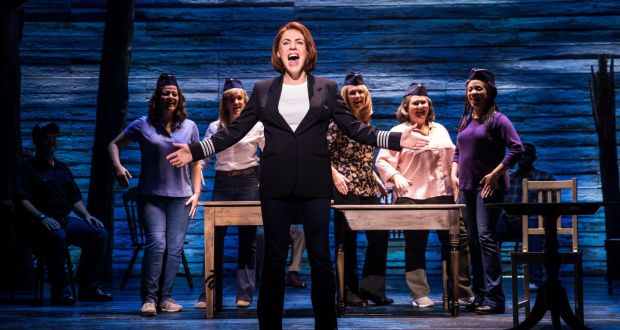
Mirroring the events and community that inspired it, Christopher Ashley’s production is a seamless team effort, in which every cast member works incredibly hard with the resources at their disposal to produce something quite wonderful. There’s not a hint of ego; despite the amount of stellar talent on stage, no one actor ever feels more or less important than any of the others – so all I can say is that (deep breath) Jenna Boyd, Nathanael Campbell, Clive Carter, Mary Doherty, Robert Hands, Helen Hobson, Jonathan Andrew Hume, Harry Morrison, Emma Salvo, David Shannon, Cat Simmons and Rachel Tucker are all outstanding.

Nor are there any fancy sets or special effects – armed with little more than a few chairs and a couple of simple wardrobe changes, the company bring to life hundreds of real people and stories, giving each one of them the care and respect they deserve. Nick and Diane, who met and fell in love during their time in Gander; Beverley Bass, the pioneering female pilot devastated at seeing the thing she loves most used as a weapon; Hannah, the mother desperate for news of her son, a New York firefighter; Unga, the pregnant bonobo chimp… any one of these or countless other true stories featured in the show would make a powerful narrative all on their own. Put them all together and the emotional impact is off the scale.

The score, as you’d expect, comes straight out of Newfoundland; with Alan Berry’s excellent band on stage throughout, we could easily be down at the legion with the locals (particularly at the end – whatever you do, don’t leave at the curtain call). Here again it’s all about the ensemble; there’s only one solo number in the whole show, and even that ends up featuring half the cast. The whole production overflows with enthusiasm, generosity and community spirit – the very qualities displayed by the people of Gander back in 2001 – and if it doesn’t send you home with a smile on your face then to be honest I doubt anything will.

Photo credit: Matthew Murphy

Come From Away has everything the world needs right now: infectious music, great performances, a fascinating true story, and a much-needed message of hope, kindness and acceptance. It’s a love story, a comedy and a celebration of Newfoundland spirit and culture – and yet it never loses sight of, or respect for, the tragedy at its heart. If you want to laugh, cry, dance and (however briefly) feel a little bit better about the state of the world, do yourself a favour and go and see this show. I’ll probably see you there.

Come From Away is at the Phoenix Theatre until at least September (hopefully much, much longer).