Review: Oh No It Isn’t! at the Jack Studio Theatre

The appeal of pantomime is a difficult thing to explain to those who haven’t grown up with it. The same few stories, featuring the same jokes, often performed by the same people, year after year – and yet, against all odds, the beloved festive tradition endures, pulling in audiences of all ages across the UK every Christmas.

Photo credit: Davor @The Ocular Creative

In Luke Adamson’s Oh No It Isn’t! we’re taken behind the scenes of one such pantomime, in which a well-worn duo, Mr Worth (Bryan Pilkington) and Mr Chancery (Matthew Parker), return to play the Ugly Sisters in this year’s production of Cinderella. It’s the last night of the run, and it’s fair to say the two men have pretty much had enough of each other, and of their tired double act. And yet the audience – both in the story and in reality – still laugh every time they dance to Right Said Fred, make weak, innuendo-laden jokes at each other’s expense, or lead us in a traditional (and, as it turns out, eventful) group sing-along.

The pair are – at least at first – a well-oiled machine on stage, but behind the scenes things are very different. While Mr Chancery views this opportunity as very much just a job to pay the bills before moving on to something better, for Mr Worth it means a great deal more, for reasons that only become clear in the latter stages of the 65-minute show. And as that story unfolds, what started out as a laugh-a-minute comedy about two panto dames at war becomes something much deeper and more tragic.

Like their characters, Matthew Parker and Bryan Pilkington are a great double act, giving us wonderful physical comedy in the on-stage scenes, and creating a delicious tension in their interactions backstage. Luke Adamson’s efficient dialogue makes references to their shared past, but resists the temptation to get into exposition-heavy exchanges, which leaves room for plenty of nice long awkward silences as the two don a series of increasingly outlandish costumes (designed by Martin J Robinson). The play is written based largely on Adamson’s own experiences – like Mr Worth, he performed in his first pantomine at the age of nine – and there’s a distinct ring of authenticity in its portrayal of the theatre industry with all its ups and downs.
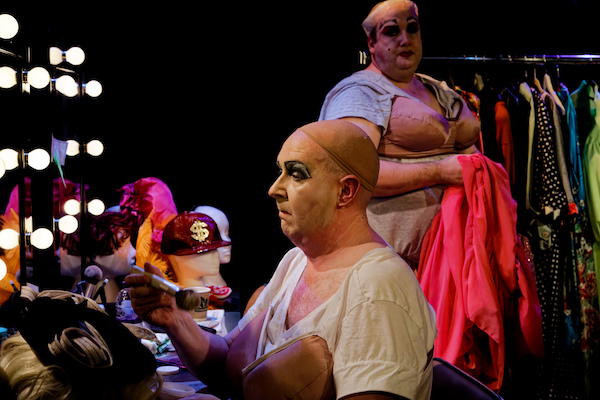
Photo credit: Davor @The Ocular Creative

Set designer Karl Swinyard has packed every inch of the Jack’s stage with the trappings of panto – costumes, wigs, props and posters – and the result is a beautiful burst of colour; like panto itself, it’s a perfect antidote to the grey drizzle outside. Under Kate Bannister’s ever skilful direction, the action moves seamlessly from dressing room to stage, with just the pushing aside of a costume rack and a quick burst of stage lights. The result is a tightly run show that’s over before you know it, but which seems to pack a huge amount of material and detail into that short running time.

Simultaneously a celebration of all things panto and a sobering insight into the cut-throat nature of the theatre industry, Oh No It Isn’t! offers something slightly different to the usual festive offerings – and feels all the richer for it.

Oh No It Isn’t! continues at the Jack Studio Theatre until 6th January 2024.

Review: Splinter at the Jack Studio Theatre

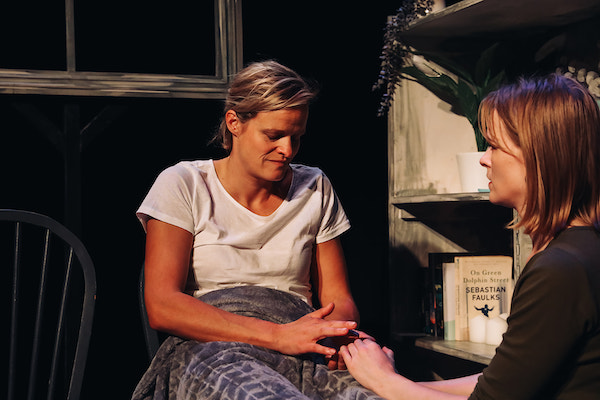
Martha Loader’s new play tackles a devastating topic with sensitivity and at times brutal honesty. Splinter is the story of Maggie (Henri Merriam) and Jac (Sarah Livingstone and Caroline Rippin), who are the very definition of “opposites attract” – while Maggie is a free-spirited activist with a fear of commitment, Jac is responsible, organised and longing to settle down. Despite the odds, their relationship works, but when Maggie is diagnosed with early onset dementia, their bond is tested to the limit.

Photo credit: Charlotte (Bishy Barnabee Photography)

Loader establishes a clear divide from the start between “before” and “after”, with alternating scenes that skip backwards and forwards in time. On the one hand, we see Maggie and Jak meet, fall in love and build a life together; on the other, we see that life begin to fall apart, a little at a time. The dementia diagnosis comes quite late in the play, which actually makes the scenes that come before it even more difficult to watch, because both women know something is wrong but can’t identify the cause. There’s a particularly clever detail in the way Jak occasionally seems to say the wrong word; just like Maggie, at first we brush it off as a slip of the tongue or assume we misheard, and it’s only as these become more common that we too start to realise something else might be going on.

There’s heartbreaking significance, too, in the decision to have Jak played by two different actors, while Maggie is played throughout by the same person. That significance doesn’t become completely clear until later on in the play, and the moment of realisation arrives in a dramatic scene that marks a clear turning point for both characters. Sarah Livingstone and Caroline Rippin mirror each other well in their mannerisms and interactions with Maggie, but at the same time they’re also clearly unique versions of Jak, demonstrating how a diagnosis like this isn’t only life-changing for the person who receives it, but also has a profound impact on those around them. Henri Merriam is on stage throughout and is mesmerising as Maggie in both eras; “before” Maggie is full of an infectious energy, passion and mischief, which we see drain away over the course of the play, leaving “after” Maggie lost and bewildered

Becca Gibbs has created a beautifully versatile set, featuring a window, bookcase and door, which are moved about after each scene to set up new locations. By keeping Maggie on stage during these scene changes, director Amy Wyllie adds an element of disorientation to the constant movement – but always brings us back to the central motif of Jak, endlessly sticking post-it notes to the bookcase in a futile attempt to help Maggie hold on to details of their life together.

Photo credit: Charlotte (Bishy Barnabee Photography)

Dementia is a cruel disease, and Splinter demonstrates very well the damage it can cause, by taking us on a journey with this perfectly imperfect couple. Apart from one incident late on in the play that comes out of nowhere and feels like it deserves more time (largely because it has the potential to change how we feel about one of the characters), this is a well crafted and powerfully performed story that really draws us in, to ensure that we feel the full impact of the events that follow. The nature of the condition means it’s not a spoiler to say this story was never going to have a happy ending, but the conclusion we get is sensitively handled and, in a way, feels as optimistic as it’s possible for it to be.

Splinter is at the Jack Studio Theatre until 2nd December.

Review: The Toymaker’s Child at Chickenshed

One of the best things about Chickenshed’s annual Christmas show is that it somehow manages to be both reassuringly familiar and at the same time, full of creativity and surprises. This year, their 21st century take on Pinocchio, The Toymaker’s Child, takes us on an epic adventure with Katy (at our performance, Beatrice Afhim) and PIN:0Cch10 (Courtney Dayes), a 3D printed teen – or “printeen” – created by Katy’s father (Gabriel Palmer) and brought to life using a microchip he found discarded in a bin. It’s not long before the two find themselves on the run and at the mercy of unscrupulous villains Mr Cunning (Demar Lambert) and Kat (Cara McInanny). Can they escape and find their way home? And will PIN:0Cch10 ever get to experience a feeling?

Photo credit: Caz Dyer

Written by Dave Carey and directed by Michael Bossisse, Bethany Hamlin, Cara McInanny and Jonny Morton, the show tackles very current issues like the rise (and risks) of AI, and the polarising effects of the media. But at its heart, it’s a story about friendship and humanity, which is, after all, what Chickenshed is all about. With a cast of 600 split across 4 rotating groups, it’s a perfect showcase for inclusivity, with young people of different abilities and backgrounds coming together to create something beautiful. The sign language, provided by eight “augmentors” dressed as toys, is seamlessly integrated and adds another level of inclusivity to this wonderful production.

As with most Chickenshed Christmas shows, the production features several musical numbers, more than one of which proves to be a bit of an ear worm (I’m still singing “Follow Me”, which closes Act 1, two days later) and which range from solos to big group numbers that give multiple cast members a moment to shine, and impress with their slick choreography. Even though it happens every year, the production’s closing scene, which sees the entire cast take to the stage for a final performance, never fails to make an impact.

Photo credit: Caz Dyer

In addition to the ensemble set pieces, the show also boasts some fantastic solo performances. Courtney Dayes is perfectly robotic as the intelligent but emotionless PIN:0Cch10, contrasting nicely with Beatrice Afhim’s passionate and often exasperated Katy. Demar Lambert and Cara McInanny bring a distinct Thénardier vibe to their wickedly comic portrayal of Mr Cunning and Kat, and Ashley Driver is equally hilarious as Mike the news anchor man, sporting an array of wigs and introducing a host of irrelevant guests. Meanwhile Bethany Hamlin shines as the Accidental Blue Fairy – a singing waitress longing for her big break, who helps the two girls in more than one hour of need.

Funny, heartfelt and clever, The Toymaker’s Child is another great Christmas show from Chickenshed. But feelings aside (sorry PIN:0Cch10), it’s also technically an incredible achievement; managing such a large cast, making it so easily accessible, and still telling a great story is something we shouldn’t take for granted. As Chickenshed heads into its 50th anniversary year, we can only hope that there are many more shows like this in its future.

The Toymaker’s Child continues at Chickenshed until 13th January.

Review: The Elephant in the Room at Theatre at the Tabard

A lot goes on in Peter Hamilton’s new tragicomedy, The Elephant in the Room – but oddly it feels at its strongest when not much is happening at all. It’s in these quieter moments that the quality of the writing is able to shine through, and we get to know most about the characters, while other, more action-packed scenes often feel a little rushed. Whether this is a deliberate choice or not is unclear, but it gives both the play and its audience a feeling of being always slightly off balance.

Photo credit: The Ocular Creative

While on a trip to India, 19-year-old Ashley Davenport (Fraser Anthony) meets Yama, King of Death and the Underworld, an encounter that prompts him to renounce – at least in his head – his life and substantial inheritance, and check himself into the Gethsemane Garden Village Retirement Home. Here he meets fellow residents Rosie (Josie Ayers), Johnny (Craig Crosbie), Judith (Kristin Milward) and David (Stephen Omer), who are more than a little dismayed to see someone so young give up on his life before it’s even begun.

In its depiction of the older residents, with their meandering conversations and often humorously blunt reflections on both life and death, the play makes for enjoyable viewing. The actors are clearly having fun – particularly Craig Crosbie as Johnny, who may be in his 90s but still has an eye for the ladies and isn’t afraid to say so, and Stephen Omer as joyously downbeat former librarian David. Among the laughs there are some genuinely touching moments, not least when Judith decides – not for the first time – that she’s ready to meet the angels, and reminisces with close friend Rosie about old acquaintances while the other characters listen from her bedside.

These scenes are in stark contrast to those involving the other characters: nurse Mr Krish (Yasser Kayani) – a “mild alcoholic” who’s so delighted to meet in Ashley a fellow traveller on the spiritual path that he inadvertently brings about his own downfall, and staff members Miguel (Baptiste Semin) and Kim-Ly (Lee Jia-Yu), both illegal immigrants with traumatic pasts who deal with their situation in very different ways – he through religion and baking, she by setting her sights on an unsuspecting Ashley. These stories, unlike the dialogue-heavy scenes featuring the older characters, sometimes move so fast you can blink and miss a crucial plot development, and the seriousness of their themes sits uncomfortably next to the mostly light-hearted banter of moments earlier.

Amidst all this we learn very little about Ashley, ostensibly the central character, apart from the fact that he owns a very nice house in Basingstoke which has an elephant in it. As a character, Ashley contributes little to the plot himself, becoming instead a vehicle that drives the other characters in unexpected directions – and he ultimately ends up regretting his decision to give up on life after having all agency taken away from him in the play’s closing moments.

Photo credit: The Ocular Creative

The production is well directed by Ken McClymont, making efficient use of the limited stage area by means of some white blocks and hospital screens. Occasional projections of the eponymous elephant during key moments heighten the tension, and also provide a dramatic entrance for the visiting deity Yama. All the actors give good performances, though the imbalance in the script means the younger cast members have significantly less material to work with than their older counterparts, and their characters feel underdeveloped as a result.

All in all, The Elephant in the Room is an interesting play that asks some big questions and tackles some serious themes. There are some lovely moments and some laugh out loud lines, and as a comedy about older people’s often irreverent views on life, it works well. In contrast, the darker aspects of the plot are more perplexing and feel like they need development to bring the whole play together into a more balanced whole.

The Elephant in the Room is at Theatre at the Tabard until 2nd December.

Review: Breaking the Castle at the Old Red Lion Theatre

The most striking aspect of Peter Cook’s powerful one man show Breaking the Castle is its authenticity. When the protagonist David tells you what it’s like to take drugs, you don’t need to have read the programme to understand that this is a man who knows what he’s talking about. The show charts David’s journey through and beyond addiction, and was inspired by true events in writer and performer Peter Cook’s life, which gives the writing an undeniable authority and makes it a gripping watch from the start.

David is a struggling actor who spends half his life at home waiting for calls from his agent, hoping that today might finally be the day he gets to play Hamlet instead of a dying cockroach. To pass the time until that day arrives, he takes drugs, and drinks, and gambles, and has sex – and then takes more drugs… Until one day he finds himself sitting in a rehab centre in Thailand, where a passionate counsellor shows him it’s possible to break out of the vicious cycle of his addiction, and make a new place for himself in both the world and his own life.

The action is fragmented and the pace frenetic as we skip backwards and forwards in time, with scenes depicting David’s rehab journey starkly contrasting against some of his lowest moments back home in Australia. Peter Cook is an engaging and energetic performer, throwing himself – sometimes literally – around the litter-strewn set and playing a multitude of characters with a multitude of accents. (In fact the number of different accents begins to be a bit distracting, and Cook’s at his strongest when playing characters who have distinctive physical characteristics – a fellow addict on the streets of Sydney’s Kings Cross and a patient he encounters during a hospital stay are particularly well depicted.)

The second half of the show brings a number of revelations about repressed childhood trauma, allowing both David and the audience to make some sense of how he got to where he is – and a recurring theme featuring butterflies injects an element of hope. There’s a surprising amount of humour, too; David’s description of his addiction is frank, honest, without a trace of self-pity, and when he smiles his whole face lights up. All this combines to make a character we can really get behind, and his evident joy in the play’s final scene is infectious.

It also helps to bring home a key message in Cook’s writing: that people who struggle with addiction are just that – people, and just as the power to acknowledge and move past it lies primarily with the individual, so the rest of us have a responsibility to look beyond our own judgment and try to see the person instead of the disease. Powerful, funny and deeply personal, Breaking the Castle has a lot to say – and it says it very well.

Breaking the Castle continues at the Old Red Lion Theatre until 11th November.