Review: When It Happens to You at Park Theatre

Based on real events, Tawni O’Dell’s hard-hitting theatrical memoir When It Happens to You makes its UK debut at Park Theatre, directed by Jez Bond and starring Amanda Abbington as Tara, a mother whose life is shattered by a 3am phone call from her daughter Esme (Rosie Day). O’Dell doesn’t skirt around the cold hard facts: Esme was followed home to her New York apartment and raped by a stranger, while her neighbours listened to her scream and did nothing to help.
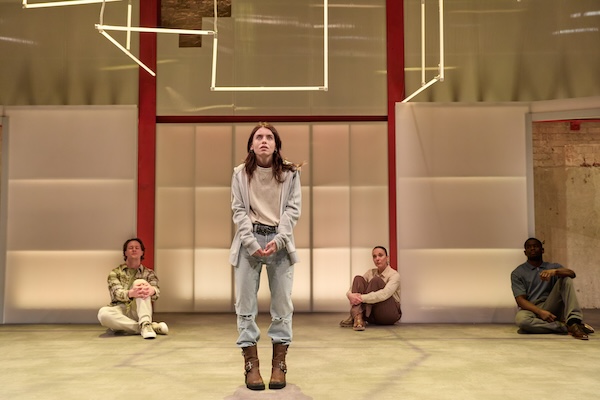
Photo credit: Mark Douet

All this we find out within the first few minutes, after which the rest of the 90-minute play dwells not on what happened that night but on its consequence, the slow unravelling of a previously close-knit family. As Esme’s life goes off the rails, Tara is forced to confront not only her devastation at being unable to protect her child, but also a dark secret from her own past. Meanwhile Esme’s brother Connor (Miles Molan) struggles to face up to the destruction that can be wreaked by other men just like him.

On an empty stage, against a generic city skyline, the three family members – joined by Tok Stephen in a number of roles – frequently stand at opposite corners, their physical distance from each other emphasising the gaping emotional chasm that separates them. We see glimpses of their former life, the typical brother-sister bickering between Tara’s two precocious children, and the bright potential both have in their respective areas of study. And in contrast, we see Connor angry and hurt in the aftermath of that 3am phone call, and Esme physically and mentally broken by her ordeal. Rosie Day is exceptional, her body language – hunched shoulders, arms hugging her midriff, lowered head – speaking perhaps even more clearly than she herself does about what she’s feeling.

Amanda Abbington is outstanding as Tara, a woman just about holding herself together and hiding her pain and rage behind dark humour and questionable life choices. She commands the stage with absolute authority from the start, which turns out to be both a blessing and a curse for the production. This is, after all, Tara’s story, and the strength of Abbington’s performance keeps us captivated – but such is her presence, and the dominance of Tara’s voice over anyone else’s, that we find we learn little about the other characters. Despite engaging performances from both Day and Molan – who are on stage throughout – Connor and, more surprisingly, Esme rarely get to speak for themselves, and most of our encounters with them consist of arguments between them and their mother. This robs us of any real connection with them, and of the emotional payoff we should feel when things finally begin to turn around for the family.
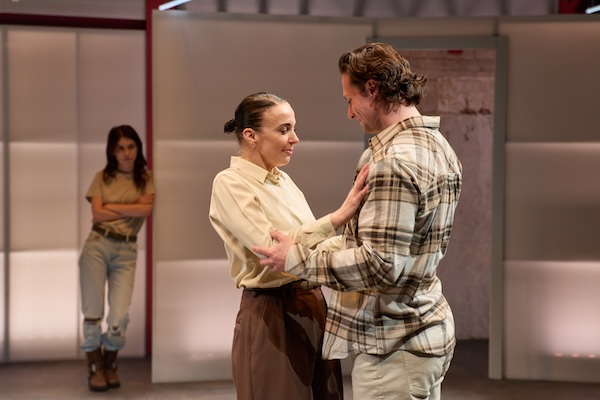
Photo credit: Mark Douet

The pace of the play is often disorientating, moving around in time and space, and covering several years at occasionally breakneck speed, so we barely have time to process one turn of events before another is upon us. But it slows in its closing minutes, giving Tara time for a shocking final revelation, and to deliver the play’s ultimate message: the disturbing prevalence of sexual assault among women and girls across the world. Even knowing that this is the case, the statistics shared in those final moments, and the way in which they’re delivered, are enough to give anyone – male or female – pause for thought. So too is the insistence throughout on using the word rape without hesitation; only by hearing it used so baldly do we realise how frequently its use is avoided, out of shame, awkwardness or just plain fear. When It Happens to You has a strong cast and stylish, thoughtful direction, but it’s this unflinching dissection of the subject matter that will stay with you more than anything else on the train ride home.

When It Happens to You is at Park Theatre until 31st August.

Review: The Marilyn Conspiracy at Park Theatre

True crime meets conspiracy theory meets Agatha Christie in The Marilyn Conspiracy, written by Vicki McKellar and Guy Masterson, and directed by Masterson. Set in the few days before and the hours after Marilyn Monroe’s sudden death in 1962, the play examines her “overdose” and reaches a very different conclusion – that Marilyn was in fact murdered, and the crime covered up by seven of the friends and physicians closest to her.

In reality the play focuses not so much on the crime itself, the circumstances of which – though we don’t see it happen – are presented as indisputable fact by the writers. The real story here is the cover-up, perpetrated by British actor and – most significantly – brother-in-law to the Kennedys, Peter Lawford (Declan Bennett). As the hours following Marilyn’s death tick by, the play becomes a sort of Twelve Angry Men in reverse, with a single character gradually convincing everyone present to collude in a terrible injustice.

Photo credit: Richard Lakos

Interspersed with scenes of the aftermath are moments from Marilyn’s last days, and it’s here – perhaps unsurprisingly – that the play really comes to life. It must be a daunting prospect to portray such a well-known icon, but Genevieve Gaunt is excellent as a fragile but resolute Marilyn; much like her housekeeper Eunice Murray (Sally Mortemore), the audience feels both protective of and frustrated by her in almost equal measure. Her scenes are written in such a way that we see several sides to her character – through conversations with press secretary and best friend Pat Newcomb (Susie Amy) we get to enjoy Marilyn’s sharp wit and delight in Hollywood gossip; her final encounter with psychiatrist Dr Ralph Greenson (David Calvitto) reveals her intense vulnerability; and her fiery exchanges with Peter Lawford and, to a lesser degree, his wife Patricia Kennedy-Lawford (Natasha Colenso, stepping in to replace writer Vicki McKellar due to illness) reveal the rashness that – in this version of events, at least – directly contributes to her fate.

In contrast, the scenes following her death feel a little slower, as the group meticulously go over the details of the evening and settle on their agreed story. Set as it is in a single room in Marilyn’s bungalow with a small fixed cast of characters, the play has a definite Agatha Christie vibe, especially when Dr Hyman Engelberg (Maurey Richards) begins interrogating a distraught Mrs Murray about exactly what took place. But what appears at first to be a simple whodunnit evolves into a more interesting story, examining not why each character might have wanted Marilyn dead, but instead why they might want the truth of her death to remain hidden.

Photo credit: Richard Lakos

The living room set, designed by Sarah June Mills, features a turntable at its centre, which rotates slowly throughout the play, giving us a sense of constant movement carrying even the most unwilling characters towards an inevitable conclusion. Because the writers present their version of events as fact, there’s no space left for the audience to make up our own minds about what happened – and as a result the play leaves us in little doubt as to who killed Marilyn. The question of motive is less well defined, however; it’s implied that she knew, and was prepared to reveal, some critical information that would be damaging to her killers. But there’s very little speculation within her inner circle as to what that information might have been, which means the play lacks the usual neatness found at the end of a traditional murder mystery. Then again, perhaps that’s to be expected in a story based not on fiction but – regardless of whether or not we believe the conspiracy theory – on fact. Either way, The Marilyn Conspiracy is a tense and somewhat timely examination of how easily hearts and minds can be changed, when reputations are at stake and a persuasive speaker is allowed to take the floor.

The Marilyn Conspiracy is at Park Theatre until 27th July.

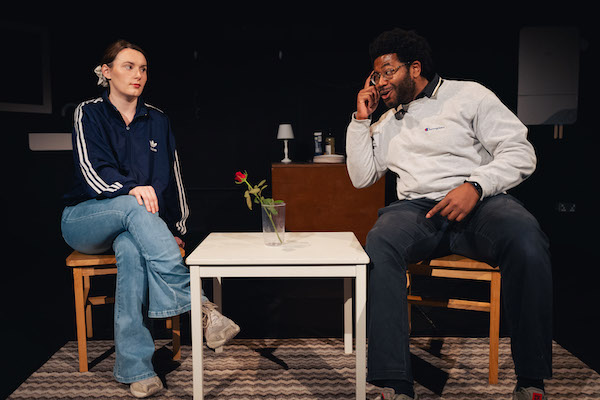
Review: Silent Houses at the Lion and Unicorn Theatre

Tommy Sissons’ Silent Houses takes us on quite the rollercoaster of emotions over its brief 75 minute run time. Ralph (Tobi Ejirele) and Cecily (Aoife Scott) are a likeable, relatable couple living in South London in 2023. Their relationship is loving but strained by the cost of living crisis, which has forced Cecily to put aside her dreams of becoming a dancer, and Ralph to resort to less than legitimate means of bringing in cash. Then Cecily discovers she’s pregnant and the story takes a sudden change of direction, with an unexpectedly funny middle section giving way to a hard-hitting and quietly devastating conclusion, which leaves its audience feeling both hopeless and slightly culpable.

Photo credit: Ross Kernahan

The central plot twist about halfway through seems to come completely out of nowhere, and because of the change in tone that accompanies it, that does make you feel a bit like you’re suddenly watching a different play, with completely different characters. But while it doesn’t necessarily seem completely believable – at least at first – this turn of events does allow Sissons to ask some powerful questions. If things had turned out differently, would the character involved have made the same choice, and if so, how would they have justified it? Is it better to be poor but happy, or financially comfortable but miserable? And how are people ever supposed to escape from poverty when they live in a society that seems set up to keep them there?

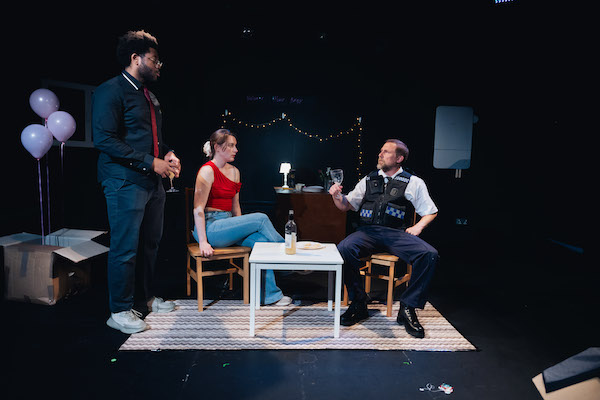
Aoife Scott and Tobi Ejirele both give strong performances; Scott has an engaging vulnerability that balances well with Ejirele’s larger than life presence. It quickly becomes clear that Cecily is the practical one, the voice of reason, while Ralph is a dreamer who wants to give her the earth – if only he could. Alongside them, Nicholas Clarke brings humour but also more than a hint of menace as policeman Albert, who enters Ralph and Cecily’s story in an unexpected way.

Photo credit: Ross Kernahan

The action is set almost exclusively in Ralph and Cecily’s small, sparsely furnished London flat, and director Lilly Driscoll uses the space well, concealing props inside the moving boxes that have become a feature of the couple’s transient existence. Meanwhile Cecily’s advancing pregnancy, portrayed with touching simplicity, charts the passing of time over several months, and it’s testament to Darwin Hennessy’s lighting design that the same set, which at the start of the play felt like a warm, loving home, by the end feels cold and empty.

Silent Houses could perhaps use a little smoothing of some of its sharp twists and turns, but that aside, it’s a thought-provoking and impactful drama that speaks to the situation of so many people across London and the rest of the UK. It’s a personal story, but there’s a bigger picture too – and with a general election looming, it’s never been more timely.

Silent Houses is at the Lion and Unicorn Theatre until 15th June.

Review: Love from Carmen at Chickenshed

Inspired by a 2022 visit to Matthew Bourne’s Car Man, Chickenshed’s latest production is a modernised adaptation of Bizet’s Carmen, set in a refugee camp ten years from now. Having already lost their homes, and now living at the mercy of the camp’s brutal army regime, the refugees have established a circus as the only opportunity to retain their voice and culture. The star of the show is Carmen (Bethany Hamlin), a fearless, passionate woman who’s not afraid to speak up for herself and for those who look to her for leadership. But when she finds herself caught between two men, arrogant fellow circus star Escamillo (Michael Bossisse) and jealous army guard Don Jose (Will Laurence) – who is himself pursued by the lovesick Micaela (Cerys Lambert) – can her independent spirit survive?

Photo credit: Caz Dyer

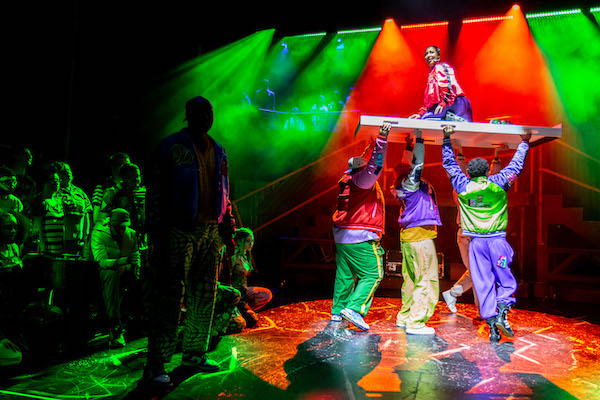
Bizet’s music is the starting point for a vibrant, creative production that brings the 150-year-old story bang up to date. Director Cara McInanny has worked with a core creative team of seven to retain the key themes, both musical and narrative, but set them to a fresh rap soundtrack performed by a diverse cast of 150. With its refugee camp setting, the show feels urgent and timely, and the addition of circus skills from several members of the cast brings an extra thrill of excitement, proving there really is very little the Chickenshed community can’t turn its hand to.

The performances from the central four actors are excellent, but Bethany Hamlin in particular dazzles as Carmen; whether dancing, singing, rapping or performing aerial hoop routines, she doesn’t put a foot wrong throughout the two-hour show. Her Carmen is feisty and sexy, but she also shows a vulnerability in quieter moments that make the character all the more real and relatable – we have no trouble believing that this is a woman who’s lost everything and is desperately clinging to the only stability she can find, by any means necessary.

The rap aspect of the show works well for the most part (although there are moments where the music drowns out the lyrics, making it hard to follow). Nor does the reworking of the music take away from Bizet’s classic melodies, which are all still there; in fact I challenge you to not walk out singing “Nar-ciss-is-tic personality….” set to the tune of “Toreador…” (Try it, it works.) The dance numbers are electric to watch, with brilliant choreography from Michael Bossisse, and bring even more energy to an already exhilarating show.

Photo credit: Caz Dyer

As fresh and exciting as Love from Carmen is, there are times, especially when the whole cast is on stage and it’s difficult to even identify who’s singing, that the spectacle of it all can get a bit overwhelming. This means that the quieter moments, when both audience and production are able to breathe for a minute, feel all the more powerful by contrast. The final scene, meanwhile, is full of drama and yet simultaneously stripped back in an incredibly clever and visually striking way, allowing it to perfectly walk the line between the two extremes, and bringing the show to a memorable conclusion.

Love from Carmen is, once again, an extraordinary showcase of the huge talent and creativity that lies within Chickenshed. It brings an old story into the 21st century, adding a political twist and opening it up to new audiences who might otherwise never have experienced it – and that in itself is worth applauding.

Review: Tess at the Peacock Theatre

Thomas Hardy and circus are perhaps not two terms you’d usually hear in close proximity, but Ockham’s Razor defy all expectation with their adaptation of Hardy’s 1891 novel, Tess of the D’Urbervilles. Atmospheric, evocative and visually stunning, the show charts its heroine’s journey – both physical and metaphorical – through a world in which, so often, “the woman pays”.

Photo credit: Daniel Denton

After her family’s horse is killed in an accident, Tess Durbeyfield (Macadie Amoroso and Lila Naruse) is forced to take employment at the home of the rich D’Urberville family, who she believes to be her distant relations. This throws her into the path of the charming but dangerous Alec D’Urberville (Joshua Frazer), who seduces and rapes her, leaving her pregnant with his child. Some time later, Tess meets and falls in love with Angel Clare (Nat Whittingham), the kind-hearted son of a pastor – but how will he react when he discovers her secret?

Alex Harvey and Charlotte Mooney’s script is deliberately sparing, allowing Tess’s story to be told not only through text, but more importantly through movement. In a beautiful evocation of Tess’s own words about the separation of soul and body, the character is played by two performers, actor Macadie Amoroso and dancer Lila Naruse, with the former narrating the story while the latter lives it. Where words are used, they’re carefully selected to highlight the continued injustice of Tess’s plight, and her mistreatment, not only at the hands of the obviously villainous Alec but also by those who claim to love and want the best for her. It’s particularly jarring to hear victim blaming attitudes that still resonate today, over a century later – have we really progressed so little?

While the spoken elements of the show offer social commentary, the emotional heart of the production lies in the physical aspect. Performed by a talented group of dancers and acrobats, it’s a testament to how much we can say without ever opening our mouths – through our movement, body language and physical interactions. Set to Holly Khan’s soundtrack and atmospherically lit by Aideen Malone, the performers use a combination of acrobatics, aerial work and dance to create a world that doesn’t need words. From the innocence of children tumbling together as they play, to the image of a young woman being ensnared within a Cyr wheel, to the pained contortions of a man who’s just learnt a devastating secret, we feel it all.

Perhaps most memorable are the scenes that portray the characters crossing a wild Wessex landscape consisting of wooden planks, which the performers balance on, scramble up and slide down. This rustic aesthetic continues across Tina Bicât’s set, which with incredible accuracy, and the occasional touch of humour, paints a vivid picture of Tess’s rural surroundings.

Photo credit: Kie Cummings

Nor is this the only light-hearted touch. Perhaps surprisingly, given the relentless misery of Hardy’s story, the production gives us several moments of comedy and even joy – a reminder, perhaps, that as the story begins Tess is only sixteen years old, with the innocence and simple pleasures of a child.

In Tess, Ockham’s Razor have pulled off an impressive feat – producing an adaptation that’s completely faithful to Hardy’s original text and at the same time, something entirely different. The show’s final image leaves you feeling haunted and infuriated and really sad, but also awestruck by the talent and teamwork of an amazing cast.

Tess is at the Peacock Theatre until 3rd February, then continues on tour – visit https://ockhamsrazor.co.uk/tess for venue details.