Where and when: UK Tour (13th-14th April at Wardrobe Theatre in Bristol, 21st April at Old Fire Station Oxford, 22nd-23rd at Yvonne Arnaud Guildford, 26th-30th April at 53Two in Manchester and 3rd May at Liverpool’s Royal Court)
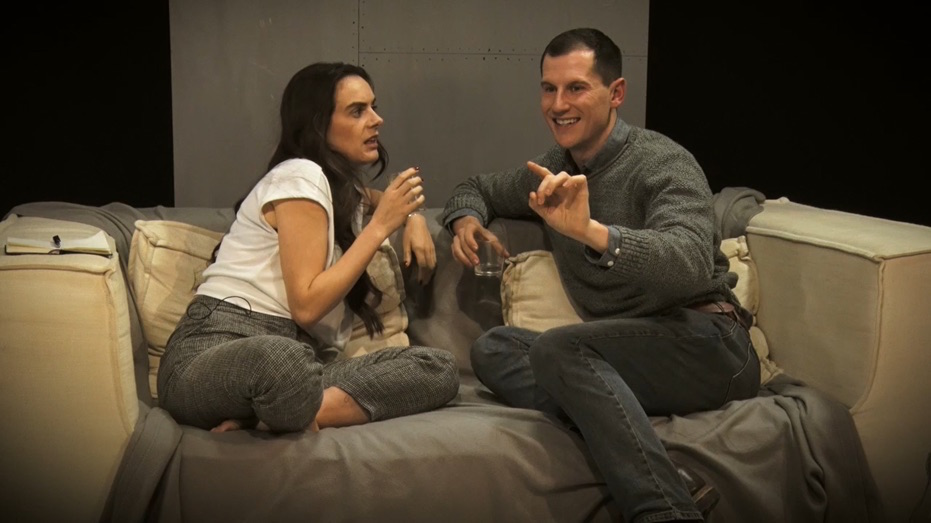
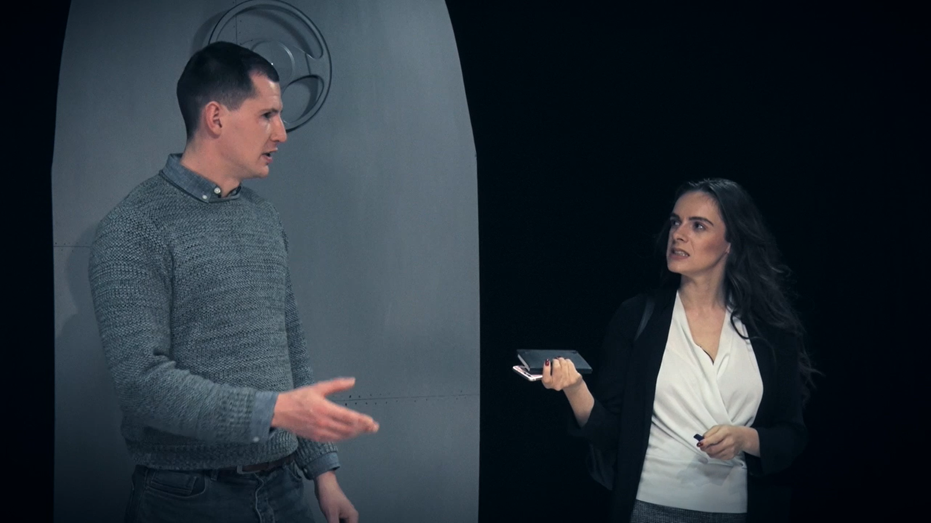
What it’s all about… Growing up in Kilburn, siblings Madani, Maryam and school mate Alex hit it off from the moment they meet. 10 years later, playful chats about ninja turtles, annoying aunties and secret swearing have been kicked out by teen opinions powered by podcasts, porn and politics. Still, best friends can talk about anything. So why are there suddenly so many unspoken thoughts between the three?
A comedy-drama about coming of age in our modern world of unfettered internet access, information overload and weaponised language.
You’ll like it if… You like theatre that makes you laugh, then makes you think!
You should see it because… It’s had critically acclaimed runs at both Edinburgh Fringe 2019 and VAULT Festival 2020 and this UK Tour is long overdue! The crack team of three talented young actors bring the audience in these intimate venues effortlessly into their world of teenage nostalgia, complicated conversations and lines in the sand.
Anything else we should know…: There’s lots of cool stuff going on to accompany the tour. The playscript is being published by Methuen, there’ll be a BSL translated performance in Manchester as well as Q&As and schools’ workshops to discuss the issues the play explores further.
Inspired by real events, Jonathon Crewe’s Under The Radar is a dark two-hander addressing themes of gender, unconscious bias, privilege and misogyny. Up and coming journalist Lee Stilling (Eleanor Hill) is thrilled to score an exclusive interview with inventor Martin Christensen (Nicholas Anscombe) and sets out to join him, alone, on the 43-hour maiden voyage of his private submarine. But once the doors are closed and the alcohol begins to flow, events take an uncomfortable turn (anyone familiar with the facts of the case that inspired the play – that of Kim Wall and Peter Madsen – will have some inkling where we’re headed).
Photo credit: Jonathon Crewe
Writer and director Jonathon Crewe has said that his intended audience for the play is primarily men, to help them see and understand how small unintended acts of misogyny can quickly escalate. That’s both fair and commendable, although in this story it feels like events spiral so quickly that there’s very little time for anyone to process the danger. Much of Act 1 is taken up by the two characters getting to know each other, discussing their complicated relationships with their fathers and how those relationships have brought them to where they are. There’s a lot of good material in this lengthy scene, particularly in Lee’s self-awareness regarding her own privilege – and Eleanor Hill and Nicholas Anscombe have genuine chemistry as the pair begin to get closer, in every sense of the word. However with the exception of Martin’s constant topping up of Lee’s glass, there’s little real sense of threat beyond a couple of inappropriate jokes and some over-enthusiastic dancing. Even the submarine setting doesn’t feel as claustrophobic as expected, given that most of the action just takes place on a sofa, and the only real indication that the characters are on a boat comes from the sonar sound effects during the scene changes.
Act 2, in contrast, throws us straight into the action – but whereas Act 1 seemed to be striving to give both characters equal stage time, Act 2 is all about Martin, while Lee’s voice is silenced just as the character and gender dynamics are starting to get interesting. And then the play takes another, far more surreal turn into black comedy, before ending rather suddenly, leaving the audience unsettled and unsure how to respond.
Photo credit: Jonathon Crewe
All this, combined with long scene changes which take place out of sight behind a curtain, makes for a somewhat disjointed experience, but the actors do well with the material; Eleanor Hill’s Lee is delightfully expressive and has all the insightful journalist mannerisms down perfectly, while Nicholas Anscombe is charming and likeable as Martin, making the play’s later events all the more shocking. And here the play does make an important point: that a man who seems harmless can very quickly become the opposite, especially when there’s nobody else around to see or stop him.
There’s a lot of interesting subject matter in this play, and it has the potential to really make audiences – of all genders – stop and consider their own behaviour and that of their friends. It’s certainly an uncomfortable watch, but issues with the pacing of the story and the imbalance of voices rather dilute the message it’s trying to get across. Nevertheless, a timely production with lots to think about.
Under The Radar continues at the Old Red Lion Theatre until 2nd April.
At first glance, it’s hard to imagine a more left-field choice of topic for a Chickenshed production. The Washing Line follows the tragic true story of Jonestown and the Peoples Temple, where in November 1978 more than 900 people died in a mass suicide at the command of cult leader Jim Jones. On closer inspection, however, it’s not so out there; Chickenshed have never shied away in the past from difficult topics, with previous spring shows tackling such issues as climate change and mental health, and it’s also easy to see how an organisation that prides itself on inclusivity and being open to all would be frustrated to see those same values twisted and corrupted by one man’s lust for power. And then there’s the depressing fact that in 2022 we find ourselves living in a world of fake news and misinformation, with similarly dangerous and even tragic consequences for those who choose to follow blindly.
Photo credit: Caz Dyer for Chickenshed
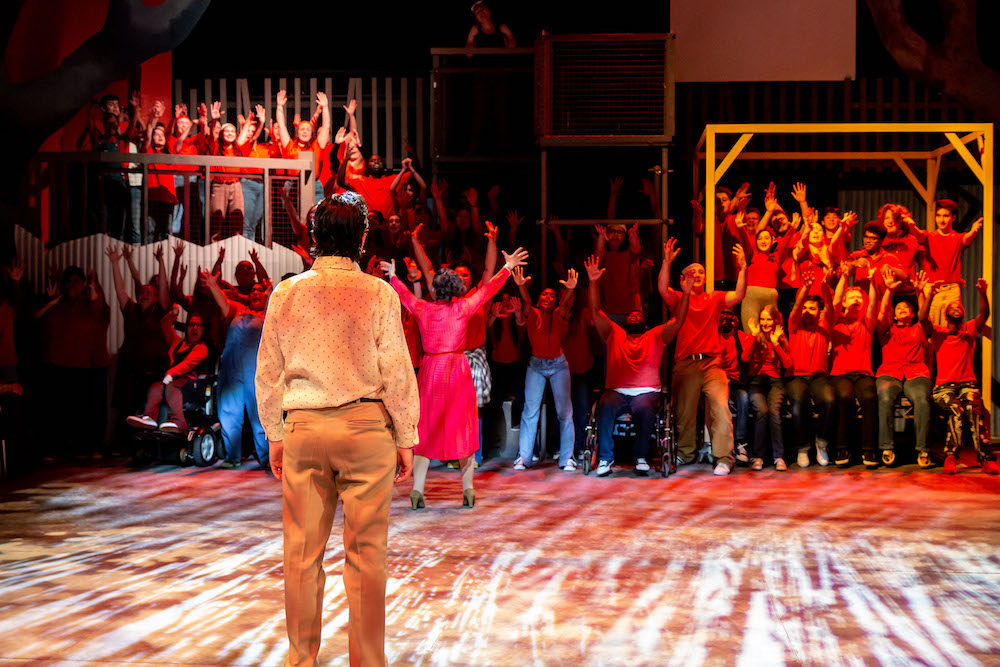
The Washing Line began life as a Chickenshed Foundation Degree production in 2017 called What’s Wrong With Jim, and has been re-worked by Dave Carey and Bethany Hamlin, with direction by Michael Bossisse. The production combines movement, music, dance and multimedia to piece together the story – and it certainly makes an instant impact, as audience members step from the lively atmosphere of the lobby into an auditorium full of bodies. This unnerving and powerful image is further enhanced by the sounds of buzzing flies, which conjure up the suffocating heat of Jonestown, Guyana. Once underway, the show uses shifting timelines to paint a picture of life in the compound, culminating in the devastating events of November 1978, alongside the investigation attempting to figure out what went wrong and to identify the victims.
Presented in the round, the production is extremely immersive, which means that while the audience feels uncomfortably close to the tragedy, we’re also very involved in the joy and sense of community portrayed in earlier scenes set within the compound. The creative team have very pointedly made the focus of the story not Jones’ intentions but those of his followers, who set out to find a better world free of racism and violence, and continued to cling to the hope of finding it right to the very end. One of the show’s most moving sequences features the washing line of the title, where we see the camaraderie and collaboration between the group’s members, and the joyous opening number in Act 2 threatens to sweep us all up in their optimism and shared faith – a stark contrast to the end of Act 1, which paints a dark picture of the life they left behind. As a result, despite the benefit of hindsight, we do get a real sense of why people wanted to be a part of the Peoples Temple project, and why they were so reluctant to give up on their dream and return home even when that dream began to unravel.
Photo credit: Caz Dyer for Chickenshed
Despite excluding him from the final scene, it would be impossible to tell the story of Jonestown without Jim Jones, and Jonny Morton makes a convincingly persuasive yet sinister figure as the cult leader who has so many – among them his wife Marceline (Gemilla Shamruk) and new recruit Jessie (Lara Decaro) – under his spell. There are also strong performances from Ashley Driver and Finn Walters as the detectives trying to make sense of such unimaginable horror, and Sebastian Gonzalez as Congressman Ryan, the politician who was murdered by Peoples Temple members before he could alert the world to what was happening in Jonestown. The true power of this show, however, lies in its ensemble performances, and it’s when the entire cast of around 200 people is on stage that its impact is most keenly felt.
While the subject matter of The Washing Line makes it a difficult watch at times, the show captures a healthy balance of the good and the bad, which means it’s far from being as depressing as it perhaps sounds on paper. In its closing moments we’re shown footage from Jonestown, bringing home the point that as incredible as they may seem, the events we’ve just watched on stage really did happen. There’s also commentary from Chickenshed members, explaining how they personally connect to the story, and their insights bring the show to a close with a sense of optimism that just maybe we – and particularly our younger generations – can prevent such a horrific event taking place again in the future.
Having become firmly established as part of their annual programme, Chickenshed’s showcase of new writing returned this year in a slightly different format. Monolog has evolved into the intriguingly named Eunoia – an Ancient Greek word meaning “beautiful thinking; a well mind” – and this year expanded its remit to include duologues as well as monologues, on a variety of different themes. With the nine short plays divided into two groups, each night’s audience saw only a selection; with more time it would have been great to head back and see the rest, but a short run and Covid chaos meant this time around I only got to see half.
Still, that half presented more than enough entertainment and food for thought. We kicked off with Sophie White’s Never Have I Ever, in which a very sober Archie (Callum Banks) seeks solitude at a house party in an empty bedroom – or at least what he thought was an empty bedroom. Unfortunately for Archie, the very drunk Cat (Stevie Shannon) got there first – and she wants to chat. They’re an unlikely pair, but over the course of their conversation they begin to find some common ground, and even the beginnings of a friendship. With a particularly enjoyable performance from Stevie Shannon, who’s clearly having a great time throughout, this is a funny and heartwarming story about two people who just happened to find each other at exactly the right moment.
Photo credit: Daniel Beacock
There’s a similar theme in Pruning by Sebastian Ross, though the setting and characters are quite different. Edith (Cathy Jansen-Ridings) is recently widowed and dealing with her grief the best way she knows how: by caring for her greenhouse, and drinking gin. Enter teenage tearaway Nathan (Alex Brennan), who’s been forced by his mum to visit Edith and help look after her plants after he did something stupid to try and look cool in front of his friends. After a shaky start, the two begin to open up to each other about the difficulties they’re facing, and to help each other move forward into a happier, healthier life. The difference in the two characters’ ages and backgrounds offers plenty of opportunities for comedy, but there’s still plenty of time and space given to exploring the real problems they each face. I’d gladly watch a longer version of this play in which the developing relationship can be explored further.
Another generation gap is explored in Sabrina’s Party by Rebecca Hardy. Sabrina (Gemma Kirk) has had a falling out with her daughter Mindy, after she tried to force her to have a 70s themed party for her 21st. On the surface, that seems like not a big deal, but as we get to know Sabrina a bit better, we begin to understand the extent of her obsession with the 1970s. Her monologue is peppered with references to the songs, TV shows and culinary delights of her childhood years – but is she just being an annoying mum, or is there more to her determination to cling on to the past? In a monologue that’s necessarily a bit rambly and repetitious, directors Kyra Ancona-Francis and William Jones keep things fresh by moving Sabrina around the stage from one part of the house to the next, and Gemma Kirk gives a great performance, hitting all the right humorous notes but also tugging on our heartstrings as she wonders if she’s lost her daughter forever.
Probably the most thought-provoking piece was Just Imagine by Sara Chernaik, purely because it’s extremely open to interpretation; even the description in the programme seems to be deliberately vague. Touching on issues of identity, immigration, mental health and family relationships among others, ultimately it invites each of us to consider what makes us who we are – and also to take a moment to consider the thoughts, feelings and experiences of others. This invitation is presented to us with a smile by actor Arden Ridings, who gives easily one of the most engaging performances of the evening, really listening and responding to the audience as we respond to him. Whether or not you enjoy having to work to find meaning in your theatre, there’s no debating the quality with which this piece is delivered.
Photo credit: Daniel Beacock
And finally, my personal favourite of the evening, Astonishing Light by Cathy Jensen-Ridings. Again, the charm of this play lies primarily in the performances – particularly that of Shiloh Maersk as Gabe, who likes to hang around the waiting room of a private cosmetic surgeon, talking their clients out of going through with their procedures. His latest target is Benedict (Daryl Bullock), whose fiancée is a wannabe influencer and has suggested his nose could be more “media-friendly”. Gabe is just the right mix of hilarious and sincere; he clearly genuinely wants to help the young men he meets see that they’re perfect just the way they are, and that perhaps they’re not the ones who have a problem. And by inviting the audience to participate in the play through the “magic trick” Gabe introduces at the start and explains at the end, the writer allows us to share in that feel-good glow, even if just for a moment.
It’s no secret that Chickenshed is home to some incredible talent; on this occasion, alongside the writing, directing and acting talent on stage, we also enjoyed a brief pre-show in the bar featuring some incredible young singer-songwriters. But what makes it really special is the way it gives everyone a voice, no matter the topic, genre or style – and while Eunoia perhaps didn’t have the variety that previous showcases have offered, it was still a great night out with lots to enjoy and think about on the drive home.
Returning to live performance for the first time in two years, Arrows & Traps prove they’ve lost none of their ambition as they bring to the stage not one but two inspiring real-life stories. Their new repertory season The Dyer’s Hand consists of two plays, both written and directed by Ross McGregor – the first focusing on the composer of The Planets suite, Gustav Holst, and the second on the groundbreaking astronomer, Cecilia Payne. These two historical figures are connected through Holst’s role as music teacher when Payne was a student at St Paul’s Girls’ School in Hammersmith, but the parallels in their stories go much deeper. Both knew from a young age what they wanted to do, but each had to overcome significant barriers – albeit of different kinds – and tragic loss on their way to career success. And so while each play can and does exist as a self-contained story in its own right, the two also work together in pleasing harmony.
Photo credit: Davor @ The Ocular Creative
Holst, whose journey is charted in the first play, The Music in the Spheres, grew up in a family of musicians, but ill health prevented him reaching the level of accomplishment in any instrument that his demanding father expected. Instead, he discovered a passion for composing, but struggled to be taken seriously, and spent years working multiple jobs to scrape a living and later support his wife and daughter. One such job was his role as music teacher at the prestigious St Paul’s Girls’ School in Hammersmith, where he became a mentor to the brilliant but troubled Cecilia Payne. This relationship forms the focal point of Ross McGregor’s play, while flashbacks tell the story of Holst’s life and career.
Leading the (as ever) astoundingly good cast, Toby Wynn-Davies is wonderful as Holst: a kind, unassuming man with a lifelong passion for music, and a keen wit that’s all the more delightful because it’s so unexpected. His exchanges with the teenage Cecilia (Laurel Marks) are a joy to watch, as two great minds go head to head, each ostensibly arguing for their own field but in reality singing very much from the same song sheet. Despite Holst’s eccentricities, the love and respect shown to him by every other character – his wife Isobel (Cornelia Baumann), employer Frances Gray and aunt Nina (both Lucy Ioannou), friend Ralph Vaughan-Williams (Edward Spence) and former student Sydney Bressey (Alex Stevens) – cements our own appreciation both for his talents as a composer and his many virtues as a teacher, a mentor and a man.
Unsurprisingly the soundtrack to the play (sound design by Kristina Kapilin) is provided by Holst and his contemporaries, and this allows for several epic movement sequences that sit very comfortably within an Arrows & Traps production. The final moments, which see an emotional Holst conducting his Jupiter movement while important figures from his life watch on, are truly spine-tingling – not to mention visually stunning – and a fitting conclusion to this story of triumph against the odds.
The second play, The Stars are Fire, leaves behind classical music and strikes a different tone, with sound designer Alistair Lax instantly rooting us in a new time and place. It’s five years later and Cecilia Payne, having completed her studies at Cambridge, takes up a fellowship at Harvard College Observatory. Despite her brilliance and determination, as a woman Payne was forced to fight for decades to earn the respect of her male counterparts, and to receive credit for her discoveries. That struggle is documented in the play, and while much of the scientific theory sailed far over my head, what comes through very powerfully in McGregor’s writing is the emotional journey taken by a young woman trying to find her place in the world, both academically and personally.
Played by Laurel Marks, Cecilia Payne doesn’t have the instant warmth of Gustav Holst – she’s awkward and stubborn, and speaks openly as a teenager in The Music in the Spheres of her disdain for the very concept of friendship. But in this play we see her begin to take her mentor’s advice and open up to others – among them fellow astronomers Adelaide Ames (Lucy Ioannou), Annie Jump Cannon (Cornelia Baumann), Donald Menzel (Edward Spence) and Harlow Shapley (Alex Stevens) – and to discover that letting people into your life can be both rewarding and devastating. Once again, the supporting cast are excellent; Lucy Ioannou in particular is a ray of sunshine as the consistently perky Adelaide Ames, while Cornelia Baumann provides delightfully dry humour as the stern but kind matriarch of the observatory, Annie Jump Cannon. Though this is Payne’s story, as with The Music in the Spheres it’s very much an ensemble piece, with each member of the cast making a vital and memorable contribution.
Photo credit: Davor @ The Ocular Creative
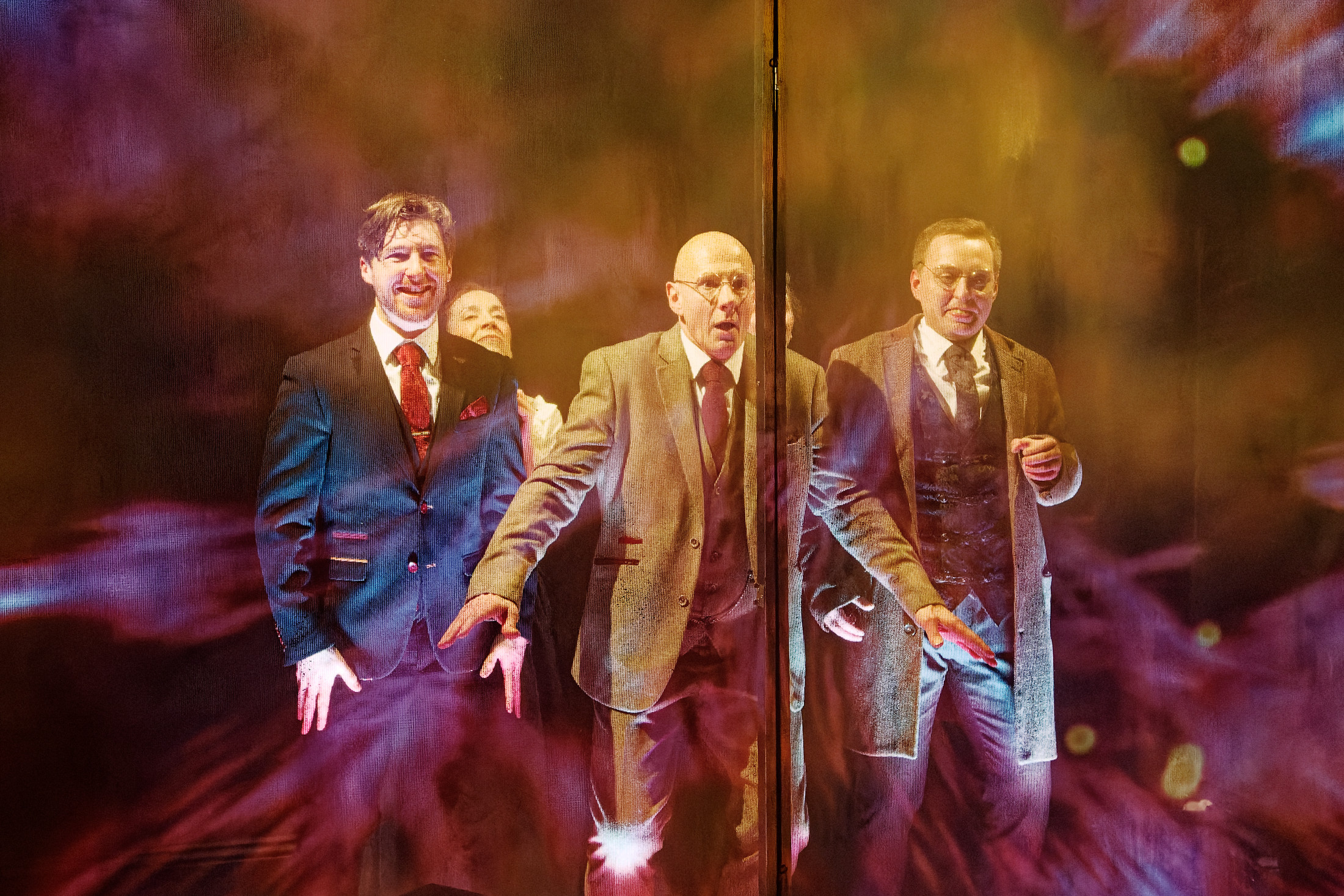
As always, the production values are exceptionally high, with every element – set and costume design by Odin Corie, lighting by Jonathan Simpson and videography by Douglas Baker – coming together in a visually beautiful piece of work. The use of a gauze screen to separate elements of the story, either by time or place, works very effectively, and the employment of projected silent movie style captions contributes to the cinematic feel of the production as a whole.
In recent years, Arrows & Traps have developed a reputation for shining a light on untold stories. While most of us will at least have heard of Holst, it’s likely (because sexism) that fewer people know the name Cecilia Payne – and in both cases, I knew very little about their lives or what inspired them to their greatest work. In these two plays, Ross McGregor and his deservedly acclaimed company have once again told stories that are funny, emotional and educational, and which push us to want to know more.






 Theatre Things