Review: The Sh*t at Bush Theatre

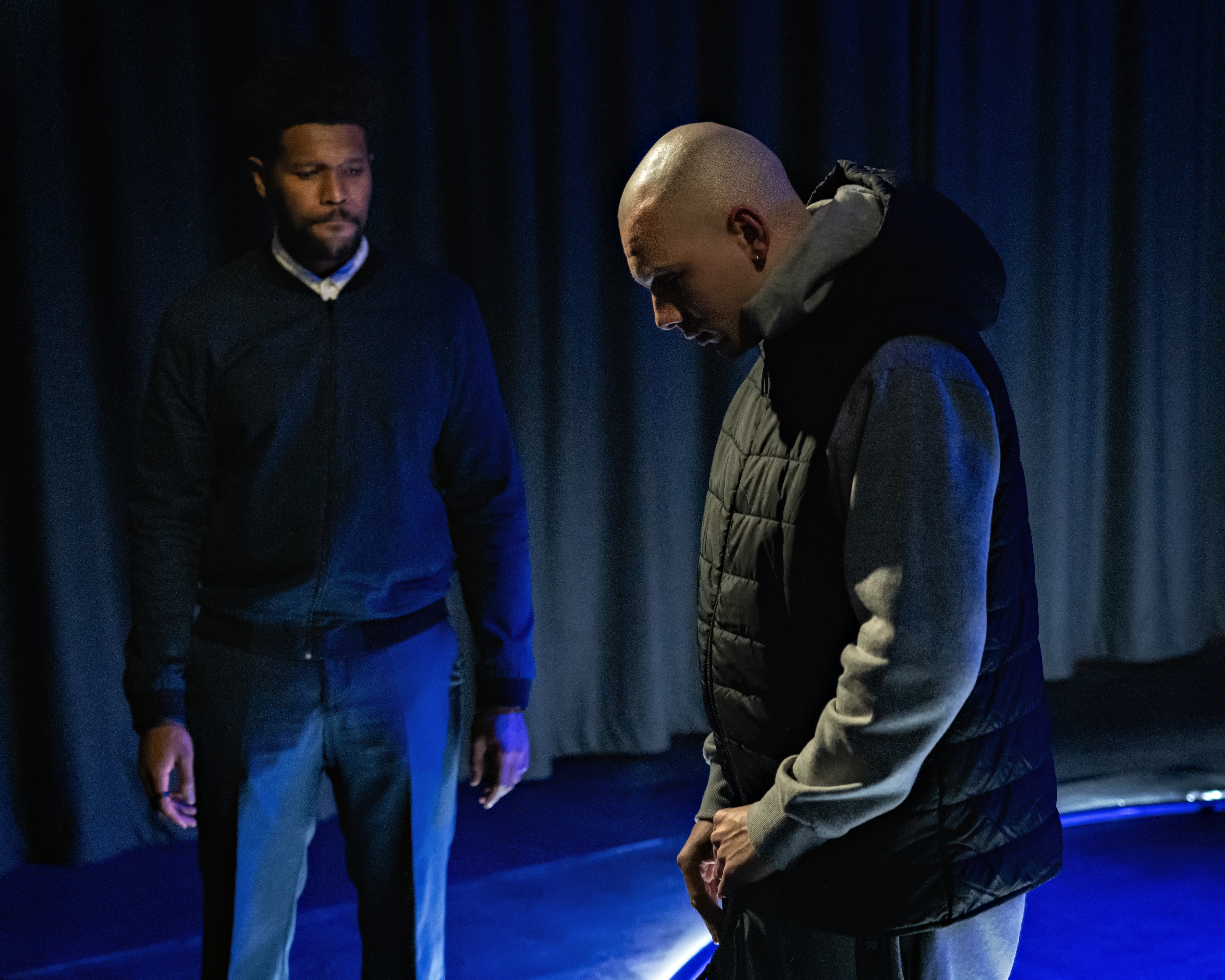
Written following six months of research and interviews in 2018 and 2019, Kenny Emson’s The Sh*t is a hard-hitting play about the challenging world of youth work. The play allows us access to a series of court-mandated sessions between youth worker Eric (Lladel Bryant) and teenager Daniel (Dillon Scott-Lewis), who’s just been released from juvenile detention. Though initially resistant, Daniel gradually begins to open up in the face of Eric’s gentle persistence, revealing the scared child behind the bravado, and the two develop a mutual respect. But through separate scenes between Eric and his unseen boss Sara (Samantha Béart), we learn about the budget cuts and bureaucracy that tie his hands, and which despite his best intentions, limit the amount of help he’s really able to provide.

Photo credit: Ant Robling

Against Caitlin Mawhinney’s backdrop of discarded plastic chairs (the poignant true significance of which only becomes obvious at the end of the play), and under harsh institutional lighting, the two characters begin as adversaries, each trying to stare the other down in grim silence – and it’s testament to the quality of the performances from Lladel Bryant and Dillon Scott-Lewis that even before either of them says a word, the dynamic between them makes for compelling viewing. Daniel understands better than anyone what he needs – to be removed from a situation that’s guaranteed to drag him back to his old life – and his frustration that that’s the one thing Eric can’t do for him is palpable. On the other side of the room, Eric knows exactly what the young man is going through, but struggles with the knowledge that his involvement can only go so far, and that ultimately Daniel’s progress will be reflected merely as a series of black and white checkboxes. Meanwhile the faceless Sara represents a system that’s holding both of them back – not through choice, but because there simply isn’t enough money to really make much difference.

Emson’s writing is heartfelt and real; language plays a key part in the development of the two characters’ relationship, helping them find common ground where none seemed to exist. Neither of them is quite what they seem at first glance, and it’s both heartwarming and heartbreaking to see the true Daniel begin to emerge as the play progresses – a boy with ambition, humour and intelligence who could have thrived had he grown up in different circumstances. Emson offers us a glimpse of what could be, before slamming the door in a conclusion that feels depressingly inevitable.

Photo credit: Ant Robling

As a piece of theatre, The Sh*t is very good – it’s often funny, with great performances and intelligent writing. But is it enjoyable? Maybe not. It makes the audience uncomfortably aware of our own privilege, and of the difficulties faced by young people all over the UK who are trapped in a life they never wanted through no fault of their own. And it’s infuriating to see the people who desperately want to help prevented from doing so, all because those with the power to provide funding and support consistently not only fail to provide it, but judge and belittle the very people they’re failing. The final scene of the play powerfully captures the conveyor belt nature of Eric’s work, and while it can’t answer the question of what needs to happen to break this never-ending cycle, it at least asks it, and that’s a good start.

The Sh*t runs at Bush Theatre until 23rd April as part of Essex on Stage.

Abigail: Q&A with Laura Turner & Stephen Gillard

Inspired by the Salem Witch Trials, Abigail is a new play that examines the female experience – both then and now – through the story of true-life character Abigail Williams. Coming to The Space next month but also available to watch online, the play is written by Laura Turner, Artistic Director of Fury Theatre, and Stephen Gillard, who also directs. Theatre Things spoke to Laura and Stephen about what inspired them to tell Abigail’s story, the show’s journey so far, and their hopes for its future.

Can you briefly summarise what the show’s about?   

Stephen: Abigail picks up the journey of Abigail Williams after the events of the Salem Witch Trials. We follow her as she arrives in Boston Massachusetts and discovers a world beyond the confines of Salem. However this is a dark, dangerous world, full of people who use those they can and destroy those they can’t. The play looks at the effects an event like Salem would have on a young, abused, fragile psyche. Examining themes such as male and white privilege, coercive control, the bisexual female experience and how the legal system fails women past and present.

How did you first learn about Abigail Williams, and why was hers a story you wanted to tell? 

Laura: The history books were our first introduction to Abigail Williams and immediately it struck us as a fascinating unheard story of the past – of a time of immense female suffering and prejudice in the toxic storm of the seventeenth century’s witch hunts – so it made immediate sense for us to connect with her as a protagonist for this story. The fact that there are only pockets of information about her as a real person meant fertile ground for us as creatives to put our own spin on the history and story of Salem, and most importantly with this play, the world beyond Salem. We want to explore the consequences of being part of something like those witch trials – the impact it might have had on the psyche of a young woman who lacked many of the elements of agency that we have in the modern world. Abigail had been parachuted into a perilous position of power when she accused her fellow women of witchcraft, but that was a position that disappeared as suddenly as it came to her when her purpose to the white patriarchal leaders of her isolated community was done and the trials were over. We want to ask, where does that leave a vulnerable young girl on the brink of womanhood? It’s a parallel to any traumatic experience that happens in our formative years.

Does writing a show about a real person feel like more of a responsibility? How did you go about researching and telling the story? 

Stephen: So little is known about Abigail Williams after the events of Salem and yet she remains an enduring figure confined within her own infamy. We felt this was indicative of a broader female experience throughout history and, indeed, into the present day. Women are often thrust into the public consciousness with an impending sense of betrayal. We almost wait for that “gotcha” moment and cast them aside once the headlines run their course. So, while Abigail was indeed a real person, we felt she was a great example of how many many women have been treated throughout history.

Laura: What’s also fascinating about Abigail Williams as a character is the fact that after the Salem Witch Trials she does crop up once more, in an apocryphal story that she ended up in Boston Massachusetts as a prostitute, where she died in prison as a teenager. This really inspired something important in the story of Abigail – what happens to take a young woman from the pedestal she’s on in Salem, to the point of no return in the city? Those gaps in history are where we can explore, ask questions, and look to start conversations and parallels with today.

Why should we come and see the show?

Stephen: This is the beginning of Abigail’s journey. We are looking to build upon each performance and hone the story. We want you, the audience, to be involved in that process. If you love Abigail, that’s amazing, but we will always be completely open to constructive feedback. This is a chance to see a play take shape and, we believe, look at a well known story from a completely different angle. We also really hope that you look at Abigail with the question in your minds; how far have we actually come?

We want this first outing for the play to be a chance to start conversations, both in terms of the developmental future of the piece but also around the themes and content of the piece. In many aspects, Abigail isn’t an easy watch – we don’t want to shy away from the violence and toxicity that women encountered then (and now, in certain situations) – but that’s an intentional choice to be brave in our storytelling and be as authentic as we can to the real experiences of so many women (and men) who might have experienced domestic abuse, coercive control, racism and bigotry. It would be disrespectful of us as storytellers to sugar-coat that, so we hope that debate and conversation will be instigated by these performances. 

Can you tell us a bit about Fury Theatre – how did the company get started and what’s your mission? 

Laura: Fury Theatre was established at the start of 2020 and came out of my body of work that I’d been creating across the previous years of my career. I am a playwright, screenwriter and actor, and it had always been instinctive to me that female stories were at the heart of my creative process, because those were naturally the perspectives, stories and voices that I connected with and gravitated towards. But as I became more confident in myself and what I was passionate about, I wanted to start making my own work as well as working on commissions with other companies. Fury was born out of that desire to take a direct hand in theatre making in all its areas, from artistic to production, and then to take ownership of the themes and questions that motivate and compel me. The things that make us angry are often a good source of creative inspiration and I began to think about how difficult anger can be to express, especially and still today, for women. It’s hard to acknowledge and embrace our fury, but it’s dangerous to repress so we need to find ways. Fury Theatre speaks to that impulse, to express ourselves, and to tell our stories with heart and fire. I hope the company will continue to grow and keep using emotionally-driven narratives to tell stories with a social conscience and something “bigger” to say.

What would you like audiences to take away from seeing Abigail? 

Stephen: Have we really come as far as we think we have? History lets us put distance between ourselves and the events we’re being asked to witness. If you watch Abigail and see the events of the play, we want you to ask if there are any similarities to things happening around the world and in our own back yard that mirror what you’re seeing? Have women gained complete agency and autonomy of their lives, their bodies and their futures now that the witch trials are over? Does the justice system offer a level playing field? In short, we just want people to take away questions and see if they can’t come up with some answers. Also, we’d really like you to actually enjoy the piece, even if we do sound super serious about everything.

Finally, where and when can we watch it?

Laura: You can catch Abigail at The Space, Isle of Dogs from 3rd to 7th May at 8pm, with an additional Saturday matinee at 2.30pm. If you’re not in London, you can also watch the livestream on 5th May, which will also be available on demand for two weeks afterwards.

You can book tickets to see Abigail at https://space.org.uk/event/abigail/

Review: Zorro the Musical at Charing Cross Theatre

After its previous run at Manchester’s Hope Mill Theatre was cut short by Covid after just two previews, Zorro the Musical has finally made its long-awaited debut in London at the Charing Cross Theatre. With music by the Gipsy Kings and an original story by Stephen Clark and Helen Edmundson, this immersive production promises much and, mostly, it delivers.

Set in California in 1805, the show tells the origin story of the legendary Zorro, a.k.a. Diego de la Vega (Benjamin Purkiss). Having been sent away to school as a child, Diego returns from a life of pleasure and privilege in Spain at the request of his childhood friend Luisa (Paige Fenlon) to confront his jealous brother Ramón (Alex Gibson-Giorgio), who’s declared himself alcalde following the mysterious death of their father (Pete Ashmore). With Diego are his gypsy friends, led by the seductive Inez (Phoebe Panaretos). On their arrival, appalled by his brother’s tyranny, Diego dons a disguise to become the masked hero Zorro and fight injustice, while somehow managing to keep his true identity secret from both Ramón and Luisa.

Photo credit: Pamela Raith

If it sounds very silly, that’s because it is – and it certainly requires more than a little suspension of disbelief on the part of the audience. But it’s great fun and never takes itself too seriously, and as a result there’s a lot to love about Christian Durham’s vibrant and immersive production, with thrilling fight sequences, flaming swords, unrequited love and infectious – and in some cases, very familiar – musical numbers. Staged with the audience on both sides, Rosa Maggiora’s intimate set makes use of every inch of space, with cast members racing up ladders and chase sequences that take in the whole theatre, ensuring that we’re at the heart of the action throughout.

The legend of Zorro is enduringly popular for a reason, but the true hero of this production, and what lifts it beyond just being an entertaining caper, is the defiant gypsy spirit that runs through all the mesmerising ensemble numbers. This means the main story and characters often take second place to any scene involving the gypsies, and Phoebe Panaretos in particular completely steals the show any time Inez steps on stage. But that’s not to say that the rest of the cast are bad; the quality overall is extremely high – Marc Pickering is both hilarious and adorable as the timid Sergeant García, Paige Fenlon’s Luisa absolutely nails some of the best solo numbers, and Benjamin Purkiss makes a suitably charming and reckless Diego/Zorro.

Photo credit: Pamela Raith

For an evening of high energy and lighthearted entertainment, you could do a lot worse than Zorro the Musical. It’s easy to pick holes in the plot (so I won’t), but ultimately it’s easy to get swept up in the sheer exuberance of it all. You’ll be dancing in your seat and leaving with a smile on your face – and after the couple of years we’ve all had, that’s more than enough.

Zorro the Musical is at Charing Cross Theatre until 28th May.

Review: Another America at Park Theatre

Bill Rosenfield’s Another America is not quite what I expected – which, it turns out, is the whole point. Inspired by the 1999 documentary film True Fans by Dan Austin, it’s not explicitly billed as a political play, but it’s easy to assume that it will be, especially for a British audience who’ve heard little else from the USA for the past few years. As with the UK and Brexit, it can be easy – especially if you spend any time on social media – to assume that everyone must have chosen a side and be constantly at odds with those who disagree. In reality, that’s not the case, and as this play ably demonstrates, there are millions of Americans who are just getting on with their lives, fighting their own private battles and enjoying their individual successes. And while Rosenfield’s play can’t quite stretch to showing us all of those people, it certainly gives it a go, with 36 characters played by just three actors.

Photo credit: Piers Foley

Basketball and diehard Utah Jazz fan Dan Austin (Marco Young) convinces his brother Jared (Rosanna Suppa) and best friend Clint Ewell (Jacob Lovick) to accompany him on a “pilgrimage” across the country from Venice, California to the Basketball Hall of Fame in Springfield, Massachusetts. Strapped for cash and with only their bikes to get them there, the trio are forced to rely on the kindness of strangers to keep them on the road, with each of their new friends invited to write some words of wisdom on the basketball they carry with them. The three actors take it in turns (sometimes more willingly than others) to play these additional characters, switching accent, personality and gender with impressive ease as we travel across the country. Some of the impact of this is inevitably lost on a non-American audience unfamiliar with the geography or regional idiosyncrasies of the USA, but the voiceover provided by the three travellers provides enough exposition to at least give us a rough idea where we are and what type of town it is.

Photo credit: Piers Foley

The steady pace, minimalist set design and absence of much drama in the plot means that in different hands, the play might not work. As it is, Jacob Lovick, Rosanna Suppa and Marco Young really bring it to life, engaging in a very natural way with both the audience and each other even before the play begins. Their friendship is completely believable, to the point that there are moments where it’s not completely clear if they’re still on script or just messing with each other. The result is a gently meandering production from director Joseph Winters, which doesn’t get the pulse racing (with the exception of one unexpected moment at the end of Act 1) but does provide an interesting snapshot of a USA most of us have never seen or even knew existed.

Oh, and if you’re not a basketball fan? It doesn’t matter, because ultimately, just as it’s not a play about politics, nor is this a play about basketball. The sport and its hallowed Hall of Fame might provide the trio with the push they need to start moving, but in the end they’re each travelling towards their own personal destination – and none of those destinations have anything to do with Utah Jazz. This is a story about regular people finding their way in life, and whatever our political, sport or other allegiances, that’s something we can all relate to.

Another America continues at Park Theatre until 30th April.

Quick Q&A: Richard II

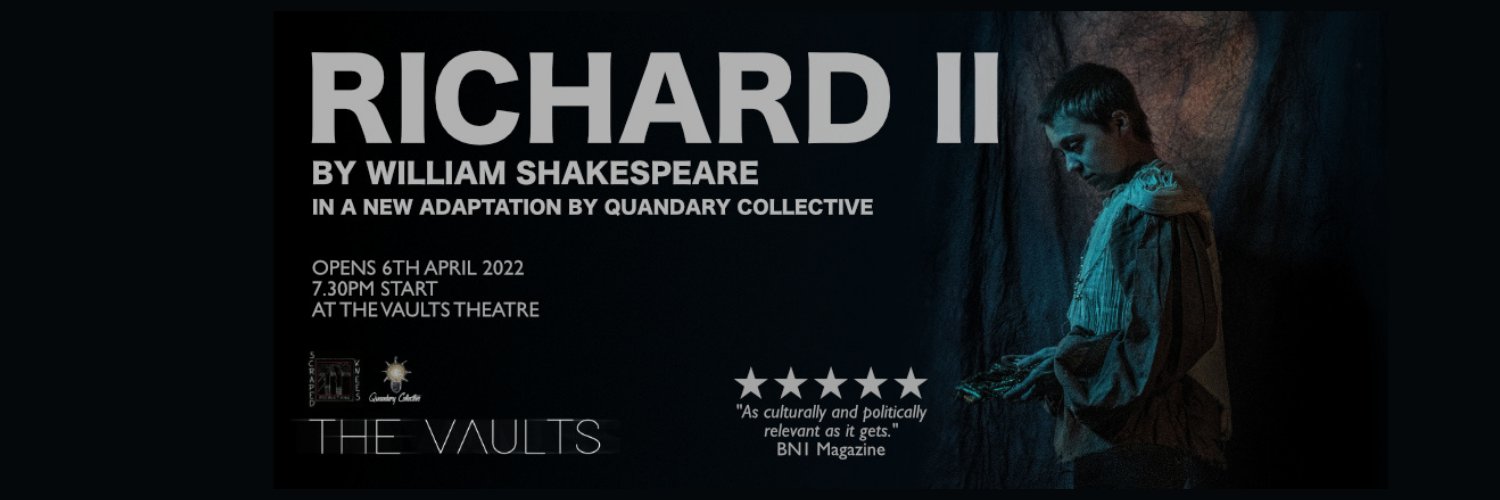
Where and when: THE VAULTS, Leake Street, SE1 7NN 6th April – 8th May 2022 Weds – Sunday inclusive Doors open 7PM for 7:30PM start

What it’s all about… This brand new adaptation is returning to London hot off the heels of a successful UK outdoor-tour and will be setting up camp at The Vaults from 6th April- 8th May 2022.

Celebrating and championing women, this company rocks a women-led production team, women-led creative team, and a woman in the starring role of Richard. Join us as we enter a kingdom in which a woman is presenting as a man to hold on to power, and be prepared to reconsider everything you thought you knew about the so-called ‘effeminate’ King.

Quandary Collective take Shakespeare’s words and fuse them with muscular movement, bloody violence and electronic beats, to bring you a gut-wrenching rendition of Shakespeare’s classic that’s somewhere between Mad Max: Fury Road, an episode of Game of Thrones and what it might have been like to stand in the pit at The Globe in 1595. This young company’s fearless adaptation looks at what it means to lead a country, the insidious effects of toxic masculinity, and why gender continually seems to matter in positions of power.

You’ll like it if… you love pumping electronic beats, epic imagery and punchy acting.  

You should see it because… it speaks beautifully about the current politics and global knife edge we are currently on. Plus it will be a really good night out!  

Anything else we should know…: It’s actually really funny.

Where to follow:
Facebook: @QuandaryCollective
Twitter: @QuandaryCollec1
Instagram: @quandarycollective

Book here: https://www.thevaults.london/richard-ii

Got a show opening soon? Visit Promote your show and tell us more!