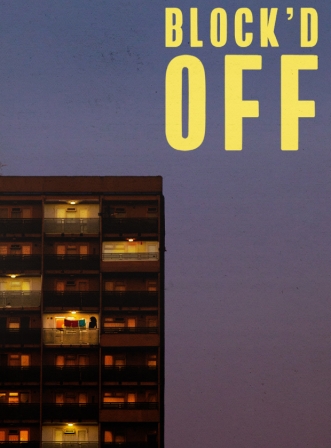
Quick Q&A: Block’d Off

Where and when: Pleasance Courtyard (Upstairs), 60 Pleasance, Edinburgh, EH8 9TJ Wednesday 3rd–Monday 29th August 2022 (not 10th, 23rd), 15:10

What it’s all about… Block’d Off is about the experiences and lives of working-class people who find themselves stuck in the cycle of deprivation. This is when you are unable, because of your circumstances, to rise out of what you have unless major sacrifices are made by yourself or people around you, or you simply get lucky. That’s a brief way of putting it anyway, it is a complex issue.

You’ll like it if… You are anyone of any age who understands what Class is, and anyone who has an opinion on how class plays a role in our life. Whether you identify as any of the strands of working-class, or middle or upper-class, then you will be able to find something in this show.

You should see it because… Block’d off offers a new perspective and new information on working-class living. It is very easy to have media portrayals depict our idea of another group that is different from us and we have to take it upon ourselves to diversify that image with different opinions. I hope that the audiences of Edinburgh take away a new perspective on this important topic.

Anything else we should know…: Block’d Off is a one of a kind play. It is a one-woman show that sees the performer play over 20 different characters with slickness and truth, and at multiple stages embodying multiple characters at a time using physical storytelling. Whether you love or hate the messages it speaks, you will never see anything like it.

Where to follow:
Twitter: @blockdoffplay, @arrowwooden, @ElGordoTheatre, @thepleasance

Ticket link: https://www.pleasance.co.uk/event/blockd#overview

Review: The Woman Who Amuses Herself at Jack Studio Theatre

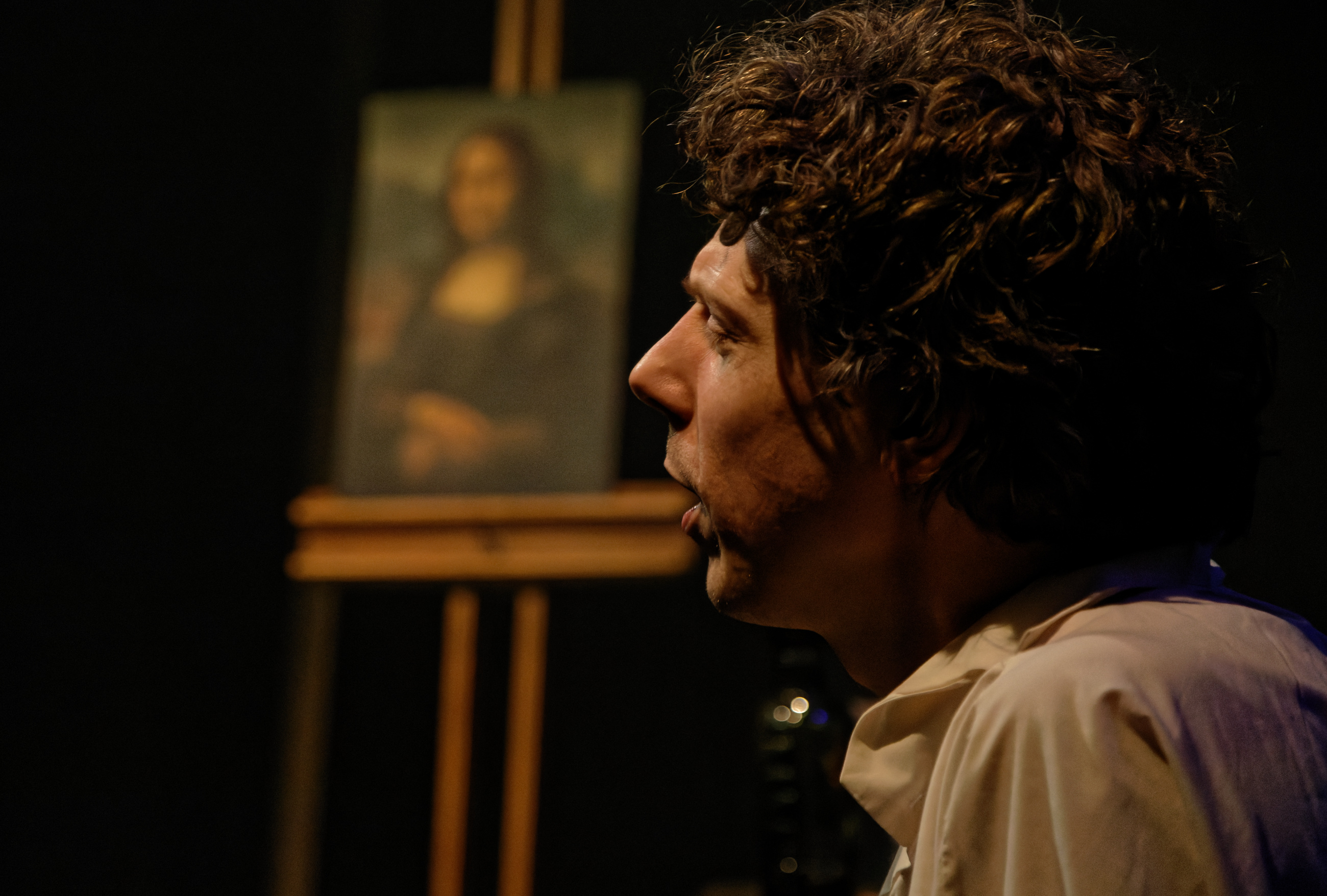
Given how famous the Mona Lisa is, it’s perhaps surprising that more people don’t know the story of its theft in 1911. And that’s a shame, because it’s a great story: Italian workman Vincenzo Peruggia (Tice Oakfield), troubled that Da Vinci’s painting resided in France and not in its creator’s homeland, took it from the Louvre with the intention of returning it to Italy. After keeping the painting in his apartment for over two years, he was finally caught when he contacted an Italian gallery owner and revealed the Mona Lisa‘s whereabouts. Peruggia spent a year in prison for the theft, but became a national hero as the painting toured Italy before being returned to the Louvre in 1913.

Photo credit: Davor @ The Ocular Creative

Victor Lodato’s 2011 play explores Peruggia’s motivations (to this day, it’s unclear if he was driven purely by patriotism or by a desire for financial reward) and his complex relationship with the Mona Lisa during the years he kept the painting in his home. Tice Oakfield’s Peruggia is instantly engaging as he addresses us directly; this is no practised criminal but a man driven by passion to do something even he can’t quite believe he’s actually capable of. And then having done it, he finds himself trapped and driven to the brink of madness – unable to give up the painting, but equally unable to live under the Mona Lisa’s calm, enigmatic gaze. Whether she’s on display or hidden away in a trunk, it’s clear that he constantly feels her presence and is fascinated and terrified in equal measure.

Peruggia’s response to the painting allows Lodato to expand his focus and allow other voices to offer their own perspectives on Da Vinci’s work. In all, there are ten characters in the play, and each of them is portrayed in Kate Bannister’s production by Tice Oakfield, who transforms before our eyes from Vincenzo Peruggia to artist Marcel Duchamps, to British critic Walter Pater, to a harried school teacher trying to get her kids to engage with art. By exploring these different viewpoints, Lodato invites the audience – at one point quite literally – to consider for ourselves this picture we’ve seen hundreds of times, and to ask anew just what it is about La Gioconda that provokes such passionate reactions in people from all walks of life.

Photo credit: Davor @ The Ocular Creative

Over the years we’ve come to expect good things from the in-house creative team at the Jack, and this latest offering is no exception. Peruggia’s humble origins are reflected in Karl Swinyard’s intimate attic apartment set, while video projections from Douglas Baker and sound design from Julian Starr enhance the narrative without distracting from Oakfield’s enthralling central performance. The result is an unassuming production that’s nevertheless quietly powerful – much like the painting that inspired it.

The Woman Who Amuses Herself continues at the Jack Studio Theatre until 23rd July.

Quick Q&A: Crash and Land

Where and when: Canal Café Theatre, Delamere Terrace, Little Venice, London W2 6NG. // 14th, 15th, 17th of July 2022

What it’s all about… Crash and Land follows Wendy, Nora, Gabrielle and Sasha, four flatmates living in London as they discover who they are in an ever-changing world.

It’s a story that explores the complexities of relationships, of family, of gender and sexuality.
It’s about love and being young and making mistakes, trying to find a way to accept yourself
no matter what.

You’ll like it if… You’re interested in: queer theatre, new writing, and stories about complicated love and loss.

You should see it because… Crash and Land is an exciting story that explores the complicated nature of relationships: friends, family, lovers. It’s an important and relevant story – showing us just how messy and confusing all these things can become.

It’s also the exciting debut of a young writer and debut actors – fresh out of training and ready to explore the world of London pub theatre. We’re very excited for you all to meet them!

Where to follow:
Twitter: @tapirlost
Instagram: @losttapirproductions
Facebook: @losttapirproductions

Book here: https://canalcafetheatre.com/our-shows/crashandland/

Review: A Plague On All Your Houses at Riverside Studios

When we learned about “the Plague” at school, how many of us suspected that we would ever live through one of our own? Now admittedly, Covid – as serious as it undeniably was and continues to be – could hardly be said to be on the same scale as the Black Death, but in A Plague On All Your Houses, writer and director Marcia Kelson argues that humanity’s responses to such a widespread catastrophic event have actually changed very little over the centuries – and there’s no reason to suspect we’ve learnt anything this time around either.

In biblical Egypt, the Pharaoh refuses to free the Israelites from slavery, even when threatened with the death of his own child. In 19th century France, two winemakers are horrorstruck when they realise an aphid brought in from America will wipe out their entire vineyard – but quickly find a way to take financial advantage of the situation. In 2022, our very own Boris Johnson is still refusing to impose Covid restrictions, despite the efforts of an increasingly frustrated Chris Whitty to convince him. And in 2025 – well, who knows where we’ll all be by then.

Kelson casually drops expressions throughout that are all too familiar to a Covid-era audience – lockdown, self-isolation, and even the dreaded “Hands, Face, Space” all come up across the centuries, along with the weary refrain, “What a time to be alive” – and in doing so draws clear parallels between the different events. Perhaps Elizabethans didn’t realise they were “going into lockdown” when they boarded up their houses and closed the theatres to keep out the Plague, but the end result was pretty much the same.

Four actors (Catherine Allison, Morgan Black, Ben May and Richard McKenna) play a variety of characters from different backgrounds, proving once and for all that disease is no respecter of class, despite what Bill and Sandra, bored passengers on A-Deck of a Covid-afflicted cruise ship, might believe. Perhaps surprisingly, given the grim subject matter, there are actually a lot of laughs to be had – though perhaps it’s more despairing laughter as we watch the characters make the same mistakes over and over again – and the cast revel in their larger than life roles, most memorably Ben May in his eerily accurate portrayal of Boris Johnson, and Morgan Black as Phylloxera, an American aphid newly arrived in France and ready to cause mischief. The musical number in the middle, performed by Rachel Wilkes, is unexpected and over almost as soon as it begins, but on the night I attended, the audience seemed to have no hesitation about enthusiastically joining in.

Ultimately, A Plague On All Your Houses doesn’t really teach us anything we don’t already know; to anyone who’s paying attention, it’s been clear for some time that our leaders have learnt little from the pandemics of history or even from the experience of the last two years. But it’s an enjoyable hour-long history lesson, and if nothing else, a reminder that though it may sometimes feel like it, we’re far from the first generation to go through an event like this – and nor, depressingly, will we be the last.

A Plague On All Your Houses continues at Riverside Studios until 16th July.

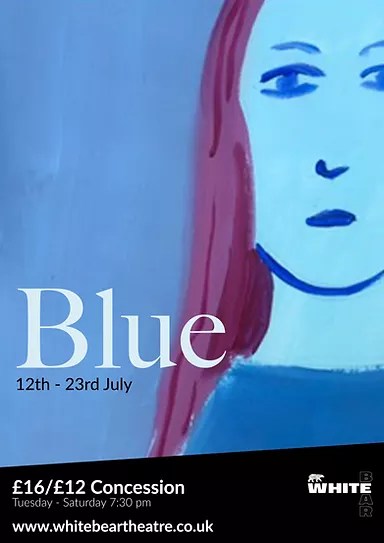
Quick Q&A: Blue

Where and when: The White Bear Theatre, 138 Kennington Park Road, London SE11 4DJ 12th-23rd July at 7.30pm (Tues-Sat)

What it’s all about… As they career towards their forties Max and Frances Davidson, a chaotic couple from Bethnal Green, have reached crisis point. Frances, a creative weaver, is convinced (wrongly) that she has MS and is also deeply troubled by a large blue square which keeps involuntarily intruding into her work.

Meanwhile her husband Max, a manic, unbalanced architect, finds respite in a panoply of prescription drugs, washed down with unhealthy amounts of vintage Armagnac. Max is also obsessed with ‘New Age’ writings such as Theosophy – a form of philosophical or religious thought based on a mystical insight.

From his academic readings he comes to realise that he is a direct descendant of the biblical King David of Israel and Judea and that he is on earth with a special mission to build the Third Temple of Jerusalem… in Glastonbury.

Into this troubled household comes Sareen, a young Armenian refugee with shamanistic powers and ambitions to become… an architect!

You’ll like it if… The play is a dark comedy. You will laugh. You will think about the ‘human condition’. You will find some of it absurd because life is a little weird and sometimes the more we think the more confusing and complicated life becomes…

The original title for the play was That Other Thing and it came from a feature article Peter Hamilton read in the Daily Telegraph about 15 years ago. In the article a nun at a convent in Wales was interviewed about how she had found her vocation. She was a very-well educated middle-class Englishwoman who had read English at Oxford, where, she commented, she had enjoyed life “to the full. But there was always this other thing”. This is what first caught Peter’s attention because this is what it was like, the religious awareness. It’s something there at the back of the mind all the time, lurking in the shadows and you know it’s going to come and get you one of these days.

Also, one day Peter was listening to Woman’s Hour on Radio 4, and there was an interview with a young black Afro-British woman who was a creative weaver. She had been born and brought up in south London but her ethnic origin was East African (he thinks it might have been Masai). She described how, on graduating from Camberwell Art School, her weaving had gone well for a while, but then inspiration dried. After some striving, she eventually revived her work by returning to her African roots and the tradition of weaving tribal history and stories.

This also struck a note with Peter: creativity flourishes from a connection to deep roots; it’s not something to be endlessly dredged up from the individual. And about this time he met a painter who lived in a terraced cottage in Bethnal Green, which he had restored himself and done a very good job. Homes always draw Peter; the idea of restoring old buildings like mills and dovecotes, warehouses and small castles and living in them.

Peter had also spent quite a few years reading ‘New Age’ and other religious literature: Alice A Bailey, who first coined the phrase ‘New Age’, Theosophy, Gurdjieff and a rather sinister book called Holy Blood/Holy Grail, as well as The Bhagavad Gita, Confessions of St Augustine (“Our hearts are restless till they rest in Thee”).

You should see it because… In a nutshell, we would like people to go and see Blue because, in all the current madness and violence of the world, we hope that it might remind them of the sureness and eternal stability of the spiritual realm, that God is on our side, that we are all on a great journey of souls, and that, as it says in the GITA: “Whenever there is a withering of the Law and an uprising of lawlessness on all sides, then I manifest Myself.”

Anything else we should know…: A first-class cast will feature in the playwright’s fifth collaboration with director Ken McClymont: Max Davidson (Tom Greaves), Stephen Omer (George), Julia Tarnoky (Megan), Emma Stannard (Frances) and Lara Ciulli (Sareen).

Where to follow:
Twitter: @mytheatremates, @clockschooltc

Book here: https://www.whitebeartheatre.co.uk/whatson/Blue