Review: One Was Nude and One Wore Tails at the Hen and Chickens

Guest review by Ross McGregor

Dario Fo’s lesser known one act play One Was Nude and One Wore Tails bears all the trademark satirical prods and nods that you would expect from the mind that wrote Accidental Death of An Anarchist.  There’s some plot, some characterisation, and a few set pieces but it thankfully never really attempts naturalism or a cohesive narrative, and you can take what you want from it. Do you fancy a cutting social commentary on how the wealthy (personified here by a nude man in a bin) rely on the assistance of the working class (personified here by a roadsweeper and also caretaker of aforementioned bin) to get them out of messes of their own making (being stuck naked in this same bin)? This play has that for you. Fancy some Brechtian working class singalongs with comedy horns and innuendo? Job done. Do you desire Beckettian dialogues on the nature of existence? Yup, got that too. Dissection of religion’s intrinsic value and man’s relationship with the deity itself in reference to our own nothingness? Job’s a good’un. Copious nob gags and funny carrot-based prop moments? Consider it done. Find people being hit over the head repeatedly with bin lids absolutely hilarious? This play has you covered.

I don’t think it’s necessary to understand every moment of the play, and to be honest it goes at such a lick that it would be almost impossible to do so without studying it heavily first. But it’s not really important. Fo is throwaway, he’s anarchic, he revels in breaking fourth walls and sending up authority. He doesn’t so much care about making coherent and empathetic narratives as giving you a laugh and a social message. It’s fun, its clever and it’s filled with invention and absurdity. Is this production well-made with love and energy? Yes, clearly – the actors are having a wonderful time up there onstage and their enthusiasm is infectious. Am I glad it was only an hour long? Yes indeed.

This production was made by Theatre of Heaven & Hell, so let’s deal with their “heavenly” points first. Their Programme Notes state the company “began in a living room in Southend-on-Sea”, and the production honours this humble origin with a charming and roughshod design. Newspapers and other street detritus litter the floor with such prolific abandon that it doesn’t so much feel like a normal city street at night but the morning after a newspaper-based apocalypse. The rest of the set is simple and does the job. The acting is enthusiastic with special mention going to Darren Ruston as the Naked Man in the bin, as he completely stole the show and chewed the scenery, sometimes literally. He had a slightly unfair advantage over his cast-mates as his role was a country mile better than the others, to the extent that when he wasn’t visible onstage the action noticeably dipped in interest, but considering he was static (in a bin) and often only a talking head (in a bin), he worked moments of utter stage magic.

Nicholas Bright and Jake Francis do well as the Roadsweeper and Man in Evening Dress respectively, and their grasp of Commedia acting style is clearly apparent and deserving of praise. Bright leads the piece as an ingénue of sorts, or an idiot savant, and somehow that comes across as the clown-like love-child of Goofy and Rodney Trotter, but it’s endearing and those type of parts are always very hard to pitch right, so Bright deserves much praise for aiming his little roadsweeper dunce with such innocence and sparkle that I only wanted to kill him a little bit. Elena Clements plays Woman with a vice-like command of punchlines and timing, and Brian Eastty multi-roles as a philosophical lascivious roadsweeper and a nosy patrolman. The cast are good on the whole, their energy is always at the apex of what is needed for the piece, and they clearly relished playing archetypes of sex workers, and policemen and ambassadors – this is not Pinter, or Shakespeare, or Chekhov – there are no three-dimensional characters here, and you can see the cast are loving living life large.

Now to deal with the “hellish” elements, as unfortunately this production could do with some honing.  The set-pieces and clowning elements were a little off in their timing and are in need of some more practice. There were multiple line fluffs which would be fixed by the actors taking a breath and some time during the performance to just “sit” in their roles and get comfortable. Only Ruston allowed the scenes to truly breathe, and it is something the rest of the cast could benefit from.

Second, the actors were all over-dressed in terms of their heat management. Many of the actors were sweating so much that it became a distraction for me, as I couldn’t get past how uncomfortable they looked. Turn the lights down, and turn the air conditioning up higher. Let them lose the hats and gloves. Make them comfortable, and they’ll be more at ease onstage. And if you’re going to have a naked man run across the stage at the end, then, let him be actually naked. Don’t fudge it with white loincloths. If he doesn’t want to, or if you don’t want to, then cut it. It’s one of those things you either do properly or don’t do at all, and to have it as the last image of the play meant that the whole production ended on a whimper as opposed to the explosion that presumably was intended.

One Was Nude and One Wore Tails is a quintessential London Fringe story. It’s a forgotten gem brought back to life, with a talented and energised cast that produce some moments of utter brilliance, but is let down slightly by a lack of precision in rehearsal in terms of movement direction. With some time and work – it could be divine.

One Was Nude and One Wore Tails is at the Hen and Chickens until 18th March.


Can’t see the map on iPhone? Try turning your phone to landscape and that should sort it. I don’t know why but I’m working on it… 😉

Review: Four Thieves Vinegar at Barons Court Theatre

Guest review by Ross McGregor

Four Thieves Vinegar is a new play by Christine Foster, directed by Adam Bambrough for The 42nd Theatre Company at Barons Court Theatre. At times with the Fringe Theatre industry, grand ideas take place in tiny cramped arenas, but here we have a perfect unison of play and venue in that the subterranean vault-like gloom of the Baron’s Court Theatre is transformed into a 17th century prison cell and this genius venue choice complements the aesthetic of the tale perfectly. The most striking element of this production is its design. Sally Hardcastle and Will Alder deserve the highest of praise for their work on this production, as they have elevated it to something worthy of the West End. The lighting, props, costume and set decoration are simply flawless, creating a perfect, captivating world in which the actors can play in. From tiny details of amber window effects, to the dirt underneath the actors’ fingernails, it’s all done with an attention to detail that is staggering.

The plot revolves around three inmates of Newgate prison and their kindly jailer, in the time of the Black Death. The possibility of a cure is understandably on everyone’s minds, and fearful superstition of God’s wrath is heavy in the air, thicker than vinegar fumes and hot brick ash. Matthias Richards, played with grace and sincerity by Nick Howard-Brown, is an impoverished alchemist trying to cure the plague before time runs out. Kate Huntsman is a fiery ball of energy and pathos as Jennet Flyte, Richards’ romantic interest, an innocent young maid who is awaiting the noose once her baby is delivered. Hannah Jeakes is the third prisoner – a world-weary nurse, played with gravel-voiced anarchic glee by Pip Henderson. Simon Holt is their keeper, with Bruce Kitchener as the slow plodding but well-meaning jailer, the lesser of the four roles but one he absolutely nails the timing for, and gets the most laughs out of an understandably grim subject matter.

The plot is packed full of different strands, but without spoiling anything too badly, no one is quite who they say they are, and as the play goes on, and the Black Death closes in around them, each character must make their peace with their own personal inconvenient truth.

This production has the makings of something truly outstanding, but unfortunately the ratio of gold to liquid in the alchemy of the show’s different elements is off, and as it stands, they are failing to fully dissolve together. The biggest culprit is unfortunately the writing. There are simply too many storylines for a 90-minute play, and it’s down to the director and writer to now work out which to keep and which to cut, if the show is to have a future revival. The plague plot is present throughout but it’s often side-lined by bickering and innuendo that tire after a while. Huntsman and Howard-Brown have the most to do in terms of characterisation and arcs, and they’re the glue that hold the production together. Huntsman is perhaps the most watchable and fully-formed in terms of her performance, claiming the stage like a little tear-stained imp, whilst giving a clear intention with every single line she’s given, whilst Howard-Brown gives his best Hamlet The Science Nerd, injecting much-needed wide-eyed mania bordering deliciously on obsession. You’re never quite sure if Richards is telling the truth about claiming to have discovered a cure, and Howard-Brown plays this with mastery and a delicate toying with the text. Kitchener has a paternal heaviness that is kindly, genial and reassuring – a lighter moment in amongst the darkness, and much needed.

Four Thieves Vinegar is an interesting idea, that could do with being longer, slower, and more precise in its plotting and pacing. The director needs to be clearer about the placing of the different narrative elements, and the cast need a script that matches their abilities, and one that isn’t so overwritten. And somebody at the Almeida needs to hire the show’s designers immediately.


Can’t see the map on iPhone? Try turning your phone to landscape and that should sort it. I don’t know why but I’m working on it… 😉
Interview: Sophia Del Pizzo, Assmonkey: In Conversation

“‘Science’, cats, Rick Astley and wank jokes,” is Sophia Del Pizzo’s concise and intriguing summary of her one-woman show, Assmonkey: In Conversation, which has its first full preview at the Rosemary Branch on 31st March.

Expanding a little, she continues, “The show is about anxiety and mental health, and what I and a lot of other people do to self help. I wanted to do this show to encourage people to talk about it more. I perform methods of coping strategies I’ve learnt over the years, which I think other people could hopefully use with their own problems. I wanted to pass on things I’ve learnt. Share the knowledge and confidence in speaking out.

“What I’d like audiences to take away is that we need to start talking more and to encourage people, especially men, to open up more. But also to take away the core message of the show, which has really helped me. Mysterious I know, but come and see the show. Smooth…”

But surely performing for an audience – especially solo – must be one of the most nerve-wracking things you can do. How does Sophia overcome her anxiety about going on stage? “I don’t,” she answers simply. “I really don’t; I’m terrified, as it’ll be its first full public showing. People might hate it, but at least I would have tried. Anxiety is fear and this is something I need to overcome. The good thing is I am able to use my nerves and fears, as some of the characters in the piece require it. I’ve never done anything like this before, but the nerves are all part of the show and I just have to allow that. For better or worse.”

Sophia had the idea for Assmonkey: In Conversation about a year ago. “I’ve been writing it for about six months and only this year started to preview it. I’ve never written a show before, so this preview will be the first time it’s been performed in full. Scary, but I guess everyone has to have their first show, right? I started by noting conversations I had in therapy and really looking at what I do to manage anxiety and how I’ve gone wrong in the past. I’ve thought of ways to bring character work and humour into it because I still want people to be entertained, even though it’s a difficult subject. I improvise a lot of the characters and write from there.”

Though she’s never performed the full show before, Sophia did preview an excerpt at last month’s HerStory festival at Theatre N16, and received some great feedback. “It’s been useful to realise different audiences get it and some don’t, which really has amped up the fear factor,” she explains. “My first preview at the HerStory festival was glorious. I was touched by the comments and people seemed to laugh a lot – I hope all shows are like that, it was great to know the tone of the show can work. I’m performing a snippet at the awesome Hatch night too, so I will be loaded with useful feedback. What is really nice is that people who’ve seen bits have thanked me for being so honest, which is reassuring because at times it can feel very self-indulgent making people sit down and listen to your story. Typical actor.”

Sophia’s a member of the Soho Theatre Writers Lab, a course that offers writers the chance to develop and refine their voice, with support, motivation and guidance from the course leaders and members of Soho Theatre’s Artistic Team. “Shout out to the Soho massive,” says Sophia. “I applied online with some short comedy sketches I’d written and I’m loving the course, I’d say it’s definitely been one of the reasons I’m doing this show. The support and encouragement from the staff and from peers is so inspiring, and it’s meant I’ve gone to see a lot more theatre and talked ideas with my peers, to a point where my confidence as a writer and performer has grown enough to prompt me to do this show. But it’s also changed how I look at forming a journey and a story. I have nothing but good things to say about Writers Lab and the resources to new writers. The Soho Theatre also do amazing talks and workshops that are open to everyone.”

For anyone who’s suffering with anxiety, Sophia has a little (spoiler-free) advice: “Without giving my show away, I’d say everything I explain, in roundabout ways relates back to meditation and asking for help. Charities like SANE have great resources and of course organisations like this have websites packed with information. But I think the most important thing is to make sure you surround yourself with supportive people if possible. Try therapy, if you haven’t. Also try looking at anxiety not as something bad, but maybe as something you just need to understand.”

Assmonkey: In Conversation previews at the Rosemary Branch Theatre on 31st March.

Review: Homecomings: The Monkey at Theatre503

John Stanley’s gritty debut play The Monkey, one of the winners of Synergy Theatre Project’s national prison scriptwriting competition, is a fast-moving, plain-talking black comedy that somehow manages to be very funny and incredibly grim all at once. Directed by Russell Bolam, it’s an honest portrayal of a world that’s often violent and unforgiving, but drawn with the sympathetic pen of a writer who knows his subject matter well, and tackles head-on the stereotype that says just because people find themselves in a bad situation, it doesn’t necessarily mean they’re bad people.

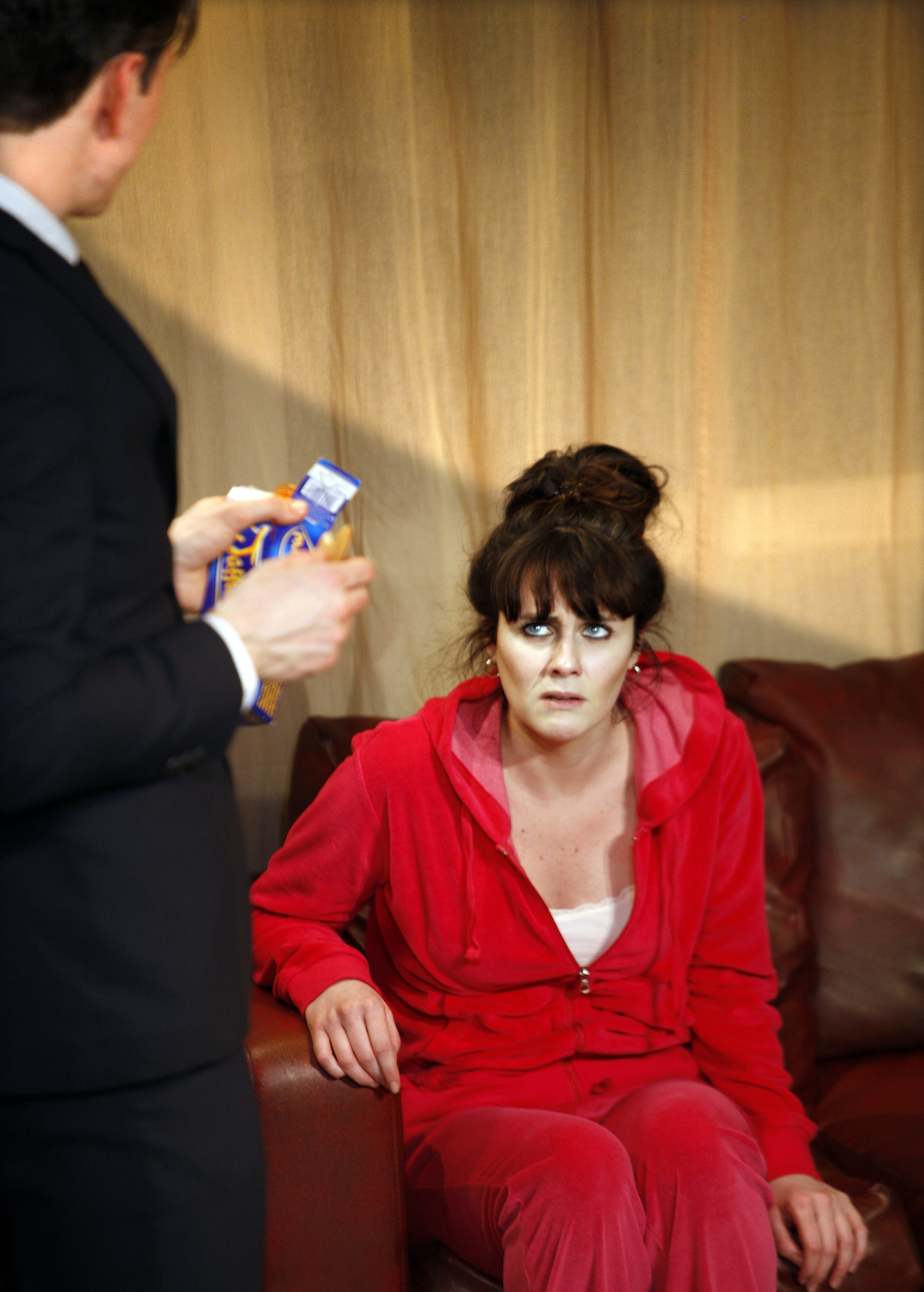
The action begins in the stairwell of a run-down block of flats in Bermondsey. This is the home of petty criminals Dal (Daniel Kendrick) and Becks (Danielle Flett), and their nice but dim local drug dealer Thick-Al (George Whitehead). Life’s not exactly easy for the trio, but it’s also fairly uneventful… until Dal’s childhood friend Tel (Morgan Watkins) comes back into town to retrieve £500 he lent Thick-Al in an unlikely moment of generosity. Realising he’s been taken for a mug, the unpredictable Tel, who’s never been quite the same since falling on his head during a robbery a few years ago, sets out to take his bloody revenge – and woe betide anyone who gets in his way.

Photo credit: Simon Annand

What’s so appealing about The Monkey is that despite everything that goes on (and between the language and the violence, it does get pretty graphic at times), all the characters – even the psychotic Tel – have redeeming features and are even quite likeable. There’s genuine friendship on display here, for instance, even if it is expressed through liberal use of the c-word, and in many ways the characters’ idiosyncrasies make them easier to get along with: Tel and Thick-Al’s shared love of Jaffa Cakes is oddly endearing, as is Tel’s unexpected obsession with cleanliness.

This flawed humanity is captured in four brilliant performances from the cast. Morgan Watkins is particularly enjoyable as Tel, a ticking time bomb of twitchy, pent-up energy that occasionally explodes in bursts of violent rage towards anyone who happens to be nearby. Impeccably dressed in suit and tie, Tel stands out from the Bermondsey crowd, and his air of superiority shows that he’s well aware of the fact, while his admiration for Tarantino’s Reservoir Dogs exposes him as a frustrated gangster wannabe.

Photo credit: Simon Annand

At the opposite end of the scale, George Whitehead’s affable and appropriately named Thick-Al has no such pretensions, and is so laid-back he’s practically horizontal; content to lounge about on the sofa all day, all he cares about is his next fix, and he’s blissfully unaware of the trouble he’s in until it’s too late. Daniel Kendrick and Danielle Flett fall somewhere in between the two as Dal and Becks – while they’re quite content to get on with life in the only way they know, they are at least alert to the danger posed by Tel’s return and its potential ramifications, not just for Al but for themselves as well.

Not for the fainthearted, The Monkey is nonetheless a thoroughly enjoyable 90 minutes (and educational: not only did I learn some new rhyming slang, I now know that Tim Roth’s from Dulwich, not Deptford – yes, I did go away and look it up) with larger than life, complex characters who feel like real people, not clichés. It’s an impressive debut from John Stanley and well worth checking out during its short run at Theatre503.


Can’t see the map on iPhone? Try turning your phone to landscape and that should sort it. I don’t know why but I’m working on it… 😉

Interview: Debra Baker, Big Guns