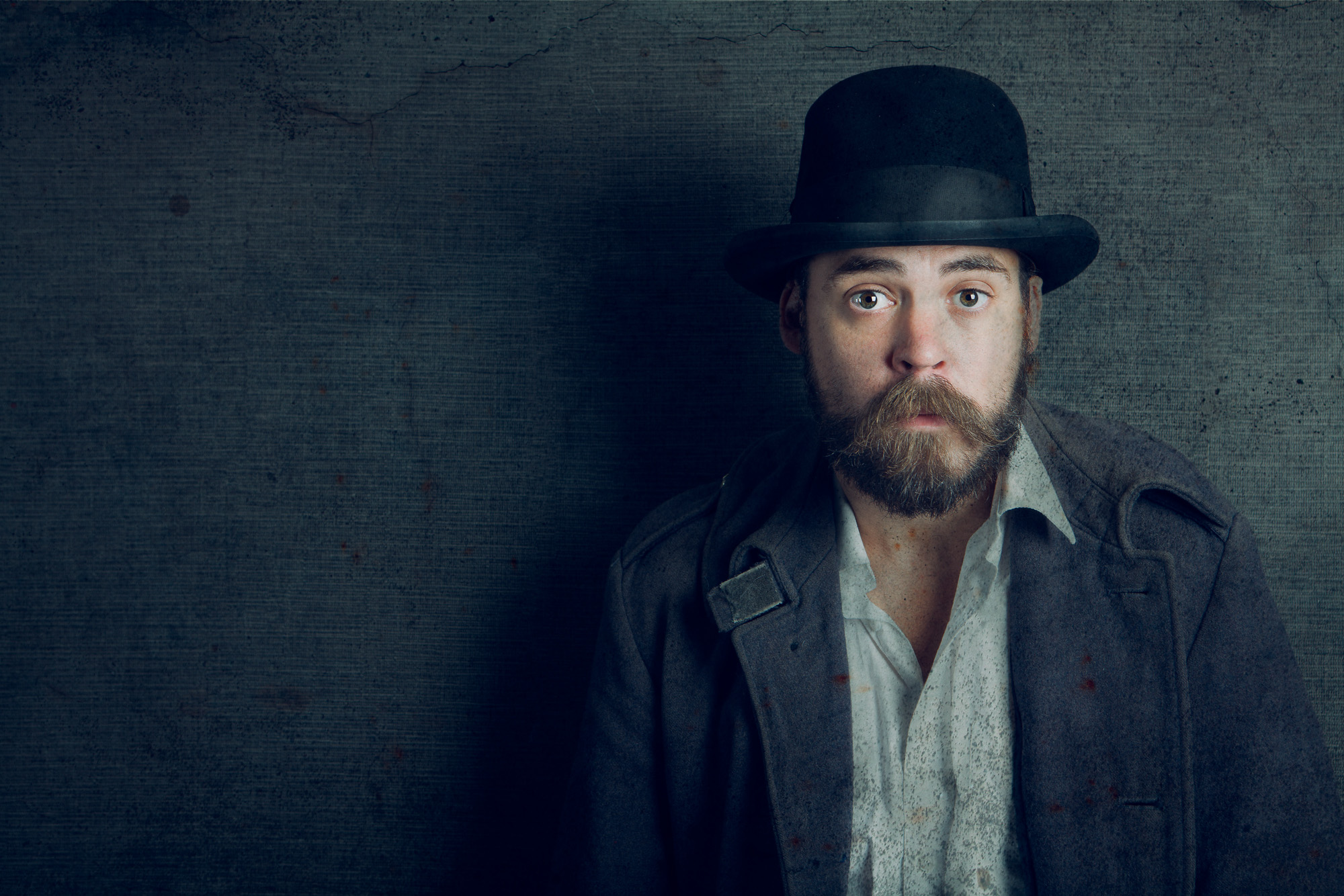
Review: She Wears Scented Rose at Theatro Technis

Razor Sharp Productions promise “original plays designed to keep an audience gripped to the end”. She Wears Scented Rose, a new thriller written and directed by Yasir Senna, delivers on this promise up to a point, but could use a little tightening up in places to make the most of a strong and intriguing plot.

Businessman Mark (Craig Karpel) is on his way home late one night when he’s attacked and stabbed several times, the victim of a suspected carjacking. But when he wakes up in hospital, police officer DI Kane (Rosalie Carn) is waiting with questions, and it turns out all may not be quite as it seems… Twists and turns take us on an emotional rollercoaster ride, culminating in a truly shocking – and very effectively staged – conclusion.

Photo credit: Robert Piwko

Like any crime drama, the key is in the detail, and She Wears Scented Rose is packed with these; looking back afterwards you realise the intricacy of the plot, and that all the clues were there all along to piece together the truth. Senna has obviously done his research, and has in particular created a complex and well-drawn central figure in the silver-tongued Mark, played brilliantly by Craig Karpel. He has strong support from Niki Mylonas as his loving wife Verity, who has a secret of her own, and Rosalie Carn as an attractive French police officer with some unorthodox investigation methods. Simon Ryerson, meanwhile, is a sympathetic figure as Mark’s nice but dim best mate Dave, who in contrast to his friend is driven by his heart rather than his head. The acting on the whole is solid, although there are a couple of scenes that start to edge towards the melodramatic and could perhaps be reined in a little.

While the story is certainly gripping and holds our interest throughout, the script in places needs a bit of a trim to make more of an impact. There are some parts of the play that start out well but could be snappier – the most obvious of these being the final scene, which takes a frustratingly long time to reach its dramatic climax. In addition, there are a lot of scene changes, which while executed smoothly by a well-oiled stage crew, inevitably interrupt the action and don’t always feel completely necessary.

Photo credit: Robert Piwko

We all love a good mystery, and She Wears Scented Rose is definitely that; the plot is well-crafted and keeps us guessing throughout so that even if we succeed in figuring out one bit, there’s always another twist waiting round the corner to catch us off guard. The characters are relatable enough that we grow to care about them (and in one case, really really dislike) so that when everything starts to kick off in Act 2, we can sympathise with what they’re going through. And I know I keep going on about it, but that ending does make a huge impact, with one particular image lingering in my memory – and not in a good way.

There’s already an enjoyable show here, but with a few tweaks to script and staging to ramp up the intensity, there’s potential for an excellent and even more memorable production.


Can’t see the map on iPhone? Try turning your phone to landscape and that should sort it. I don’t know why but I’m working on it… 😉

Review: Threads at The Hope Theatre

On the surface, David Lane’s Threads appears to be a standard break-up drama. Five years after she left him, Charlie (Samuel Lawrence) has finally managed to track down Vic (Katharine Davenport) and convinced her to come and visit him at their old flat. Vic’s moved on – new home, new job, new relationship – while Charlie’s struggling; he hasn’t left the flat for several years, but we’re about to discover that’s the least of his worries.

Photo credit: Lidia Crisafulli

Because there’s much more to Threads than meets the eye, and Lane waits just the right amount of time for us to relax before casually taking the story in a new and decidedly unsettling direction. It turns out Charlie’s not just feeling a bit low; his life has quite literally stopped moving forward (I’ll leave it there for fear of spoilers). And Vic isn’t doing all that well herself – for all her protestations of “resolve”, the wall she’s consciously built around Charlie in her memory is crumbling before our eyes, as is the image she projects to the world of her perfect new life. At the centre of the play is the metaphor of threads that connect us to each other, and the impossibility of simply severing those cords and walking away when a relationship comes to an end.

Like the story, Jo Jones’ set takes the mundane setting of Charlie’s flat, complete with the sort of things you’d expect – armchair, kitchen, window – but adds a touch of Frankenstein-esque gothic weirdness to keep us on our toes. The dingy room gives off the vibe of a mad scientist’s workshop, and electric cables hang from the walls and ceiling and creep across the furniture, occasionally glowing with a crackling energy as the couple’s simmering, unresolved passion threatens to boil over. (I kept half expecting them to come to life and start moving on their own, but was very glad they didn’t; that way nightmares lie.)

That same energy also radiates from the actors, neither of whom seem able to keep still as they restlessly cover every inch of the space. Samuel Lawrence is jittery and anxious from the start, stammering and raising his voice in frustration at his inability to make Vic believe what he’s going through. Katharine Davenport, on the other hand, starts out cool, calm and collected – but there’s a rising tension as her defences begin to fall, and the explosion when it comes is unexpectedly fierce. The two initially appear to have little in common, yet there are shared moments of tenderness as they reflect on a memory or private joke, and it’s in these moments that we can appreciate what they once had together.

Photo credit: Lidia Crisafulli

Director Pamela Schermann keeps up the intensity throughout, aided by light and sound design from Rachel Sampley and James Scriven, which are effective but not intrusive and allow our focus to remain on the human drama unfolding just inches away. The intimate Hope Theatre lends itself perfectly to this play, drawing us right inside the living room and holding us there just as it does Vic. By the end of the 70 minutes we’re left feeling exposed, and drained by the emotion of seeing laid bare an experience most of us will have gone through in some way during our lives, but may not have been able to articulate.

Threads is a highly original and unpredictable piece of theatre that grabs hold of you and doesn’t let go. It deals in metaphors without trying to be too clever, and remains a gripping human drama – whilst also providing plenty of food for thought for the train home.


Can’t see the map on iPhone? Try turning your phone to landscape and that should sort it. I don’t know why but I’m working on it… 😉

Review: It’s Not Yet Midnight at the Roundhouse

As someone who’s never even mastered the basic handstand, circus acts like Compagnie XY always fill me with two emotions, in fairly equal measure: awe – because I’m watching people do things that shouldn’t even be possible for the average human being, let alone someone as hopelessly uncoordinated as me – and dread, because it always seems very likely that at some point someone’s going to end up falling on their head.

Photo credit: David Levene

Of course, nobody actually does fall on their head in It’s Not Yet Midnight, the third show from the French collective… but it’s not for lack of trying. An action-packed programme sees the acrobats tumbling, flying and balancing high above the ground, seemingly without fear and often even with a hint of amusement. You know you’re looking at something pretty special when after a while even a three-person tower doesn’t warrant a round of applause any more. It’s not that it’s not impressive; it’s that they make it look so easy, like this is a completely everyday occurrence – which I guess for them it is – and that matter-of-fact attitude becomes slightly infectious.

But this is not just a troupe of acrobats stringing together trick after trick to dazzle us; there’s a story and a cheeky sense of humour to the show, which takes us through the events and emotions of a not-very-average night out. The evening begins with a mass brawl, followed by reconciliation, dancing, romance, uncontrollable laughter and a mesmerising dream-like sequence that sees one acrobat make her way across the stage balanced on her colleagues’ outstretched hands. In fact there’s so much going on, all the time, that it’s often hard to know where to look; while we’re watching a couple lindy hop at one side of the stage, it’s easy to miss another of those three-person towers being quietly constructed elsewhere. With all 22 acrobats on stage for most of the show, it’s complete chaos – but clearly of the meticulously organised kind.

Some stunts are set to music, others performed in pin-drop silence, interrupted only by the audience’s squeaks of terror as another body goes flying casually through the air. Though of course that terror isn’t really necessary – not just because these are obviously highly skilled acrobats who know exactly what they’re doing, but because such is the care and attention between the performers that if anything does go wrong, they’re always prepared. Though the stunts are undoubtedly incredibly risky and not to be tried at home, the trust between the acrobats – who live, work and train together – is absolute, and the show’s daring stems from the fact that every man and woman on the stage knows there’ll be someone there to catch them if they fall.

Photo credit: David Levene

Compagnie XY was founded on the principles of friendship and collaboration, the idea that “alone we go faster, together we go further”. This is true from a technical point of view – many of the stunts quite literally wouldn’t be possible without a team of people to play their part. But it also comes across in the spirit of 22 performers who, despite each being incredibly talented, make no attempt to outshine anybody else, and who often seem to be having just as much fun as the audience.

Despite gradually upping the stakes throughout the hour-long show, It’s Not Yet Midnight ends not with a dramatic finale, but with the group simply standing together on stage. Far from being a disappointment, this striking visual image sums up what the company and their show are all about, even before a moving curtain call message about the importance of working together. Consequently, the show ends up as heartwarming as it is sensational, jaw-dropping and hugely entertaining.


Can’t see the map on iPhone? Try turning your phone to landscape and that should sort it. I don’t know why but I’m working on it… 😉

Interview: Matthew Parker, Brimstone and Treacle

The Hope Theatre in Islington has been quietly building a reputation for excellence over the last couple of years, collecting rave reviews and countless award nominations, including one for Fringe Theatre of the Year at The Stage Awards. Much of this success must be attributed to the theatre’s artistic director Matthew Parker, who came on board in late 2014 and was recently named Best Artistic Director at the Off West End Awards.

Next month The Hope kicks off its 2017 in-house season with a 40th anniversary revival of Dennis Potter’s controversial Brimstone and Treacle, directed by Matthew and starring Olivia Beardsley, Stephanie Beattie, Fergus Leathem and Paul Clayton. Originally written as a BBC Play for Today in 1976, it was banned for its disturbing content, and wasn’t performed until the following year at the Sheffield Crucible. A film version starring Sting followed in 1982, but it wasn’t until 1987 that the BBC finally allowed the play to be transmitted.

Brimstone and Treacle is about a young man who thinks he’s the devil, and visits a middle class, middle aged couple who are caring for their vulnerable daughter,” explains Matthew, who admits he’s been longing to tackle this particular play for years. “It’s darkly funny, frightening and shocking, a controversial masterpiece about good and evil, identity, religion and what it means to be British. Who wouldn’t want to tackle a one act play that explores all of those monumental themes? Plus, and crucially for me and the Hope, it is a gender balanced cast – two women and two men – with roles for two actors over 50.”

40 years after it was written, Potter’s play remains just as relevant in 2017 – though that’s hardly something to celebrate. “It’s about racism, the horror that lies behind the twitching floral curtains of middle England homes,” says Matthew. “It attacks what it means to be British and the lengths people will go to inside their own heads to ‘reclaim their country’. Coming off the back of 2016’s Brexit vote it really couldn’t be more timely if it tried! It’s the 40th anniversary this year and I am always fascinated to look at these 20th century classics with a 21st century audience and ask ourselves, ‘What has changed?’ It’s scary to see just how little matters have actually changed in terms of attitudes to race, gender and religious tolerance.”

The play contains scenes that were deemed too offensive to be shown in the 1970s, but does it still have the same shock value today? Matthew believes it does: “In a word, yes. It contains scenes of sexual violence against someone in a vulnerable position and it really doesn’t shy away from showing evil, both in a physical and mental way. It’s very important to me that our production is not exploitative with the scenes of sexual violence. But nor should it be sugar-coated. We are dealing with pure evil here. The darkness of humanity. The piece examines the nature of good and evil, and asks whether miracles can occur from an act of evil – from the visitation of the devil rather than an angel.

“And it is funny – and the fact that it is funny as well as violent is shocking in itself. Even at our first read through some of the team were laughing away whilst some others were staring at them in horror, thinking ‘how can you be laughing at that?’ As a director, work that creates different reactions within audiences has always attracted me.”

Matthew’s delighted with his cast for the show. “Well, they’re bloody brilliant. Stephanie Beattie was in my production of Steel Magnolias last year and blew everyone away with her astonishingly heartbreaking performance as M’Lynn. Joining her as her on stage hubby is Paul Clayton, an actor with an amazing career spanning TV (Peep Show, Him and Her, Coronation Street) and theatre including RSC, Chichester, Royal Exchange, West End. They are joined by two graduates of Drama Studio London: Fergus Leathem, who last year appeared in Game of Thrones, and Olivia Beardsley joins us less than a year from graduating and I’m super-excited to get to work with her at this early stage of her career. She’s definitely one to watch!”

As disturbing as the play undoubtedly is, there is some good news. “I’d like our audiences to take away the comfort that good will always triumph over evil,” says Matthew. “And knowing that The Hope takes risks with its programming, and that you can see theatre here that is bold, theatrical and stunningly performed.”

So what makes The Hope different from other fringe theatres? “Little room – BIG ideas. Small space – HUGE ambition. Minimal money – MASSIVE passion,” summarises Matthew. “And every piece is theatrical. It’s not kitchen sink dramas. It’s not really naturalism. Everything has a little sprinkle of magical theatricality.”

Not surprisingly, when it comes to choosing which productions go into a season at The Hope, Matthew and his team operate a careful, thorough selection process: “I have a brilliant team of people who read all the plays that get submitted. If they like them then I read them, then I meet with the company and chat though the unique way in which we collaborate with people at The Hope. Not everyone is the right ‘fit’ and I won’t just take anyone or any show.

“It’s super important to me that everything that takes place in that lovely little space is brilliant. I take risks but I take them on people who enter into the collaboration with honesty, and with joy and passion. It really is fantastic to see that this approach has paid off with a Stage Award nomination as Fringe Theatre of the Year and my recent success at the Off West End Awards as Best Artistic Director 2016.”

Catch Brimstone and Treacle at The Hope Theatre from 2nd-20th May – and why not check the theatre’s website to see what else is coming up?

Interview: Henry Maynard, Flabbergast Theatre

“I’d like our audiences to walk away with aching sides and a slightly bemused expression, secure in the knowledge that they had a jolly good time, even if they weren’t always convinced that they had a hold on what was happening…”

Henry Maynard is a former War Horse puppeteer, Amused Moose Laugh Off finalist and founder of Flabbergast Theatre, who are bringing two of their favourite shows to Wilton’s Music Hall in London next month. One sees the return of Balkan bad boys and stars of the Edinburgh fringe, Boris and Sergey; the other is a solo show about one man’s quest for a friend, performed by Henry himself.

Photo credit: Richard Grubby

“Tatterdemalion is an hilarious one-man, silent-ish, physical comedy with silliness in abundance, to a backdrop of Victoriana and otherworldliness with a dash of pathos,” he summarises. “And Boris & Sergey’s Astonishing Freakatorium is the Balkan bad boys of puppetry’s homage to the travelling freak shows of the 1930s, featuring escapology, wild animals and a live séance… Hilarity will ensue.”

All Flabbergast’s shows are the result of an ongoing development process in which both company members and audience play a vital role. “We work with a highly collaborative devising process,” explains Henry. “I come up with the stuff… they do it.

“I’m being facetious. Normally we get in a room with our ideas and keep what makes us laugh. Then we bring it all together in a mostly coherent way.

“All our shows develop in front of the audience; the things that work stay in and the things that don’t we keep flogging away at until eventually we realise we’d be better doing something else. I like the organic way our shows grow.”

Unsurprisingly, this means that audience interaction is an important part of Flabbergast’s productions. “All live theatre relies on participation, the shame is that audiences are often unaware of it,” says Henry. “I blame Stanislavski and his cursed ‘fourth wall’. He was like an earlier version of Trump – ‘I’m gonna build a wall and the performers will pay for it!’

“If you come to a Flabbergast show you are involved and that’s what is great about live theatre – otherwise you might as well stay at home and watch Gogglebox.”

Henry founded Flabbergast back in 2010 to make uncompromising and exciting physical theatre. “I was inspired to set up Flabbergast by Puppetry, Clown, Commedia dell’arte and all the other avant-garde theatre styles that make no money… anywhere… ever,” he explains. “I wanted to perform, learn, direct and teach them. As a company, we aim to make theatre that is sweaty and engaging, physical and alive, and we want to promote puppetry and clown specifically as valid and important art forms in theatre.”

Currently, the company’s focus is on Bunraku puppetry, and particularly on how this can be used to reach an adult audience. “Bunraku is like distilled humanity,” says Henry. “We can sometimes become hardened to real adult people, callous and uncaring – but puppets get through to us like children and animals do, we sympathise with them more. They’re magical and draw the spotlight, they call to our innate desire to personify and humanise everything; we delight in their play as children delight in the antics of their toys.”

Photo credit: Claudine Quinn/Lens On Legs

Both shows have proved a hit so far, with a host of four and five star reviews, and Henry’s looking forward to sharing them with a London audience: “Bringing the shows to London and specifically to Wilton’s Music Hall is going to be incredible. It’s another feather in the Balkan bad boys of puppetry’s cap as they march towards inevitable world domination, and the beautiful theatre is the perfect backdrop for Tatterdemalion. If you’ve never been to Wilton’s Music Hall you must come to the shows just to see it. It’s the oldest grand music hall in the world.”

So of the two shows, which one does Henry recommend? “I’m in Tatterdemalion so that one…” he suggests. “But seriously, I’m proud of both the shows and they are great for different reasons. If you’re a puppetry fan, Boris & Sergey is pure puppetry fun, whereas Tatterdemalion has a sprinkling but will appeal more to physical theatre fans. Neither are pretentious though, we take a tongue in cheek approach to our art and work.” 

Then again, with a 20% discount for multiple booking, we could just see both…

Catch Boris & Sergey’s Astonishing Freakatorium and Tatterdemalion at Wilton’s Music Hall from 9th-13th May (for dates and times of each show, visit the website).