Review: Eat the Poor at The Point, Eastleigh

Guest review by Edward Learman

Once, I toyed with the idea of performing at an open-mike night, and basically just talking “seriously” about my most humiliating and disturbing experiences: this would include recollections about diarrhoea, testicles, job interviews and GP visits, culminating with the crème de la crème topic of conversation: Brexit. This final part of the performance would simply involve me repeating (loudly!) the words “Europe”, “this country”, “capitalism”, “Tories”, “Labour”, “Tony”, “Donald”, “Margaret”, “freedom”, “Islam”, “bankers”, “immigration”, “unemployment” over and over again for as long as it took to get thrown out or the audience to start throwing things before leaving, thus illustrating the ridiculousness of any attempt at rational discussion.

I have yet to persevere with this concept, or to be at an open-mike night where I’m drunk enough. Jonny and the Baptists’ award-winning two-man show Eat the Poor takes a slightly more sanitised and friendly, but no less abrasive, approach to delivering their message on the state of the nation.

The two performers, Jonny Donahoe and co-star Paddy Gervers, explain early on that this show is not for everyone for the following reasons: 1. They talk about Brexit 2. They use the word “f***” a lot, except not in a sexual way 3. They’re both “socialists” who went to university. They also politely advise that they’ve had a lot of walkouts, and if there are any UKIP or Tories in the audience, they’ll likely hate the rest of the show and should go home immediately to count their money, or to reassess their priorities if they don’t have any.

Photo credit: Anna Soderblom

This sets the tone for the next 100 minutes. Not exactly a dissection of modern politics or British ideals, more a good-natured, self-effacing plea for sanity in the face of an election that will dictate whether things will stay exactly the same as they always have been or change slightly in favour of the poor who want a better future. To say the irony’s not lost on the two performers is obvious and they know it.

They’re middle-class, they’re artists, their parents own their own homes, they can afford to live in London and their chances in life are better compared to the vast majority of people working as low-paid labourers, nurses and teachers; however, there’s clearly no shortage of starving artists in this country.

Between the jokes, which are a brand of improvised comedy that riffs on how the audience responds – at one point Jonny pointed at a group in the audience and said something like: “I can see you’re already unhappy with this, but please please please don’t leave until the interval because it gets much, much worse, I promise you. Seriously, there’s a lot of jokes I haven’t done yet, and you might enjoy it” –  Jonny gives a brief explanation about their ideology, describing their work with the homeless and their contempt for the super-rich elite like Andrew Lloyd Webber (who gets mentioned a lot!), and it feels like they really mean it.

The antics range from songs about how difficult it is for liberals to admit Blair and New Labour were bad when instead we should all just dig up Thatcher and bury her again, to Jonny ditching Paddy and becoming a worldwide success who takes over from Murdoch and controls the media whilst resisting Andrew Lloyd Webber’s deadly seduction, to a song about what would happen if swans declared their independence from Queen Elizabeth’s reign and then conquered the world. This is all clearly meant to be metaphorical, and it’s very funny.

There were also some quite educational moments; at one point the team produce a magazine called The Tatler, a luxury lifestyle publication, where they read a list of the top wealthiest and most important people in England, and which includes such interesting pastimes as wearing hats and owning things. A slightly less absurd example is a song about the 2015 parliamentary vote on whether to abolish tax credits for the lower-income bracket. This consists of a list of names, including Andrew Lloyd Webber, David Cameron and Theresa May, conjoined with the phrase “Dickvalve. What a bunch of dickvalves!” repeated again and again, with Jonny descending upon the audience to high-five anyone who’s willing.

This is a very funny show, and I’m glad I got to see it – and that I’m not the only starving artist who thinks that politics (or power) is absurd.

Eat the Poor continues on tour until 27th May; check the website for dates and venues.
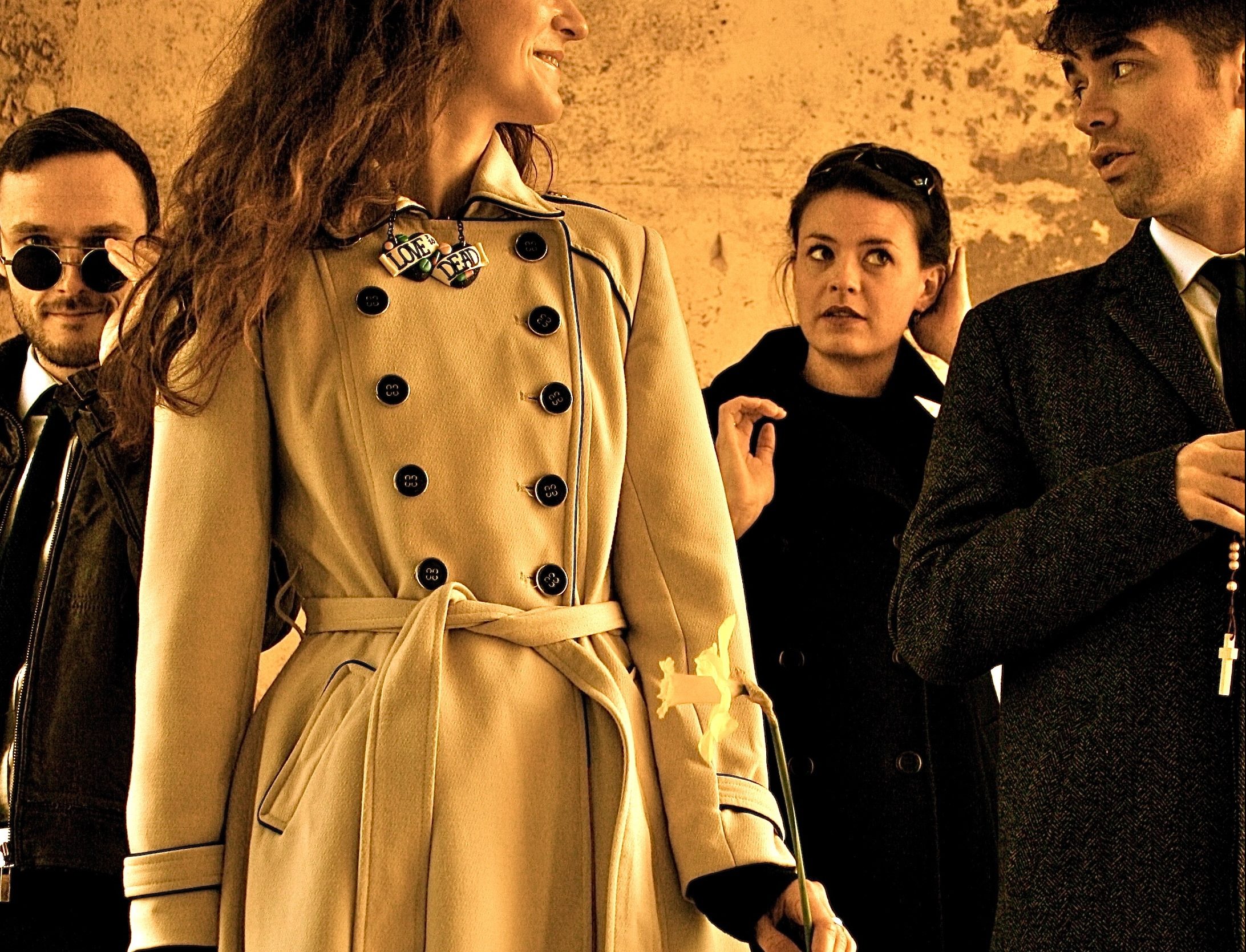
Interview: David Fairs and Anna Marsland, GOLEM!

“David Lynch colliding with The Godfather – and a bit of Cruel Intentions…” is David Fairs’ intriguing summary of GOLEM!’s second production. Following the success of last year’s Macbeths (check out my review for LondonTheatre1), the company are back at The Hope Theatre on 13th June with I Know You Of Old, a fresh take on Shakespeare’s Much Ado About Nothing.

I took the original text and then built a new story out of it,” explains David, who also plays Benedick in the play. “So it only has three characters, and the starting point for our play is two weeks after the actual death of Hero. We pick up the night before her funeral, when Benedick, Beatrice and Claudio all encounter each other in the chapel of rest, and the whole play takes place over about twelve hours leading up to the funeral the next morning.”

“You don’t need to be familiar with Much Ado,” adds director Anna Marsland. “Our hope is that you’re coming to see a new play in which you know someone’s died and you know these three people are connected to her, and you’re uncovering the story as the play goes on. But my hope is that anyone who does know the play gets an added extra in terms of seeing that dialogue repurposed.”

GOLEM!’s first production, Macbeths, followed the same narrative as Shakespeare’s original but placed the Macbeths’ domestic relationship at the heart of the story. “I’d always had this fascination with examining Shakespeare’s great characters as real people who are brilliant examples of the human condition,” explains David. “So I just started to think about how we might do that, and the first thing that came to mind was Lady Macbeth, and I became really fascinated with the idea of isolating those two characters and seeing what story could be told.

“Then after MacbethsI started thinking about other relationships it would be interesting to isolate and examine. Much Ado is one of my favourite plays, and I was most interested in the relationship between Beatrice and Benedick, why they behave like that – they’re very entertaining but when you actually look at them, they’re very odd. They know each other so well that they can play whatever game they want, they can tactically pick up on what the other person is doing and destroy them with it. You have to know someone incredibly well to do that, and it was interesting to me to put that relationship into a pressurised environment.

“And the other element that’s always struck me as missing is a real deep examination of the shaming of Hero – because it’s something that occurs and is then forgotten. The thing that happens to her is horrendous; she’s destroyed on her wedding day by her father and her fiancé, and yet in that final scene nobody offers her an apology.”

So this play is putting that completely at the heart of it,” says Anna. “She’s been slut-shamed, she’s been destroyed – and that has gone so far that she’s died; that pain has killed her.”

Unlike Macbeths, development for I Know You Of Old has been a collaborative process from the start, with input from both David and Anna, along with fellow company members Sarah Lambie (Beatrice) and Conor O’Kane (Claudio). “Dave and I often have very similar instincts about things,” explains Anna. “I think we are artistically very much on the same page, and I think it’s important that we trust each other a lot. But I think that trust has allowed us to make that distinction quite smooth: I trust Dave to go off and write the thing – after we had the idea, we signed the contract to go and do it at The Hope and then I said, ‘Okay you need to write it now!’

“And we were quite strict with ourselves – workshop, second draft, workshop, rehearsal draft. And once the rehearsal draft is done, that’s when Dave hands it over to me. And of course there are little tweaks but the fundamental set-up and structure are there – and I feel like we’ve tested it as a piece of writing rigorously enough that now we’re in rehearsals I’ve got Dave the actor in the room, not Dave the writer.”

“I do implicitly trust Anna with the script and the play,” agrees David. “That became so evident immediately when we were doing Macbeths in that I had the script, but as soon as I gave it Anna to direct she brought things out of it that I hadn’t even dreamed of. So it’s a really nice process – I prepare it, we have that crossover period where we’re workshopping it, and we work out that we’re on the same page and streamline it down to that shared idea, and then I’m happy to hand it over.”

I’ve not really worked on a play in the same way before, in terms of being so involved with the actors who are going to be in it,” says Anna. “And as a company it feels like we had the luxury of a lot of development time, which has taken the pressure off rehearsals because we’ve had all those conversations over the last six months between the four of us about where this piece is heading.”

And what of those people who think Shakespeare is not to be messed with? “I have no problem with this being polarising, I think that’ll be very interesting,” says David. “And I don’t think there’s any disrespect in any of it – I’m very much coming from the point of view of someone who absolutely loves Shakespeare. He is my favourite playwright, my favourite thing to act and to watch. I have a huge amount of respect for him, and it doesn’t feel like that is in conflict with what I’m doing.

“None of this is arbitrary – the structure and form of this play is very much designed to almost be an extension and a compliment to Much Ado, not a rehash of it. I think you can revere Shakespeare and the words he wrote, without considering that it’s sacrilegious to do anything to the text. I love the idea that actually what he gave us was an incredibly rich raw material that is so brilliant that we actually don’t lose the DNA in the expansion of it.

I also love what previous – and the current – artistic directors have done with Shakespeare’s work at the Globe. Going back to Rylance, I love the idea that you can take this and you can play with it – the idea is that it’s something to be enjoyed and experimented with.”

“We wanted to take it a step further this time,” adds Anna. “The idea of setting up GOLEM! was about how much we can take a text and change it some way, and one way of doing that is this re-orchestration. And it’s how far we can push that, so there we just changed the text to the story of Macbeths and reshaped it; here we’re taking the text and the characters and some of the plot, and veering off in another direction. And I don’t know what the next step would be – maybe taking the text and telling a completely different story, or even taking multiple texts.”

Anna and David first worked together at university, an experience he remembers for one very specific reason… “My overriding memory of what Anna had me do was get covered head to toe in ice cream for the final scene of the play – but we discovered ice cream doesn’t look like ice cream when you’re covered in it. So ultimately I was covered in gallons of Angel Delight, performing in a theatre that didn’t have showers, and had to leg it across the city to a friend’s room and shower, then head back for a drink!

“Once the prospect of the R&D space for Macbeths became available at the Catford upon Avon festival last March, I obviously knew that we needed a director and Anna was top of my list to approach. I knew that she’d worked at the RSC and the Globe, and that she was London-based at the moment because she was – and still is – Resident Director on Curious Incident in the West End.”

“So it was quite a chance reunion in a way,” says Anna. “I love working on Shakespeare and I also really love prioritising those female stories in Shakespeare. So interests-wise and working-wise, it was just a happy collision really.”

And what’s next for GOLEM! after I Know You Of Old? “Our hope is that what we’ll end up with is two nice companion pieces – two adapted Shakespeare plays: one tragedy that’s become a love story and one comedy that now has a much darker heart,” says Anna. “And the idea is maybe to tour them as a double bill or a pairing that could be on alternate nights. We’re kind of hoping we might take them up to Edinburgh next year.”

“And another idea once we’ve finished this run, the next thing I’d be interested in looking at is a direct sequel to Macbeths, picking up and seeing where all of the characters might have ended up,” suggests David. “And potentially with this one forming a story and a script out of multiple plays, out of the whole canon, and seeing what story I can build.”

Book now for I Know You Of Old at The Hope Theatre from 13th June to 1st July.

Review: Who’s Afraid of Virginia Woolf? (screening) at the Harold Pinter Theatre

Guest review by Edward Learman

“I’m not drunk enough to figure it out yet.” – George

There are many great lines in Edward Albee’s classic play about alcoholism, marriage and the failure of American virtues. Who’s afraid of Virginia Woolf? remains both a portrait of an era and one that has a truly timeless and universal appeal for audiences across the world.

The play is currently being performed at the Harold Pinter Theatre, and I was able to see a live screening at my local theatre, Thornden Hall. The venue is a 388-seat auditorium with a state-of-the-art sound system and digital facilities located on the Thornden School’s grounds, with the purpose of supporting the Performing Arts and Education in Eastleigh and Chandlers Ford. This is the first time I had visited the site, and I was impressed with the service, the speed at which I was given my ticket, but especially with their selection of beers, which were surprisingly cheap compared to most venues. For this event the middle rows were almost completely filled, so the venue must’ve sold at least 200 tickets.

It’s my personal theory that no performance of Albee’s play should be watched without being inebriated; this is to fully appreciate the nauseating maelstrom of hissing put-downs and devastating one-liners as the two couples go at it, engaging themselves in verbal sparring contest, cutting each other to the bone.

“Fun” is not exactly the word I would use to describe Albee’s play, unless by fun you mean some sort of psychological game in which all your darkest fears and skeletons are resurrected to be paraded for the horrible amusement of the younger guests, who aren’t quite sure what’s going on or why they can’t just leave. “I don’t mind self-flagellation as long as it’s done right,” Nick (Luke Treadaway), the young and handsome academic, quips as he attempts to find a common ground with George (Conleth Hill), the older, once aspiring history professor, who is appalled by the young man’s naivety and his wife Martha’s (Imelda Staunton) reasons for inviting him into their home.

There are many layers and twists to the play, and this allows the actors to explore the depths of their characters, wear many masks, and to flip from passiveness to anger to humour to pain to despair to insanity and then back to smiling indifference again. Like Beckett’s Waiting for Godot, it’s a real spectacle of drama and a masterful piece of staging where it seems as if Albee has challenged himself by asking: “How far can I push this?” It’s strange to think that when the play opened in 1962, the judges for the Pulitzer Prize chose not to have an award that year rather than give it to Albee, for they’d objected to use of profanity.

Interestingly, when I’d first come across the play as a teenager after watching Mike Nichol’s 1966 film adaptation, I couldn’t quite imagine Elizabeth Taylor and Richard Burton, despite their incredible performances, using language like “F*** you, motherf***er!” I suppose no one would expect their parents to say this, even during a blazing row.

And how does this cast fare against the one with two of the greatest film stars of the 1960s? Well, I wasn’t quite sure how the two-hour film, which is basically just one long argument, could possibly be performed on stage. For the film version, visually there were room changes and moments where the characters could take a breather. But here the director James Macdonald, who like Nichols is a veteran of the theatre (previous works include Sarah Kane, Caryl Churchill and David Mamet among others), chooses to restrict the action and drama to a single room, with one or two dialogue scenes kept intact in contrast to the adapted film version.

Critics have described MacDonald’s version as the “funniest and most high-energy version ever”; I don’t disagree with this since during the entire three-hour production there doesn’t appear to be a single quiet moment, except during the two brief intermissions. Quite how the cast, which boasts seasoned stage and screen actors Conleth Hill (Game of Thrones), Imelda Staunton (Gypsy) and Luke Treadaway (The Curious Incident of the Dog in the Night-Time) and West End newcomer Imogen Poots (28 Weeks Later), have managed to give such gut-wrenching performances since February just amazes me. But especially Staunton, who simultaneously channels Elizabeth Taylor’s spirit whilst bringing a sensitivity to the character which I never thought was there, and which moved many in the audience to tears, including myself.

Staunton’s performance as Martha reminded me of Heath Ledger’s scene-stealing role as The Joker in The Dark Knight  a part which any intelligent actor or critic would look upon as a monumental challenge after another great actor, in that case Jack Nicholson, had already made it iconic. Like Ledger, Staunton succeeds in the same way, which is to simply play the character slightly differently, and although at certain times, I felt I was watching Taylor and Burton, which was astonishing, here the actors can physically utilise the stage space, enhance their performances and somehow make the characters more three-dimensional. Staunton also screams louder than any actor or actress I’d ever seen in any live performance, and again, I can’t quite believe how she manages to give such an electrifying performance night after night.

Who’s Afraid of Virginia Woolf? is at the Harold Pinter Theatre until 27th May. For details of future events at Thornden Hall, visit http://www.thorndenhall.co.uk/.

Review: BLUSH at Soho Theatre

We’ve all felt that flush of shame when someone tags us in a terrible photo on Facebook, or we’ve tweeted something and instantly wished we could take it back. But what if it was far worse than an embarrassing selfie or misjudged comment? Sharing isn’t always caring, as we’re about to discover in Charlotte Josephine’s BLUSH, an intense, exhausting and impassioned two-hander.

Directed by Ed Stambollouian, BLUSH delves into the world of social media, with all its practical, social and psychological side effects. We now live in a world where anything we do at any time can be made public, whether by our choice or not. At the same time that world provides sufficient anonymity for people to behave in a way they almost certainly wouldn’t in real life: make vile comments on a video of a teenager that her boyfriend posted as a joke; make public naked selfies that a young woman sent privately through a dating app (and then use them to blackmail her into sending more); make rape threats against a girl on Twitter because she turned down the advances of a man they don’t even know.

Photo Credit: The Other Richard

These are some of the stories told by the three women and two men played by Charlotte Josephine and Daniel Foxsmith in BLUSH; at first in an orderly fashion, taking it in turns to step up and tell their story, the show becomes increasingly frantic and chaotic as it builds to a climax, leaving both actors out of breath and dripping with sweat, and the audience feeling we’ve gone through it all with them.

The script is descriptive and at times verging on poetic (opening with a particularly graphic picture involving 30,000 pairs of eyeballs) without ever feeling forced or inauthentic. And the set is literally that – a film set, surrounded by lights and cameras, with a circular red carpet at the centre that could be interpreted in several ways: the “stage” of a TED speaker trying to reach out to an audience; the record button on a camera; the embarrassed blush of the show’s title; or maybe just a big stop sign.

The presence of a male and female voice means we also get to explore the fascinating and distressing gender imbalance at play. A young male professional on a high-profile business trip gets drunk and tweets about a girl who turned him down, unleashing a torrent of hatred – against her. In response he gets a slap on the wrist and is whisked back home on the next flight. Simultaneously, a young woman whose boyfriend has ghosted her posts explicit images and videos of him on the Internet – but the instant backlash is against her, not him.

Photo Credit: The Other Richard

The play makes no attempt to justify this behaviour on either side, or to suggest answers (though there is a pointed comment at one stage about the ineffectiveness of the law on revenge porn); instead it focuses on making us aware of the dangers lurking and the countless ways both we and those around us can be affected by our widespread need for validation. Importantly, though, BLUSH doesn’t indulge in victim blaming; quite the opposite – it goes out of its way to be clear that the fault lies squarely with those who feel the need to take advantage of others’ vulnerability.

Hard-hitting, complex and hugely topical, at a little over an hour BLUSH feels both mercifully short and not long enough – and certainly makes you think twice about reaching for your phone the moment it’s over.


Can’t see the map on iPhone? Try turning your phone to landscape and that should sort it. I don’t know why but I’m working on it… 😉

Review: Much Ado About Nothing at the Bridewell Theatre

The Tower Theatre Company begins each performance with an announcement of their next production – which is usually only a week or two (if that) in the future; in addition to this week’s Much Ado About Nothing, they’ve got four more plays lined up between now and mid-July. Yet even with such a hectic schedule, the quality of each production remains consistently high.

Perhaps it helps in this case that the Tower Theatre are no strangers to Much Ado About Nothing; in fact this is their eighth production (the first was way back in 1933). On this occasion, the play is directed by Jean Carr and John Morton with an Austen-esque vibe. This feels rather fitting since all the romantic misunderstandings in the story wouldn’t be out of place in one of Austen’s novels – though I suspect she might have had something to say about Shakespeare’s depiction of Hero; I can’t imagine Elizabeth Bennet forgiving her fiancé quite so easily for publicly shaming and dumping her at the altar.

Photo credit: Robert Piwko

The story revolves around two main plots – that of Beatrice (Sarah Evans) and Benedick (Shane Sweeney), whose constant bickering hides from nobody but themselves the fact that they’re madly in love, and that of Hero (Asma Mani) and Claudio (Paul Isaacs), who fall in love at first sight but whose engagement comes to a swift and unhappy end on the wedding day after Claudio’s tricked into believing she’s been unfaithful. Somehow, in true Shakespeare comedy style, everything still ends happily – thanks largely to the intervention of local constable Dogberry (John Chapman) and his nice but dim band of minions.

In a strong cast, Sarah Evans and Shane Sweeney stand out with excellent comic performances as Beatrice and Benedick; taking obvious delight in their characters’ “merry war” when on stage together, they also have fun individually in the physical scenes as they dive behind screens and pillars to eavesdrop on their friends. Paul Isaacs and Asma Mani are equally well matched as the far too trusting lovers Claudio and Hero, and natural comedian John Chapman is a joy as Dogberry, whose good intentions are matched only by his hilariously terrible vocabulary.

Photo credit: Robert Piwko

Much Ado is probably one of Shakespeare’s easiest plays to follow, and this straightforward production is extremely accessible and thoroughly entertaining throughout. And if it all gets a bit ridiculous towards the end – well, we can blame Shakespeare for that. The show also looks great and has an infectious energy, the sun-kissed Mediterranean courtyard of Leonato’s home filled with ladies in colourful gowns and gentlemen in military uniform with nothing more pressing to do than sing, dance, fall in love and play matchmaker for their friends. As problematic as some of the gender roles undoubtedly are, and whether or not we subscribe to the view that the solution to all life’s unhappiness is to “get thee a wife”, this is at its heart a feel-good play, and another excellent and highly recommended production from the Tower Theatre.


Can’t see the map on iPhone? Try turning your phone to landscape and that should sort it. I don’t know why but I’m working on it… 😉