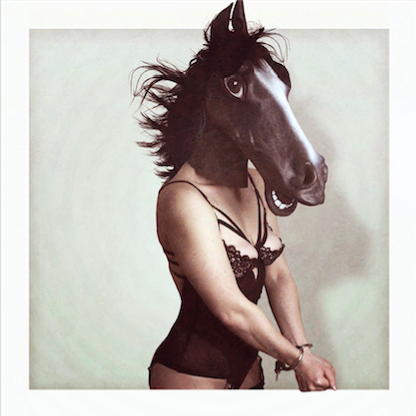
Now in its third year, new writing showcase #Festival47 kicks off next week at the King’s Head Theatre. Among 19 shows featured in the programme is Bridle from Clamour Theatre, a contemporary satire on female sexuality and the attempts to control it, written by Stephanie Martin.
“Bridle is about challenging and rewriting narratives and perspectives on female sexuality and behaviour,” explains Stephanie, who also performs in the show. “It’s about desire, heartbreak, shame, fathers, violence, pornography, millennial culture. It’s about how female sexuality and behaviour are subtly policed and judged.”
Bridle marks Stephanie’s debut as a writer: “I wrote it last May, inspired by the disparity between the people I know in real life and the tropes of behaviour that are defined as ‘good’ or ‘proper’,” she says. “We shared the show for the first time, as a full length piece, at the brilliant Camden People’s Theatre hotbed Festival of Sex in April. Our first sharing saw me performing the piece with other actors, Elissa Churchill and Charlotte Clitherow, and so #Festival47 will be the first time I’ve ever performed it solo – I’ll be heartbroken/lonely and bored without the other two.
“As Bridle is the first thing I’ve ever written, I’m also extremely grateful to EJ and Pip at Pluck Productions, Georgie and Will at Flux Theatre and the Emerge Night, as well as Nastazja Somers and her HerStory baby, for first programming excerpts of Bridle as part of their respective new writing nights in November and December 2016. These three companies are a great example of London’s new writing scene, giving opportunities, support and confidence to new writers and makers.”
Bridle may be about women, but that doesn’t mean it’s only a show for women. “Absolutely not, it’s a show for all,” says Stephanie. “I personally believe we all exist as a gorgeous mismatch of the male and the female, so come as you are and enjoy. Some of the ‘male’ audiences of the past performances seemed a little disconnected or in some way to blame for some of Bridle, which I didn’t predict or imagine at all.
“I want us to all remove shame from our lives, to feel comforted that lots of us go through the same things, to feel okay about being weird and vulnerable. And to laugh at me and laugh at all of us.”
Clamour Theatre describe themselves as “raw, excited and all about today”. Stephanie explains, “We’ve formed to explore new perspectives, new characters, new stories in raw, explosive and enjoyable ways. We love humour, we love energy and we like looking at new stories and/or re-examining the status quo.”
Stephanie will be performing the show at the King’s Head on 11th, 12th and 16th July at 9.30pm. “It’s an honour to be programmed as part of the festival and defined as part of the ‘future of the theatre’, especially by a theatre with a reputation like the King’s Head,” she says. “The rest of the festival line-up looks fab too and we’re looking forward to seeing the other companies. I’ve seen such a huge variety of fab, quality work at King’s Head over the last 4 or 5 years so looking forward to being on that stage, too.”
Book now for Bridle at the King’s Head Theatre, 10th-16th July.
First, a word of warning: don’t go and see Mumburger on an empty stomach. It’s all kinds of confusing.
Now that we’ve got that out the way, let’s discuss Sarah Kosar’s play. Andrea just died in a horrific car accident on the M25, leaving behind her devastated daughter Tiffany (Rosie Wyatt, reprising her Offie-nominated role) and husband Hugh (Andrew Frame). What begins as a seemingly straightforward story of two people struggling to process their grief in very different ways (she’s made a Google spreadsheet and is looking at urns on Amazon; he just wants to read the messages of condolence on Facebook and watch his wife’s favourite movie) takes a surreal and grisly turn when a mysterious delivery arrives. Inside the greasy bag are burgers – an odd enough sight in a house of committed vegans, even before we learn that they’re in fact a “Digestive Memorial” arranged by Andrea as a way to sustain her family after she’s gone.
Photo credit: Lidia Crisafulli
If it’s visceral theatre you’re after, you’ve come to the right place; it’s impossible to watch Mumburger – which follows Tiffany and Hugh’s horrified attempts to abide by Andrea’s final wish – without feeling some kind of physical reaction. Director Tommo Fowler has obeyed to the letter the writer’s instruction that “the actors should consume food when it says they eat”, so there’s no getting away from either the consumption or the various bodily functions that accompany it. (Or indeed the smell of cooking burgers, which explains the confusion I mentioned earlier.) It’s disgusting and messy and uncomfortable to watch, particularly when you add into the mix a series of video projections against the curtain at the back of the set, which verge at times on motion sickness inducing.
But let’s put the meat to one side for a second. At its heart, Mumburger is a story about a family coping with the loss of the person that held them together. Though we never meet Andrea, Kosar’s script paints a detailed picture of her; it’s clear from listening to Tiffany and Hugh argue and reminisce that she was the common link between them, and that without her they’re almost strangers who have no idea how to communicate. Both are also pretty annoying in their own ways; Tiffany, played by Rosie Wyatt, is shrill, domineering and self-involved, while Andrew Frame’s Hugh would rather play Candy Crush on his iPad than deal with anything even remotely difficult. Each believes that they knew Andrea better and therefore has more right to grieve, and the mumburgers become a physical manifestation of that competition. All of which begs the question: was Andrea’s intention really a noble wish to help her bereaved daughter and husband go on, or was it prompted by her own selfish need to maintain her position at the centre of the family for as long as possible?
Photo credit: Lidia Crisafulli
Many plays about bereavement go for the emotional jugular, encouraging us to feel sympathy for the characters and move us to tears as we watch them bond over memories of their loved one. Mumburger is not one of these plays. You’re more likely to come out feeling slightly sick than overwhelmed with emotion (though the play certainly has its moments) but that doesn’t make it any less real, and in this regard it’s actually oddly refreshing. Death – particularly of the sudden, violent kind – is not romantic or glamorous, but messy and painful. Not everyone who dies is perfect; nor are the people they leave behind. Grief can drive us apart just as much as it brings us together. These may not be truths we want to hear – or see, or smell – but they’re truths all the same. Not one for the faint-hearted (or vegetarians), maybe, but Mumburger certainly makes a lasting and powerful impression.
Can’t see the map on iPhone? Try turning your phone to landscape and that should sort it. I don’t know why but I’m working on it… 😉
You do have to wonder sometimes what makes people go into politics. Despite certain obvious benefits, it seems often a very thankless career, exposing you to public scorn, ridicule and disdain the minute you mess up or show the slightest sign of weakness. Because of the nature of the job, politicians become public property – and the public has the power to make or break them on a whim.
This is the very predicament in which Tom Crowe, the Labour MP at the centre of Tim Cook’s new play Tremors, finds himself. After a private encounter in a hotel room with a senior party member goes viral, he takes the advice of his PR advisor Lisa and flees to Eastbourne. But his hometown is in chaos, with riots and vandalism led by anti-austerity activists threatening to tear the town apart – and a dark secret from Tom’s past that could derail the attempt to salvage his future.
Though written a few years ago, by chance the staging of Tremors by Broken Silence Theatre has fallen during one of the most extraordinary eras that many of us can remember in British politics. It’s an indication of how disillusioned and suspicious we’ve become – not really a surprise after watching our politicians routinely turn on each other over recent months – that a character like Tom, who genuinely just wants to help people, seems entirely too good to be true. Even so, William Vasey gives a believable performance, managing to convey both the wide-eyed idealist, who followed his heart into politics, and the ambitious social climber, whose accent these days is more Oxford than Eastbourne.
Tom’s one of four characters who never get fully developed, despite good performances from the cast. Much like in politics, each of them comes to represent a particular ideology, which overrides their individual personalities, and consequently we never really get to know them as the 60-minute play unfolds. At the opposite end of the scale from Tom is his old friend Chris (Tim Cook), who has the same passion to make the world better, but very different ideas on how to achieve it. And then there are the women: Lisa (Vicky Winning), a hard-nosed ice queen who doesn’t do feelings, remorse or indeed anything that might get in the way of her own career interests. Her opposite number is Marie (Cerys Knighton), Chris’ sister; her activism days are firmly behind her, and now all she cares about is finding her brother before he does something stupid.
There’s a lot going on for such a short piece, and some of the plot threads at times become a little tangled – Tom’s career crisis and concealed homosexuality, the decline of his coastal hometown, Chris’ struggles to come to terms with his past or the country’s future, and the revelation of the secret that binds the three old friends together. And despite some helpful BBC News announcements, the timeline of the play isn’t always entirely clear; some early flashback scenes only really make sense in the closing minutes.
Though not without some issues, Tremors is an interesting premise and definitely has potential for development into a longer play examining the issues in greater detail. What connects all the various plot threads is a simmering anger over the growing distance between we the people and those who put themselves forward to represent us – which is something I think most of us can identify with. Judging by recent events, that’s not an issue that seems likely to go away any time soon, so here’s hoping Tremors will return to shake things up in the future.
Can’t see the map on iPhone? Try turning your phone to landscape and that should sort it. I don’t know why but I’m working on it… 😉
It’s the golden rule of capitalism: to convince a customer that your product will make them happy, you have to first make them realise how very unhappy they are without it. Science fiction musical The Quentin Dentin Show by Henry Carpenter takes this concept to infinity and beyond; now directed by Adam Lenson, the show introduces us to bored (and boring) couple Nat and Keith, who become the unwitting subjects of the universe’s most bonkers marketing scheme when they find a mysterious golden microphone in their living room. At the helm is Quentin Dentin – or at least the synth currently in possession of that name – whose only job is to sign them up to The Programme and make them both happy forever (although what that actually means is removing their souls, but you know, same difference). Naturally, Quentin isn’t doing this for nothing; he’s in line for an upgrade if he can seal the deal, so is willing to do just about anything to sign his subjects up.
Photo credit: Lidia Crisafulli
In case you were wondering, this is all absolutely as bizarre as it sounds. Luke Lane steals the show with a gloriously over-the-top portrayal of TV host/preacher/mentor Quentin, backed by his two robotic “friends”, creatively named Friend 1 and Friend 2 (Freya Tilly and Lottie-Daisy Francis). Behind their beaming smiles, cheery singalongs and energetic choreography, there’s a decidedly sinister undertone about this trio as they skilfully manipulate Keith and Nat into signing their lives – and more – away.
Shauna Riley and Max Panks do a good job with necessarily flimsy characters, whose bemusement quickly gives way to acceptance of their own unhappiness and rejection of the dreams they thought they had. It’s a bit hard to believe Nat and Keith would so readily succumb to a strange man who appeared out of their radio, and nor do we ever find out why they’ve been chosen as Quentin’s latest subjects – but by this point we’re so far through the looking glass anyway that it’s best to just go with it.
That said, there is still a nugget of harsh truth about humanity’s constant search for happiness to be found amidst the manic grins, talking microphones and inflatable fish (don’t ask) – and the show’s unexpectedly bleak ending leaves us to wonder rather despondently if finding the meaning of life through artificial means really is the best future we have to look forward to.
Though there are only a couple of songs that are particularly catchy – among them a Hey Jude-esque final chorus that I still can’t get out of my head – all the musical numbers are enthusiastically performed by band and singers, with sharp, synchronised choreography from Caldonia Walton. In fact, movement in general throughout the show is crisp, polished and perfectly timed, down to the simplest turn of a head at just the right moment.
Photo credit: Lidia Crisafulli
The production does suffer from a few sound issues; with the band on stage throughout, there are a couple of numbers where it’s hard to make out all of the lyrics, and there’s also an odd disconnect between the intimacy of Nat and Keith’s living room and the fact that they’re talking to each other in it through radio mikes. The show would perhaps work better in a slightly larger space – it certainly has the larger than life personality required to fill a bigger stage.
The show’s been described as “The Rocky Horror Picture Show for the new millennium”, and the influence of Richard O’Brien’s show is obvious (ordinary couple stumble into the path of a charismatic but unhinged stranger, who makes them question everything they thought they knew about themselves). Whether Quentin will ever reach the same levels of cult fandom I couldn’t say, but there’s no denying the show makes for an entertaining – and slightly bewildering – evening out.
Can’t see the map on iPhone? Try turning your phone to landscape and that should sort it. I don’t know why but I’m working on it… 😉
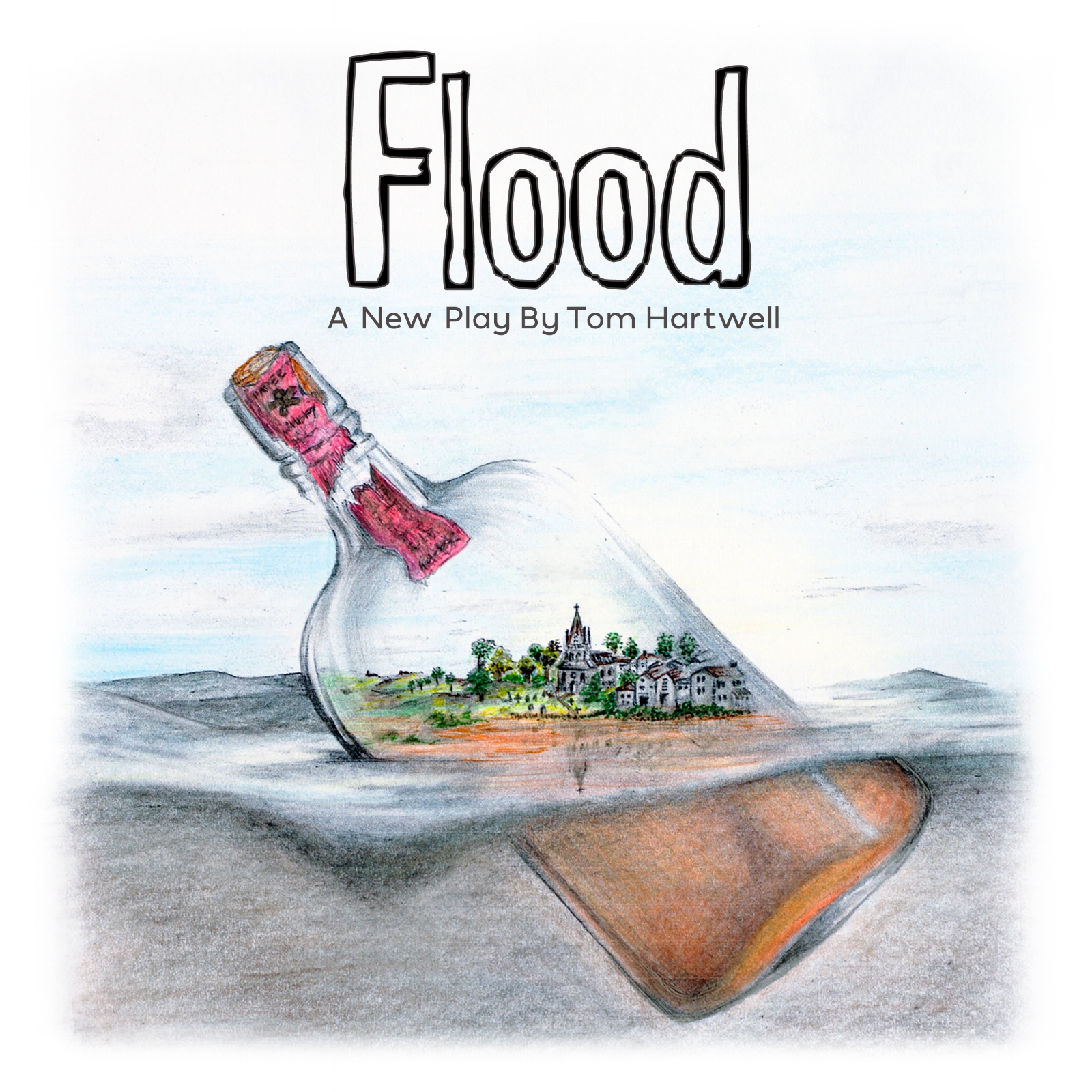
Paper Creatures is a new London-based theatre company founded by Jon Tozzi and Nathan Coenen. The company’s debut production, Flood, which opens at Tristan Bates Theatre on 31st July, is a comedy drama written by Tom Hartwell (known for recent hits You Tweet My Face Space and Contactless), which shines a light on the millennial generation while examining themes of grief, nostalgia and what it means to leave home – and come back again.
“The play centres around the day’s events in this village at two of the characters’ mother’s funeral, and friends coming back,” says Jon. “We have one character, Adam, who’s never left the hometown and everyone else has, so it looks at the effect that’s had on him and them. We were just fascinated with this idea of why everyone wants to move away from home, where does this come from? But it’s a comedy drama – we wouldn’t get Tom Hartnell on board if it wasn’t going to have its light moments!
“Tom was in the year below me at drama school and I remember having a drink with him and I told him about the potential of this company and how we wanted to look at certain themes. And then he went on tour for a month to a place called Tenbury Wells, where every year it gets flooded and the government has deemed it too small a place to do anything about it. And he was really interested in how that affects the people living there, and especially the millennial demographic – so he wrote Flood.”
While Jon is “a London boy, born and bred”, Nathan knows all too well what it’s like to move away from home. “I’m from Perth, Western Australia – as south as you can get, almost! So there are definitely themes in the play that are very strong for me, and in the rare times I’m able to get home there are scenes that happen in this play, which Tom wrote of his own accord, that have exactly happened to me. I wanted to leave in order to achieve the things I wanted to do with my life – I knew I wouldn’t be able to do that in Perth – but it’s fascinating to me to think about identity and where you relate to. Would I call myself a Londoner now? I’ve only lived here five years. It’s an interesting question.”
The decision to focus on the millennial generation was made early on: “We’re very intrigued by this term,” explains Jon. “There’s almost this association now with the millennial generation that we’re addicted to phones, and disconnected from people because we’re so invested in the technologies that are around us. There’s a reason for that – because our lives are on phones and laptops and emailing – but at the end of the day we’re human beings and we still feel, and I think the way we’re portrayed sometimes in the media is that we don’t have those feelings. We wanted to dig deeper and prove that we still grieve, we still laugh, love, we still have secrets.
“But we didn’t want a gimmick with the company either. From the get go we believed that the story should be enough and you should take something away from it – regardless of what the play’s about, there’ll be a moment there. It’s all about the story for us; that’s our USP, I think. I reference theatre to history as well, and the reason we have history is to learn from it. Theatre’s the exact same thing – so we can with new writing tell these stories now so in the future people can look back and see what we were like.”
“I think we’re lucky to have access to so much amazing classical theatre, but I also think classical plays get put on all the time, and it’s incredibly important to continue to create a platform for new writers to come forward,” adds Nathan. “There are never enough new voices and we just wanted to not do anything special or different, but just provide another platform for new writers to have a voice and share their stories.”
Jon and Nathan met on a five-month tour of Much Ado About Nothing with The Lord Chamberlain’s Men, and bonded over a mutual love of the NBC show Friday Night Lights. “We absolutely adored the show because of the simple storytelling of these country people’s lives in Texas, where their whole lives revolved around their Friday night football game,” says Nathan. “To them it was the be all and end all. And we’d watch it and see a really honest portrayal of people caring about something so much. Then we’d chat about theatre, and when the tour finished we went and saw a lot of theatre together – Chekov, Yerma, Groundhog Day. We started going to some of the fringe theatres and we really got excited there.
“We’re really inspired by other new writing companies like Falling Pennies and Flux, and we wanted to create a place in which creatives and artists from all different aspects of the theatre community – lighting designers, actors, directors, writers, sound designers – could come together and invent. And particularly focusing that on the millennial generation; everyone we’re working with is a young, emerging artist, that’s really exciting for us.”
Jon adds, “And everyone helps each other out. We met up with so many people that we really admire – because we’re still learning every day, it’s not something you can get a degree in, you just have to crack on with it. We kept having these meetings and they were so helpful and honest with us so we could take what we wanted and put our spin on it. So we’re not just mimicking, we’re utilising what we’ve learnt.”
Photo credit: Benjamin Cooper
Even so, starting a theatre company is not without its challenges: “We’re trying our best to make it feel really professional,” says Jon. “It’s that feeling of making our team feel safe so they can just show up and enjoy themselves. And we’re learning about other elements of being in the theatre world like marketing, doing interviews – these are all new to us. I think it’s a really admirable thing when actors do decide to set their own companies up because you’re taking a massive risk.”
“I’ve been fascinated by the learning process of having to trust our own instincts about things,” agrees Nathan. “Things that I didn’t think I’d ever have to worry about as an actor, like designing posters, and then standing by your decisions. If you’re an actor in a play you have a director to guide you, but as the producers and the artistic directors we’re the ones calling the shots. It’s very rewarding but also you just have to click and hope – ‘I don’t know if this is right but let’s go for it’! And it’s been really gratifying to have to learn to trust our instincts on that.”
One of the biggest hurdles proved to be deciding on the company’s name, and it took about a month to finally settle on Paper Creatures. “We used to sit and just crack names out; we wanted to make it personal to us,” Jon explains. “The idea behind the name is: the paper is the script, and the creatures are the characters that come from that, the storytelling, and theatre is where we show you that. So the more you think about it, the more it makes sense – instead of thinking about an origami tiger or a swan, it makes so much more sense if you think about story, characters and theatre – just in a more poetic way. So that’s how it came about, but not without a lot of trial and error!”
Finding the right cast and creatives to work on Flood was another new experience, but Jon and Nathan are thrilled with the team they’ve assembled. “Our lighting, sound designer and set designers we’d never met before, so we found them essentially by just talking to people. Georgie Staight is the director – I did a scratch night with her last year, and she was great, then she directed Dubailand at the Finborough and we saw that she really gets a lot out of her actors, so we approached her and she thankfully said yes because she liked the play.”
The cast of five, which includes Nathan, Jon and Tom, is completed by Emily Céline Thomson, who was at drama school with Nathan, and Molly McGeachin, who was introduced by another friend. “That’s a nice element as well, meeting new people – we’ve never met some of them before but already have a great relationship,” says Jon. “It’s quite nice now to let the creatives get on with things and trust that they’ll do a great job, which they will, and we can concentrate on learning our lines!
“We want this to go really well. We want to learn a lot from it and make sure we’re doing it right, so we’re taking our time with it and not rushing into things, we’re making careful decisions – which venue we go for, what time slot, what kind of show we want to put on, what ideas we want for the poster… We’re making sure it’s done in the right amount of time, because the last thing you want when you’re putting on your first show is for it to be stressful and horrible. We want it to be a great experience for everyone involved.”
Nathan adds: “We want it to be fun, not one of those really stressful fringe productions where everybody’s tearing their hair out. We want them to want to do another play with us and be a part of it – that’s the kind of atmosphere we want to create. And we adore people getting in touch with us – actors, all different creatives; we want to create a community, so get in touch with us!”
Finally, why should we come and see Flood? “It’s a world premiere!” says Jon. “I think that’s exciting. So it’s a new piece of writing full of heart and humour, set in a flooded Somerset village, from a new emerging writer and company – what else could you want?”
“I think that theatre is something that’s a bit of a mirror. We go to the theatre to see ourselves or see something new, and I think that Flood will have moments we can relate to, and you’ll learn new things about people you might know,” concludes Nathan. “There will 100% be at least one moment where everybody will sit back and smile and say ‘I totally get that’. And that’s why we go to the theatre.”
Book now for Flood at Tristan Bates Theatre from 31st July-5th August.




 Theatre Things