Interview: Douglas Baker, Dante’s Divine Comedy

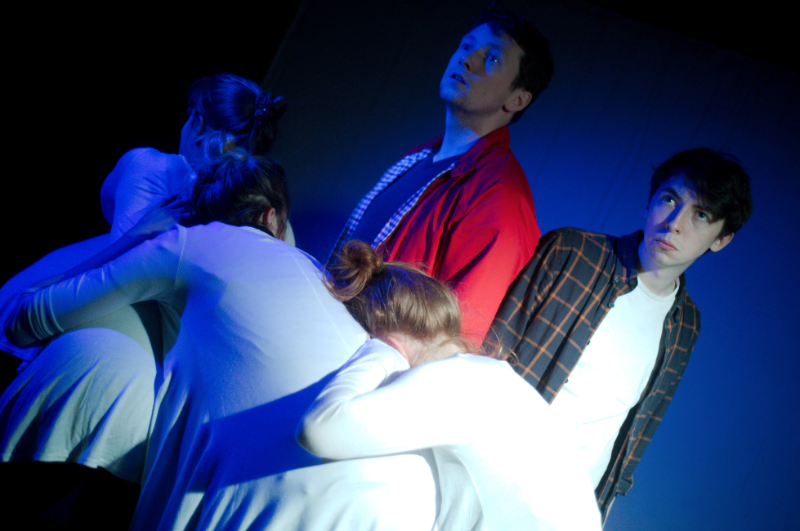
So It Goes Theatre return to Barons Court next month with their 21st century interpretation of Dante’s Divine Comedy. Adapted from the 700-year-old narrative poem, it’s the story of Dante’s quest to rediscover the reasons for living by reuniting with his lost childhood love Beatrice; to do this he’s taken on a tour of hell, purgatory and heaven by mysterious stranger Virgil. “Naturally there’s loads to explore: faith, morality, friendship, redemption. You name it, there’s a whole world inside this show,” says director Douglas Baker.

Funnily enough, Douglas didn’t originally set out to adapt Dante’s classic poem. “I’m embarrassed to say it was basically a complete accident,” he admits. “I had in my head an entirely different piece of source material – which I won’t go into now because it may surface in the near future. However, when I arrived at the Barons Court, I knew instantly it wouldn’t work there, so I had a mad weekend reading lots of different texts to try and find something else to do.
“I wanted something that was seriously old, out of copyright, brimming with theatrical potential. There was one particularly desperate moment where I was considering stringing all Shakespeare’s sonnets together into a narrative; thank God I found the Divine Comedy. As I started reading it, I couldn’t put it down. It drew me in with every passage. The pace of the thing – despite its hefty length – is incredible.”

Despite its appeal, turning Dante’s original poem into a 90-minute play for a 21st century audience came with some pretty big challenges. “I don’t want to give too much away but I think there were three big problems,” says Douglas. “Firstly, trying to create a dramatic arc in a poem that is essentially a series of meetings where the main character simply accepts what he sees as truth; structurally this is so boring and doesn’t make so much sense as a coherent story. So we’ve flipped, rearranged and cut down lots in order to – fingers crossed – make an emotionally believable journey.

“Secondly, we wanted a culture in the rehearsal room where we worked openly with only dialogue on the page. So it was a challenge to try not premeditating what I thought it would look like on stage. Even though scenes were brimming with potential, I didn’t want to lock us into something that we couldn’t achieve. So finding that balance between honouring both the text and the devising process was tricky, but hopefully we’ve made it work.

“The other main problem was trying to present medieval morality sympathetically. I quickly saw that it was impossible, so as a result we’ve had to take some liberties. Our Dante is younger and more rebellious. I thought that youthful mindset could work because we the audience are basically seeing this stuffy old fashioned world through Dante’s eyes, so we can hopefully justify the difference between the Dante in the poem and the Dante we present on stage. The story is the same, but Dante’s feelings towards it have been modernised.”

Douglas is looking forward to introducing new audiences to Dante’s work, and says prior knowledge of the Divine Comedy isn’t a must: “I would say not. Part of the attraction to the poem was the feeling that many people knew of it, but not in any real detail. There’s something incredibly exciting about introducing people to a dusty old book for the first time; perhaps our interpretation will encourage people to read it for themselves and come to their own understanding about morality or the afterlife. I hope people will see our piece as a series of questions rather than assertions. The hope is we can ignite curiosities that will push people to reach their own conclusions.”

The show returns to Barons Court for a second time following a well-received run in April. “Being back is strangely unnerving,” says Douglas. “We always forget how small the stage is, so it requires seriously precise coordination to keep things visually interesting. Luckily our movement director Matthew is a genius at utilising space in interesting ways, so your eye is always drawn correctly. Other than that it’s just been a case of balancing creating with re-creating, we don’t want to just redo the original production but rather build on it and improve.”

This latest run, which opens on 5th September, sees almost all of the seven-strong cast reprise their roles. “They are the most generous people you could ever hope to meet,” says Douglas. “The bond between performer and director can be so fragile if egos are at play. If a cast don’t trust the director they will seize up and work only for themselves. But these cast members work for each other, they are beautifully spirited people.

“As a director I often get my actors to do very weird weird things to create the spectacle for the audience, so if it’s to translate into a coherent performance where they can commit completely it’s utterly reliant upon their trust in me. I think we have that trust, so the rehearsal room is a joyful space where we can really play and find the truth in what we’re doing.”

Douglas co-founded So It Goes Theatre with producer Charles Golding. “Charlie and I created the company way back in 2011, its been on hiatus for a while because Charlie now has a family but we always knew it would be back some day,” he explains. “We wanted to do a combination of reimagining classic stories and telling brand new ones. We want to showcase new performance talents in a largely ensemble context. We were also aware that the majority of actors auditioning for us were female, so we decided very quickly to produce work that in general favoured largely female casts. Maybe it was pragmatic rather than righteous, but it’s worked for us so far.”

Book now for Dante’s Divine Comedy at Barons Court Theatre from 5th-30th September.

Review: Sophie at the Lion and Unicorn Theatre

Written and performed by Julia Pagett, Sophie is a story about mental illness and its lasting and wide-reaching impact. At just 20 minutes, the play’s over almost before we know it, but nonetheless provides plenty of food for thought.

Though Sophie is the central character, it’s not she who tells her story; that duty falls to her twin sister, who we first encounter looking through old photos and smiling fondly, while a stereo at her feet plays Puff the Magic Dragon all the way to its sad final verse. Although she’s surrounded by these memories (the set also contains an old bike, which later prompts her to reminisce about the one time she saw her sister truly happy), when she speaks, she reveals a far more complex cocktail of feelings towards Sophie: love, anger, grief, remorse and confusion all make an appearance in this short, heartfelt monologue.

Though it’s never specifically named, the implication is that Sophie was suffering from an eating disorder, and the play focuses predominantly on the ideas of perception and reality: how we see ourselves compared to how others view us. We’re told more than once that Sophie was beautiful, and it’s her failure to see this, more than anything, that her sister can’t understand.

The fact that Sophie’s a twin helps to explore this theme of distorted perceptions in more depth. We hear so much about their mysterious, unbreakable bond that it’s easy to think of twins as two halves of one whole, mirror images of each other – emotionally, even if not physically. The fact that despite this, Sophie still fails to see her true self reflected back at her reveals the undiscriminating power of mental illness, and heightens the tragedy of one twin being left behind.

Under the direction of Keir Mills, there’s a confrontational, defiant tone to Julia Pagett’s delivery that suggests Sophie’s sister knows what she’s saying will be considered shocking and controversial, as she admits to believing her twin was being ungrateful, and to refusing to admit Sophie had a problem or to help even when she begged her to. Even now, as she struggles with her feelings of guilt and grief, that powerful rage still simmers beneath the surface, ready to explode. As distressing as this is to see, it’s a brave, sincere and very moving approach to talking about mental illness that forces us to consider how damaging it can also be for those not directly affected.

I wish the play had been longer – largely because it clearly had a huge amount to say, and felt like it was only just getting going when it ended. It would be great to see Sophie developed into a longer piece that builds on this strong foundation and really digs into the important issues raised.


Can’t see the map on iPhone? Try turning your phone to landscape and that should sort it. I don’t know why but I’m working on it… 😉

Interview: Rachel Lee and Laura Taylor, Job’s A Good’Un

Job’s A Good’Un is a semi-autobiographical one-woman sketch comedy written and performed by Laura Taylor. Laura’s had 11 jobs in 10 years, from collecting glasses in a gangster-run bar in the Midlands to arranging flower baskets for Eva Longoria. Physical, narrative and highly relatable, the show includes all the ridiculous situations, eccentric characters and endless hours Laura’s spent in the workplace over the years.

“When I was bored in my jobs or was in a ridiculous situation, I thought it might be funny to put on stage,” she explains. “You meet so many characters in day to day life, and there’s something theatrical about that.”

Director Rachel Lee adds, “And as an extension of that, we think everyone’s been in a position where they hate their jobs or feel frustrated at certain workplace situations, whether laughable or just pure despair. We wanted to bring the ridiculous, emotional quality of that on stage.”


Since most of us will have had at least one or two rubbish jobs in our time, Rachel and Laura are hoping the show will be easy to relate to: “We’ve been discussing in our rehearsals how to make the connection with the audience and get them interested even though the storyline is very much autobiographical,” says Rachel. “I think people should come see it because it’s funny and it’s relatable. It’s a personal story, yes, but it is full of emotional moments that will make us go, ‘Oh yeah, I’ve been there!’ 

“I was reading a book and the author was talking about When Harry Met Sally – which is very different, obviously – and she describes that the film ‘has the precision of a personal story, but is actually interested in drawing out universal truths’. That’s exactly what we’re doing.”

They’re also, obviously, hoping it will make us laugh: “A good comedy begins with a story that is engaging that people can relate to or are interested in,” says Laura. “The way that story is delivered is the secret to a good comedy.”

Rachel adds, “As a director’s point of view, I think the secret is to be aware of the elements that are funny, but also not milk them too deliberately.”

The show features in the final week of the month-long Camden Fringe, whose programme has included over 200 shows across 20 venues. “I think Camden Fringe gives shows such a great placing no matter big or small, and we’re very excited to contribute our story to everything that’s out there and feel part of something that’s bigger,” says Rachel.

Together, Rachel and Laura make up Smol & Ginger (so named because one of them’s small and the other’s ginger). “We were on the same Drama course at Goldsmiths and graduated a year ago,” explains Rachel. “We’re both really interested in telling stories, no matter the really personal ones, untold ones, weird ones that no one really thinks about.”

Finally, what would be their number one tip for anyone stuck in a job they hate? “Don’t let jobs define who you are,” advises Laura. “The people and situations that you find unbearable at the moment, let them drive you forward. Anything bad that happens at work remind yourself that you aren’t saving lives – unless you’re a doctor…”

Job’s a Good’Un is at Camden People’s Theatre on 25th and 26th August.

Review: The Monologues of a Tired Nurse at the Lion and Unicorn Theatre

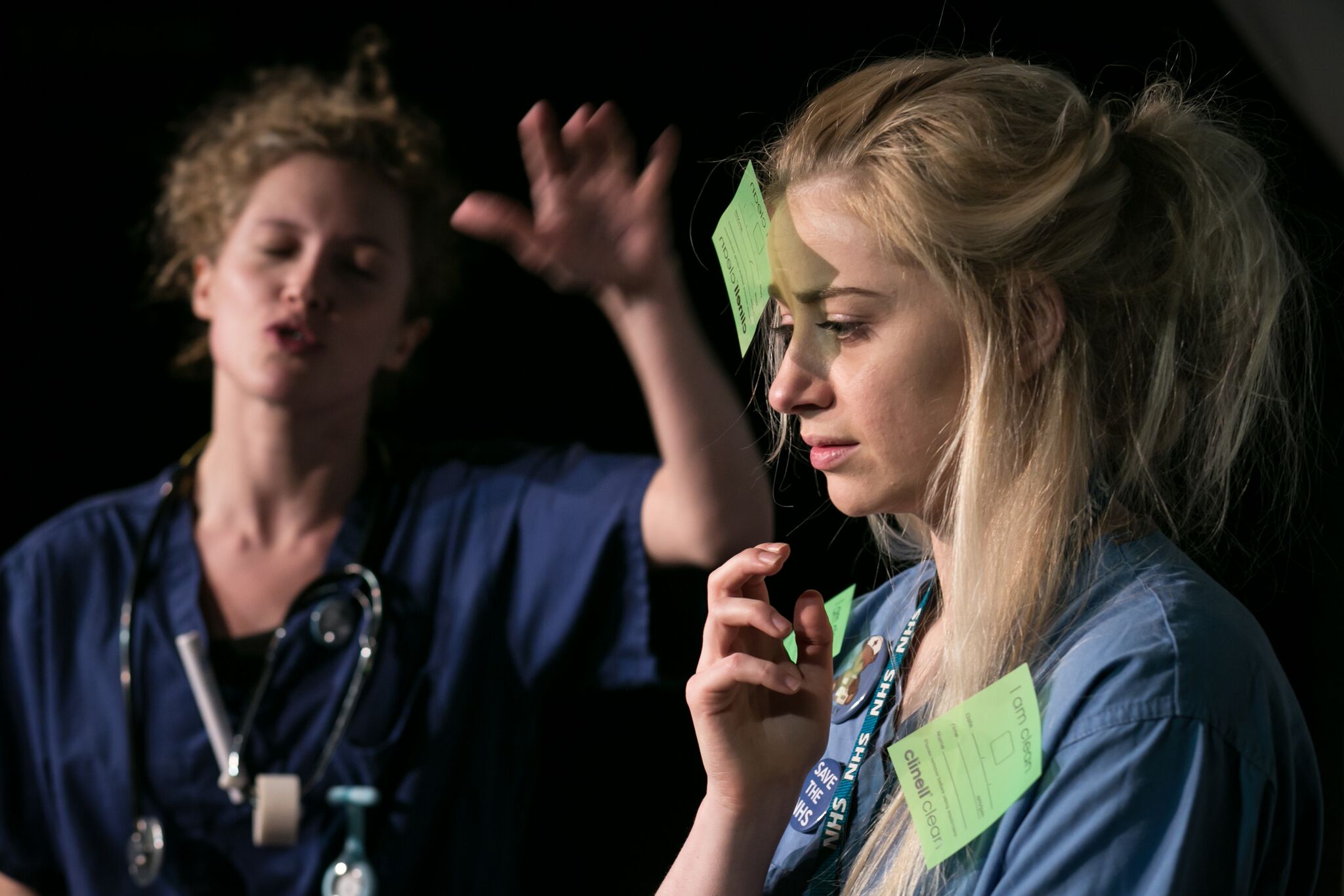
Stephanie Silver’s aim when she wrote The Monologues of a Tired Nurse was to give audiences “a brutally honest account of how it feels to work within the NHS in a understaffed, underpaid and emotionally draining time”. As a nurse herself, it’s a feeling she knows all too well, and though her characters are fictional, it’s clear throughout that the play is coming from a very personal place.

Brutal is an accurate word to sum up the show, which sees newly qualified nurse Emily grow gradually more and more dishevelled and distressed (not to mention covered in various unmentionable body fluids) as she realises actually being a nurse is considerably tougher than she expected. Her mentor, the older, wiser and much more experienced Sally, tries to toughen her up, not because she enjoys being mean, but because when you’re working in acute medicine, there’s no time to stop, worry, think (or eat, sleep, breathe…) – you just have to get on with it and hope for the best.

The play, directed by Simon Nader, makes a political statement about the increasingly limited resources available to the NHS, placing ever more pressure on the already stretched staff and putting patients’ lives at risk as a result. Stephanie Silver’s Sally has grown used to working under this pressure, but that doesn’t mean she’s okay with it – her monologues reveal a bitterness and world-weary honesty; if she could go back, she tells us frankly, she’d choose a different career. She’s done her fair share of crying over the years, but these days she just smokes and drinks, puts the tough days behind her and moves on, because she has no choice – if she breaks down, the patients will still be there needing help, and if she’s not there to offer it, then who will?

Makenna Guyler’s Emily, on the other hand, is young and idealistic, and hers is a personal rather than political viewpoint. She went into nursing for a very specific reason, inspired by a traumatic family history and lingering sense of guilt, but her fear of cracking under the pressure means she repeatedly does just that. Despite her brave attempts to claim that getting a thank you from a patient makes the long hours and emotional turmoil all worthwhile, her bright smile begins to crack more and more frequently. The harsh fact of the matter is that at the end of the day, wanting to help – however desperately – may not be enough.

Despite, or perhaps because of, these difficult truths, it’s impossible to leave the theatre without a new respect and admiration for anyone in the nursing profession. Put aside any misguided beliefs that nurses are just there to hold hands and empty bedpans; they have to make life or death decisions every single day, and that responsibility alone – even with limitless resources at their disposal – would be enough to break a lot of people.

The growing crisis in the NHS is well documented, and we’ve heard a lot in recent months about the struggles of junior doctors to keep up with ever-increasing workloads – but nurses never seem to make the headlines, despite being an equally essential part of the health service so many of us take for granted. The Monologues of a Tired Nurse aims to remedy this, and does so with unflinching honesty. It’s not pretty… but it certainly packs a punch.


Can’t see the map on iPhone? Try turning your phone to landscape and that should sort it. I don’t know why but I’m working on it… 😉

Review: Pluto at the Cockpit Theatre

Who among us didn’t feel a little bit sad when Pluto lost its planetary status back in 2006? Partly because it messed up the mnemonic we all learnt at school (mine was Some Men Very Easily Make Jam Sandwiches Under No Pressure, which just doesn’t work without the P) but mostly because it just all seemed a bit unnecessarily harsh. Poor old Pluto’s up there minding his own business, doing what he’s always done, and down here on Earth someone’s tweaked a few rules and suddenly he no longer makes the grade. And to add insult to injury, he didn’t even ask to be part of our solar system in the first place.

This is the premise for Moonchild Theatre’s debut show, in which a depressed Pluto (Liam Joseph) struggles to come to terms with his sudden change in status, despite the best efforts of his devoted and kind-hearted moon Charon (Charlotte Price) – and the stripper she “forgot” to cancel (Thomas Lovell) – to cheer him up. Why is there a stripper there, you may ask? Well, because Neptune, Pluto’s next door neighbour, tricked him into having a party to celebrate what he thought was going to be an exciting announcement from NASA. And then didn’t show up. Along with all the other planets.

Photo credit: Dave Bird
Writer and director Callum O’Brien’s idea of presenting Pluto and friends as people with unique personalities, emotions and even sexualities presents plenty of comic opportunities (I particularly enjoyed the shared obsession with Sigourney Weaver). But it also makes their plight a lot easier to relate to, and the play has some really moving moments – largely due to the fact we’re not just talking about planets here. The show was inspired by the ongoing controversy in the USA over transgender bathroom laws, and from this very specific starting point explores the more general theme of individuals being labelled according to someone else’s world – or in this case, solar system – view, and the damaging effects this can have on their mental health and relationships.

The three characters complement each other well, in a story that balances Pluto’s persistent gloom against Charon’s energy and perkiness, and then throws in the Stripper to mix things up. The first outsider to visit in, presumably, a really long time, he brings with him all the prejudices they feared, but also a new, different energy that affects the two friends in contrasting ways and leads the play to a somewhat subdued and ambiguous conclusion.

Perhaps in a nod to their relative youth within Earth’s view of the solar system (Pluto was only discovered in 1930), both Liam Joseph and Charlotte Price bring a childlike energy to their roles – he’s pouting and petulant; she’s full of enthusiasm and a touching innocence – she has, we learn, been rescuing the dogs sent up on test missions by Russia because she couldn’t bear to see them die. They’re a likeable, if dysfunctional, pair with a genuine, irresistible fondness for each other – but heartfelt monologues from both reveal there’s considerably more going on behind the party games and comedy dance moves.

Equally enjoyable is Thomas Lovell’s decidedly un-childlike Stripper, who certainly knows how to make an entrance, and holds nothing back as he camps it up to the max. But this character also has hidden depths, and ultimately it’s he – not Charon – who finds a way to get through to Pluto.

Funny and thought-provoking, Pluto is an exciting debut from Moonchild Theatre. Being an astronomy fan (and having a pre-existing fondness for Pluto) will help but isn’t essential; at heart this is a story about the importance of not letting others’ prejudices define how you see yourself. And that makes it a lot closer to the human experience than its distant setting would suggest.


Can’t see the map on iPhone? Try turning your phone to landscape and that should sort it. I don’t know why but I’m working on it… 😉