Review: Billy Bishop Goes to War at Jermyn Street Theatre

Marking the centenary of the Armistice that brought World War I to an end, Proud Haddock’s excellent revival of Billy Bishop Goes to War is a fitting tribute to all those who risked – and in many cases, gave – their lives in combat. The show tells the remarkable true story of WWI pilot Billy Bishop, who was credited as the top Canadian and British Empire ace of the war with 72 victories to his name. But don’t be fooled; despite first appearances, some very jolly tunes and the show’s Enid Blyton-esque title, as the evening goes on there’s a mounting sense of anger and dismay at the utter pointlessness and waste of both this particular conflict, and war in general.

Photo credit: Robert Workman

It all begins cheerfully enough; 20-year-old Billy Bishop enlists in 1914 and leaves his home in Owen Sound, Ontario, eager to have a laugh and kill some Germans. A year later, he joins the Royal Flying Corps as an observer, and helped along by the patronage of London socialite Lady St Helier, a year after that he trains as a pilot and takes triumphantly to the skies, machine gun in hand. But though Billy’s skill and courage earn him medals, promotions and international acclaim, after a while the thrill of shooting down the enemy – however successfully – can no longer quite compensate for the loss of countless friends, the longing for home, or the dawning realisation that the lives he’s taking might be more than just numbers on a scoreboard.

The two-hander, directed by Jimmy Walters, is performed brilliantly by Charles Aitken and Oliver Beamish, who play the younger and older Billy, and who complement each other perfectly. Aitken takes centre stage (and beyond) as the charismatic young pilot, quickly establishing a rapport with the audience and unafraid to bear his soul in the play’s darker moments. Beamish, meanwhile, is a steadier, more reflective presence, who keeps out of the way and spends the majority of the play tucked quietly behind a piano.

Both men also play a number of other parts, often to hilarious effect: among them Billy’s patron Lady St Helier, her snooty butler Cedric, and the various officers and dignitaries who have no qualms about placing their men in harm’s way, or using them as figureheads when the occasion suits. It’s at these moments that we’re reminded most forcibly that Billy – like so many others – was not a British soldier, but a Canadian dragged into another nation’s war, only to be manipulated shamelessly by those who considered themselves superior but who weren’t willing to step up and pay the price they expected of others.

Just as the actors show us two sides of the same man, so Daisy Blower’s set cleverly toes the line between a WWI bunker and a 1950s man-cave, so that like Billy himself, we feel we’re simultaneously in two different time zones. The level of detail in the set is astonishing and the overall effect – enhanced further by light (Arnim Friess) and sound design (Dinah Mullen) – is visually stunning, with so much to look at that it almost feels more than one visit is needed to take it all in.

Photo credit: Robert Workman

Billy Bishop Goes to War is the most popular play in Canadian theatrical history, and it’s not hard to see why. The show certainly doesn’t glorify war, but it does celebrate heroism, in particular that of a young man willing to risk everything for someone else’s country. Despite all that he did for us, few Brits in 2018 have even heard of Billy Bishop – and for that reason alone, the play deserves to be seen by as many people as possible. Fortunately, the quality of the production more than lives up to the importance of the story it’s telling; beautifully performed, designed and directed, this timely revival is a must-see.

Can’t see the map on iPhone? Try turning your phone to landscape and that should sort it. I don’t know why but I’m working on it… 😉

Review: Sweet Like Chocolate Boy at the Brockley Jack Studio Theatre

Powerful, polished and utterly absorbing, Tristan Fynn-Aiduenu’s Sweet Like Chocolate Boy explores the changing face of Black British identity and protest over the last three decades, through the very different experiences of two young Londoners.

In the 90s, Bounty (Michael Levi Fatogun) is a quiet, well-spoken boy who just doesn’t quite fit, no matter how hard he tries. He’s aware of racism, even in his best friend James, but he doesn’t like to confront it – a reluctance that will come back to haunt both him and the people he loves. In the present day, Mars (Andrew Umerah) is street-smart and brimming with confidence as he sets out to meet his dream girl, Fantasia (Veronica Beatrice Lewis) for a protest march that simmers throughout the day with the potential for violence. Mars and Bounty seem at first glance to have little in common – until an explosive finale reveals that their lives and actions are far more intricately linked than we thought.

Photo credit: Aaron Kelly

The show’s lyrical and fast-moving script is set to a soundtrack of garage and jungle, which evolves with the story through the decades, and is accompanied by energetic choreography and movement sequences from Sean Graham. Under writer Fynn-Aiduenu’s direction (and the watchful eye of Alice Fofana as the omnipresent god-like figure of the DJ), the action is as non-stop as the dialogue, with the actors often given only seconds to slip on a new outfit and in doing so, embody a very different character. All rise to the challenge with incredible dexterity; such is the success of the play’s characterisation that it often feels like we’re watching a much bigger cast. Veronica Beatrice Lewis in particular shines as she reappears in the guise of brash Sandra, mysterious Fantasia and sweet-natured Michelle, as well as the overly aggressive mental health nurse trying to get Mars’ attention.

Andrew Umerah and Michael Levi Fatogun are equally impressive as the two central characters. Umerah owns the stage as the young, cocky Mars – but like the chocolate bar after which he’s named, beneath the tough facade there’s a softer centre. We learn that he met Fantasia while recently hospitalised after a bout of depression, and it’s clear that she holds significant power over him; his actions on the day of the march are motivated just as much by his need to be loved – by her or by anyone – as by any particular ideology. Meanwhile, Fatogun’s endearingly awkward Bounty struggles to understand his place within an increasingly politically active Black community; he just wants to get along with everyone, and his naive attempts to fit in and act the role he thinks he should play are simultaneously a source of humour and desperately sad to watch.

Photo credit: Aaron Kelly

Sweet Like Chocolate Boy isn’t always an easy play, not least to those of us for whom it’s an uncomfortable (but necessary) reminder of our own privilege. But with race as an important, current and ever-present backdrop, the play also doesn’t shy away from tackling other themes like mental illness, the need for human connection, and the struggle faced by so many young people in Britain today to find a place in the world where they can truly feel like themselves. This is a challenging and gripping piece of theatre from an exciting emerging voice; though it may be named for a 90s tune, it has just as much to say – and maybe even more – in 2018.


Can’t see the map on iPhone? Try turning your phone to landscape and that should sort it. I don’t know why but I’m working on it… 😉

Review: The Full Brontë at The Space

The life and works of the Brontës have been the traffic of many a stage over the years – but I suspect never quite like this. Scary Little Girls’ two-hander “literary cabaret” The Full Brontë is a joyously chaotic homage to the famous writing family, which features song, dance, storytelling, Kate Bush, Black Lace, a “ukelady”, quite a bit of audience participation and several packets of crisps.

The show is hosted by “actor-manager” Maria (Rebecca Mordan) and her amiable, much put-upon assistant Brannie (Sharon Andrew), who does everything else – music, props, wardrobe, stage management… you get the idea. It quickly transpires that what was supposed to be a celebration of the Brontës is in reality intended as a celebration of Maria’s great artistic talent – or at least it would be if Brannie didn’t keep stealing all the best lines and showing her boss up with a more in-depth knowledge of the Brontë family history. Somewhat predictably, though Maria casts herself as the star, Brannie quietly – and quickly – wins us over, so it’s no surprise that in any moment of conflict between the two, the audience always sides with her.

It’s also no particular surprise that despite the title, there’s not actually much about the Brontës in the show. References to their novels and poetry are sketchy at best, often straying on to other topics including (of course) a couple of awkwardly shoehorned jokes about Brexit and Trump. Even the extended scenes based on the Brontës’ two best-known novels – Jane Eyre and Wuthering Heights – reveal far more about the tense partnership between Maria and Brannie than they do about the literary works that inspired them.

That isn’t necessarily a bad thing, however (although anyone going along to actually try and learn something about the Brontës might disagree), and the comedic talents of Rebecca Mordan and Sharon Andrew more than compensate for the show’s lack of literary substance. Both audience and actors are kept on our toes by the threat/promise that most of us will be “used” at some point during the evening, and it’s often these improvised exchanges with audience members – when neither party quite knows what might happen next – that get the biggest laughs.

The Full Brontë is without doubt a very silly, chaotic 80 minutes, during which you’ll learn next to nothing about the Brontës (except that they may or may not have been Cornish…?) and may well come out a bit more confused and considerably more flustered than when you went in. But even so, it’s hard not to be charmed by this thoroughly entertaining comedy duo, and for an evening of good-natured fun, the show is well worth a visit.


Can’t see the map on iPhone? Try turning your phone to landscape and that should sort it. I don’t know why but I’m working on it… 😉

Review: Baby at Drayton Arms Theatre

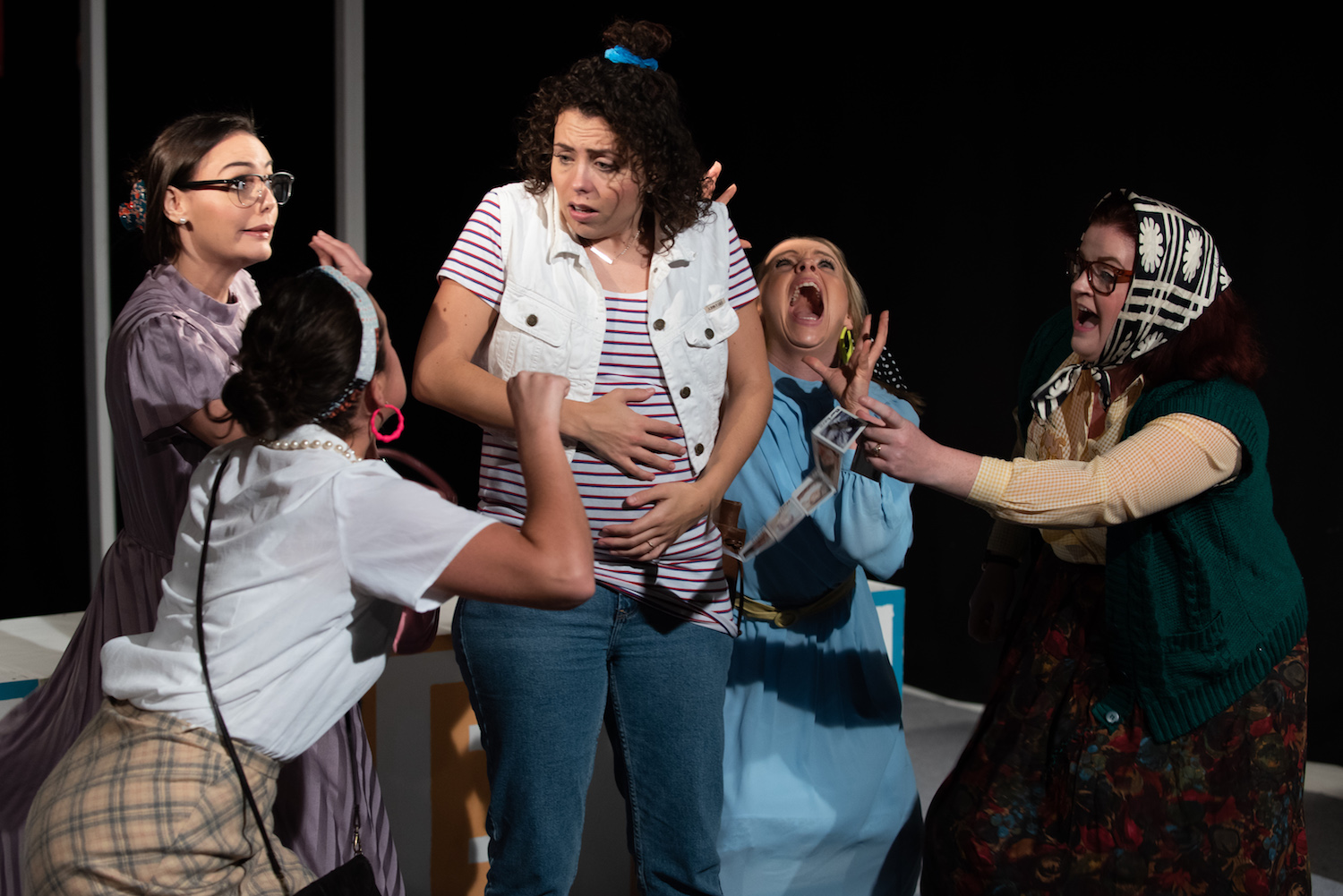
If you’ve ever felt like everyone you know is having babies, then you’ll be right at home watching Baby, a romantic comedy musical about, er, people having babies. The story, set at a college in the States, begins with three women – a student, a gym coach and the wife of a professor – discovering they’re pregnant, and follows each of them as they set out on the life-changing path ahead.

Photo credit: Thomas Scurr 

And there’s no doubt that this news does change each of their lives, just not necessarily for the better. While Pam (Laurel Dougall) is delighted to hear she’s finally pregnant after two years of trying, for 21-year-old student Lizzie (Holli Paige Farr) and 43-year-old mum of three Arlene (Barbara Jaeson), the thought of having a(nother) baby is more than a little daunting. And in all three cases, both the announcement and the events that follow it expose cracks in what seemed like perfectly healthy relationships.

This is actually fortunate, because despite the best efforts of writers Sybille Pearson (book), David Shire (music) and Richard Maltby, Jr. (lyrics), it turns out being pregnant (or not) alone doesn’t really provide enough material for a two-act musical. It’s therefore the couples’ marital (or not) problems that form the backbone of Act 2, which is much more sombre than the joyful optimism of Act 1. By the end of the show, it’s not only a question of who will have their baby, but also who will overcome their problems and stay together – and whether they even should.

Written and set in the 80s, the show also exposes quite a few outdated attitudes, none of which, frustratingly, are ever challenged by any of the characters, male or female. Pam’s husband Nick (Stuart Scott) is the perfect partner – sweet, funny, supportive, encouraging – right up until he discovers it might be his baby-making equipment that’s defective, not hers. Danny (Danny Whelan), Lizzie’s boyfriend, is outraged when she refuses to compromise what she believes in and marry him just because they’re pregnant. And even Arlene’s husband, the otherwise lovely Alan (Christopher Lyne), throws a bit of a strop when his wife expresses perfectly legitimate concerns about becoming parents all over again.

Photo credit: Thomas Scurr

The flawed story is, however, supported by an enjoyable score, with a well balanced mix of humour and emotion. It’s also extremely well performed by the cast, directed by Marc Kelly and accompanied by musical director Kieran Stallard on piano. The three female leads – Holli Paige Farr, Barbara Jaeson and Laurel Dougall – are particularly strong vocalists, the only issue being that their performances occasionally seem to belong on a much larger stage. The same is often true for the ensemble numbers, which can be a bit overpowering given that the audience is mere inches from the performers.

An enjoyable romantic comedy, Baby makes for an entertaining evening, in the company of a polished and talented cast. Together they take us on a rollercoaster ride of emotion through the highs and lows of bringing a baby into the world, with all the expectation, delight and disappointment that’s a natural part of that journey – and although aspects of the show could certainly use an update, those emotions remain pretty timeless.


Can’t see the map on iPhone? Try turning your phone to landscape and that should sort it. I don’t know why but I’m working on it… 😉
Review: Pickle Jar at Soho Theatre

When you’re at school, you tend to assume your teachers are fully functioning adults who have life all figured out. Then a few years pass, you reach the age they were when they taught you, and you’re startled to realise that perhaps they weren’t quite as together as you thought.

In Maddie Rice’s one-woman play Pickle Jar, Miss is a young English teacher struggling to find her footing both in and out of the classroom. Away from work, she’s just been dumped and can’t stop obsessing over how bad her life is compared to everyone else’s. At work, her approach to teaching is to try and be friends with her teenage pupils, who fascinate her with their apparent confidence and worldliness – it often seems her attempts to connect with them are as much for her own comfort and support as they are for her students’ benefit.

Photo credit: Ali Wright

Maddie Rice, who previously starred in the touring production of Fleabag, was encouraged by that show’s creator, Phoebe Waller-Bridge, to write something that made her laugh or cry. Pickle Jar ticks both boxes. Directed by Katie Pesskin, the first half of the show is straight-up, laugh-out-loud comedy, as Miss reflects on everything from her meagre Instagram follower count, to the night her ex broke up with her (shortly after advising her to get tested for chlamydia), to her fumbling attempts – egged on by best friend Mairead – at flirtation with Mr Ellis, the much-fancied food tech teacher.

And then, about halfway through, the story takes a dark turn, and just keeps getting darker as one twist follows another, ultimately catching us off guard with some very uncomfortable, and topical, questions around consent and victim blaming. The humour is still present, but the laughs become far less frequent, and the overwhelming emotion we feel as the show comes to an end is much closer to anger than amusement. Even in the #metoo era, the fact that a female character feels she has to shoulder any of the responsibility for a man’s actions shows how very far we still have to go.

One thing that’s immediately clear is that Maddie Rice is an exceptional performer, bringing an extensive cast of characters, a complex back-and-forth timeline, and a number of different locations to life without ever missing a beat. Colleagues, friends, students, strangers: they’re all here, and all perfectly distinct from each other. Miss in particular is a well-drawn, realistically flawed character who most of the show’s target audience – women in their 20s and 30s – can identify with to some extent (whether we’re willing to admit it or not). The half hour that we spend getting to know her, laughing with – and at – her, never feels like wasted time, even though it delays the show getting to its actual point.

Photo credit: Ali Wright

There’s so much to enjoy about Pickle Jar, a very funny and brilliantly acted hour of theatre that will no doubt resonate with teachers, women and indeed anyone still trying to figure out how this whole adulting thing works (which, let’s be honest, is most of us). But behind the laughter, the play does have a point to make – and it’s a point that needs to be heard and acted on, however uncomfortable that might be.

Can’t see the map on iPhone? Try turning your phone to landscape and that should sort it. I don’t know why but I’m working on it… 😉