Review: The Memory Show at Drayton Arms Theatre

The Memory Show began life in 2008 as a thesis project for Sara Cooper and Zach Redler, both of whom had their own memories of seeing a loved one go through Alzheimer’s. And that may well be why watching this heartbreaking musical feels uncomfortably like intruding on a very private and intimate moment, between a mother diagnosed with early onset Alzheimer’s and her daughter who reluctantly returns home to care for her. As their already tense relationship is put under ever greater strain, we’re presented with an unflinchingly honest view of the emotional and practical repercussions of caring for someone with this devastating condition, along with an exploration of the unpredictable nature of memory itself.

The Memory Show
Photo credit: Claire Bilyard (www.scarabpictures.co.uk)
And so there’s a song about cleaning the toilet, and another listing all the things that need to be done before the mother passes away. The daughter, forced to be endlessly patient with a parent who’s more like a child, doesn’t hold back about her complicated mix of emotions; she loves her mother, and despises her at the same time for all she’s had to give up. She wants it all to be over, but wishes that it could be possible afterwards to call her mother for a chat. Often speaking directly out to the audience as her only other human contact in an increasingly claustrophobic situation, she explains about difficulties with doctors, and confesses her fears about whether she’s doing the right thing.

But as hard as this blunt honesty is to watch, there are also some lovely, tender moments – as they sit together on the sofa looking at potential matches on a dating website, they could be any mother and daughter, rather than a patient and her carer. And the final scene is bittersweet, because we know that whether or not the two can mend their relationship, it’s still going to be too late.

The Memory Show
Photo credit: Claire Bilyard (www.scarabpictures.co.uk)
The relationship between Ruth Redman and Carolyn Maitland as the nameless mother and daughter is utterly convincing – the ups and downs, the bickering, the reminiscing – and both show flashes of the same feistiness. As they reflect on their difficult history together, one topic keeps recurring: Ira, late husband and father, who seems to be remembered very differently by the two women. One of them is remembering him wrong… but not necessarily the one we might expect – and the continued references to a ‘secret’ hold us in suspense until the truth is finally revealed.

The simply staged production, directed by Alex Howarth, finds the characters and audience confined within the pair’s living room, with a string of lights above their heads that illuminate during the mother’s brief, and increasingly rare, moments of clarity. Behind them, meanwhile, a white sheet provides a backdrop for flickering images from home movies, a haunting reminder of the life and happiness that’s slowly fading away.

The Memory Show paints a brutal picture of the horror that is Alzheimer’s, but it also leaves a powerful impression for those without direct experience of the disease. It’s a story of two people who learn how to love each other only when it’s too late, and encourages us to reflect on our own relationships, and the power of memory to make or break them. A heartbreaking show to watch, true, but still one that should be seen.


Can’t see the map on iPhone? Try turning your phone to landscape and that should sort it. I don’t know why but I’m working on it… 😉

Review: Dress Rehearsal at OSO Arts Centre

It’s an intriguing premise – a ‘play with opera’, following a group of performers both on and offstage, and giving us a glimpse at what goes on behind the scenes. And for the Overtones, it’s not a pretty sight; the air in their dressing room is heavy with bitterness, resentment and sadness over opportunities lost. As diva Bella (Amanda Wagg) and young newcomer Kit (Luke Farrugia) vie for the limelight, Steph (Alexandra Cowell) and Lionel (Tony Baker) are left to reflect on what might have been, and the group’s enthusiastic and talented pianist Phyllis (Karen Newby) – who’s secretly a bit of a rockstar – is completely overlooked by everyone.

Photo credit: Scott Rylander

Meanwhile, in the foreground, another story is unfolding – the story of a younger Steph (Chiara Vinci) and her romance with Micky (James Richards), a stand-up comedian on the verge of fame and fortune. As the truth about her past is gradually revealed, we begin to understand how Steph’s ended up as Bella’s backing singer, when she could have been so much more.

There’s a lot to like about the play, which is directed by Paola Cuffolo – not least the idea itself, which is original and full of comic potential. There are some lovely moments when, just like in an opera, the actors express a world of emotion without saying (or singing) a word, and it’s a nice touch to have AJ MacGillivray, who plays agent Zeno (agent as in talent, not secret, just to be clear), sitting in the audience to enjoy the show before suddenly making himself known to the performers.

Though the story is touching, and the characters are entertaining to watch, there are some frustrating plot holes which meant I found myself on the train home repeatedly thinking, ‘But what about…?’ There’s an allusion to a scandalous secret involving Kit’s mother, but we never get any further details; the same goes for Bella’s broken marriage, and Lionel’s story is summed up in just a couple of lines. Likewise we never really know what made young Steph decide to run out on her wedding, or how Micky declined in the intervening years to the shambling, broken figure we see in the second act (or even how many years it’s supposed to be). And then the play ends, with every character deep in thought but very little resolved.

Of course it’s not always necessary to wrap everything up, and the writer herself freely admits that it’s her goal to leave the audience with questions, but personally I would have enjoyed a little bit more background to help me really get invested in the characters, so I could share their triumphs and disappointments.

Photo credit: Scott Rylander

The cast are talented and enthusiastic, especially in the musical numbers; Luke Farrugia is particularly memorable as the young, arrogant Kit, who likes to show off by spontaneously updating the lyrics to some of the most popular opera classics, and Chiara Vinci balances her primarily speaking role with two show-stopping performances of songs by Gilbert and Sullivan. When it comes to silent acting, though, it’s Alexandra Cowell who stands out as Steph; in one scene, she watches her younger self performing with an expression of such longing that it’s genuinely quite heartbreaking.

Dress Rehearsal is a clever and original concept, with some strong vocal performances and an enjoyable repertoire of opera favourites. With a bit more character and plot development, it has the potential to be something special.


Can’t see the map on iPhone? Try turning your phone to landscape and that should sort it. I don’t know why but I’m working on it… 😉
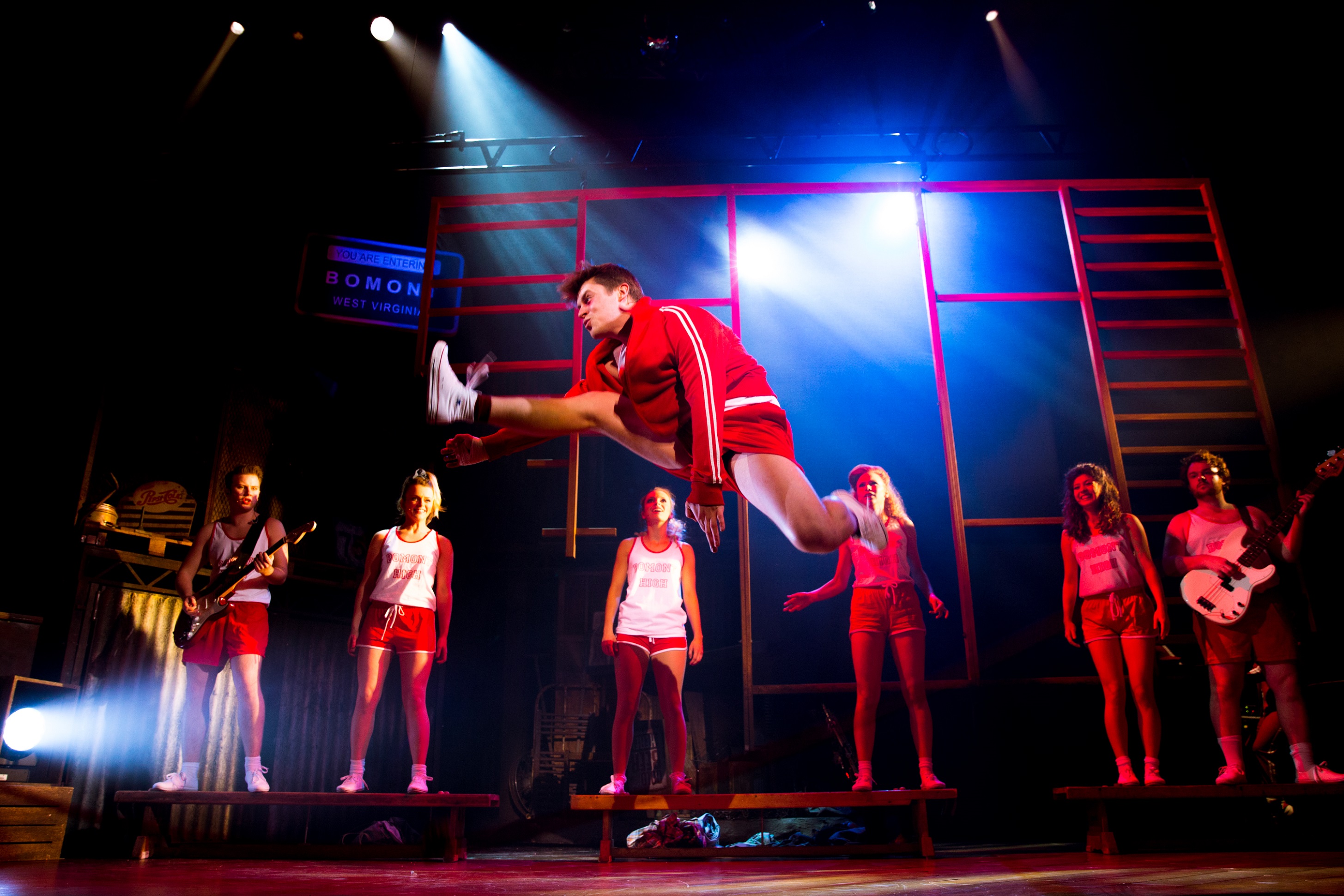
Review: Footloose at the Orchard Theatre

Footloose, as most people above a certain age will know, was the 1984 movie starring a young Kevin Bacon as teenager Ren McCormack. Forced to leave Chicago and move to the small town of Bomont, Ren discovers that dancing’s been banned by the town council, and immediately sets about trying to change their minds. It’s based on a true story about Elmore City, Oklahoma, and touches on issues of religion, loss, prejudice and gender roles.

Now adapted for the stage by the movie’s original creator Dean Pitchford, and directed by Racky Plews, Footloose is a toe-tapping triumph of a show in which the multi-talented cast are also the band; they may not always be allowed to dance but they can still express themselves through music, playing everything from the electric guitar to the oboe. This gives the show a very collaborative feel, reminiscent of the brilliant Once (although in every other respect the two couldn’t be more different).

Luke Baker as Ren and the cast of Footloose. Photo Credit Matt Martin
Photo credit: Matt Martin

It might surprise some people to learn that the show’s big name star, Gareth Gates, doesn’t play the central role of Ren. That honour goes to Luke Baker, who gives an impressive, layered performance as the tortured teen. Gates, meanwhile, plays Ren’s friend Willard, in what turns out to be a perfect piece of casting. He’s a bit awkward, nervous around girls and far too attached to his mama, but with a twinkly charm and impeccable comic timing that’s guaranteed to win over anyone who still thinks of him as just that guy from Pop Idol. And his performance is memorable for another reason… but I won’t ruin the surprise.

Maureen Nolan – no stranger to emotional roles after recently reprising her role as Mrs Johnstone in Blood Brothers – plays Vi Moore, the preacher’s wife torn between loyalty to her husband (Nigel Lister) and concern about the rebellious behaviour of their daughter, Ariel (Hannah Price, who makes her professional debut in style). But it would be wrong to single out any one cast member; this is very much a team effort, and a fantastic one at that.

Photo credit: Matt Martin

Choreographer Matthew Cole has captured the freedom of dance that’s so key to the story; though it may not all be particularly elegant, it’s full of energy and an irresistible joy to watch. The cast also make the line dancing routines look very easy, which I know from brutal experience they really aren’t. (I went to a line dancing class the other day. Let’s move on.)

And finally there’s the music, some of which was written specially for the musical by Tom Snow – but the tunes that really get the audience bopping in their seats are the classic hits from the movie, which include I Need A Hero, Let’s Hear It For The Boy and, of course, the title track. It’s a perfect piece of 80s nostalgia, for those of us old enough to remember that far back; for everyone else it’s just great fun.

Footloose is at the Orchard Theatre, Dartford, until Saturday 13th February.

Review: Red Velvet at the Garrick

The latest offering from Kenneth Branagh’s season at the Garrick is Tricycle Theatre’s award-winning production of Red Velvet, starring Adrian Lester as renowned Shakespearean actor Ira Aldridge – and it’s safe to say Sir Ken has another hit on his hands.

Written by Lolita Chakrabarti, the play imagines the events of 1833, as Aldridge is brought in to replace Edmund Kean, who’s collapsed on stage whilst playing Othello. The young actor brings with him an unorthodox acting style, which goes for realism as opposed to the posturing ‘teapot school of acting’ – but what bothers his fellow cast members – and the critics – even more is the idea of a black actor playing (gasp) a black character.

The play may be set 200 years ago, and of course nobody bats an eye any more at the thought of a black man playing Othello (in fact, it would probably be much weirder if they didn’t). But that doesn’t mean the issues at the heart of Red Velvet have gone away, and all too often the colour of an actor’s skin is still of more interest than whether they’re any good at their job – as we saw only too clearly in the recent reaction to Noma Dumezweni’s casting in Harry Potter and the Cursed Child. And so, while we might have moved on from the days of actors ‘blacking up’, not to mention the kind of casual racism that draws audible gasps from the audience at the Garrick, this is still an incredibly relevant piece of work.

Red Velvet at the Garrick

Adrian Lester gives a spell-binding performance as both the young and old Ira Aldridge, ageing 30 years in an instant, into a sad, sick old man. He’s not always entirely likeable – there are hints about his various extramarital dalliances, one of them possibly with Ellen Tree (Charlotte Lucas), who plays Desdemona in the production. And alongside his appealing passion for his art is the arrogant belief that the experienced cast must do things his way, whether they like it or not. But these flaws only make the man more real, and the fact that he can still break our hearts as he begs his friend Pierre Laporte (Emun Elliott) to save his reputation, is testament to Lester’s layered and compelling performance.

Despite the heavy subject matter, the play is also surprisingly funny, with many of the laughs supplied by Simon Chandler as nonplussed actor Bernard Warde, and Alexander Cobb as the idealistic Henry Forrester. Mark Edel-Hunt indulges in a fabulously childish tantrum (giving a couple of audience members a bit of a start), but becomes an altogether more serious figure the following morning, when he takes a little too much pleasure in reading aloud the negative reviews. And Charlotte Lucas shines as Ellen Tree; she has her own battles to fight as a woman in the arts, and does so with great spirit and humour.

Indhu Rubasingham’s direction sees the cast rarely leaving the stage, instead quietly observing and reacting to scenes in which they don’t appear from the wings, and the set changes are beautifully choreographed by Imogen Knight, so the action flows seamlessly. Act 1 takes a little while to hit its stride, with a conversation between the elderly actor and a Polish journalist leading into a lengthy acting lesson from the younger Aldridge. But it ends on a high with Lester/Aldridge’s intense performance as Othello, carrying us through into the passionate and gripping scenes of Act 2.

Red Velvet is a fascinating insight into the life of a man whose name and achievements have faded into relative obscurity. But it’s also highlighting an issue that should have faded with him – or rather, instead of him. The powerful final scene, in which a frail and elderly Aldridge prepares to play King Lear, is shocking but perfect, summing up the heart of the story in a single, haunting image. I’ve no idea how historically accurate the play is, but it certainly makes its point.


Can’t see the map on iPhone? Try turning your phone to landscape and that should sort it. I don’t know why but I’m working on it… 😉

Review: Weald at Finborough Theatre

It’s a stereotype based – sadly – in fact that men aren’t very good at talking about their feelings. Inspired by statistics on male suicide compiled by the Campaign Against Living Miserably (CALM), playwright Daniel Foxsmith has created a short but incredibly powerful piece of work in Weald, presented by Snuff Box Theatre at the Finborough.

The story’s set in rural England, and opens as Jim returns home after six years in London, begging his late father’s friend, Sam, for a job at his livery yard. The older man grudgingly agrees, and the two throw themselves into their work, not only refusing to deal with their past problems but also avoiding the uncomfortable truths they’re now hiding from each other. But neither can run forever, and reality ultimately catches up with them as the play reaches a gripping and emotional climax.

Weald at Finborough Theatre
Photo credit: Alex Brenner

One of the biggest strengths of Weald is its casting of two actors who have genuine chemistry. David Crellin is the world weary Sam, a man so obsessed with history that he can’t look ahead to the future, while Dan Parr is a twitchy bundle of energy as Jim, putting on a show of bravado to hide his deep insecurities and fear of what lies ahead. It’s clear that Sam is a father figure to his young friend, but the relationship between the two ends up working both ways, and ultimately turning completely on its head as the story unfolds and the characters develop.

Bryony Shanahan’s direction allows these two fine performances to take centre stage, with no distractions. The actors use every inch of the intimate space, often springing from the stage and almost landing in the audience as they go about their work. And while we’re offered a glimpse into their world, nobody else is: other characters are alluded to but never actually enter the yard, and the horses are only ever present in the audience’s imagination. This heightens the sense that these two damaged souls are completely isolated from the rest of their community, and have no-one but each other to rely on for support.

Weald at Finborough Theatre
Photo credit: Alex Brenner

Weald is an important play, beautifully written and performed, that really highlights the struggle faced by many men to own up to their emotions. It’s clear from the start that something’s not right – Jim’s sudden reappearance, Sam’s refusal to answer the phone – and the play’s heartbreaking climax is a direct consequence of their inability to address their problems, just as the emotional conclusion offers a faint glimmer of hope. It’s not an easy play to watch, but it is one that deserves to be seen, leaving us as it does with a feeling of responsibility for the world we live in and the people we share it with.


Can’t see the map on iPhone? Try turning your phone to landscape and that should sort it. I don’t know why but I’m working on it… 😉