Anyone who regularly reads Theatre Things (if that’s you, thank you!) may have noticed I’ve not reviewed much recently, and I wanted to take this opportunity to share why.
Basically, about a year ago I was diagnosed with a particularly nasty brain tumour, which has led to a whirlwind 12 months of surgery, treatment, hospital appointments, endless medication and recovery at home. It’s also restricted my ability to travel within and outside of London, and to write coherently (you wouldn’t believe the number of times I re-read my last couple of reviews to make sure they made sense!) which is why if you’ve invited me to your show recently and I’ve said no or just not replied, I apologise – it’s nothing personal I promise, I’ve just had a lot going on, both mentally and physically, so haven’t really had the headspace (literally) for dealing with invites and reviews as well.
I’m lucky because I have great support from my friends and family and my medical team, and while it’s definitely not been a fun year, I’m just trying to take one day at a time. I’m still keen to support theatre on all scales, so who knows, I may be back online at some point, but you’re unlikely to find me standing through Hamlet at the Globe any time soon…!
In the meantime I really miss my little theatre community, and felt I owed an explanation for my sudden disappearance 😢
Even on a second visit, the immersive setting as you step inside the auditorium to watch Chickenshed’s The Washing Line still has the power to take your breath away. Based on the horrific events of the 1978 Jonestown massacre, this powerful multi-media production feels as timely as ever, examining as it does what happens when vulnerable people in search of a better, fairer world find themselves at the mercy of ruthless manipulators driven by ego and a thirst for power. First devised as a Foundation Degree final year production in 2017, The Washing Line ran as Chickenshed’s spring show in March 2022, and directors and choreographers Michael Bossisse and Bethany Hamlin have revived and developed it further for 2025.
Photo credit: Caz Dyer
In November 1978, over 900 people, including U.S. Congressman Leo Ryan, died in Guyana at the instigation of Jim Jones, cult leader of the “Peoples Temple”. Long considered history’s deadliest mass suicide, the event is now more accurately described as mass murder, and the production begins at the end of the story, instilling an instant sense of dread in the audience. This dread continues to linger throughout the show, even though many scenes paint a hopeful, even joyful, picture of life in the community (just try and sit still for the gospel performance at the beginning of Act 2, I dare you). The show is very carefully balanced in this sense, and through a variety of formats – among them dramatised scenes of life in the settlement and the investigation of the tragedy, interviews with survivors, audio clips, photos and video footage – makes sure to portray not only the dark side but also what drew people to the movement in the first place, and the genuine optimism they brought to their new society. A beautifully choreographed sequence at the end of Act 1 evokes the collaborative family feeling that existed in the early days, before Act 2 explains how it all began to go so badly wrong, finally showing us the events of the devastating last hours.
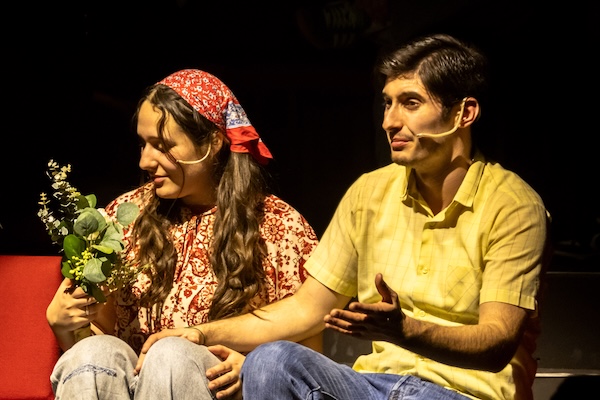
As with all Chickenshed productions, this is very much an ensemble effort, and the group scenes in which the stage is filled with people are always a spectacle to witness. However, some individual performances deserve highlighting. Jonny Morton hits exactly the right balance of charismatic and sinister as Jim Jones; even though we know from the start who and what he is, it’s difficult to look away when he appears on the platform preaching to the adoring crowd. Meanwhile Ashley Driver’s DI Johnson, one of the scene’s first responders, is entirely convincing in his baffled horror at the scene, which causes him to repeatedly lash out at his equally overwhelmed fellow investigators. Anna Listo-Rees and Alex Brennan are sweet and compelling to watch as a young couple within the compound, Jessie and Vernon, in whose story it’s impossible not to become emotionally invested, and Sarah Driver brings a terrifying blend of victim and abuser to her portrayal of Jim Jones’ wife Marceline.
Photo credit: Caz Dyer
Concluding with screened footage of real events and testimony from Jonestown, all of which back up the veracity of the scenes we’ve just witnessed, the show ends on a chilling note, making applause feel inappropriate. But this absence of ovation is no reflection on the quality of the show, which as always showcases some of the incredible talent – both in terms of creative direction and performance – to be found within the Chickenshed community. Presented as it is in the round, and by such a huge cast, there are inevitably some small difficulties from time to time with the audibility of dialogue, but this is a single criticism of an otherwise extremely well thought out production.
The Miss Havisham we meet at the beginning of Heather Alexander’s one woman show Havisham is exactly the one we’d expect, the character having become firmly established as one of English literature’s most iconic. Miss Havisham is known as the sinister manipulator of Charles Dickens’ Great Expectations, a jilted bride frozen in time in her ruined, cobweb-strewn mansion, who plots for her adopted daughter Estella to break the heart of the novel’s protagonist, Pip.
Photo credit: Peter Mould
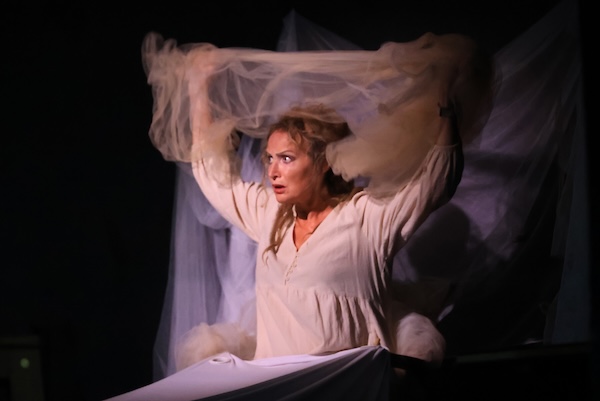
That Miss Havisham is who we first encounter at the centre of an atmospherically lit set filled with memories of a tragic life and with a frozen clock on the wall – but the Miss Havisham from whom we hear over the course of the evening is not at all that icy villain we believe we know. She is first and foremost a frightened child at the mercy of ruthless authority figures, the majority of whom (it hardly needs to be said) are men. The first half of the play deals with her brutally traumatic childhood and adolescence, and also establishes an important link between the play’s protagonist and the mythical monster Medusa, another woman now universally known more for what she became than for how – and, critically, at the hands of whom – it came about. Heather Alexander’s unflinching imagining of the young Miss Havisham’s misfortunes is at times a difficult watch and takes us to some very dark places, but also succeeds in establishing our sympathy for her – a sympathy that only builds as the charming character of Compeyson enters the story in the second half of the piece. Portrayed as he is only through the eyes of the woman who loves him helplessly, we need not be intimately familiar with Dickens’ novel to anticipate that the affair can never end well, and certainly through no fault of hers.
Photo credit: Peter Mould
Heather Alexander is an accomplished, engaging writer and performer, and the highly visual, stripped back nature of director Dominique Gerrard’s production allows her to shine at centre stage as the story unfolds. Her intention with Havisham is to “restore her humanity and challenge the hostile stereotypes surrounding women past and present.” And in this she certainly succeeds; though the character may have been written in the 19th century, there are elements of Miss Havisham’s story that modern day women will, unfortunately, strongly relate to. The parallel between Miss Havisham and Medusa is also cleverly set up and mantained throughout the narrative, encouraging us to view the journey of both these women – and by extension, many others from literature – in a very different way.
Havisham‘s final performance at the Jack Studio Theatre is tonight, 15th March.
Set in 1980s California, Jeffrey Sweet’s The Value of Names nonetheless touches on some interesting questions that resonate with a 21st century audience living in an era of cancel culture, where it’s often asked if we can – or indeed, should – separate an artist’s work from their political beliefs and activities. Following success in the USA, the play has its UK premiere at the White Bear in a quietly thought-provoking production directed by the writer, which relies heavily on the performances of its three actors.
Norma (Katherine Lyle) is an up and coming actor who’s landed a potentially career-defining role in a new play. But her excitement falters when the play’s director is taken ill and replaced by Leo (Tim Hardy), who testified some years earlier against Norma’s father Benny (Jeremy Kareken) to the House Un-American Activities Committee (HUAC). As a result comic actor Benny ended up on the Hollywood blacklist, while Leo went on to have a successful career in the entertainment industry. When Leo pressures her to remain with the play, Norma must decide whether to stand by her father and withdraw, or secure her own future at the expense of their father-daughter relationship.
Photo credit: Zack Layton
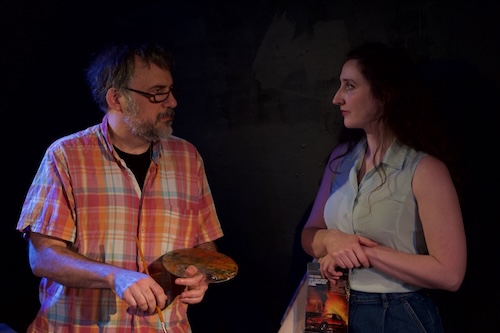
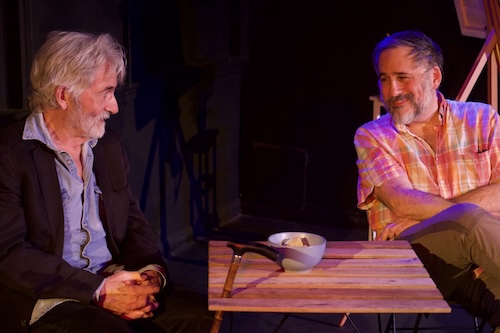
The dialogue-heavy production’s set is minimal; in the opening scene Norma fills in the gaps by explaining to the audience that we’re on the porch of her father’s beach house overlooking the Pacific, where Benny, now retired from acting, fills his days by painting the ocean view. The affectionate bickering that makes up most of the exchanges between Norma and Benny at first appears to offer light relief from some of the play’s more serious themes – but behind Benny’s wisecracking bravado lies a vulnerability and disappointment at his daughter’s failure to understand the depths of Leo’s betrayal. This vulnerability reaches its peak as Benny and Leo meet for the first time in years and in a lengthy scene, the two men try and fail to find common ground.
With such reliance on the dialogue to make its point, it’s important that the performances are strong, and for the most part, they are. Katherine Lyle is excellent throughout as Norma, backed into a corner and torn between her affection for her father and her ambition to succeed as an actor. Jeremy Kareken’s Benny is engaging and sympathetic, especially in the play’s closing scenes, and Tim Hardy is charming and soft-spoken as Leo, a man who’s clearly used to getting what he wants without needing to raise his voice – but he too has a fragility to him; while he claims to be unrepentant about his previous actions, his need to make peace with his old friend before it’s too late is palpable.
Photo credit: Zack Layton
An understanding of 20th century American political history will help with navigating The Value of Names‘ often dense dialogue, but ultimately this is a play not about politics but about human relationships. By putting Norma’s dilemma at the heart of the play, Sweet asks the same question of the audience: do we stand behind Benny, who was one of the first to be “cancelled” for his political beliefs, or Leo, who opted to suppress his own views and keep creating art, even at the expense of his conscience and a close friendship? Ultimately, Norma will make her decision, but her choice is inevitably going to leave someone unsatisfied, and as such, while the play poses some interesting questions, in the end it answers none of them, instead leaving the audience to draw our own conclusions.
Following the global success of mega-hit Six was always going to be a challenge. Why Am I So Single? is the new show from Toby Marlow and Lucy Moss, a “big fancy musical” that celebrates friendship and platonic love, while also paying homage to 90s rom-coms and musical theatre. On paper it’s a must see for anyone who’s ever bemoaned their perpetual state of singledom (which let’s be honest, is most of us) or the unrealistic romantic standards set by every glamorous TV couple ever – and with an LGBTQ twist and Oliver! puns galore, should it consider itself another instant classic like its predecessor?
Photo credit: Danny Kaan
When Nancy (Leesa Tulley) arrives at the flat of best friend Oliver (Jo Foster) after yet another disastrous date, the pair of aspiring musical writers decide against watching yet another re-run of Friends, and instead set out to get to the bottom of the ultimate question – why are they so single? And so the stage is literally set for a rollercoaster ride through online dating, obsessive texting, awkward flirting and bee defeating (yes, you read that correctly) before, like every good rom-com, a final big romantic gesture: just not, perhaps, the kind either character expected.
There’s a lot to like in Why Am I So Single? The script is clever, the jokes are funny, the songs are catchy, and the performances from Jo Foster, Leesa Tulley and a hard-working ensemble are pitch perfect. And yet somehow it’s only really in Act 2, when the show really finds its heart and the characters are allowed to be vulnerable, that it comes alive. At times in Act 1 the show gets a bit bogged down by its own cleverness, and the deliberately formulaic, exposition-heavy plot and dialogue result in scenes that slow things down and often feel at odds with the years-long relationship between the two characters.
But if at the interval I was a bit on the fence, by the end of the show I was won over. Perhaps that’s because Act 2 features arguably the best number and performance of the evening, or because it reintroduces us to the fabulous Artie (Noah Thomas), the pair’s loved-up mutual friend who pops up like a genie every now and again to give them sage life advice. But most likely it’s because the protagonists suddenly feel less like caricatures from a rom-com and more like real people with real, complex issues – which makes the big warm hug of a finale all the more satisfying.
Photo credit: Danny Kaan
And the show certainly lives up to its billing as a big fancy musical, delving into an array of styles from disco to rock to ballads; there’s even a tap number in Act 1. Marlow and Moss have produced another fantastically infectious score that stands very much on its own as a soundtrack, even if the accompanying storyline has an occasional wobble. With slick choreography from co-director Ellen Kane, and flawless and impressively versatile vocals from the cast, the musical numbers in general are much stronger than the spoken sections.
Why Am I So Single? isn’t necessarily breaking any new ground – bar the welcome inclusion of a non-binary main character – and it could use a bit of tightening up plot-wise, but like a certain beloved 90s sitcom that provided inspiration, that certainly doesn’t make it any less fun to watch.





 Theatre Things