Review: The Sound of Music at the Orchard Theatre

If the measure of a good show is how many people burst into song as they leave the theatre, The Sound of Music is surely well up there. Based on the true story of the Von Trapp family, Rodgers and Hammerstein’s musical is undoubtedly a classic, featuring a host of much-loved songs, a heartwarming love story, some unexpected Nazis and the world’s nicest children. What’s not to love?

Photo credit: Mark Yeoman

Set in 1930s Austria, The Sound of Music tells the story of Maria, a young woman struggling to adapt to the restrictive life of a nun, who’s sent away to live with the Von Trapp family as a governess. Charmed by the seven musically talented Von Trapp children, it’s not long before she starts to fall for their father too. All seems to be turning out well, until the Nazis turn up and try to ruin everything (as Nazis do).

Bill Kenwright’s revival stars Lucy O’Byrne, who gives a pitch perfect performance in just about every way. Maria is a role that requires a lot more vocally than just do-re-mi, and O’Byrne wastes no time in showing off the incredible range that took her all the way to the final of TV’s The Voice, along with the irresistible joie de vivre that instantly wins over both Von Trapps and audience alike.

But it’s not just the star of the show who hits the mark vocally. Rebecca Caine comes close to outshining the rest of the cast, as she brings down the curtain on both acts with her stunning rendition of Climb Every Mountain. Former Corrie star Andrew Lancel produces a charming Edelweiss, and the Von Trapp children repeatedly melt our hearts with their polished performance and beautiful harmonies.
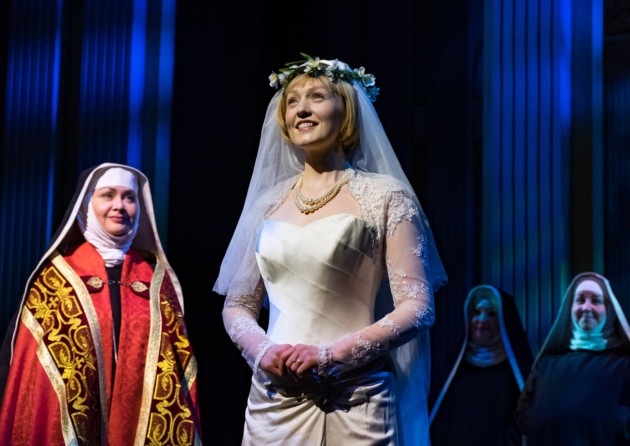
Photo credit: Mark Yeoman

Gary McCann’s set is one of the most impressive I’ve seen at the Orchard. The story takes us back and forth more than once between Nonnberg Abbey and the Von Trapp house, with occasional trips to other locations – and the set follows suit, without ever missing a beat or compromising on either scale or detail. And these frequent set changes happen so smoothly that the audience, absorbed in the story and music, barely notices them.

Nazis aside, The Sound of Music is very much a feel-good show; it’s difficult not to walk out feeling a little bit better about life (and, let’s be honest, even the Nazis aren’t that scary, really). It’s a love story first and foremost, but there are some other themes in there too, like growing up, finding your passion in life and standing up for what you believe in, no matter what anyone else says. Also, singing is good. As are hills.

For lifelong fans of The Sound of Music, this revival is a fitting tribute. For first timers or – dare I say it – sceptics, it may just win you over. Either way, it’s a production not to be missed.

The Sound of Music is at the Orchard Theatre until 1st October.
Review: Rehearsal for Murder at the Orchard Theatre

After ten years producing classic thrillers from the pen of Agatha Christie, Bill Kenwright has taken a (slightly) new direction. Rehearsal for Murder is the first production from The Classic Thriller Theatre Company; written by Murder She Wrote’s Richard Levinson and William Link, and adapted for the stage by David Rogers, there’s nonetheless a distinctly Christie-esque quality to this story of love, murder and revenge.

rehearsal-for-murder-grimsby-auditorium

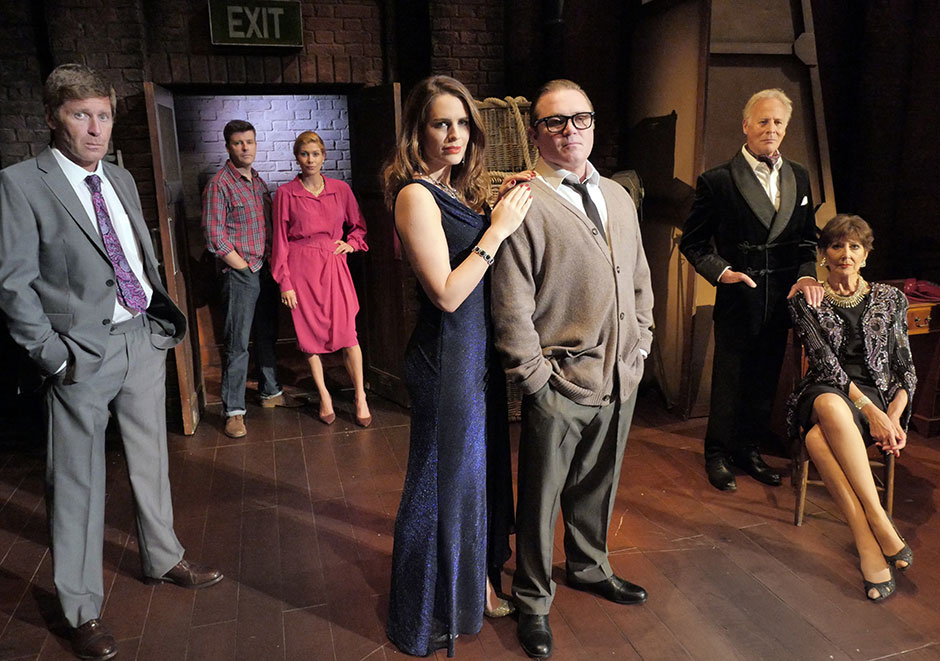
Playwright Alex Dennison (Alex Ferns) has started work on a new script, and gathers together his old cast, director and producer for a rehearsal. Not by coincidence, this reunion happens to take place exactly one year after Alex’s fiancée, the beautiful movie star Monica Welles (Susie Amy), fell to her death in an apparent suicide. And it soon becomes clear to the assembled group that Alex has a very specific reason for bringing them all back together; despite all the evidence to the contrary, he believes Monica was murdered – but by who…?

There’s a defined formula to this kind of mystery: a cast of suspects, each with a clear – if not always entirely imaginative – motive for the crime; a suitably spooky location (this particular story takes place in an empty theatre) from which nobody’s easily able to escape; a few red herrings; and, of course, a twist in the tale before the murderer is finally revealed. It’s also not uncommon for the first act to involve a lot of talking and not much in the way of action, as motives are established and clues worked in so as to give the audience a fighting chance of figuring out the mystery. Rehearsal for Murder is no exception. After a relatively slow start, the action kicks off in dramatic fashion in Act 2, culminating in an unexpected turn of events which, like all good twists, is only predictable with the benefit of hindsight.

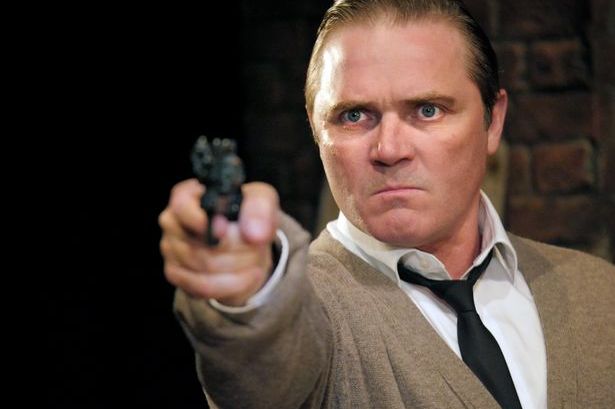
Ex-Eastenders villain Alex Ferns is the heartbroken playwright; although clearly slightly unhinged, his desperation to solve the mystery of his fiancée’s death is heartfelt and it’s hard not to cheer him on in his pursuit of justice, even when he starts waving a gun about (because of course, there had to be a gun). Ferns is joined by a cast of familiar faces from TV and film, including Peak Practice actor Gary Mavers, Carry On star Anita Harris, and veteran of the Agatha Christie Theatre Company, Ben Nealon, as a variety of theatrical ‘types’ – each of them with something to hide.

rehearsal-for-murder

Rehearsal for Murder is at once comfortingly familiar and yet still original enough to surprise, with a liberal sprinkling of theatre-related humour, thanks to the choice of setting. At times the pace is a little more gentle than it needs to be, and the story does sometimes feel a bit thin – but that comes with the territory, like the way everyone knows Hercule Poirot’s a famous detective, yet they always choose to commit murder when he happens to be visiting, then seem surprised when he solves the crime. Formulaic it may be, but fans of classic murder mystery won’t be disappointed in this enjoyable and cleverly staged thriller.

Rehearsal for Murder is at the Orchard Theatre until 24th September.

Review: Dirty Dancing at the Orchard Theatre

It’s a show that needs no introduction. Like the movie on which it’s based, Dirty Dancing the musical has been a runaway success ever since it first opened in Australia in 2004, and continues to thrill its devoted fan base to this day (this is a show that has no need to cast TV or pop stars to bring in the crowds). Now it’s back for a brand new 2016/17 tour, directed by Federico Bellone – and while return visitors may notice a few differences in the staging, the show itself retains a comforting familiarity that pretty much guarantees its ongoing success.

Photo credit: Dreamteam Pics

For die-hard fans, there’s really very little I can say by way of review, because the show lifts almost all its dialogue, music, dance moves and even some of the costumes directly from the movie – and as long as Baby gets to carry a watermelon, and nobody puts her in a corner, there’s not much for even the harshest critic to complain about. There are a few additional scenes that seem intended to provide a bit of depth, and while there’s nothing wrong with that, the truth is nobody’s going to see Dirty Dancing to hear about freedom riding or how Baby’s parents got together; the show would have gone down just as well without any of the extra content. (Well, with the exception of Johnny flashing his bum, which I think it’s fair to say most members of the audience considered an essential and long overdue addition.)

The cast, led by Katie Hartland and Lewis Griffiths, do a great job of recreating their well-known characters in both look and personality. The dance numbers are genuinely sensational and a joy to watch, particularly those featuring Griffiths with Carlie Milner, who plays Penny. And there are strong vocals from Michael Kent and Daniela Pobega, although it does feel like the show could have given these two talented singers more opportunities to shine; most of the musical tracks are taken straight from the original soundtrack, with a full-length version of She’s Like The Wind the only noticeable absence.

Photo credit: Dreamteam Pics

Roberto Comotti’s rotating set reproduces every bit of Kellerman’s camp in all its wholesome glory (the effect marred only slightly by a distracting mechanical squeak that could often be heard even over the music), while a huge video screen is put to equally effective use for other scenes – the bit in the lake is particularly creative, drawing audible sounds of appreciation from the audience.

With Dirty Dancing, you get exactly what you’d expect: an entertaining story, familiar characters, a few steamy moments, and a string of fabulous music and dance numbers. It’s also a massive cheese fest, obviously, but the show makes no effort to gloss over that fact, choosing instead of revel in it and, if anything, take it up a notch. And we wouldn’t have it any other way.

I think it’s fair to say this is a show that will have audiences singing, dancing, swooning, and having the time of their lives (sorry, I couldn’t help it) for many years to come.

Dirty Dancing is at the Orchard Theatre, Dartford until Saturday 10th September.

Interview: The Two Bit Classics, Pride and Prejudice

It’s one of the world’s most popular love stories, the ultimate boy meets girl romantic comedy. Pride and Prejudice, written by Jane Austen in the early 19th century, has been adapted countless times for stage and screen, in many different ways – but perhaps never quite like The Two Bit Classics’ production, which is about to return for a second UK tour from October. Joannah Tincey’s adaptation features just two performers: Jo herself, and her husband, Nick Underwood.

Pride and Prejudice - UK Tour

The unique production was last staged in 2014, when it was described by A Younger Theatre as “a delightful little gem of theatre that pulses with comedy and energy”. As the company prepares to tour again, Nick explains, “We decided to bring the show back because people enjoyed it so much the first time! We had so many wonderful emails from people, many of whom wanted to see it again. We love playing the show, we enjoy working together. It’s a great fit all round.”

Pride and Prejudice has brought us some of literature’s most iconic characters, from the romantic to the ridiculous. “The characters are immediately recognisable, fallible, funny and engaging,” says Jo. “Austen creates these fully fleshed characters, full of strengths and weaknesses. We recognise ourselves in there somewhere, I think.”

But does a cast of just two actors mean we only get to enjoy two of these brilliant creations? “Definitely not!” says Jo. “21, in fact,” clarifies Nick.

Jo explains what inspired her unique adaptation: “I’d been doing a lot of work as an actor on various multi-role style productions – including some Shakespeare and Dickens. Each time I was involved in one, it struck me how clear the language becomes when you have to use it to tell an audience who you are and what you want (when you’re changing characters from moment to moment, that’s important!). I love Austen’s wonderful language and wit and it struck me that here was a way to bring it to life theatrically.

Pride and Prejudice is such a wonderful story and there are so many double-acts within it: Jane and Lizzy, Darcy and Lizzy, Mr and Mrs Bennet, Lydia and Kitty, Bingley and Darcy…”

“All the words we say are ones that Austen wrote herself,” adds Nick. “Jo didn’t need to invent dialogue. Characters use Austen’s text, we talk to the audience in character, and our job is to grow that relationship each night. It’s a really immediate and exciting way to work.”

Bringing to life so many characters with just two performers naturally presents quite a challenge. “An actor’s job is to find the truth in every character, otherwise we’re wasting an audience’s time,” Nick explains. “That doesn’t mean characters can’t be funny, but we aren’t sending them up in any way. If this was two hours of silliness, people would get bored. This is two hours of pure Austen. As for other challenges, well, you need to be pretty fit to play 21 characters between the two of you…”

Photo credit: Carrie Johnson

Unique it may be, but die-hard fans of the novel need not fear – The Two Bit Classics’ production remains completely faithful to Austen’s original. “The straightest form of the story is the novel of course, and any adaptation will offer a different experience from that,” says Jo. “Screen adaptations or more traditional stage adaptations usually need to invent dialogue – because Austen didn’t write a script! There’s always something new in there. Our take is two actors, but our language is as pure as it gets.”

Both Jo and Nick agree what excites them most about this second tour is new audiences for their show, and a fresh chance to play the story each night. “The audience are a part of the show, as it’s their imagination and response to our story-telling that brings the show alive,” says Jo. “We want them to go away having actively experienced the story of Darcy and Lizzy, having heard and felt the brilliance of Austen’s writing in a way that is really immersive.”

Nick concludes, “I hope they go away having laughed and having been moved by the brilliance of Austen’s story and characters.”

Pride and Prejudice opens at Preston Guild Hall from 6th-8th October and all tour dates can be found at www.pandptour.com.

Interview: John Ginman, Frankenstein

2016 is the 200th anniversary of Mary Shelley’s Frankenstein, and critically acclaimed Blackeyed Theatre are marking the occasion with a brand new adaptation of the classic horror story. The production, directed by Eliot Giuralarocca, will feature Bunraku-style puppetry designed and built by Yvonne Stone, with live music composed by Ron McAllister – and sees the company reunite with John Ginman, who wrote their hugely successful adaptation of Bram Stoker’s Dracula in 2013.

“It’s refreshing to work again with such a talented team who have a commitment to high standards,” John explains. “Blackeyed Theatre’s work keeps evolving but the key ingredients are always the same: a passion for distinctive live theatre, strong creative leadership, a company of multi-skilled performers, and a determination to take bold, innovative live shows to audiences throughout the country.”

Frankenstein, Blackeyed Theatre

In 1816, nineteen-year-old Mary Shelley composed the first draft of Frankenstein as part of a writing competition with Lord Byron, John Polidori and Percy Shelley, during a wet summer’s stay at Lake Geneva. Two centuries later, her novel continues to both fascinate and horrify readers and audiences across the world. But how can we explain this enduring popularity?

“It’s partly a matter of genre,” John suggests. “Gothic fiction has been popular with readers for more than two centuries – though it’s fair to say that Frankenstein has reached its largest audiences through its numerous stage, and later film, adaptations. In writing Frankenstein Mary Shelley has created a powerful new version of an ancient myth. Its narrative seeks unashamedly to ‘chill the blood’, which readers and audiences love. However, the story engages us even more deeply because it still poses questions that challenge us. Should we limit what scientists are allowed to research, in an age when boundaries to knowledge no longer seem to exist? And how can we ensure that we take responsibility for the discoveries we make?”

As with any classic work, adapting Frankenstein was not without its challenges: “The key challenge is to translate a 200-page novel into two hours of theatre for audiences who may or may not be familiar with the book. You have to be selective and identify what’s essential in terms of story, character, tone and themes. The bottom line is that the story has to be clear. It also has to work as theatre, and you have to achieve this with images, space, sound and rhythm, of which the spoken words are also a part. You have to remember that as you are writing.

“The other challenge is to honour the novelist’s vision. In this case I wanted to put on stage the important aspects of the novel that are often excluded in adaptations. We’ve used Robert Walton’s story as a frame to focus the whole action, which allows The Creature to tell the story from his point of view – it’s clearly important to Mary Shelley that we understand how he thinks and feels.

“It’s also wise to be aware of any shortcomings the book might have. In this case, surprisingly perhaps, the female characters have less depth than the men, and I’ve worked to give more substance to Elizabeth, in particular.”

John reflects on his previous collaboration with Blackeyed Theatre back in 2013: “Dracula confirmed my sense that you can achieve almost anything in a live show with very simple theatrical elements, and that you have to trust the skill and versatility of the performers to create the effects you need. The script is like a musical score and so really comes to life when it’s being performed. Also, I noted the hunger of audiences for powerful live theatre in venues large and small the length of the UK, and that’s been very encouraging.”

In a unique and exciting twist, the production will feature a full-size 6’4″ Bunraku-style puppet, which needs up to three people to manipulate it. It’s been designed and built by Yvonne Stone, who’s working with Blackeyed Theatre for the first time, and whose previous credits include Warhorse and His Dark Materials for the National Theatre.

What does John feel this use of puppetry adds to the play? “That will be for the audience to say! Puppets can be remarkably expressive and add more dimensions to the experience of a live show. Bunraku has a wonderful, long tradition in Japanese theatre, but we’re using its techniques here in a completely contemporary way.”

Audiences across the UK will have the opportunity to see the show as it embarks on an extensive tour later this month, taking in over 30 venues before Christmas and additional locations in the spring. “My chief hope is that the audience will enjoy a powerful two hours of theatre, something quite distinct from watching a film version, for example,” concludes John. “I also hope that they will realise there is much more to the novel than the familiar horror story about a crazed scientist.”

Frankenstein opens at Wilde Theatre, Bracknell, on 22nd September. Full tour dates and ticket info can be found on Blackeyed Theatre’s website.