Review: Idle Women of the Wartime Waterways at The Cruising Association, Limehouse

Before last night, my only knowledge of the boating world came from a long ago family holiday on the Norfolk Broads (and if I’m totally honest, I didn’t really learn a huge amount from that). Worse, I knew nothing at all about the Women’s Training Scheme or the so-called Idle Women, who left their comfortable homes and stepped up to take charge of the working boats during World War II. And I have a feeling I may not be the only one.

Fortunately, Alarum Theatre are setting out to change that. They’re embarking on a tour with their historic boat, Tench, and an all-female crew to mark the 75th anniversary of the Idle Women by recreating their route from London to Birmingham and back via Coventry, performing at waterside venues along the way.

The double bill consists of two solo performances by writer and storyteller Kate Saffin and poet and singer-songwriter Heather Wastie, who met on Twitter in 2016 and realised their two shows went rather well together. The first, Isobel’s War, is a fictional and often very funny depiction of the arduous training scheme through the eyes of one of the recruits, while Idle Women and Judies is a collection of poems and songs inspired by, and often directly quoting, the words of the women themselves. Both give us an insight into the hard work and less than comfortable living conditions on board – but also the friendships and sense of accomplishment that the women shared.

Though not exactly your typical night at the theatre, together the two pieces make for a simple, charming and informative evening. And though the performances are quite different in format, they have one important thing in common, and that’s the obvious affection and admiration not just for the Idle Women, but for all the women from boating families who’d been quietly doing the same work for generations before the war. The enthusiasm of both ladies, who come from boating backgrounds themselves, is infectious; even someone as averse to audience participation as I am couldn’t resist joining in with the final chorus (though I wish it hadn’t been quite so catchy – it’s a difficult one to forget once you’ve learnt it).

If you don’t already know the story of the Idle Women, Alarum’s show is a fascinating introduction. If you do, it’s an enjoyable retelling and great entertainment. But it’s also a powerful reminder of the crucial role women played in keeping the country running during the war – and let’s face it, nothing brightens a gloomy Monday like a bit of girl power.

But if it was such hard work on the boats, why were they called the Idle Women? You may well ask – but I’m not the one to answer. You’ll have to see the show to find out…


Can’t see the map on iPhone? Try turning your phone to landscape and that should sort it. I don’t know why but I’m working on it… 😉

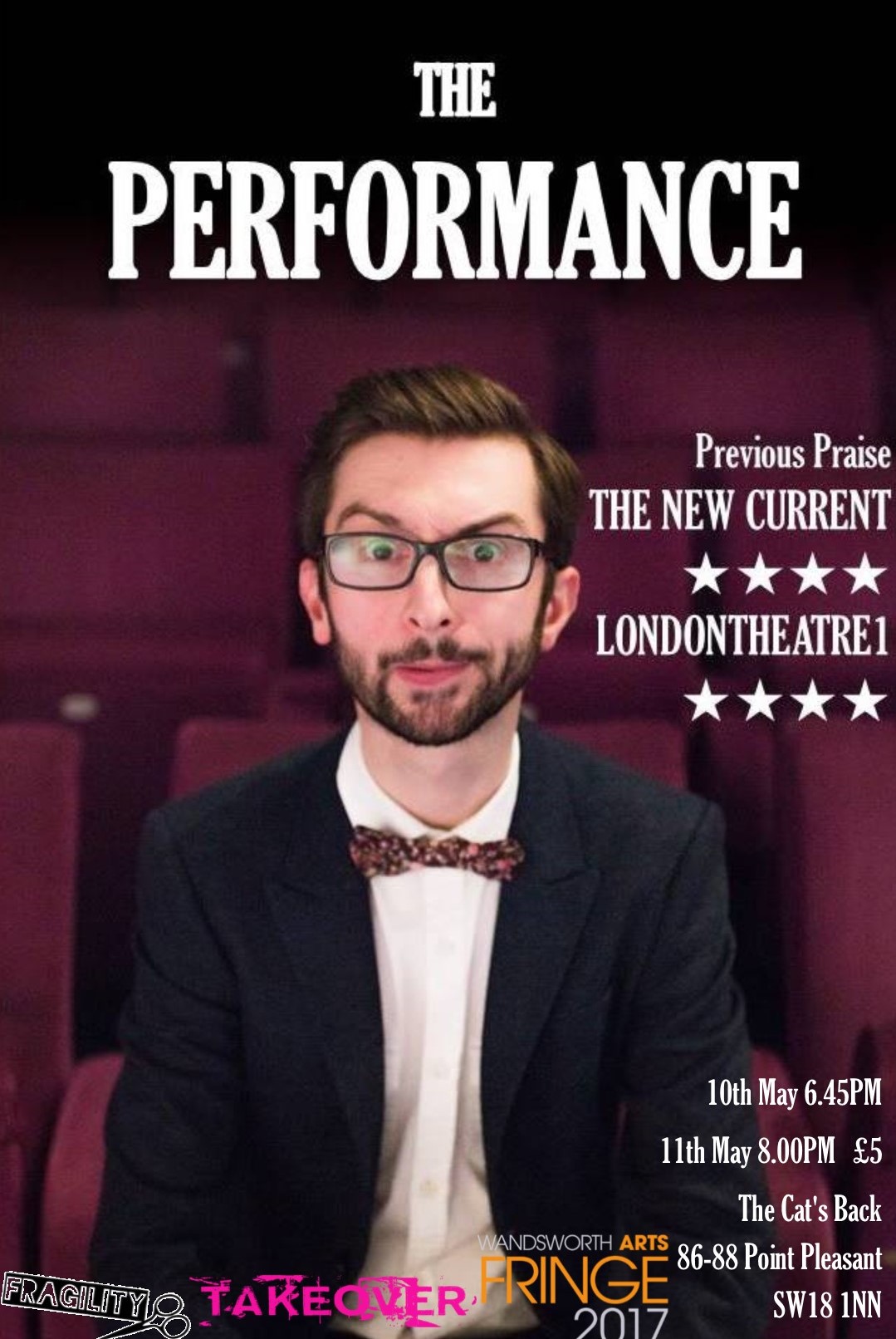
Interview: Iain Gibbons, The Performance

Iain Gibbons is a London-based actor, most recently seen as a stressed out junior doctor in Resuscitate Theatre’s Rounds at the Blue Elephant Theatre. But he’ll be taking on a rather more light-hearted role in his new solo show, The Performance, which previews at the Wandsworth Fringe on 10th and 11th May before heading to Brighton for its premiere.

The Performance is a sometimes sketch, sometimes clown, sometimes farcical comedy show about three men’s attempts to make the best of a bad situation,” explains Iain. “The performance must go ahead, no matter how silly things get.

“Originally, the idea came from a Charlie Chaplin quote that says, ‘Life is a tragedy when seen in close-up, but a comedy in long shot’. Also, after watching some of the later Jacques Tati films, where often you would see one eccentric figure in the giant canvas of the shot, I began to wonder what ‘giant canvas’ I could set a comic figure against. As I spend a lot of my time in theatre auditoriums, I decided to create a short experimental piece in 2012 where the audience sat on the stage and looked up at a lone figure eating his lunch in a sea of red seats. The idea was funny to me and remained in the back of my mind until I decided to develop it further late last year.”

Though The Performance is not his first one-man show, after working as part of a close-knit team on devising and performing Rounds, Iain admits to mixed feelings about performing solo again. “It’s absolutely terrifying. The key element of creating theatre for me, particularly comedy, is responding to an audience. You can only know if a show works when you’re physically there performing it with people. A lot of the work I’ve done for this show has been alone in a room trying to work out how to physically get from one place to another – but I have a supportive group of people I can draw reaction and ideas from, which has been invaluable in ensuring the practicalities remain fun to perform.”

As a performer, Iain takes a lot of his inspiration from classic comedy: “I watched sketches from the likes of Charlie Chaplin, Jacques Tati, Rowan Atkinson, Fry and Laurie, Monty Python and Tommy Cooper, amongst others. I think you can see a lot of these influences in the mix of the show. They were particularly essential for working out the structure of the sketches and guiding my approach to the timing. Timing will also be affected by the audience present on the night.

“I studied with master clown Philippe Gaulier, who emphasises the child-like playfulness of the moment, while listening and responding to the audience present. His master insults will be ringing in the back of my head as I discover how this show really works at the two festivals I’m attending this summer. You may also recognise influence from early Stoppard, Ionesco and Pirandello. These are all hugely successful idols to work from, which I feel is important when you’re trying to create something successfully wonderful yourself.”

In The Performance, Iain plays “the most annoying audience member you could ever wish to sit next to”. As an actor, he’s seen his fair share of bad theatre etiquette – but what bugs him the most? “From noisy eating to stage invaders, I’ve seen quite a bit of distracting activity in the theatre stalls,” he says. “However, what most irritates me are those ‘seasoned’ audience members who believe that they have a right to disrespect the audience and theatre staff. The theatre is a shared space, so we should *ahem* share the space…”

So what would his number one piece of advice be to an inexperienced theatregoer? “Have fun. Enjoy the experience of being with people presenting ideas live in front of you – or indeed in any direction. Anything could happen, so be open to the possibilities.

The Performance is like most other theatre shows, in that there will be a performer, an audience and an usher on the door. The only twist is that I’ll be playing all three. If you recognise the theatre setting, you’ll connect with the world I’m creating instantly; if you’re new to theatre, I hope I can show you how much fun we can have in a space that still appears daunting to outsiders. Come and see why I find people sharing a theatre setting fascinating to watch. But most of all, come to have fun!”

Catch The Performance at The Cat’s Back, Wandsworth on 10th and 11th May, and at The Warren: Studio 3, Brighton on 25th-27th May.

Interview: Stephen Unwin and Colin Tierney, All Our Children

“People keep saying to me is it weird? But in a funny kind of way it isn’t – it’s rather wonderful,” says Stephen Unwin, writer and director of All Our Children, which opens at Jermyn Street Theatre this week. “It’s the first time that I’ve both written and directed a play, so that’s a whole new interesting experience for me.”

Set in Nazi Germany, All Our Children examines the barbaric programme that saw thousands of disabled children murdered by the state, and its effect on five individuals, each of whom is involved in a different way. It’s a very personal project for Stephen, whose 20-year-old son is profoundly disabled, and who was recently appointed chair of children’s charity KIDS.

“There are three aspects to it,” he explains. “My mum is German Jewish; she left Germany as a child in 1936. And then I was brought up in Catholicism, and now I’m the parent of a disabled child, so it’s a kind of perfect storm; it all came together. The idea came from when I was reading a brilliant social history of the Third Reich, and it suddenly started talking about the Nazi programme of murdering disabled people, but then the opposition of this highly conservative Catholic priest called Von Galen – played in All Our Children by David Yelland – who extraordinarily wrote these letters and delivered three very famous sermons. As a result of his power, passion and commitment, the programme was discontinued, and it’s pretty much the only record of someone standing up to Hitler from within Germany and actually changing policy.”
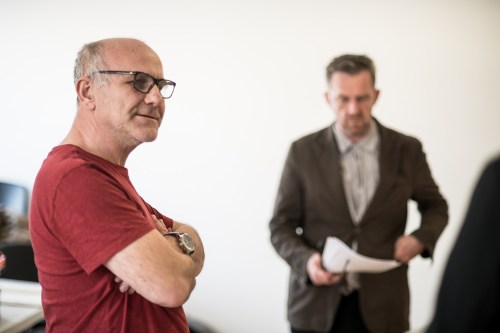
The story takes place in a hospital for severely disabled children, run by chief paediatrician, Dr Victor Franz. Colin Tierney, who plays the doctor, explains, “The Nazis have taken power and they’ve created this situation where children are being sent off to their deaths because they don’t conform to the new German ideal of what life should be. And the play is about my character’s struggle on one day to deal with what he’s doing, why he’s doing it and how he’s going to get out of it.

“Victor Franz was a children’s doctor, somebody who spent his life looking after people, who created this institution where disabled children could be looked after, and all of a sudden in this different new Germany, he feels as if he’s been taken over by this new force. This is what I’m trying to work out along the way – his struggle about what he’s doing and how he makes the decision not to do it. So he’s essentially a good man who’s been forced to do these terrible things, and that’s the complex dilemma I’m wrestling with.”

In getting to know his character and the crisis he’s facing, Colin’s worked closely with Stephen. “It’s quite a short rehearsal time, so I’ve been reading the play a lot and discussing it with Stephen, who of course is both writer and director, and is really inside the world of the play. He’s given me so much information, so much detail around the backstory of the world – and because Stephen has a disabled child of his own, I’ve been looking to him for lots of clues. I’ve done a bit of reading around the subject but the bulk of my work has been in the room with the script, with the actors, breaking down the moments, finding the detail and finding how deeply they resonate within me on a human level.

I’m just enjoying it a lot – even though it’s a serious subject matter, there’s a great sense of wanting to do justice to the work, so there’s a good attitude. People are working hard and committing in a really positive, honest way.”

Despite the heavy topic, both Stephen and Colin are keen to reassure audiences that the play is not as brutal as it sounds. “It’s not a heavy dirge of an evening,” says Colin. “It’s not light either, but it’s philosophical and incredibly well written.”

“You don’t see any children, you don’t see any violence, but you know it’s there,” adds Stephen. “It’s a drama of human beings in a ghastly world trying to work out how to be human beings again. It’s not brutal as a play, and I think maybe some people are worried that it’ll be really horrible, about kids with Down’s Syndrome being shot – but you don’t see any of that, that’s not what I’m interested in presenting. I’m much more interested in presenting why might somebody think that kids with Down’s Syndrome are a bad thing.

“One of the Nazis’ main reasons for their persecution of these people was that they said they’re so expensive, that keeping somebody with cerebral palsy cost a fortune and that money could be spent on better things. And of course although I don’t say that the lives of the disabled is the same as in Nazi Germany – that would be a grotesque thing to say – there are issues today about how do you value a human being in terms of their monetary worth. What do you do about people who will never pay tax, will never have a job, who are non-productive? And it’s a very big radical question, it challenges our priorities. And that’s what I’m really interested in.

“One of my characters, played by Lucy Speed, is the mother of a disabled child. As chair of KIDS, I’ve come into contact with lots of parents of profoundly disabled kids, and there’s a mixture of love for their children and intense love for their vulnerability, combined with absolute towering rage for a society that doesn’t value them properly. It’s really palpable – they’re very radical people.

“We also have Edward Franklin as Eric, a young, committed Nazi – but you discover that his antipathy to disability actually comes from his father having been disabled in World War 1, and he hates it because he’s so angry about that. So one of the things I’m interested in is the way that discrimination towards disabled people is actually towards people’s anxieties about their own weaknesses – and also fear. Our final character is the doctor’s maid Martha, played by Rebecca Johnson, who has an important line about this towards the end: that she used to be afraid of them, used to think they could infect her, but she’s not afraid of them any more. And that’s a great big important development that society needs to take on – how not to be afraid of people with profound disability.”

Colin agrees that even though we’ve moved on from the horrific events depicted in All Our Children, the play still carries important messages for a 21st century audience. “Hopefully it will make people think about our responsibility to others, and our responsibility as a society – how important love is and looking after people, especially those who have trouble looking after themselves. I think that’s the measure of a society, whether people who can help others should, instead of everybody thinking for themselves and doing their own thing and saying ‘screw you’. That’s where the heart of the play is. It’s not like we live in Nazi Germany now at all of course, but I think there’s a strong human resonance that people can tap into when they see this play.”

Book now for All Our Children, at Jermyn Street Theatre from 26th April to 3rd June.

Review: She Wears Scented Rose at Theatro Technis

Razor Sharp Productions promise “original plays designed to keep an audience gripped to the end”. She Wears Scented Rose, a new thriller written and directed by Yasir Senna, delivers on this promise up to a point, but could use a little tightening up in places to make the most of a strong and intriguing plot.

Businessman Mark (Craig Karpel) is on his way home late one night when he’s attacked and stabbed several times, the victim of a suspected carjacking. But when he wakes up in hospital, police officer DI Kane (Rosalie Carn) is waiting with questions, and it turns out all may not be quite as it seems… Twists and turns take us on an emotional rollercoaster ride, culminating in a truly shocking – and very effectively staged – conclusion.

Photo credit: Robert Piwko

Like any crime drama, the key is in the detail, and She Wears Scented Rose is packed with these; looking back afterwards you realise the intricacy of the plot, and that all the clues were there all along to piece together the truth. Senna has obviously done his research, and has in particular created a complex and well-drawn central figure in the silver-tongued Mark, played brilliantly by Craig Karpel. He has strong support from Niki Mylonas as his loving wife Verity, who has a secret of her own, and Rosalie Carn as an attractive French police officer with some unorthodox investigation methods. Simon Ryerson, meanwhile, is a sympathetic figure as Mark’s nice but dim best mate Dave, who in contrast to his friend is driven by his heart rather than his head. The acting on the whole is solid, although there are a couple of scenes that start to edge towards the melodramatic and could perhaps be reined in a little.

While the story is certainly gripping and holds our interest throughout, the script in places needs a bit of a trim to make more of an impact. There are some parts of the play that start out well but could be snappier – the most obvious of these being the final scene, which takes a frustratingly long time to reach its dramatic climax. In addition, there are a lot of scene changes, which while executed smoothly by a well-oiled stage crew, inevitably interrupt the action and don’t always feel completely necessary.

Photo credit: Robert Piwko

We all love a good mystery, and She Wears Scented Rose is definitely that; the plot is well-crafted and keeps us guessing throughout so that even if we succeed in figuring out one bit, there’s always another twist waiting round the corner to catch us off guard. The characters are relatable enough that we grow to care about them (and in one case, really really dislike) so that when everything starts to kick off in Act 2, we can sympathise with what they’re going through. And I know I keep going on about it, but that ending does make a huge impact, with one particular image lingering in my memory – and not in a good way.

There’s already an enjoyable show here, but with a few tweaks to script and staging to ramp up the intensity, there’s potential for an excellent and even more memorable production.


Can’t see the map on iPhone? Try turning your phone to landscape and that should sort it. I don’t know why but I’m working on it… 😉

Review: Threads at The Hope Theatre

On the surface, David Lane’s Threads appears to be a standard break-up drama. Five years after she left him, Charlie (Samuel Lawrence) has finally managed to track down Vic (Katharine Davenport) and convinced her to come and visit him at their old flat. Vic’s moved on – new home, new job, new relationship – while Charlie’s struggling; he hasn’t left the flat for several years, but we’re about to discover that’s the least of his worries.

Photo credit: Lidia Crisafulli

Because there’s much more to Threads than meets the eye, and Lane waits just the right amount of time for us to relax before casually taking the story in a new and decidedly unsettling direction. It turns out Charlie’s not just feeling a bit low; his life has quite literally stopped moving forward (I’ll leave it there for fear of spoilers). And Vic isn’t doing all that well herself – for all her protestations of “resolve”, the wall she’s consciously built around Charlie in her memory is crumbling before our eyes, as is the image she projects to the world of her perfect new life. At the centre of the play is the metaphor of threads that connect us to each other, and the impossibility of simply severing those cords and walking away when a relationship comes to an end.

Like the story, Jo Jones’ set takes the mundane setting of Charlie’s flat, complete with the sort of things you’d expect – armchair, kitchen, window – but adds a touch of Frankenstein-esque gothic weirdness to keep us on our toes. The dingy room gives off the vibe of a mad scientist’s workshop, and electric cables hang from the walls and ceiling and creep across the furniture, occasionally glowing with a crackling energy as the couple’s simmering, unresolved passion threatens to boil over. (I kept half expecting them to come to life and start moving on their own, but was very glad they didn’t; that way nightmares lie.)

That same energy also radiates from the actors, neither of whom seem able to keep still as they restlessly cover every inch of the space. Samuel Lawrence is jittery and anxious from the start, stammering and raising his voice in frustration at his inability to make Vic believe what he’s going through. Katharine Davenport, on the other hand, starts out cool, calm and collected – but there’s a rising tension as her defences begin to fall, and the explosion when it comes is unexpectedly fierce. The two initially appear to have little in common, yet there are shared moments of tenderness as they reflect on a memory or private joke, and it’s in these moments that we can appreciate what they once had together.

Photo credit: Lidia Crisafulli

Director Pamela Schermann keeps up the intensity throughout, aided by light and sound design from Rachel Sampley and James Scriven, which are effective but not intrusive and allow our focus to remain on the human drama unfolding just inches away. The intimate Hope Theatre lends itself perfectly to this play, drawing us right inside the living room and holding us there just as it does Vic. By the end of the 70 minutes we’re left feeling exposed, and drained by the emotion of seeing laid bare an experience most of us will have gone through in some way during our lives, but may not have been able to articulate.

Threads is a highly original and unpredictable piece of theatre that grabs hold of you and doesn’t let go. It deals in metaphors without trying to be too clever, and remains a gripping human drama – whilst also providing plenty of food for thought for the train home.


Can’t see the map on iPhone? Try turning your phone to landscape and that should sort it. I don’t know why but I’m working on it… 😉