Review: torn apart (dissolution) at The Hope Theatre

One of the warnings on the door at Bj McNeill’s torn apart (dissolution) is of full frontal nudity. What it doesn’t mention is that this doesn’t just mean physical nakedness. Yes, the first three scenes of the play each begin with a couple having enthusiastic sex, but there’s a lot more going on here. Over 90 breathless, intense minutes, the six characters in this interlocking trio of love stories are stripped bare emotionally as well as sexually, as we touch on family, politics, drug addiction, homosexuality and much more.
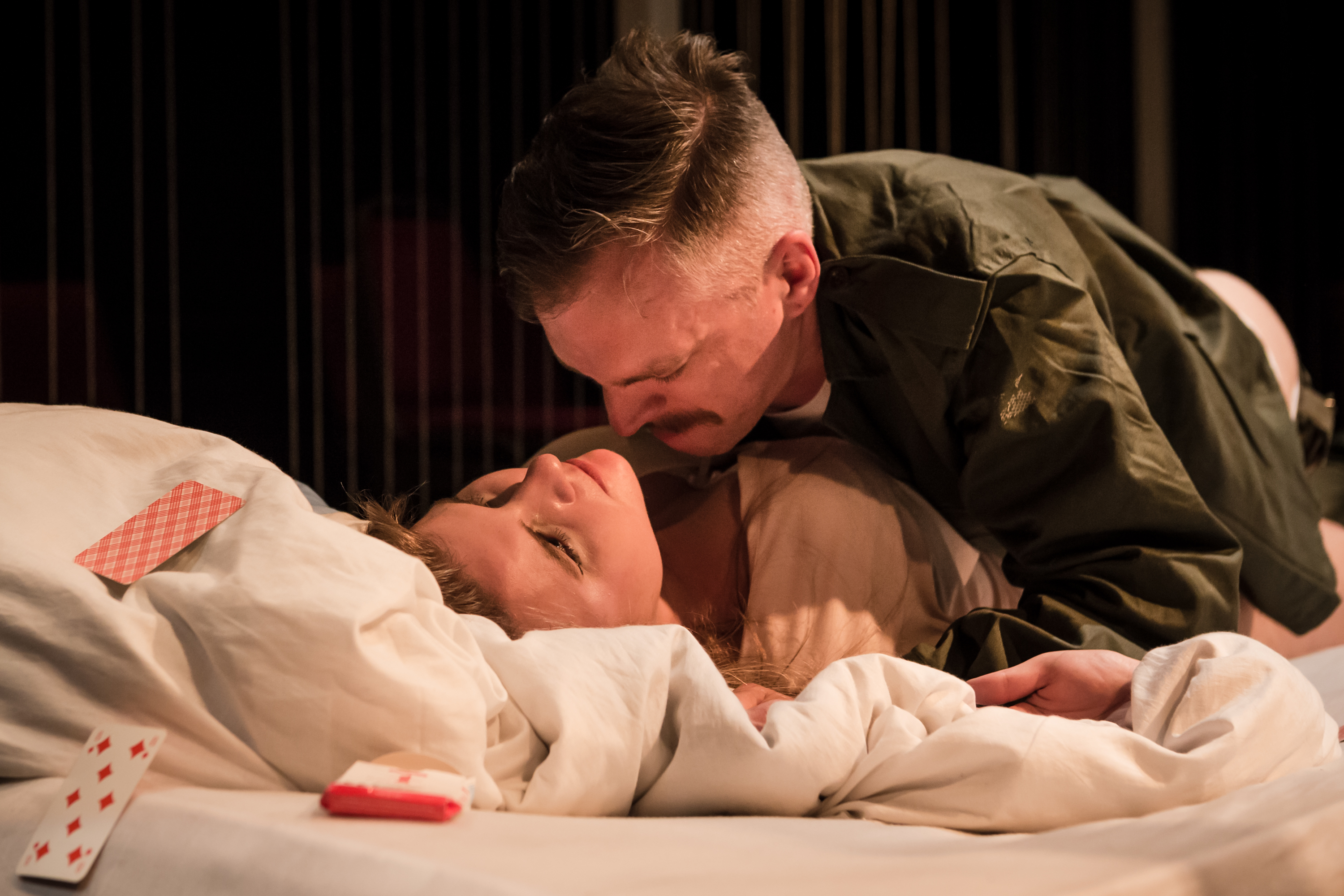
Photo credit: Scott Rylander

I previously saw the play at Theatre N16, where I remember being struck by the proximity of Szymon Ruszczewski’s set – a string cage that encloses the stage area – to the audience. At The Hope Theatre, if possible, we’re even closer to the action and there’s nowhere to hide as the three stories unfold mere inches away, sometimes quite literally in our faces. Alina (Nastazja Somers), a student in West Germany in the early 1980s, is locked in a passionate relationship with an American soldier (Charlie Allen) who’ll soon have to return home. Elliott (Elliott Rogers), in London in 1999, is in love with Australian backpacker Casey (Christina Baston) whose visa’s about to run out. And Holly (Sarah Hastings), now, is struggling to rationalise her decision to leave her perfect husband and embark on a relationship with Erica (Monty Leigh) – who’s dealing with problems and a past of her own.

There’s a secret that links the three couples together, which is gradually revealed piece by piece as the play goes on; seeing it for the second time it’s fascinating to see the little clues scattered along the way. But what ultimately unites them all, as the play’s title suggests, is the experience of lost love and the lasting impact this can have – and not only on those directly involved. The early scenes of carefree, passionate lovemaking soon feel like a distant memory as the clothes go on and the relationships begin to crumble. And though the three couples are indeed torn apart by circumstances beyond their control, it’s clear that, while their love is genuine, each also has (perhaps) insurmountable issues that may only be revealed in the privacy of their own bedroom.

Photo credit: Scott Rylander

The show’s main strength lies in its excellent cast, all but one of whom reprise their roles from torn apart‘s previous run in Balham. The relationships – both physical and otherwise – are totally convincing, and the actors play expertly on our emotions as they try desperately to hold on to what they have at any cost. McNeill has made a point of placing female characters at the centre of the action and allowing the female voice to come through loud and proud, particularly in Nastazja Somers’ Alina and Christina Baston’s Casey, who stand up for what they think is right rather than take the easy option, even if it means losing everything.

But McNeill also avoids falling into the trap of promoting women by relegating men to a one-dimensional role; both Charlie Allen and Elliott Rogers portray characters who are just as complex and damaged as the women they love. Sarah Hastings and Monty Leigh complete the cast as two women who come from very different backgrounds and have very different ideas about pretty much everything. They spend more time arguing than anything else, yet there’s a genuine tenderness in their relationship, and Holly’s desperate attempts to hold on to the life she’s only just discovered is particularly heartbreaking.

Fearless and uncompromising, torn apart (dissolution) is not a play that can be easily forgotten; nor is it one that everybody will agree on (and there’s enough material for several post-show discussions) – which just goes to show that when it comes to love, there are no right or wrong answers.


Can’t see the map on iPhone? Try turning your phone to landscape and that should sort it. I don’t know why but I’m working on it… 😉

Review: Instructions for American Servicemen in Britain at Jermyn Street Theatre

There’s nothing we Brits love more than laughing at ourselves… except possibly laughing at Americans. Instructions for American Servicemen in Britain from Fol Espoir and The Real MacGuffins has both of these things. It also has cricket, Brussels sprouts and a perfectly brewed pot of tea. It’s very funny if you’re British, possibly a little less so if you’re American, and I imagine fairly baffling to everyone else.

The premise is simple: a unit of American airmen, recently arrived in England during World War II, has had rather too much fun in the nearby village of Nether Middleton – resulting in a cat up a tree, the local policeman locked in his own cell, and a prize marrow stuck on the church spire. As compensation, they must apologise and help clean up, but also take a course in British culture, to foster friendship and cooperation with their new neighbours – all whilst preparing for a visit from “the President of London”, Winston Churchill himself.

You can probably imagine what comes next. Instructions for American Servicemen in Britain is a high-energy, tongue-in-cheek and frequently quite bonkers celebration of the many ways in which Brits and Americans are different – and the many, many ways that each nation’s way of life baffles the other. Think Dad’s Army with Americans, and you get the general idea.

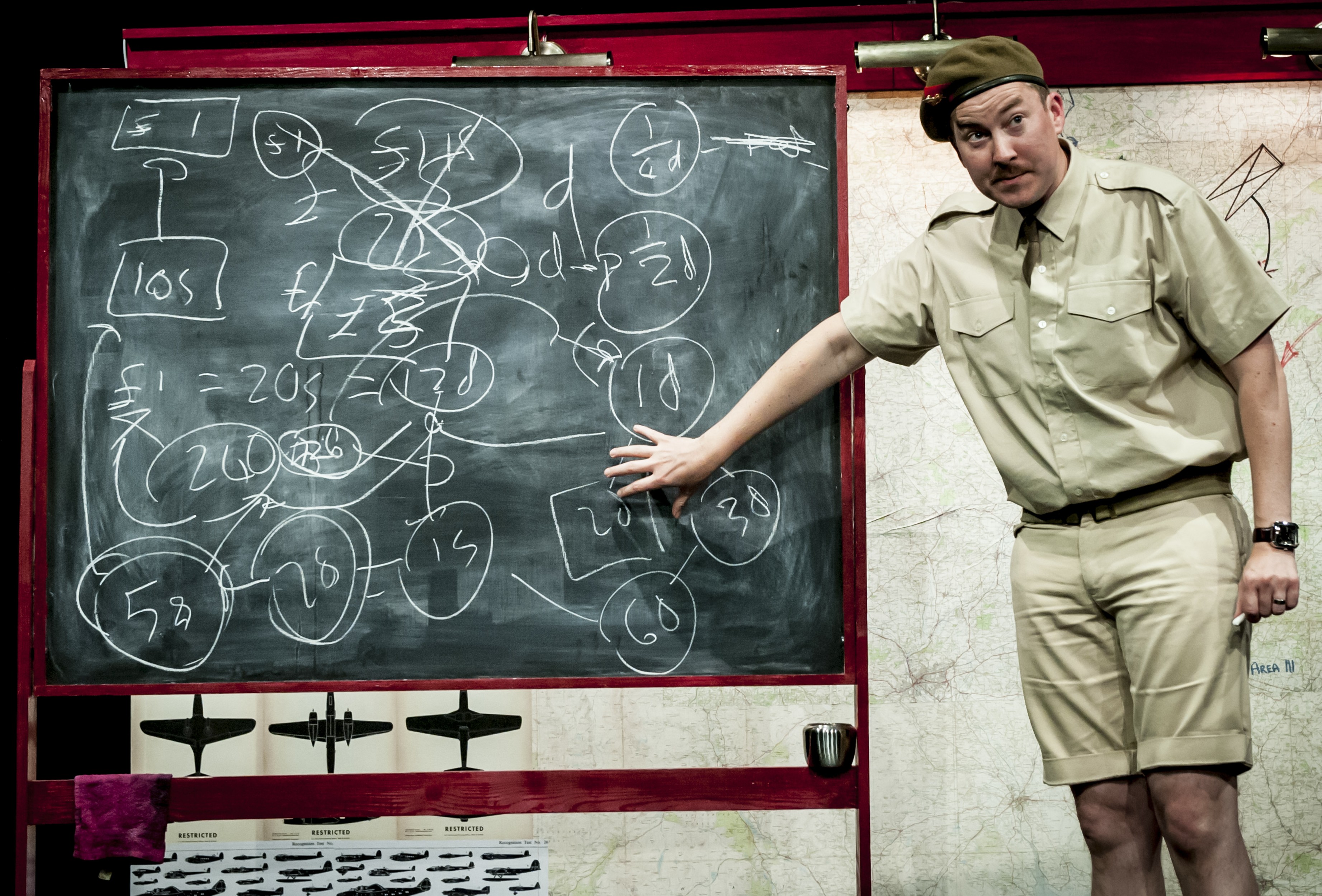
It’s all inspired by a genuine pamphlet issued to American GIs in 1942 introducing them to the quirks and customs of British life, but that’s where the historical accuracy comes to an end – or at least I assume it does, otherwise I’m really not sure how we ever won the war. A few of the jokes are funny precisely because of the historical nature of the show and the benefit of hindsight; an oblique reference to the current resident of the White House goes down particularly well, as does the British lieutenant’s disdain for decimalisation as he launches into a hilariously convoluted explanation of pounds, shillings and pence.

Established comedy trio The Real MacGuffins – aka Dan March, Jim Millard and Matt Sheahan, who wrote the show with director John Walton – turn up with a variety of costumes and accents as, among others, a bullying American colonel, some German spies-in-training, a cricket-loving English lord and a randy Scottish pensioner. They’re clearly having a blast, and it’s impossible not to get caught up in their enthusiasm, or to admire their improvisation skills when the occasional curveball is tossed their way from the audience (cricket fans, please pardon the baseball pun).

Speaking of the audience, it’s worth mentioning – without giving anything away – that this is a show requiring everyone’s participation. The front row is a particular danger zone, but even those hiding at the back will have an opportunity to join in the fun, even if there isn’t really sufficient space to get involved properly (I’ll just leave that there for your imagination to mull over). But it’s all very good-natured and there’s no pressure on anybody to perform, so if you’re not a fan of participatory theatre, don’t let it put you off.

Like all the best comedy, Instructions for American Servicemen in Britain is funny because it’s largely true, a joyous celebration of all those little oddities of which we Brits are secretly rather proud. Definitely one to check out in between drinking tea and talking about the weather…


Can’t see the map on iPhone? Try turning your phone to landscape and that should sort it. I don’t know why but I’m working on it… 😉
Interview: Stephanie Martin, Bridle

Now in its third year, new writing showcase #Festival47 kicks off next week at the King’s Head Theatre. Among 19 shows featured in the programme is Bridle from Clamour Theatre, a contemporary satire on female sexuality and the attempts to control it, written by Stephanie Martin.

Bridle is about challenging and rewriting narratives and perspectives on female sexuality and behaviour,” explains Stephanie, who also performs in the show. “It’s about desire, heartbreak, shame, fathers, violence, pornography, millennial culture. It’s about how female sexuality and behaviour are subtly policed and judged.”

Bridle marks Stephanie’s debut as a writer: “I wrote it last May, inspired by the disparity between the people I know in real life and the tropes of behaviour that are defined as ‘good’ or ‘proper’,” she says. “We shared the show for the first time, as a full length piece, at the brilliant Camden People’s Theatre hotbed Festival of Sex in April. Our first sharing saw me performing the piece with other actors, Elissa Churchill and Charlotte Clitherow, and so #Festival47 will be the first time I’ve ever performed it solo – I’ll be heartbroken/lonely and bored without the other two.

“As Bridle is the first thing I’ve ever written, I’m also extremely grateful to EJ and Pip at Pluck Productions, Georgie and Will at Flux Theatre and the Emerge Night, as well as Nastazja Somers and her HerStory baby, for first programming excerpts of Bridle as part of their respective new writing nights in November and December 2016. These three companies are a great example of London’s new writing scene, giving opportunities, support and confidence to new writers and makers.”

Bridle may be about women, but that doesn’t mean it’s only a show for women. “Absolutely not, it’s a show for all,” says Stephanie. “I personally believe we all exist as a gorgeous mismatch of the male and the female, so come as you are and enjoy. Some of the ‘male’ audiences of the past performances seemed a little disconnected or in some way to blame for some of Bridle, which I didn’t predict or imagine at all.

“I want us to all remove shame from our lives, to feel comforted that lots of us go through the same things, to feel okay about being weird and vulnerable. And to laugh at me and laugh at all of us.”

Clamour Theatre describe themselves as “raw, excited and all about today”. Stephanie explains, “We’ve formed to explore new perspectives, new characters, new stories in raw, explosive and enjoyable ways. We love humour, we love energy and we like looking at new stories and/or re-examining the status quo.”

Stephanie will be performing the show at the King’s Head on 11th, 12th and 16th July at 9.30pm. “It’s an honour to be programmed as part of the festival and defined as part of the ‘future of the theatre’, especially by a theatre with a reputation like the King’s Head,” she says. “The rest of the festival line-up looks fab too and we’re looking forward to seeing the other companies. I’ve seen such a huge variety of fab, quality work at King’s Head over the last 4 or 5 years so looking forward to being on that stage, too.”

Book now for Bridle at the King’s Head Theatre, 10th-16th July.

Review: Mumburger at Old Red Lion Theatre

First, a word of warning: don’t go and see Mumburger on an empty stomach. It’s all kinds of confusing.

Now that we’ve got that out the way, let’s discuss Sarah Kosar’s play. Andrea just died in a horrific car accident on the M25, leaving behind her devastated daughter Tiffany (Rosie Wyatt, reprising her Offie-nominated role) and husband Hugh (Andrew Frame). What begins as a seemingly straightforward story of two people struggling to process their grief in very different ways (she’s made a Google spreadsheet and is looking at urns on Amazon; he just wants to read the messages of condolence on Facebook and watch his wife’s favourite movie) takes a surreal and grisly turn when a mysterious delivery arrives. Inside the greasy bag are burgers – an odd enough sight in a house of committed vegans, even before we learn that they’re in fact a “Digestive Memorial” arranged by Andrea as a way to sustain her family after she’s gone.

Photo credit: Lidia Crisafulli

If it’s visceral theatre you’re after, you’ve come to the right place; it’s impossible to watch Mumburger – which follows Tiffany and Hugh’s horrified attempts to abide by Andrea’s final wish – without feeling some kind of physical reaction. Director Tommo Fowler has obeyed to the letter the writer’s instruction that “the actors should consume food when it says they eat”, so there’s no getting away from either the consumption or the various bodily functions that accompany it. (Or indeed the smell of cooking burgers, which explains the confusion I mentioned earlier.) It’s disgusting and messy and uncomfortable to watch, particularly when you add into the mix a series of video projections against the curtain at the back of the set, which verge at times on motion sickness inducing.

But let’s put the meat to one side for a second. At its heart, Mumburger is a story about a family coping with the loss of the person that held them together. Though we never meet Andrea, Kosar’s script paints a detailed picture of her; it’s clear from listening to Tiffany and Hugh argue and reminisce that she was the common link between them, and that without her they’re almost strangers who have no idea how to communicate. Both are also pretty annoying in their own ways; Tiffany, played by Rosie Wyatt, is shrill, domineering and self-involved, while Andrew Frame’s Hugh would rather play Candy Crush on his iPad than deal with anything even remotely difficult. Each believes that they knew Andrea better and therefore has more right to grieve, and the mumburgers become a physical manifestation of that competition. All of which begs the question: was Andrea’s intention really a noble wish to help her bereaved daughter and husband go on, or was it prompted by her own selfish need to maintain her position at the centre of the family for as long as possible?

Photo credit: Lidia Crisafulli

Many plays about bereavement go for the emotional jugular, encouraging us to feel sympathy for the characters and move us to tears as we watch them bond over memories of their loved one. Mumburger is not one of these plays. You’re more likely to come out feeling slightly sick than overwhelmed with emotion (though the play certainly has its moments) but that doesn’t make it any less real, and in this regard it’s actually oddly refreshing. Death – particularly of the sudden, violent kind – is not romantic or glamorous, but messy and painful. Not everyone who dies is perfect; nor are the people they leave behind. Grief can drive us apart just as much as it brings us together. These may not be truths we want to hear – or see, or smell – but they’re truths all the same. Not one for the faint-hearted (or vegetarians), maybe, but Mumburger certainly makes a lasting and powerful impression.


Can’t see the map on iPhone? Try turning your phone to landscape and that should sort it. I don’t know why but I’m working on it… 😉

Review: Tremors at the King’s Head Theatre

You do have to wonder sometimes what makes people go into politics. Despite certain obvious benefits, it seems often a very thankless career, exposing you to public scorn, ridicule and disdain the minute you mess up or show the slightest sign of weakness. Because of the nature of the job, politicians become public property – and the public has the power to make or break them on a whim.

This is the very predicament in which Tom Crowe, the Labour MP at the centre of Tim Cook’s new play Tremors, finds himself. After a private encounter in a hotel room with a senior party member goes viral, he takes the advice of his PR advisor Lisa and flees to Eastbourne. But his hometown is in chaos, with riots and vandalism led by anti-austerity activists threatening to tear the town apart – and a dark secret from Tom’s past that could derail the attempt to salvage his future.

Though written a few years ago, by chance the staging of Tremors by Broken Silence Theatre has fallen during one of the most extraordinary eras that many of us can remember in British politics. It’s an indication of how disillusioned and suspicious we’ve become – not really a surprise after watching our politicians routinely turn on each other over recent months – that a character like Tom, who genuinely just wants to help people, seems entirely too good to be true. Even so, William Vasey gives a believable performance, managing to convey both the wide-eyed idealist, who followed his heart into politics, and the ambitious social climber, whose accent these days is more Oxford than Eastbourne.

Tom’s one of four characters who never get fully developed, despite good performances from the cast. Much like in politics, each of them comes to represent a particular ideology, which overrides their individual personalities, and consequently we never really get to know them as the 60-minute play unfolds. At the opposite end of the scale from Tom is his old friend Chris (Tim Cook), who has the same passion to make the world better, but very different ideas on how to achieve it. And then there are the women: Lisa (Vicky Winning), a hard-nosed ice queen who doesn’t do feelings, remorse or indeed anything that might get in the way of her own career interests. Her opposite number is Marie (Cerys Knighton), Chris’ sister; her activism days are firmly behind her, and now all she cares about is finding her brother before he does something stupid.

There’s a lot going on for such a short piece, and some of the plot threads at times become a little tangled – Tom’s career crisis and concealed homosexuality, the decline of his coastal hometown, Chris’ struggles to come to terms with his past or the country’s future, and the revelation of the secret that binds the three old friends together. And despite some helpful BBC News announcements, the timeline of the play isn’t always entirely clear; some early flashback scenes only really make sense in the closing minutes.

Though not without some issues, Tremors is an interesting premise and definitely has potential for development into a longer play examining the issues in greater detail. What connects all the various plot threads is a simmering anger over the growing distance between we the people and those who put themselves forward to represent us – which is something I think most of us can identify with. Judging by recent events, that’s not an issue that seems likely to go away any time soon, so here’s hoping Tremors will return to shake things up in the future.


Can’t see the map on iPhone? Try turning your phone to landscape and that should sort it. I don’t know why but I’m working on it… 😉