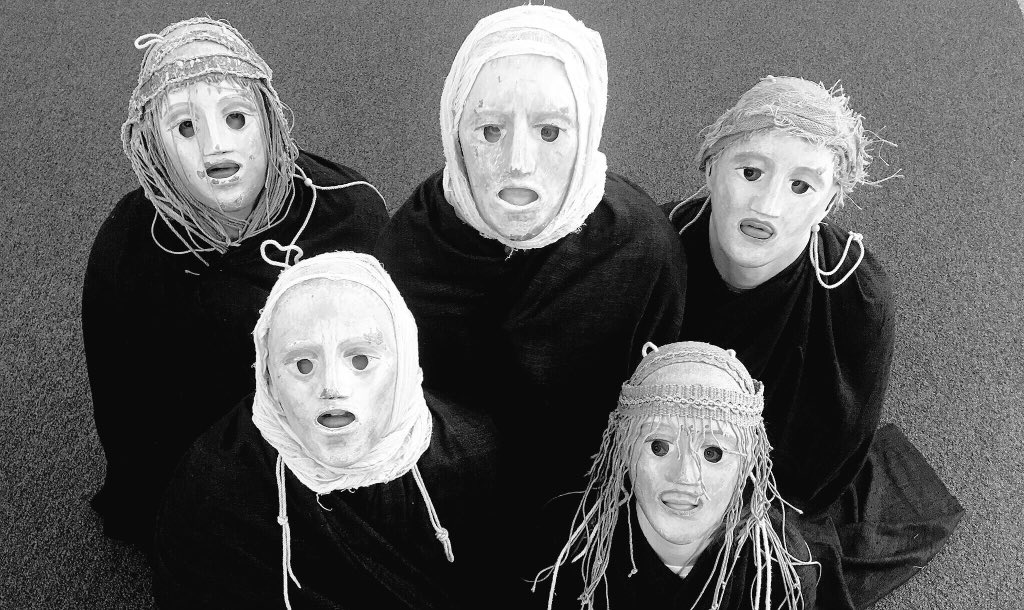
Review: Dante’s Divine Comedy at Barons Court Theatre

I mean this in the nicest way possible… but if you’re looking for a theatre in which to stage a play about descending into hell, I can think of few better than Barons Court. Partly because you actually do have to descend a flight of stairs to get there, but mostly because with its low arched ceilings and shadowy corners, it guarantees an atmospheric setting for any production.

The directors of So It Goes Theatre clearly had a similar instinct, and have returned to Barons Court for a second time with their adaptation of Dante’s Divine Comedy, based on the epic 14th century poem by Dante Alighieri. A dark tale of suffering and loss, this modern retelling also has an unexpectedly wry sense of humour, and is packed full of witty one-liners that are often as surprising as they are enjoyable. Who knew hell would be so funny? (Although I suppose the clue’s in the title…)
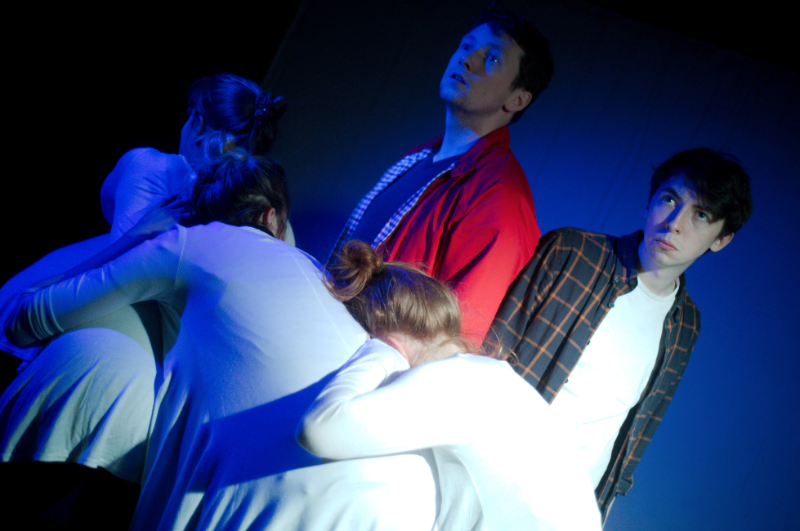
Following the death of Beatrice, the woman he loves, Dante’s about to kill himself when up pops the Roman poet Virgil, who takes him on a slightly grim guided tour of hell and purgatory before dropping him off at the gates of paradise, where Beatrice awaits. But their reunion may not be quite as joyous as expected…

Alex Chard is great as the depressed yet determined Dante, really coming into his own in the second half of the production when he has the opportunity to get into some meaty theological debate. His budding bromance with Virgil, played by Jack Blackburn, is fun but also surprisingly touching, particularly the moment when Dante promises to have a word with God about getting his new best mate through the Pearly Gates. Their witty banter, right up to the moment Virgil leaves, means the icy encounter that follows with Kathryn Taylor-Gears’ Beatrice is all the more jarring.

A hard-working and incredibly versatile all-female Chorus (Sofia Greenacre, Marialuisa Ferro, Sophia Speakman and Michaela Mackenzie, along with Kathryn Taylor-Gears) accompany Dante on every step of his journey, as the condemned souls suffering the countless torments of hell, those unfortunates stuck in the limbo of purgatory – brilliantly reimagined as the mind-numbing boredom of a daily commute – and the shockingly unpleasant residents of heaven. I’d go so far as to say that the Chorus steal the show in the first part of the play; their pain, fear and anger grows ever more palpable as Dante and Virgil descend deeper into the inferno.

It would be easy to assume that a small cast of seven, in a tiny pub theatre, might not be able to quite reproduce the epic scale of heaven and hell – but Douglas Baker’s production is a masterclass in how to do a lot with very little. A couple of handheld torches, a few chairs, a balloon and some cardboard cut-outs prove more than enough to create some fantastic effects, particularly when combined with video projections and some exquisite movement sequences directed by Matthew Coulton. The whole show is so absorbing, in fact, that it comes as something of a shock when Virgil suddenly breaks the fourth wall and reminds Dante – and us – that we’re just watching a piece of theatre created by the man himself; all his suffering is entirely self-inflicted.

I don’t know much about Dante’s original poem (though I may check it now), and I’m definitely no theologian – but neither is really necessary in order to appreciate this creative, powerful and really enjoyable production. So again, in the nicest possible way – I politely recommend that you go to hell.


Can’t see the map on iPhone? Try turning your phone to landscape and that should sort it. I don’t know why but I’m working on it… πŸ˜‰

Review: Talk Radio at the Old Red Lion Theatre

We’re taught from a young age that telling the truth is important. We’re also taught that everyone has the right to say what they think. But what happens when those two things combine to create something potentially harmful, not just to another person, but to society in general? Where do we draw the line between freedom of speech and hate speech – and what can we do about it?

Eric Bogosian’s Talk Radio might have been written 30 years ago, but the issues it addresses are as fresh and current as ever. Barry Champlain, the shock jock radio DJ in Bogosian’s play, is angry, damaged, a heavy drinker and drug taker who’s incapable of maintaining a healthy adult relationship with anyone, even the people who like him. But despite appearances, his mission with the late-night radio show Night Talk – in which he encourages people to phone in and say what’s on their mind – isn’t to spread hate; instead he’s trying, in his own backwards way, to stop it. Unfortunately, his listeners aren’t getting the message… and despite Barry’s best efforts, it seems the phone is never going to stop ringing – particularly as the show’s been so successful that its bosses want to roll it out nationally.

Photo credit: Cameron Harle

Perhaps ironically in a play about a radio host who nobody ever sees, Matthew Jure is fascinating to watch as the chameleon-like Barry, adapting his approach at lightning speed to suit whoever’s on the end of the phone line, with the face behind the voice becoming increasingly haggard and desperate as he finally realises the monster he’s created. Isolated for the entirety of the play behind glass in his soundproof booth, he becomes almost an exhibit for his audience to examine; for better or worse, everyone thinks they know him – and have no hesitation about telling him their darkest secrets – but monologues from Barry’s three colleagues reveal the complexities behind the facade.

These three roles – nicely played by Molly McNerney, Andy Secombe and George Turvey – are necessarily a bit sketchy; their purpose is to support and facilitate Barry, both professionally and personally. The cast is completed by real-life Radio One DJ Ceallach Spellman, in a brilliant turn as vacuous teenager Kent. Invited to the studio, he’s both hilarious and horrifying in equal measure, representing for Barry everything that’s gone wrong in society.

There are two more stars in Sean Turner’s production: Max Dorey’s set, a meticulously detailed reproduction of a 1980s radio station, and Dan Bottomley’s sound design. Not surprisingly, the script calls for a lot of interaction between Barry and the recorded voices of his many callers, and this works seamlessly throughout – it’s easy to believe you’re watching an actual radio show being recorded.

Photo credit: Cameron Harle

Talk Radio is undoubtedly entertaining and on several occasions completely gripping, but it’s hard to leave with a smile knowing that the voices we’ve just heard haven’t gone away, and probably aren’t going to. The play certainly won’t make you feel any better about the state of the human race; if anything, Barry’s final rant is directed as much at today’s theatre audience as his Ohio-based listeners, and none of us come out of it very well. Those who spread hate aren’t the only target of his anger – he also loathes the banality of those who have nothing at all to say (I can imagine a 2017 version of Barry being incensed by the recent Love Island frenzy), and the play’s ultimate message is both damning and faintly depressing. You’d like to think that this could be a force for change, but 30 years on the sad truth is – to use Barry’s own words – it looks like we’re stuck with each other.


Can’t see the map on iPhone? Try turning your phone to landscape and that should sort it. I don’t know why but I’m working on it… πŸ˜‰

Interview: Elliot Clay, The State of Things

The State of Things is a new British musical, written by The AC Group’s artistic directors Elliot Clay and Thomas Attwood. Inspired by their own schooldays nostalgia and the current political situation, it’s the storyΒ of a high school band who find out the school is being forced to cut its music course. The show follows the young people’s fight to save their course, as they learn to live and love in austerity Britain.

“Myself and Thomas – the show’s book writer and director – grew up together, so The State of Things is semi-autobiographical, based on our own experiences and encounters with austerity both at school and at home,” explains Elliot.Β “Arts funding, both in schools and in general, seems to be falling every day the current government is in power. I’ve had people contacting me on Twitter, some of them music teachers, expressing their dismay at the effects of austerity on funding in schools, particularly in creative subjects.

“It’s also a musical about young people in the north, written by young people from the north – it’s these stories that need to be voiced. I hope that the story we tell will, at the very least, open up a discussion with members of our audience, no matter where they sit on the political spectrum. Theatre alone can’t change the world, but it can affect the way people think, talk and vote.”

As composer and lyricist, Elliot’s been enjoying the chance to work with different musical styles: “In terms of musical inspiration, it was a chance to write in styles that you usually wouldn’t find work in a musical. Because all the songs in the show are the songs that the β€˜band’ have written, it allowed me to draw on inspiration from The Rolling Stones, Adele, The Beatles, Coldplay, and of course put in some crazy guitar solos!”

Following The AC Group’s acclaimed productions of Macbeth andΒ Side By Side By Sondheim, the company are looking forward – with a little trepidation – to returning to the Brockley Jack Studio Theatre, this time with an original piece: “In the words of Stephen Sondheim – ‘excited and scared’!” admits Elliot. “It’s a real privilege to shape every artistic detail of the production, but we couldn’t do it without the brilliance of our creative team and cast.

“I’m incredibly lucky to be working with a supremely talented cast of young actors, all of whom play multiple instruments live on stage every night. It’s such a joy telling this story and sharing the stage with them.”

Surprisingly, the show has only been in development for three months. “Kate Bannister, the artistic director of the Jack Studio let us know in May that there was potentially a free slot for a production in September, and we instantly knew we wanted to write and stage The State of Things,” says Elliot. “Since then the ensuing three months have been a wonderful, crazy and thrilling blur.”

The AC Group was founded by Elliot and Thomas in 2014, when they staged a sell-out musical theatre concert in Covent Garden, with a cast and orchestra of over 50. “Since then we’ve been lucky enough to stage revivals such as the 40th anniversary production of Side By Side By Sondheim at the Jack Studio and Theatre Royal Drury Lane, and Macbeth, which was nominated for 2 off-West End awards – alongside developing our new writing. It’s been an exciting journey so far and we’d love to see you at the premiere of The State of Things.”

Book now forΒ The State of Things at the Brockley Jack Studio Theatre from 7th-23rd September.

Review: Richard III at Temple Church

Antic Disposition certainly know how to make a good first impression. Temple Church, their home for the next two weeks, is another majestic, beautiful and powerfully historic setting for the company’s production of Shakespeare’s Richard III – and brings to an end their most recent tour of some of the UK’s most stunning cathedrals.

Fortunately, the awe-inspiring venue is more than matched by the quality of the show, which is utterly absorbing from start to finish. Based on the probably completely untrue history of Richard, Duke of Gloucester, the play recounts his bloody path to the throne as he gradually eliminates every other heir in his way, before being defeated at Bosworth Field by the future King Henry VII.

This modern interpretation reimagines the royal family and their entourage as well-heeled city types, and even without the little topical details – which include a comedy mayor called Boris, and a competitive handshake Donald Trump would be proud of – the point being made is clear. Our leaders may no longer send each other to the executioner’s block, but the ruthlessness of those who seek power for their own ends is just as dangerous today as it was 500 years ago.

At the head of a fantastic cast is Toby Manley as the murderous monarch, in a performance so charming that it’s easy to see how he keeps getting his way. Watching him, I couldn’t help but be reminded of Andrew Scott’s Moriarty in Sherlock; he plays his part so well that you can forget how evil he actually is – if not for the occasional furious outbursts that expose the crazed ambition lurking within. And in case that doesn’t do the job, a glance down the aisle reveals a silent army of vengeful ghosts, as each of Richard’s victims rises from the grave to take his or her place and wait for an opportunity to have their revenge.

This simple yet powerfully effective device from directors Ben Horslen and John Risebero not only helps keep track of the rising body count, but also contributes to the play’s sense of impending doom as we build towards a spine-tingling climax. And they’re not alone, as Louise Templeton’s Queen Margaret, draped in the flag of her dead husband and son’s royal house, appears regularly on stage like Hamlet’s ghost to ensure justice is done.

Perhaps surprisingly in a play so full of violence, there’s also a lot of humour, in the dramatic, semi-hysterical posturing of Joe Eyre’s Buckingham, who could be mistaken for a radical religious preacher as he makes the speech that secures Richard’s place on the throne. And Robert Nairne’s Catesby, who’s transformed for this production into a no-nonsense security man, enjoys some fun interaction with the audience as he hands out flags for the young princes’ arrival, before smugly presenting the two moody teenagers with an XBox to keep them quiet.

It’s clear from both the production and the directors’ programme notes that there’s a topical subtext to be found in Antic Disposition’s interpretation of Richard III. But this message is applied subtly enough – for the most part – that anyone who simply wants to see an excellent and very accessible production of Shakespeare’s historical play will find themselves more than satisfied. It takes some doing to put together a performance so gripping that it can distract from such an amazing venue – but while the setting certainly adds atmosphere, the true star of this show is the show itself.


Can’t see the map on iPhone? Try turning your phone to landscape and that should sort it. I don’t know why but I’m working on it… πŸ˜‰

Review: Helen at the Hen and Chickens

If today we’re all too familiar with the concept of fake news, Euripides was a few centuries ahead of his time when he wrote Helen in 412 BC. An alternative view on the Trojan War, the play argues that Helen – whose seduction by Paris was the cause of the decade-long conflict – was actually in hiding in Egypt the whole time, while the Helen taken to Troy was no more than a copy created by the goddess Hera to punish Paris. Unfortunately, nobody knows about this, so they all blame Helen for the devastation waged in her name, leaving her desperate to expose the lie and save her reputation.

The story’s picked up in Egypt following the fall of Troy, when who should arrive shipwrecked and scantily clad on their shores but Helen’s husband Menelaus. His phantom wife conveniently vanishes into thin air just as he re-encounters the real one, and together they trick the Egyptian king Theoclymenus – who wants to marry Helen himself – into letting them go.

This new version of Euripides’ play comes from Theatre of Heaven and Hell, a company dedicated to producing absurdist plays and reviving forgotten gems. Helen is a bit of both; a little more comedy than tragedy, it moves through the story at a brisk pace, and doesn’t shy away from exposing its more farcical aspects. There are moments in Michael Ward’s production that feel a bit like Monty Python does Ancient Greece, contrasting sharply with the play’s slightly sinister opening and closing sequences, in which the masked and robed Chorus set the scene to a dramatic soundtrack.

As difficult as it is to categorise, Helen nonetheless makes for an entertaining hour of theatre. The women come out on top – Helen herself and the prophetess Theonoe, played by Elena Clements and Sarah Day-Smith respectively – emerge not only with the most dignity but also all the moral fibre, while the men are made to look like fools. Nicholas Bright and Darren Ruston play the famous leaders Menelaus and Theoclymenus as comically simple souls who are nothing without women to tell them what to do, and Brian Eastty and Marius Clements have two of the funniest scenes as messengers who patiently expose their rulers’ mistakes.

A surprising twist on an old story, Helen touches on some very modern themes, from feminism and victim blaming to fake news and the pointlessness of war. The scene in which one of Menelaus’ men questions their reasons for going to war in the first place is funny but painfully topical, and the responsibility placed on Helen’s shoulders for the actions of men invites us to ponder gloomily how much attitudes have really changed several centuries later.

It’s an odd little play, which is nothing like you might expect (let’s be honest: you hear Euripides, you don’t expect lines like, “We went to war for a cloud?”) but Helen is undeniably good – if slightly surreal – fun.


Can’t see the map on iPhone? Try turning your phone to landscape and that should sort it. I don’t know why but I’m working on it… πŸ˜‰