Review: Don’t Stop Thinking About Tomorrow at Chickenshed

As the narrator of Chickenshed’s Don’t Stop Thinking About Tomorrow – a fictional climate change artist called Oscar Buhari – points out, here in the UK we’ve become largely desensitised to the topic of saving the planet. Living as we do in our privileged first world environment, it’s difficult for us to really appreciate the damage that’s already being done, and which will only get worse, as a result of our own irresponsible actions.

The show aims to tackle this by discussing climate change not in terms of the theoretical science (though there is a little of that), but through showing us the real world implications for both our fellow citizens of the world, and ultimately for ourselves. The result is a show that is big, bold and visually stunning, but also terrifying and humbling – not least because it’s performed by a young cast who understand that they’ll be left to deal with the chaos previous generations have created.
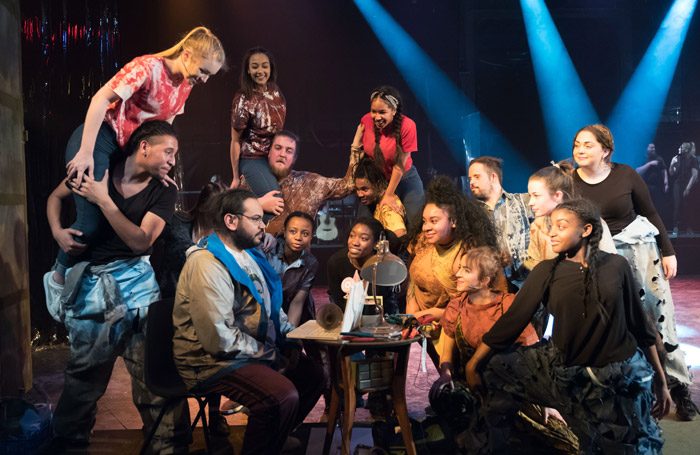
Photo credit: Daniel Beacock

Lou Stein’s production is made up of several short pieces blending dance, song and spoken word, each introduced by a short monologue from the affable Oscar Buhari, played by Ashley Driver. These performances take us from the depths of the sea, where marine life is destroyed by an army of discarded plastic, to the lively streets of New Orleans as Hurricane Katrina approaches, to an imagined future world whose limited water supply is rationed by a little more each day. The theme of refugees also recurs several times, with stark reminders that it’s not only war that can drive people from their homes.

It’s not all bad news, though, and the show does conclude on a positive note, first by introducing us to two resourceful communities who brought their villages back from the brink of disaster, and finally with a word of gentle advice from Oscar: he’s shown us the picture as he sees it, and now it’s up to us to decide what to do about it.

Musical director Dave Carey’s score features original music, as well as excellent live renditions of popular tracks including Joni Mitchell’s Big Yellow Taxi, Johnny Cash’s Hurt and Fleetwood Mac’s Don’t Stop Thinking About Tomorrow, all imbued with new significance by the context of the show. There’s also a reworded version of The Star-Spangled Banner, reflecting the inadequate political response to Katrina, which packs quite a punch – especially when accompanied by a photo of George W. Bush looking down on the devastation from the safety of Air Force One.

Photo credit: Daniel Beacock

Although each piece was devised by a different team and therefore has its own unique style, they’re all united by a creative incorporation of recycled everyday materials, and a use of colour and light that really brings each performance to life. And as always, it’s a pleasure to see the inclusivity that is Chickenshed’s driving force reflected on stage, both in the show’s large and diverse cast and in the collaborative, mutually supportive spirit of the performance. The young ensemble shows a real understanding of the show’s important message, and their energy and commitment is infectious.

Don’t Stop Thinking About Tomorrow is a powerful call to arms that looks and sounds great, and also makes you stop and think about the careless way we treat our planet, and what the impact of that might be. A fascinating watch, this show is well worth the long trip to the end of the Piccadilly Line.


Can’t see the map on iPhone? Try turning your phone to landscape and that should sort it. I don’t know why but I’m working on it… πŸ˜‰

Review: One Last Waltz at Greenwich Theatre

Inspired by and performed in memory of writer and director Luke Adamson’s grandad Ernest, One Last Waltz from Black Coffee Theatre is a poignant and deeply personal portrayal of Alzheimer’s and the impact it can have on people’s lives and relationships.

The play was written with the aim of raising awareness of the disease, particularly in the early stages when symptoms can be easily dismissed as signs of old age or just “getting a bit forgetful”. This is the point at which we meet recently widowed Alice, who’s come into the room looking for something – if only she could remember what. What she does find are her old dancing shoes, which spark long ago memories of waltzing in Blackpool with her husband George.

Alice’s daughter Mandy, who’s becoming more and more concerned about her mum’s memory lapses, suggests the two of them take a trip to the Blackpool hotel her parents stayed in, and go for one last waltz at the Tower. The only problem is that the hotel’s in decline, the Tower’s closed down, and nothing about the town is quite as Alice remembers it. As she becomes increasingly confused and distressed, Mandy – with a bit of help from hotel manager Georgette – begins to understand the difficult road that lies ahead.

Unsurprisingly, the writing shows a real understanding of the nature of Alzheimer’s: that it doesn’t happen all at once but begins with small, barely noticeable lapses that slowly build up to form a bigger picture. As the play opens, Alice – played with touching vulnerability by Amanda Reed – seems quite lucid; the only clue that something might be wrong is that she’s wearing her top inside out and keeps getting distracted from her search for photo albums. Her memories of 1958 are clear as day (including a nice reference to Ken Dodd, the inclusion of which may or may not be a coincidence), and yet she doesn’t remember having breakfast that morning, and as the play goes on she finds herself forgetting more and more – including, most tragically, that her husband passed away two months ago.

At the same time, the play also examines the strain that looking after someone with Alzheimer’s can place on family and friends. As single mum Mandy, Julie Binysh strikes a perfect balance between exasperation, anxiety and tenderness – but the biggest surprise is Julia Faulkner’s deceptively humorous Georgette, who unexpectedly reveals that she understands all too well what Mandy’s going through, and that she sees in Alice an opportunity to atone for a decision that’s haunted her for years.

There’s never any attempt to deny the fact that Alzheimer’s is a desperately cruel way to lose someone, and the play certainly succeeds in its aim to inform audiences about what to look out for, and the difficulties of living with the condition. But although we’re all too aware that this ultimately won’t be a story with a happy ending, the play contains lots of moments of humour, and concludes on a heartwarming note as Alice finally gets to waltz again in Blackpool. And as Luke Adamson writes of his grandad in the show programme (originally written for his funeral, after he passed away in December 2017), “although he faded away somewhat over the last few years, that cannot take away a lifetime of memories that can’t help but bring a smile to your face”. The image of Mandy and Alice embracing on the dance floor, ready to face up to the uncertain future that lies ahead, is exactly the right note on which to end this moving and heartfelt tribute.

One Last Waltz has now concluded its run at Greenwich Theatre, but for news about future productions from Black Coffee Theatre, visit blackcoffeetheatre.co.uk or follow @BlackCoffeeUK.


Can’t see the map on iPhone? Try turning your phone to landscape and that should sort it. I don’t know why but I’m working on it… πŸ˜‰

Review: Things That Do Not C(o)unt at Waterloo East Theatre

2018 is an interesting time to be a woman. On the one hand, it’s depressing to realise that we haven’t progressed as far as we might have hoped; on the other, it’s inspiring to see so many female role models emerging to tirelessly campaign for change.

One of these is Nastazja Somers of No Offence Theatre, who along with Bj McNeill has created experimental feminist show Things That Do Not C(o)unt,Β exploring themes of body positivity and female sexuality. Following in the footsteps of the similarly daring Torn Apart (Dissolution), this solo show is a bold, visceral and uncompromising hour of theatre that’s clearly fuelled by frustration and an urgent need to speak out, but with a welcome smattering of humour that every woman in the room can relate to. In a twist, though, there’s also an autobiographical element to the show, as Somers looks back on her Polish heritage and reflects on its impact on her relationship with her body. And if all that doesn’t get your attention, there’s also free vodka.

Through a combination of performance – some in Polish – and video footage she lays herself bare, openly discussing sexual encounters and past struggles with self-image. It’s clear from the start this is not your typical one-woman show, as she spends the first few minutes eating a grapefruit with sensual relish, smiling serenely at the audience, and without saying a word. (Warning to the front row: you may get splattered by flying fruit juice. On the other hand, you’re also first in line for vodka – so I’ll leave you to weigh that one up.)

This isn’t the only food to be consumed during what turns out to be an extremely messy show, as Somers examines with increasing passion the conflict between enjoying food (and sex) and the inevitable guilt that so often follows in the wake of society’s disapproval and judgment. And that judgment doesn’t only come from men, but from women too: her mother wishes aloud that she was “a bit anorexic”, other girls at school tease her about her early development, and a disembodied female voice repeatedly brings up the subject of body image, insisting “diet, exercise” is the answer to everything. Yet despite all this, it’s her grandmother’s message – one of positivity and unconditional acceptance – that she chooses to hold on to.

It’s not always comfortable to watch (fish guts, anyone…?), and is definitely not your traditional night at the theatre – but at the same time it’s impossible not to be inspired by the fearlessness, energy and power of Nastazja Somers’ performance, or to feel the powerful impact ofΒ Things That Do Not C(o)unt‘s taboo-smashing content.

Also, did I mention the free vodka?

Review: After the Ball at Upstairs at the Gatehouse

The aptly named Time Productions have set themselves an ambitious challenge in staging Ian Grant’s After the Ball, which covers several decades in the life of one family. Opening just before World War 1, it’s the story of William and Blanche, a young couple brought together by friends and shared political views, but with little else in common. Then, despite having spoken out frequently against the war, William voluntarily joins the army and heads to Belgium, where he falls in love with another woman. Back home, meanwhile, Blanche is left alone to raise their daughter, and even after he comes back she’s never able to forgive her husband for his betrayal.

Photo credit: Mitzi de Margary

The play, directed by Nadia Papachronopoulou, opened on International Women’s Day, and at the start there are some promising discussions about votes for women that suggest we’re about to see a play with some strong female characters. And admittedly Blanche’s friend Margery, who chooses not to marry and later goes off to travel the world on her own, fits the bill – as does daughter Joyce, who grows up to be a leading light in the Labour Party and refuses to let a cheating husband get in her way.

Blanche, on the other hand, loses any independent spirit she once had the minute she gets married, spends their first few months together pleading with William not to go to war – and when he does, she ends up a sad, bitter woman stuck in a loveless marriage and unable to let go of the past. We don’t get to see how she copes without him because we’re in Belgium watching William, first getting wounded and then having an affair. On his return, any hope we might have that Blanche somehow gets the last laugh gradually fades as the same conversations and recriminations come up again and again. The result is, sadly, a script that becomes repetitive and characters that begin to feel a bit annoying; we even go back to the start of their marriage at one point in Act 2, for no obvious reason, to replay the argument again.

The same actors play the characters throughout their lives, which means in some cases they’re faced with the challenging task of playing both a 20-something and an 80-something. Stuart Fox is poignantly impressive as a fragile, elderly William, suffering with dementia and lost in fragmented recollections of his life – but both he and Julia Watson as Blanche struggle to differentiate clearly between their younger and older selves, and it’s down to the other characters and the historical context to help us locate where we are in the story. There is, however, a welcome injection of energy from Emily Tucker as Joyce, determined to live life on her own terms despite her mother’s disapproval, and Elizabeth Healey is a refreshing voice of reason as both Margery and Marguerite.

Photo credit: Mitzi de Margary

In a programme note, writer Ian Grant explains that After the Ball is “a story of resilience in the face of personal trauma … of political and social bonds that get stretched beyond breaking point … of female liberation and political emancipation”. That’s a lot to tackle in two hours, but unfortunately we never really get to explore any of it in much depth. Nor do we feel much connection to the characters – again, with the possible exception of Joyce – which means a twist ending has far less impact than it should. All in all, sadly After the Ball is an interesting idea that begins well but never quite delivers on its early promise.


Can’t see the map on iPhone? Try turning your phone to landscape and that should sort it. I don’t know why but I’m working on it… πŸ˜‰

Review: Checkpoint Chana at Finborough Theatre

It sometimes feels like barely a day goes by without someone in the public eye saying or doing something ill-advised, only to back down under the inevitable public outcry and issue a hastily written apology. This is the situation in which we find Bev Hemmings (Geraldine Somerville), the central character in Jeff Page’s Checkpoint Chana. Her latest collection of poems has just been published, with one particular piece attracting widespread attention and criticism for a line that many view as anti-Semitic. Even Bev’s loyal PA Tamsin (Ulrika Krishnamurti) isn’t quite sure how she feels about it, but she throws herself nonetheless into damage control – a task made more tricky by the fact her boss doesn’t think she’s done anything wrong.

Photo credit: Samuel Kirkman

And the truth is that for all her many faults, Bev seems far more guilty of poor judgment and extreme naivety than of any actual prejudice. She doesn’t want to apologise because she didn’t mean any harm – and looked at from an entirely rational perspective, she might have a point. Except when it comes to anti-Semitism, taking emotion out of the equation is a very difficult thing to do, and it’s her failure to appreciate the strength of feeling on both sides that’s brought Bev to this point. This, along with a dying father, a serious drink problem (as the play opens, she swigs wine surreptitiously from a hot water bottle – an odd addition from director Manuel Bau, given that Bev’s love of booze is soon revealed to be an extremely open secret) and a career that’s hanging by a thread, provides us with plenty of reasons to pity rather than condemn her, should we choose to do so.

Despite appearances, Checkpoint Chana isn’t a particularly political play, and anyone hoping to engage in sturdy debate about the Middle East is likely to come away feeling unsatisfied. Page steers clear of discussing the historical background to the furore, choosing instead to focus on Bev’s personal turmoil. Geraldine Somerville perfectly captures the complexity of her character, making her pathetic enough that we find it hard to hate her, but stopping far short of being someone we can admire. There are references to a successful past career but those days are long gone, and Bev now seems almost to revel in her self-destructive choices.

Photo credit: Samuel Kirkman

The other characters have less depth to them, but the actors – Ulrika Krishnamurti, Matt Mella and Nathaniel Wade – do well with the material they have, under the close scrutiny of an audience who are seated in the round mere inches away. Tamsin’s relationship with her boss is interesting to watch, the two more like patient/carer than employer/employee but with a bit of witty banter thrown in, while sympathetic Jewish journalist David and arts centre employee Michael each offer Bev a shot at redemption, if she’s willing to take it.

As a discussion of the ins and outs of the Middle East conflict, Checkpoint Chana doesn’t have a great deal to say (although to be fair you’d need a bit more than 70 minutes to get into that subject properly). But if political controversy is relegated to the side dish, the main course – a thoughtful and well-acted study of a woman on the brink – is still more than enough to satisfy.


Can’t see the map on iPhone? Try turning your phone to landscape and that should sort it. I don’t know why but I’m working on it… πŸ˜‰