Review: Citizen at The Space

Just a few days after another British-Iranian citizen – Abbas Edalat, a professor of computer science and mathematics at Imperial College in London – was arrested on spying charges in Tehran, Suitcase Civilians’ show Citizen strikes very close to home. Simultaneously a celebration of the country’s proud culture and a condemnation of its political repression, the show brings together a collection of news and personal stories that explore what citizenship really means, and invites us to ponder why the simple question “Where are you from?” is increasingly fraught with complications and potential dangers.

Alongside well-known news stories like that of Nazanin Zaghari-Ratcliffe, the British-Iranian project manager detained in 2016 while on a family visit with her 22-month-old daughter, writer and director Sepy Baghaei also includes deeply personal anecdotes like that of a family forced to flee their country at a moment’s notice, and a young man who avoided death by seconds when his office building was hit by a bomb – but whose friends weren’t so lucky.

Nor is the focus only on Iran’s controversial treatment of its citizens; one of the first stories we hear is that of Behrouz Boochani, an Iranian refugee detained on Manus Island since 2013, because he attempted to reach Australia by sea. And let’s not forget Donald Trump’s travel ban, preventing citizens of seven nations – including Iran – to enter the USA, the byproduct of which has been countless people living in the States who are too afraid to travel home to see their families, in case they can’t get back.

There are lighter moments too, however. In one scene a filmmaker narrates a social interaction between two women, describing in hushed tones the unique customs on display, and in another two of the actors talk us cheerfully through “how to make an Iranian”, before handing out tea and dates to the audience.

Such a varied show – which also features music and poetry – presents a demanding task for its cast, but the actors rise to the occasion admirably, moving seamlessly from one persona and accent to another. David Djemal is particularly moving in an emotional portrayal of Behrouz Boochani as he describes the trauma of his detention on Manus Island, and Nalân Burgess stands out as a young woman who reminisces about growing up in Britain whilst trying to remain connected to her Iranian heritage.

Ending on a quietly reflective note that looks ahead to an uncertain future, Citizen is a thought-provoking piece of theatre that doesn’t hold back with regard to the ongoing political issues in Iran. That said, the picture it paints is far from simplistic; unlike those politicians quoted in the show, Beghaei and Suitcase Civilians recognise that the country you come from – while it may have a profound impact on how you live your life – doesn’t necessarily define who you are. The show focuses on Iran as an example, and is a fascinating insight into a culture that many Londoners will know little about, but its message is far broader, and feels uncomfortably relevant in a society that continues to make sweeping judgments about other human beings based on race and nationality.


Can’t see the map on iPhone? Try turning your phone to landscape and that should sort it. I don’t know why but I’m working on it… 😉

Review: Tumble Tuck at the King’s Head Theatre

The King’s Head Theatre’s Who Runs The World? season is both a celebration and showcase of female playwrights, produced in response to a suggestion last year by the Artistic Director of the Hampstead Theatre, Edward Hall, that there a) aren’t many of them around, and b) nobody will pay to hear what they have to say anyway.

Headlining the season is Tumble Tuck by Sarah Milton, which proves both arguments wrong in one fell swoop. It also turns out that not only will people pay good money to see a play written and performed by a woman, they might even – gasp – have a great time doing it. Appropriately, in light of the comments that inspired the season, the play examines the true meaning of success, as seen through the eyes of Daisy, a young swimmer about to take part in her first race.

Photo credit: Alex Brenner

As her big moment approaches, all Daisy – played by Milton – can think about is her wobbly bits, her imperfect swimming style, and how flawless the other girls on the team are in comparison. Worn down by her mum’s off-hand comments about her “big daughter”, and tormented by the thought that if she’d only let her boyfriend have sex with her he might not have ended up in prison, she ultimately finds solace in the water and her love of swimming – not for medals, but for the simple pleasure of doing something she’s good at.

Milton’s solo performance is a fast-moving tour de force, which sees her bring to life and engage in conversation with the various unique characters in Daisy’s life: her mum, ex-boyfriend, best friend, swimming coach, teammate… each entirely distinct and with their own personality and mannerisms. It’s as Daisy herself, however, that Milton really shines; her chatty, confessional and very funny style – not to mention her unapologetic love of cheese and KitKats – means that we quickly consider her a friend, and when the story later takes a darker path, we have no hesitation in following to see where it leads.

Directed by Tom Wright, the show fully immerses us in Daisy’s world, moving Milton around the intimate stage area and converting the simple space into her local swimming pool so effectively through the use of light and sound that you can practically smell the chlorine. It’s in the pool also that we’re treated to some lovely slow-motion movement sequences, as Daisy embraces the freedom to be completely herself that she only finds underwater.

Photo credit: Alex Brenner

Tumble Tuck is an uplifting and often hilarious study of a young woman as she comes to the realisation that true empowerment comes from within, not from the validation of others. It’s a message that will resonate with everyone, not only women, and as such is a great choice to headline a season that specifically sets out to prove female writers can – and do – have universal appeal.

Can’t see the map on iPhone? Try turning your phone to landscape and that should sort it. I don’t know why but I’m working on it… 😉

Review: One Flew Over The Cuckoo’s Nest at Chickenshed

Here’s an interesting piece of pub quiz trivia: One Flew Over The Cuckoo’s Nest was both a novel and a play over a decade before it became an Oscar-winning movie. In fact Dale Wasserman wrote the play just a year after the publication of Ken Kesey’s 1962 novel – long before Jack Nicholson and co got involved – and in doing so kept largely faithful to Kesey’s original plot. In taking on such a culturally significant story, Chickenshed and director Lou Stein have set themselves a daunting challenge. Having said that, this poignant and still relevant story about the way society treats those who don’t fit the mould feels like an appropriate choice for a theatre company that prides itself on making everyone welcome.

Photo credit: Daniel Beacock

In a psychiatric hospital in Oregon, the ward’s well-established and quietly humdrum routine is thrown into chaos by the arrival of Randall McMurphy, who’s managed to get himself committed in order to avoid a hard labour sentence for statutory rape. Almost immediately McMurphy clashes with the formidable Nurse Ratched, encouraging the other patients to have some fun and join him in rebelling against her reign of tyranny. At once harrowing and uplifting, you don’t need to have seen the movie (or indeed read the book) to appreciate why this story is hailed as a classic.

As ever at Chickenshed, a diverse cast brings Kesey’s characters to life, with an outstanding performance from leading man Olivier LeClair in particular. He’s got Jack Nicholson’s beanie hat and sly grin, but otherwise succeeds in making this iconic role completely his own, in a charismatic and energetic turn that has us on his side from the beginning. Belinda McGuirk’s Nurse Ratched is introduced more subtly, her seemingly compassionate manner gradually revealed to be a facade as she manipulates and belittles her patients – not to mention the ward doctor – into submission. There are moving performances also from Bradley Davis as Chief Bromden, a Native American patient who’s feigned being deaf and mute for years, and Finn Walters as shy, stuttering Billy Bibbit, who’s spent his whole life feeling like a disappointment, and just wants someone to love him.

Photo credit: Daniel Beacock

The production makes use of every little bit of space in the intimate studio theatre; characters often speak (or sing) from off stage, and the action even expands into the corridor outside at one point. Nor does everything happen at floor level – Robin Don’s set features a slanting roof window that opens skywards, offering the characters a way in… and potentially a way out, if they only have the nerve to take it. The fact that most of the patients are revealed to be on the ward voluntarily speaks volumes about a world where being different is so hard that they’d rather not even try. And while the clinical practices portrayed in the play may no longer be used today, society’s understanding of mental illness is still dangerously insufficient, making One Flew Over The Cuckoo’s Nest as relevant now as it was when Ken Kesey first put pen to paper.

In a rather unhappy coincidence, Chickenshed’s production of One Flew Over The Cuckoo’s Nest opened just a few days after the death of Miloš Forman, who directed the acclaimed 1975 movie adaptation. In the show programme, Lou Stein dedicates the production to Forman – and this unique, courageous and entertaining play makes a fitting tribute.


Can’t see the map on iPhone? Try turning your phone to landscape and that should sort it. I don’t know why but I’m working on it… 😉

Review: Moormaid at The Arcola Theatre

The fact that the opening scene, in which disenchanted art teacher Melissa tries to hang herself with her favourite scarf, isn’t the most dramatic moment in Moormaid immediately tells you quite a lot about Marion Bott’s play. When her attempt to end it all is interrupted by the arrival of Mehdi, a former student who stood her up for dinner two years earlier and hasn’t been seen since, things start to get really messy – in more ways than one.

Photo credit: Anika Wagner

This is partly because Melissa (Sarah Alles) has since got married to Simon, who’s away a lot for work and with whom she maintains a cheery but detached phone relationship; they sound more like old friends who haven’t seen each other in a while than two newly-weds. But complications arise mostly because Mehdi (Moe Bar-El) isn’t alone; he’s accompanied by his own personal ghost – his friend Khan (Ali Azhar), who he abandoned in the desert while they were both off fighting for IS.

This fact, revealed partially in Act 1 and confirmed in Act 2, feels at odds with the mercy mission that brings Mehdi to Melissa’s apartment, and the way in which his intervention “saves” her not only from her suicide attempt but potentially also from a meaningless, joyless future. This in turn prompts an interesting debate: is it possible for someone who’s been radicalised – and acted on it – to still be the person their friends and family once knew, and is redemption ever really an option for someone who’s committed such acts of brutality? Mehdi’s left the desert behind and seems to feel real remorse; on first meeting he’s a nice enough guy, and his adoration of Melissa appears to be genuine, if a little overbearing and dysfunctional (he calls her “Miss Darwood” far more than he uses her first name, and essentially asks to revive their teacher-student relationship by requesting painting lessons in exchange for the pleasure of his company). And yet he also admits to being a killer, and there are a couple of explosive, unsettling moments in Act 2 where we really believe it – all credit to Moe Bar-El’s excellent and chillingly convincing performance.

Mehdi isn’t the only one who’s complex and contradictory, however; all three characters are more than they first appear, and this is reflected in their sensitive portrayals from not only Bar-El, but also Sarah Alles and Ali Azhar, all making their UK debuts in convincing style. After the initial shock of seeing him, Alles’ Melissa somehow maintains an air of dignified authority despite the predicament in which Mehdi finds her, and the chemistry between the two is very believable. As Khan, Ali Azhar brings a different kind of energy to the room; there’s a restless, pent-up anger and hurt over what’s happened to him, and constant reminders of where he’s been and what he was doing – but there’s also a playful and surprisingly likeable side to his character, which further blurs the line between friend and terrorist.

Photo credit: Anika Wagner

Director Zois Pigadas takes Bott’s script and gives it an additional artistic twist, with Melissa and Mehdi painting each other’s bodies and engaging in dizzyingly hypnotic movement sequences as the tension between them builds and, finally, erupts. Some of the cultural references – specifically to “the androgynous” – are perhaps a bit on the obscure side (they went over my head, anyway), but fine performances and an intelligent, balanced portrayal of radicalisation and the psyche of a terrorist make Moormaid well worth a look.


Can’t see the map on iPhone? Try turning your phone to landscape and that should sort it. I don’t know why but I’m working on it… 😉

Review: The Gulf at Tristan Bates Theatre

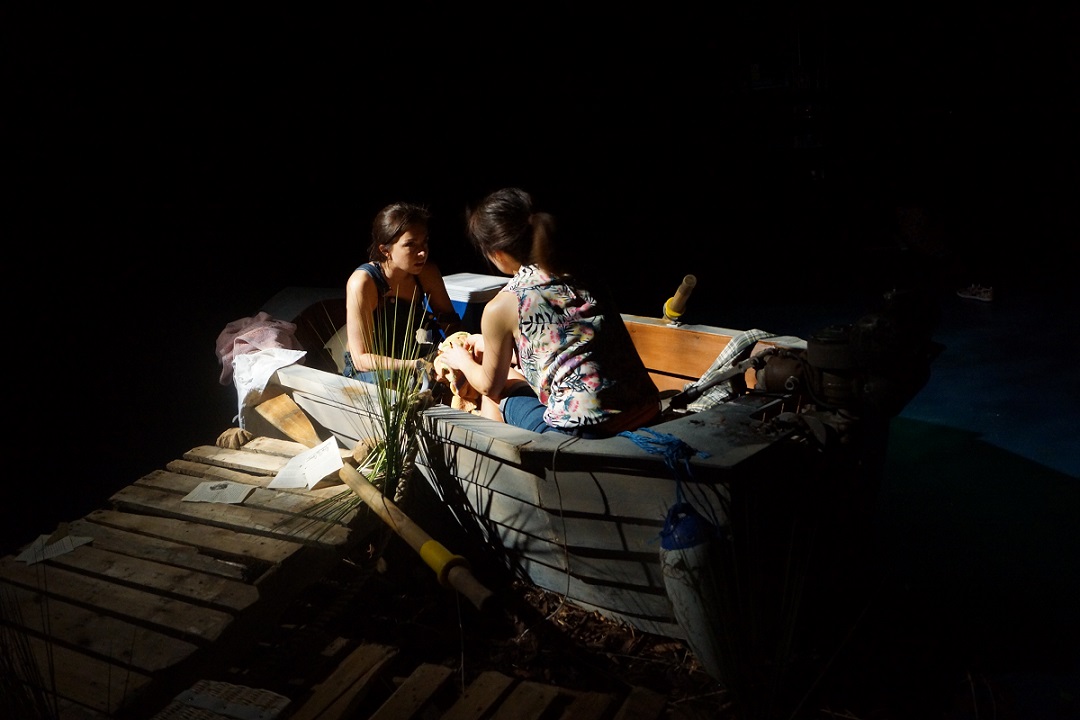
We could be forgiven, as Audrey Cefaly’s The Gulf begins, for thinking we’d stumbled on an idyllic scene. Two women sit by the water in what appears to be companionable silence: one fishing, the other sunbathing. It’s only when the silence is broken that we begin to realise the vast distance that separates Kendra and Betty, even when they’re sitting right next to each other. Stranded on a broken down fishing boat, as the light fades around them, the couple are forced for the first time to really face up to their problems and make some tough decisions about their future.

Photo credit: Rachael Cummings

The Gulf is an intimate and realistic portrayal of a relationship in crisis; like any couple, Betty and Kendra’s conversations keep circling back to the same few subjects, and when there’s nothing left to say they lapse into long, awkward silences. Unfortunately, in achieving this verisimilitude, the play sacrifices any sense of drama, and the lack of pace in Matthew Gould’s production means that much like the broken down boat the two women are stuck on, it ultimately doesn’t really go anywhere.

All of which is a pity, because the performances from Louisa Lytton and Anna Acton are very good. Both nail the distinctive Alabama accent, and we get a clear sense of both the journey their characters go on throughout the play, and the striking difference in their personalities. Betty (Acton) is an optimist, who always says what’s on her mind, and is on a mission to improve her own life but blind to the fact that her attempts to do the same for Kendra might be misconstrued as criticism. Kendra (Lytton), on the other hand, is quite content to stay where she’s comfortable; unlike Betty, she mostly keeps her thoughts to herself, but when pushed reveals a deep vulnerability that’s masked by her tough and at times deliberately provocative manner.

It’s also refreshing to see a play that depicts a same-sex relationship but doesn’t make it the main focus of the story. In fact Betty and Kendra’s sexuality is completely incidental to the plot: they could be two women, two men, a man and a woman, or any combination, and the issues they’re facing would still be exactly the same, because they go far deeper than gender or sexuality.

Photo credit: Rachael Cummings

Visually, the production is impressive in its detail – boat engine, picnic lunches, fish guts and all – although at times this contributes further to the slowing of the action; Betty’s careful preparation of a snack, for instance, pauses proceedings for a good couple of minutes, and is particularly frustrating because the audience can’t see what she’s doing. Mitchell Reeve’s lighting works very well, however, fading imperceptibly over the course of the 90 minutes, until the two characters end up sitting in near darkness.

There’s a lot to like about The Gulf, as it delves insightfully into what makes relationships work, and what makes them fail. Unfortunately, though, despite strong performances the play is let down by a lack of drama and pace, making it difficult to really engage with Betty and Kendra’s predicament – as much as we might want to.

Can’t see the map on iPhone? Try turning your phone to landscape and that should sort it. I don’t know why but I’m working on it… 😉