Review: Weald at Finborough Theatre

It’s a stereotype based – sadly – in fact that men aren’t very good at talking about their feelings. Inspired by statistics on male suicide compiled by the Campaign Against Living Miserably (CALM), playwright Daniel Foxsmith has created a short but incredibly powerful piece of work in Weald, presented by Snuff Box Theatre at the Finborough.

The story’s set in rural England, and opens as Jim returns home after six years in London, begging his late father’s friend, Sam, for a job at his livery yard. The older man grudgingly agrees, and the two throw themselves into their work, not only refusing to deal with their past problems but also avoiding the uncomfortable truths they’re now hiding from each other. But neither can run forever, and reality ultimately catches up with them as the play reaches a gripping and emotional climax.

Weald at Finborough Theatre
Photo credit: Alex Brenner

One of the biggest strengths of Weald is its casting of two actors who have genuine chemistry. David Crellin is the world weary Sam, a man so obsessed with history that he can’t look ahead to the future, while Dan Parr is a twitchy bundle of energy as Jim, putting on a show of bravado to hide his deep insecurities and fear of what lies ahead. It’s clear that Sam is a father figure to his young friend, but the relationship between the two ends up working both ways, and ultimately turning completely on its head as the story unfolds and the characters develop.

Bryony Shanahan’s direction allows these two fine performances to take centre stage, with no distractions. The actors use every inch of the intimate space, often springing from the stage and almost landing in the audience as they go about their work. And while we’re offered a glimpse into their world, nobody else is: other characters are alluded to but never actually enter the yard, and the horses are only ever present in the audience’s imagination. This heightens the sense that these two damaged souls are completely isolated from the rest of their community, and have no-one but each other to rely on for support.

Weald at Finborough Theatre
Photo credit: Alex Brenner

Weald is an important play, beautifully written and performed, that really highlights the struggle faced by many men to own up to their emotions. It’s clear from the start that something’s not right – Jim’s sudden reappearance, Sam’s refusal to answer the phone – and the play’s heartbreaking climax is a direct consequence of their inability to address their problems, just as the emotional conclusion offers a faint glimmer of hope. It’s not an easy play to watch, but it is one that deserves to be seen, leaving us as it does with a feeling of responsibility for the world we live in and the people we share it with.


Can’t see the map on iPhone? Try turning your phone to landscape and that should sort it. I don’t know why but I’m working on it… 😉

Review: Shakespeare As You (Might) Like It at Rosemary Branch

Wait, what just happened?

Honestly, I have no idea how to sum up what I just saw. Shakespeare As You (Might) Like It is a mish mash of party, cabaret and game show, with bits of serious drama thrown in for good measure. After enjoying free stoops of wine and sweet treats, unsuspecting audience members are called on to read lines, ring bells and pass parcels, and are occasionally hauled on stage to join the mayhem – all whilst wearing paper hats, found inside the party bags that are handed out at the door.

The fact that every single person willingly put their hat on, though, is a testament to the infectious enthusiasm and joy of both the show and its performers. Shook Up Shakespeare’s Roseanna Morris and Helen Watkinson are a natural double act, bouncing off each other (sometimes literally) as they engage in witty banter, play energetic party games, sing Shakespeare-inspired songs (written by Shane Rutherfoord-Jones) and reenact a few of the Bard’s best loved scenes.

Shakespeare as you (might) like it, Shook Up Shakespeare

It does all get a bit manic, and even slightly alarming, from time to time, and it’s never completely clear what’s planned and what’s just ad libbed on the spot – although I suspect it’s a mixture of the two. The two actors throw absolutely everything into their performance, backed by their ‘one-man, one-wo-man’ band, who often look as bemused as the rest of us.

The show is described as a ‘Quad Centenary Wake’ and is a light-hearted tribute to the great playwright, poet and party planner that was William Shakespeare. I’m not sure what he would have made of it, but hopefully he would have been entertained – and perhaps only mildly outraged by the criticism of his poetry (which we established, through extensive research, ‘doesn’t even rhyme!’). Despite a scene that seems to suggest otherwise, these ladies clearly know their Shakespeare plays, and it’s fun to try and spot all the references to his works casually dropped in throughout the show.

If you’re a diehard fan of ‘straight Shakespeare’, these guys may not be for you; they’re unconventional, unpredictable and often very, very silly, mixing scenes from different plays with wild abandon. Equally, if you dislike audience participation, you may not feel entirely comfortable – although in reality nobody’s asked to do anything too terrifying.

But if you enjoy a bit of randomness, you fancy some light entertainment with a Shakespearean flavour, or you just like the occasional stoop of wine and ‘much ado about muffin’ (I did enjoy that one, I must admit), then they may be right up your street. This particular show ended its run at the Rosemary Branch Theatre this evening, but keep an eye on Shook Up Shakespeare to see what’s coming up next.


Can’t see the map on iPhone? Try turning your phone to landscape and that should sort it. I don’t know why but I’m working on it… 😉

Review: To She Or Not To She at Lyric Hammersmith

About ten months ago, I was at a scratch night at Morley College, where I watched the first fifteen minutes of a very funny one-woman show about a teenage girl who wants to be Hamlet in her school play, but is devastated to see the role going to an inferior actor – who just happens to be a boy.

Five months later, I was back at Morley to review the full show before it went up to Edinburgh, and was surprised by the direction it had taken. Instead of a riotous comedy about a woman playing Shakespeare’s men, the piece had developed into an honest and brave (but still funny) account of the difficulties faced by female actors in the theatre industry through one woman’s personal experience.

Last night, Joue le Genre‘s To She Or Not To She was back in London, playing to a sell-out crowd as part of Evolution at the Lyric Hammersmith, and I was keen to see how it had developed both during the Edinburgh run and since, under its new director Katharina Reinthaller.

To She Or Not To She, Joue le Genre

To She Or Not To She is the story of actor Emma Bentley, who plays various versions of herself at ages 14, 19, 23 and 24, as well as a host of other colourful characters from her past. Emma’s a natural comedian, and has no problem with joining the audience in laughing at herself – although even she seemed taken aback last night at how popular some of her one-liners were. Much of these are in-jokes for either the theatre crowd or the women in the audience, but none are so specialist that they can’t be appreciated by anyone who doesn’t fall into one of those categories.

Emma’s confident, natural performance and openness about her own shortcomings and disappointments – as an actor and a woman – mean that by the time we arrive at the serious heart of the show, the audience is fully invested and willing to listen, not just to Emma’s story but also to the other female actors who’ve supplied verbatim accounts of their experiences in the industry, for a scene that marks the show’s turning point from pure comedy to something much darker.

Under its new director, To She Or Not To She has been reworked – so gone is the record player that used to open the show, and instead we see Emma indulging in a bit of secret Shakespeare fangirling whilst mopping floors at the coffee shop where she works to pay the bills. This, it turns out, is the present day, and acts as a sobering backdrop to the younger Emma’s optimism as she chats excitedly to the audience about her future prospects.

It’s a privilege to have seen To She Or Not To She develop from its very early days into the show it is now – one that’s really fun to watch, but also has a clear and powerful political message. At a time when equality in acting is a hotly debated issue, it’s also very timely, and while Emma herself recognises that her own disappointments may not be the most shocking or serious, they nonetheless pave the way for an important discussion that needs to take place.


Can’t see the map on iPhone? Try turning your phone to landscape and that should sort it. I don’t know why but I’m working on it… 😉

Review: The Long Road South at King’s Head Theatre

Paul Minx was inspired to write The Long Road South in tribute to Carney, a man who worked for his family in Indiana for almost 15 years, and became a ‘shy second father’ to the young boy. And yet despite this close relationship, Minx knows very little about Carney’s personal life, because he was advised ‘not to pry, particularly with “the help”‘.

This contradiction is recreated in the play through a brief glimpse into the lives of the white Price family and their black ‘help’. Andre and Grace are preparing to leave for Alabama to join the civil rights movement – but as Andre fights for the courage to ask for his final wages, the Price’s teenage daughter Ivy tries anything to make him stay, and her mother Carol Ann heads towards a breakdown, it seems increasingly unlikely that they’ll ever be able to get away.

The Long Road South, King's Head Theatre
Photo credit: Truan Munro

A truly excellent cast, directed by Sarah Berger, draw us into the complex relationships between the family members and their employees, revealing deep personal issues on both sides, where nothing is quite as it seems. Andre (Cornelius Macarthy) is mild-mannered and deeply religious, but fighting an endless battle against the demons who nearly destroyed him, whilst trying to be the man aspiring writer Grace (Krissi Bohn) wants him to be. Ivy (Lydea Perkins) seems like a self-centred brat, until we realise she’s just seeking the attention she doesn’t get from her parents. And Carol Ann (Imogen Stubbs), far from being a bored housewife, is actually a depressed alcoholic, missing her absent son and desperate for her bullying husband Jake (Michael Brandon) to take the pain away.

The drama created by putting these five damaged individuals together is fascinating, with the Prices singled out as, while maybe not the villains, definitely not the heroes of the piece. (They also get most of the laughs – of which there are many – but always at them rather than with them.) Meanwhile Andre and Grace, though far from perfect themselves, behave with a dignity that only serves to highlight the failings of their employers. It’s quite clear which side we’re expected to be on, and it’s pretty easy to oblige.

Photo credit: Truan Munro

Though it’s often unexpectedly funny, at its heart The Long Road South, at King’s Head Theatre until 30th January, is a serious and heartfelt depiction of race, religion and family values in 1960s America. Maybe it doesn’t bring any startling new insights to the discussion of these well-worn issues – but that’s not really the point. The play is intended to pay personal tribute to a man the writer loved but never truly got to know, and it does so in fine and truly entertaining style.


Can’t see the map on iPhone? Try turning your phone to landscape and that should sort it. I don’t know why but I’m working on it… 😉

Review: Big Brother Blitzkrieg at King’s Head Theatre

Could Adolf Hitler win Big Brother?

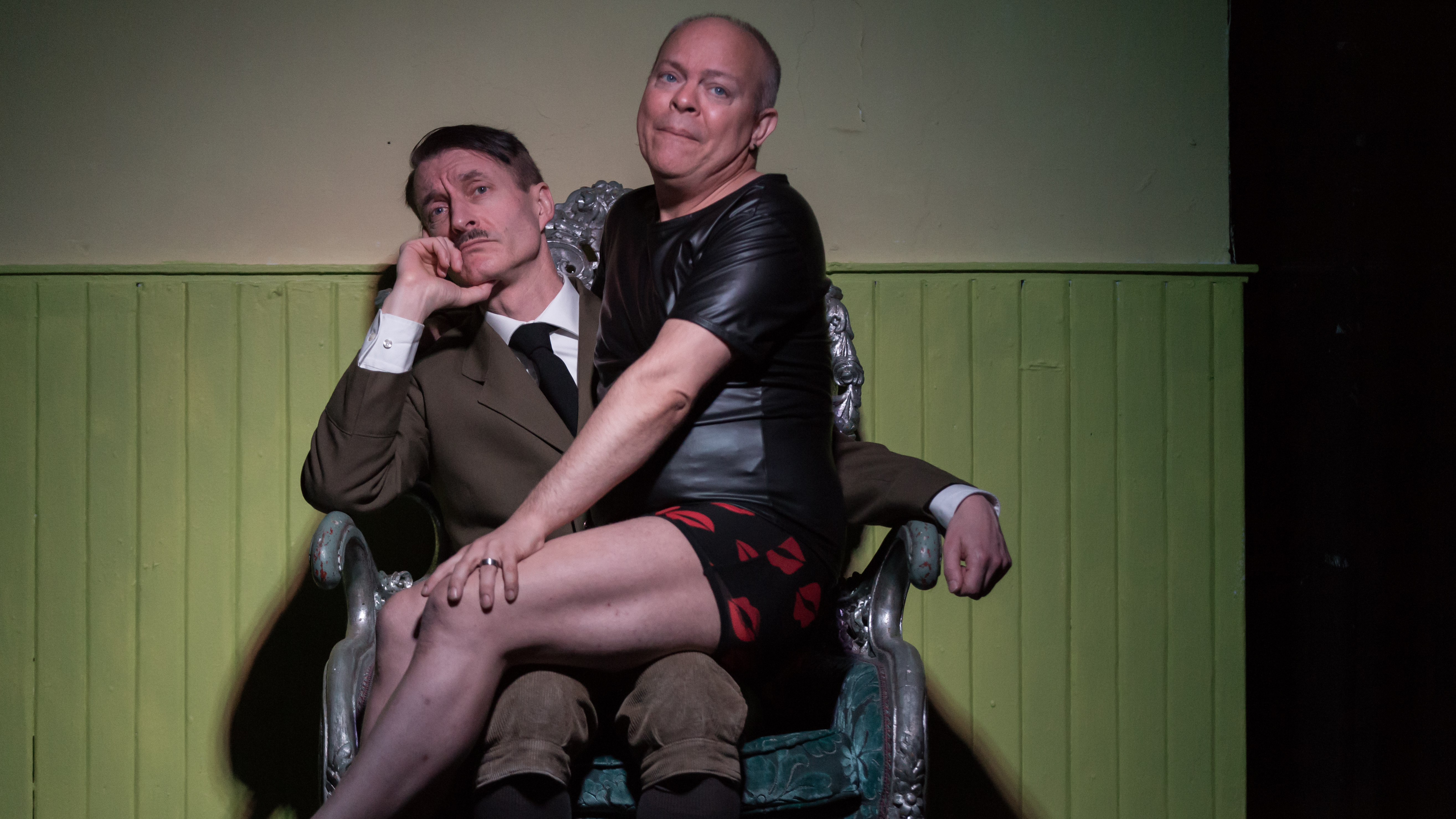
Yes, you read that correctly. Big Brother Blitzkrieg, at King’s Head Theatre until 30th January, is a satirical play by Hew Rous Eyre and Max Elton, in which a confused Hitler wakes up to find himself the newest contestant on the infamous reality TV show. Bemused by the pointless tasks and petty squabbles, and with an instant hatred for mum of three, Rachel, it’s not long before Hitler begins to subtly manipulate his fellow housemates – and the British public – with alarming ease.

Big Brother Blitzkrieg, Bitter Pill
Photo credit: Jack Fisher

The idea is bizarre, and the show takes arguably a little too long to make its point – though there’s certainly plenty of fun to be had along the way. But in the end the message, encapsulated in the powerfully visual final scene, is quietly horrifying. We’d like to say that the rise of Hitler could never happen again, that we’ve learnt our lesson – but the truth is, whether it’s a Big Brother contestant or Donald Trump, it turns out human beings can still be that easily led.

Stephen Chance is brilliant as Hitler, with a seemingly limitless range of facial expressions and a flawless accent. His performance brims with the charisma that won over so many, and yet also highlights the character defects – temper tantrums, stubbornness, petulance – of this legendary historical figure, who at the end of the day was just a man, and a pretty ridiculous one at that.

He’s joined by an eccentric cast of housemates, each of whom is necessarily a bit one-dimensional, a ticked box on the reality TV checklist: gay guy (Neil Summerville), young rapper (Kit Loyd), feminist (Hannah Douglas) and PR superwoman (Jenny Johns). The only one who doesn’t seem to fit is Rachel (Tracey Ann Wood), who just seems like a nice person, without any particular ‘angle’ – and is consequently derided by her fellow housemates as boring and weak.

Big Brother Blitzkrieg, Bitter Pill
Photo credit: Jack Fisher

Leaving aside Hitler for a moment, the parody of Big Brother (who’s represented by the calm, unflappable voice of George Smith) is great fun, whether you’re a fan of the show or not. But it’s also, depressingly, not a parody at all; in fact, if anything, it’s pretty tame compared to some of the things that actually go on – just look at the bizarre mix-up on CBB this week over David Bowie’s death. And even though the play’s housemates openly admit that the show’s rubbish and nobody watches it any more, they all still desperately want to win. Never mind Hitler – what does that say about the human race?

Big Brother Blitzkrieg is almost like two plays in one, taking on Hitler and Big Brother simultaneously. It’s great fun and quite, quite bonkers – the image of a Marigolds-clad Hitler clutching a feather duster is one I won’t soon forget. But Bitter Pill’s production also has a serious message, which – once it becomes clear – is unsettling and should give any modern audience pause for thought.


Can’t see the map on iPhone? Try turning your phone to landscape and that should sort it. I don’t know why but I’m working on it… 😉