Review: The Return of the Marionettes at Bridewell Theatre

Welcome to the 1960s, where girl group The Marionettes are taking to the stage at the height of their fame. But as they come to the end of their final number, one of the girls runs from the stage in tears. And that, we learn from their manager George Ellis, is the end of the Marionettes.

Until now (well – 1984, anyway): 20 years later, the girls are back together for a one-off reunion show that could see their career picking up where they left off. But with so much history to work through – personal and professional – can they put the past behind them and deliver the show their adoring fans have been waiting for?

13412175_10154979027938289_5124830498646302303_o

Writers Peter and Phillip Ley of Tower Theatre Company take us back to the start of the story, introducing us to four giggling schoolgirls who call themselves the Moonbeams, and charting their progress to the top. Along the way, we’re treated to 18 original songs that capture the spirit of the 60s and – like all the best songs from that period – are easy to pick up and totally infectious. (Two days later, I’m still singing the Marionettes’ first big hit, Dynamite.) Polished performances from the cast, along with Ruth Sullivan’s choreography and costumes from Lynda Twidale, mean the musical numbers do a great job of transporting us back in time.
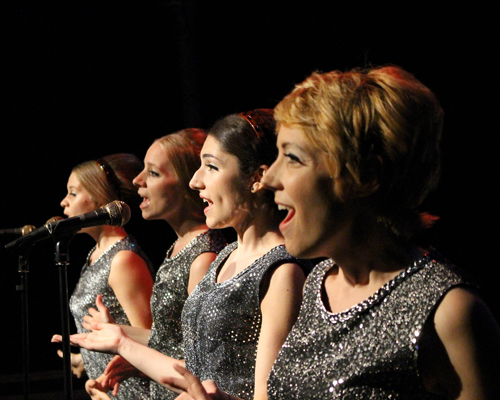
Photo credit: Robert Piwko

A dual cast of actresses play the Marionettes then and now, which enables the two groups to share the stage, with the older women often observing their younger selves and providing commentary on events as they unfold. Angharad Ormond and Stella Henney earn their place as lead vocalist Cathy with some impressive performances, but both also reveal a touching vulnerability hidden beneath a veneer of false confidence. Meanwhile Fiorella Osborne and Annette Ross show the fiery passion and determination that have always made Mary the true leader of the Marionettes.

What works really well is the way the dynamic of the group picks up where it left off 20 years ago – the professional tension between Mary and Cathy continues, there’s tension of a whole other kind between Mary and George, and the Meltzer sisters (Olivia Barton-Fisher and Jessica O’Toole as the younger, Deborah Ley and Annemarie Fearnley as the older) are enjoying the moment and providing light relief with their banter. The transition is aided by the constant, reassuring presence of Brad Johnson as both the older and younger George, along with Julian Farrance as heartless record boss Allan Tyrell.
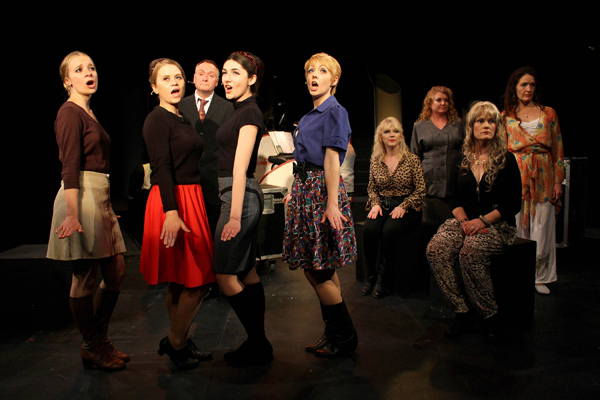
Photo credit: Robert Piwko

Despite a few small stumbles in the spoken scenes, and some sound issues – the live band, led by musical director Colin Guthrie, are fabulous but occasionally drown out the actors – there are a lot of great things about this show, and opening with the break-up of the band creates an enjoyable suspense as we wait to see not only what eventually proved to be the last straw, but whether the women can now overcome their differences. It would have been nice to see more of the simmering romance between Mary and George; considering their feelings for each other are still present and obvious to everyone 20 years later, there are very few references to it in the flashbacks. And while it’s a challenge to recreate the sensation of a huge sell-out gig in an intimate fringe setting, there’s a lovely moment with some crazy fans, which helps demonstrate just how big the group were at the height of their fame.

The Return of the Marionettes is a thoroughly enjoyable take on the familiar ‘rags to riches to ruin to redemption’ story we’ve come to know and love from shows like Jersey Boys and Dreamgirls. With a soundtrack of irresistible songs, some strong vocal performances and a rousing finale, this is a show with great potential, which is pretty much guaranteed to send audiences out with a smile on their face and a skip in their step.


Can’t see the map on iPhone? Try turning your phone to landscape and that should sort it. I don’t know why but I’m working on it… 😉

Interview: Les Femmes Ridicule, In The Gut

Les Femmes Ridicule are Alice Robinson, Siobhan McKiernan and Margot Courtemanche, who together aim to create highly entertaining, moving and fresh work that directly engages with their audience. Following recent performances at the Brighton Festival, the trio are about to bring their show In The Gut to London for a short tour.

“In The Gut broaches the subjects of pregnancy, childbirth and parenthood; tackling tragic themes, such as miscarriage and infertility, with a thoughtful and comedic approach,” explains director Alice Robinson. “The audience will be introduced to different scenarios that offer alternative perspectives and approaches to the subjects – from the ridiculous and strange, to the dramatic and poignant.

“The show came about as an off shoot of another project that failed, which we’re really glad about! The three of us found we had so much to say on the topic of fertility and potential motherhood, and that we shared a slightly dark and silly sense of humour.”

In The Gut, Les Femmes Ridicules

In The Gut is Les Femmes Ridicules’ first show as a trio, and they’ve enjoyed working together. “It’s been really good! We’ve devised the show from our collective imaginations and passions, and that’s always a big process. As devisers our process is ongoing as we meet our audiences and continue to respond to them. We’ve laughed a lot in rehearsals and been really honest throughout, which is essential.”

The company hope to raise awareness for miscarriages in all relationships and are delighted to have the support of the Miscarriage Association and the Maternal Mental Health Alliance. “They really helped us in the research stage and opened our eyes to the impact of miscarriage on men, women and their families. We have been handing out Miscarriage Association leaflets at the shows and hope to promote the incredible services that they offer.

“In the Gut is direct in its staging of the fears around pregnancy. It doesn’t take sides, or preach, it’s unafraid of looking ugly, of moving its audiences and of playing with them.”

The RADA-trained trio’s creative process starts with simple improvisation. “I just shout things – ideas, thoughts, questions – at the other two and they plough on, adapting to what’s said in their own way. We all feed off each other’s ideas and we ended up with something we could never imagine on our own. Everything starts with a hunch, a question or something really silly like trying to outdo each other with a mime of the worst birth possible… and off we go!

“We think comedy is a brilliant way to open up a discussion, to heal and to set us free! There is humour in everything and releasing or acknowledging that is more interesting than ignoring it. Our audiences have taken the show really well, in that they have responded differently and personally. They have laughed and been moved. We’ve had midwives, parents, grandparents, people who don’t want children, young adults, people who do and people who can’t. There’s something for everyone, and everyone has an opinion on the subject matter, which is a great start.”

In The Gut is at the London Clown Festival on 12th June, the Blue Elephant Theatre from 14th-18th June, and the RADA Festival at John Gielgud Theatre on 25th and 29th June.

Interview: Clementine Lovell, Pop-up Opera

Pop-up Opera was established in 2011 with the goal of encouraging more people to see and enjoy opera. After recently performing their first ever tragedy, I Capuleti e i Montecchi, the company return to comedy for their new production of Rossini’s Il Barbiere di Siviglia, which will – as always – take them to some unique and unforgettable venues around the UK.

Director Clementine Lovell founded Pop-up Opera on her return from living in Italy. “When I began training as an opera singer I had mixed reactions from my friends. Opera wasn’t really their thing – one even claimed to be ‘allergic’ to it. That stayed with me, and I wanted to prove them wrong, to show them that opera could be magical, hilarious, devastating or moving.

“Opera is so much a part of Italian culture, so broadly appreciated, and is performed everywhere, not just in the big houses. I grew up in a small village in the UK miles from an opera house. We never went to see it, it wasn’t an option. My uncle has a barn where he hosts folk and blues events and we put on an opera there for a largely non opera going audience. They loved it. It made me think about how the setting can have a bearing on people’s enjoyment, or their willingness to give it a go.”

Photo credit: Richard Lakos

Each new space presents a unique challenge: “The production grows and evolves as it pops up in different places. We stage it in the rehearsal room and then adapt it to embrace each venue, so every night is different. The performance spaces vary wildly in size, shape, acoustic, feeling. We get in to the space on the day and start working out the entrances, exits, how to involve the audience… The performers have to think on their feet and be willing to allow some freedom and spontaneity. I think this keeps it fresh and creates a very special atmosphere.”

Clementine has countless happy memories of the unusual venues in which the company have performed. “One of our first venues was a boat made of scrap metal in Shoreham. The stairs were made out of an old car and the room we performed in had previously been part of a bus. We once performed 100ft underground in Clearwell Caves – to make some of the entrances the singers had to grope their way down a very dark tunnel with only headlamps to light the way, and one of them was terrified of bats!

“Another venue was the ruins of Raglan castle, where our backstage area was a crumbled down tower… We’ve also done shows in the Brunel Museum Thames Tunnel Shaft several times. It used to be more challenging to get in there – you had to crawl through a tiny entranceway and then down a scaffold stairway. It was always a nightmare getting props down there. We love going to the Garlic Farm on the Isle of Wight, the audience always go crazy for it. But my favourite venue will always be our original, the cider barn in Herefordshire. You can have a glass of cider from the Ross-on-Wye Cider & Perry Co, and the atmosphere is always fantastic.”

Photo credit: Richard Lakos

Il Barbiere di Siviglia is one of the world’s best-loved operas, but for those of us who may not know what it’s all about: “It’s the story of Count Almaviva, who wants Rosina to fall in love with him for who he is, not for his money or fame, so he conceals his true identity. In order to win her he must also get past her guardian, so many ridiculous obstacles and disguises ensue before he can get the girl.

“Our version is unique because it’s truly ‘pop-up’ in the way it can adapt to each space. We want to embrace the fact that we have an electric piano, and that we don’t have the budget of the Royal Opera House. We’ve stripped the costume and set right back so it allows the music and the story to shine through. We want to allow those things to take front stage, to show people that you don’t need all this extra stuff to make a comedy: with brilliant singing and acting and by involving the audience you can still create an amazing show.”

The opera will be sung in its original Italian with English captions, presented in Pop-up Opera’s signature style: “We believe that you can still make opera accessible when performed in the original language. The music, the intentions of the actors, the interaction between the characters and the power of the drama get the story across. The captions are there to complement, not to detract. They keep the audience broadly abreast of the story but don’t demand their attention all the time. With a comedy the captions can add another layer of humour, and we can play around with the modern context. In our last production, which was a drama, we kept the translation more ‘straight’ but still with the same approach of captions rather than a full text translated into continuous surtitles.”

As a company, Pop-up Opera aim to broaden opera’s appeal and challenge the perception that it’s stuffy and elitist. “We want to make our productions engaging, exciting, hilarious, dramatic, moving… We hope audiences go away having laughed until their cheeks ache or having been moved to tears, that they will have been drawn into the story and connected with its characters. We hope they take away with them a thirst for more opera, whether it’s by fringe companies or at the Royal Opera House, and a different attitude towards what they thought opera was about or represented. Never been to the opera? Come to one of our shows! You won’t regret it.”

Il Barbiere di Siviglia can be seen around the UK until 1st September 2016 – check the website for full dates and venues.


Review: Titanic at Charing Cross Theatre

There are a few events in history that we all just sort of know about, without necessarily remembering how or why. Henry VIII and his wives would be one; the World Wars, obviously… and the sinking of the Titanic is another. It’s an event so legendary, and so much a part of our national history, that sometimes we forget the sheer scale of the tragedy that claimed 1,517 lives in the early hours of April 15th, 1912.

This probably wasn’t helped by James Cameron’s blockbuster movie – which happened to coincide with my teenage years, so I make no apology for the fact I saw it five times at the cinema. As much as we all cried when she let go (admit it), the film went so overboard – sorry – on the special effects that as Celine Dion sang us out, the story of the Titanic still felt like just that: a story.

Photo credit: Scott Rylander

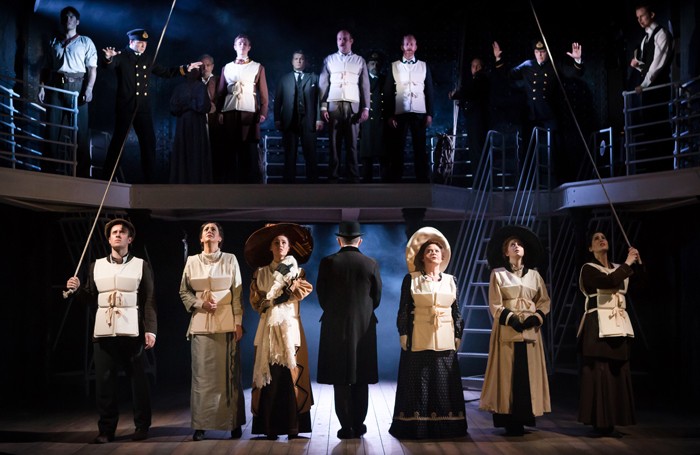
Maury Yeston and Peter Stone’s Tony award-winning musical, which was first performed on Broadway in 1997, approaches telling the story in a similar way to the movie it preceded. Act 1 (pre-iceberg) is considerably longer than Act 2, setting the scene and introducing us to the lives, loves, hopes and fears of a cross-section of the people aboard the ship: passengers – from first, second and third class, and all based on real people – and crew, from Barrett the stoker all the way up to Captain Smith. But with no Jack and Rose to hog the limelight, and despite the need to keep over twenty characters straight in our heads, we care about the fate of every single one. There’s also a lovely touch at the end of the show, which ensures we leave thinking not just about the people on stage, but about everyone who perished in those icy Atlantic waters.

Of course no portrayal of the Titanic would be complete without an element of social commentary; the theme of class runs throughout the show, without ever lecturing (because, let’s be honest, it doesn’t really need to). Heartbreakingly, it’s the third class passengers who are most likeable, and have the most to look forward to, yet we know from the start it’ll be they who are more likely to perish, simply because of where they come from.

Photo credit: Scott Rylander

It’s quite a feat to not only recreate on stage a ship with over 2,000 people on board, but then to sink it too. And yet somehow, despite the relatively intimate setting and with surprisingly little in the way of special effects, Thom Southerland’s production feels like an epic. Partly this is down to the incredible cast, who rotate through a multitude of roles, costumes and accents, giving the sensation there are hundreds of them instead of a couple of dozen. And it’s partly a result of David Woodhead’s multi-level and constantly moving set, which brings us right on board the Titanic, so that we feel the same awe as the passengers and crew on their first sighting.

But it’s mostly due to Maury Yeston’s music, with new arrangements by Ian Weinberger and directed by Joanna Cichonska, which is nothing short of exquisite. The show is a true ensemble piece, and while the solo numbers are fantastic, it’s when the cast and orchestra all come together – whether in hope as the ship sets sail, panic as it begins to sink, or grief as loved ones are separated – that the music quite literally soars, filling every inch of the space with its stunning harmonies.

Unlike its ill-fated subject, Titanic looks set to repeat the resounding triumph of its 2013 run at Southwark Playhouse. It’s a show that deserves a larger stage and a much wider audience. I know I’m gushing, but that’s how much I loved it – and I’m a grown-up now (or so they tell me), so I can’t even put my reaction down to a teenage crush on Leonardo DiCaprio.

Thank you so much to boxoffice.co.uk for the opportunity to review this show.

Review: Off the Kings Road at Jermyn Street Theatre

Off The Kings Road is the first full-length play from former Hollywood publicist Neil Koenigsberg. A touching reflection on grief, companionship and getting older, the play sees American widower Matt Browne check into a small hotel in London, where he intends to spend some quiet time rebuilding his life following the death of his adored wife, Betty, from cancer. But London has other plans for Matt, and the resulting journey of self-discovery is at once laugh out loud funny and powerfully moving.

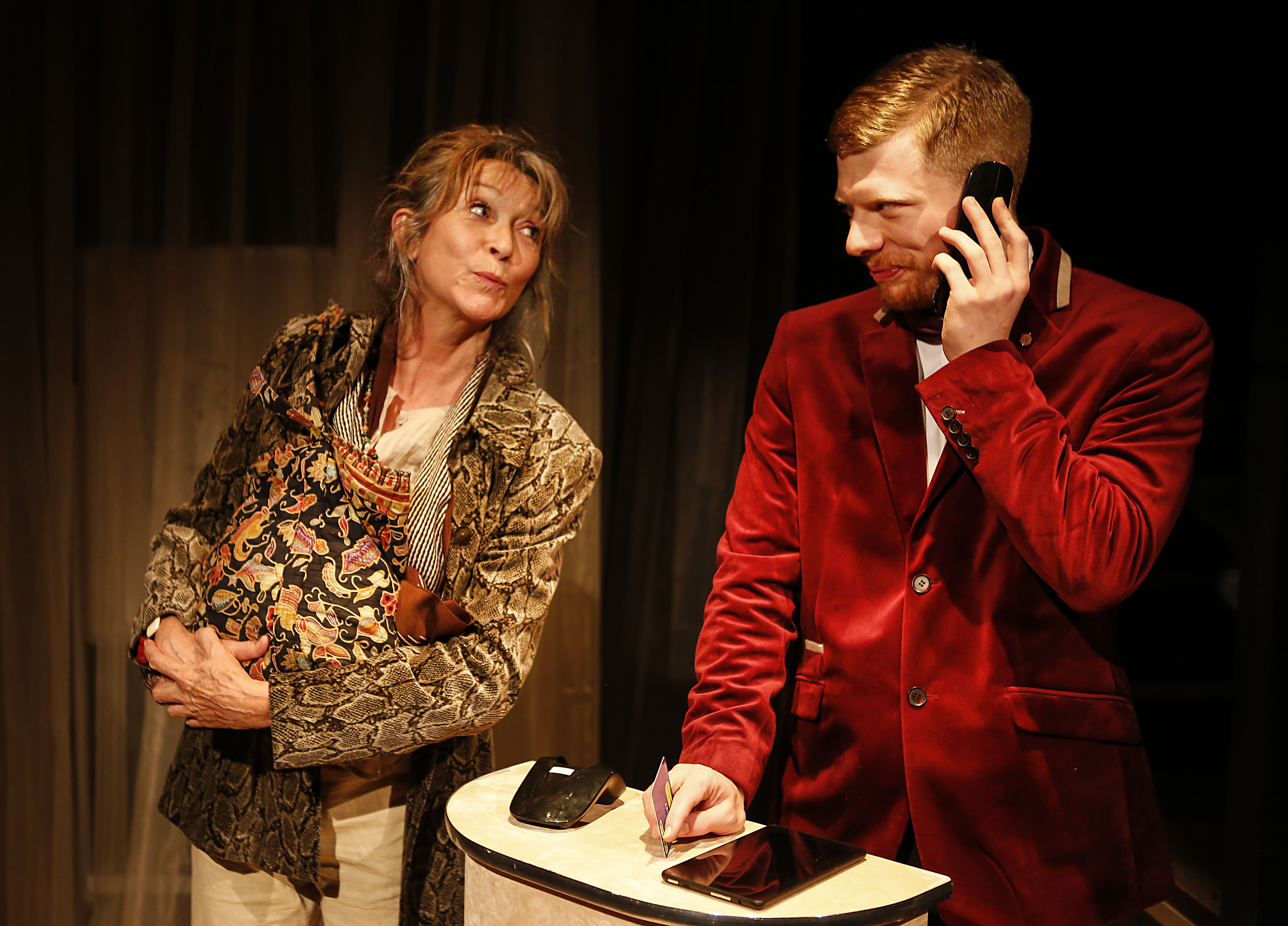
Michael Brandon leads the cast as Matt with a performance that perfectly captures his character’s fragility, but also his humour and compassion; we can’t help but like this genuinely good guy who’s just trying to make his way in a new, unfamiliar world. Along the way he meets some interesting characters, among them Freddie, the hotel concierge, and Ellen, a crazy cat lady from down the hall. Luke Pitman and Cherie Lunghi shine in these roles; as a long-term resident, Ellen has a close friendship with Freddie, and the affectionate scenes they share on stage are wonderful to watch. Though the two roles are predominantly humorous ones, with both actors revelling in their characters’ eccentricities, there are hidden depths here too: Freddie, while often a touch over-enthusiastic, is very good at his job and genuinely cares about his guests’ welfare, while Ellen turns out to have a lot more in common with Matt than he realises.

Photo credit: Pamela Raith

Diana Dimitrovici also appears as a Russian prostitute, the intriguingly named Sheena McDougal. Following their first encounter in her flat, the relationship between Matt and Sheena moves in a direction that’s not wholly unexpected, but no less touching for its predictability, and Dimitrovici gives a strong performance as a young woman disguising her own vulnerability with a veneer of toughness.

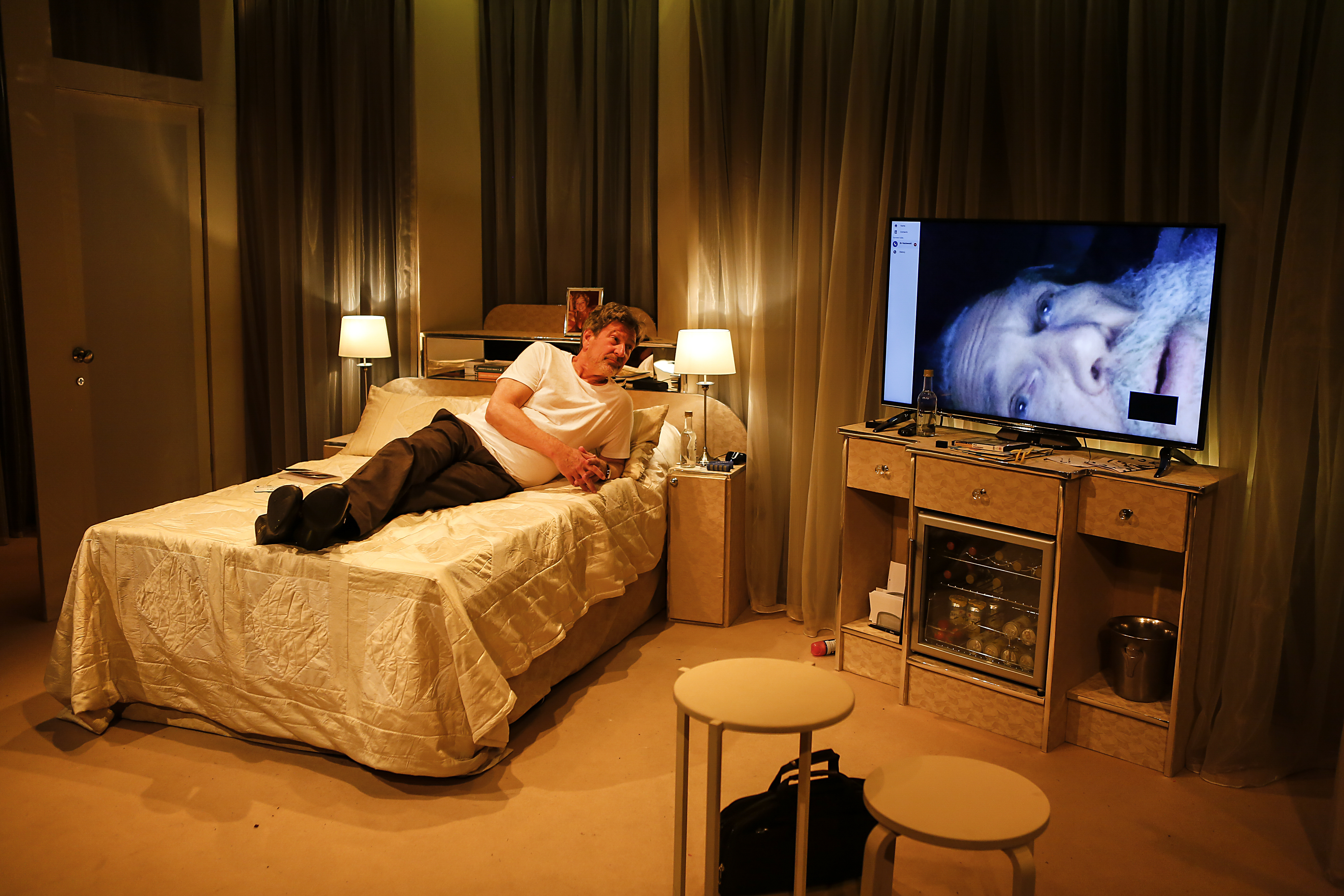
In a unique and thoroughly modern twist, the cast of Alan Cohen’s production includes a fifth member, one who never sets foot on the stage; Oscar winner Jeff Bridges ‘e-appears’ as psychiatrist Dr Kozlowski, with whom Matt has several Skype calls throughout the play. There’s comedy gold in these scenes, partly in watching the two men attempt to use the technology, but mostly because Kozlowski is a spectacularly bad psychiatrist, who’s going through his own marital difficulties, and seems permanently a bit stoned. But where he fails as a doctor, he succeeds as a friend – proof that we don’t always need someone with all the answers; sometimes we just need somebody who’ll listen when things go wrong. These scenes fit so naturally within the live action, and Brandon interacts with the screen so well, that it’s almost possible to forget Bridges’ appearance is pre-recorded.

Photo credit: Pamela Raith

At its heart, Koenigsberg’s play is a celebration of human relationships, in all their wonderful weirdness. Matt starts out as a lonely figure, but as soon as he allows other people in, his life begins to change (mostly) for the better. Like the Ingmar Bergman movie referenced throughout the play, this bittersweet comedy is the story of a man on a journey, both physical and emotional – and like its characters, it’s very hard not to love.


Can’t see the map on iPhone? Try turning your phone to landscape and that should sort it. I don’t know why but I’m working on it… 😉