Interview: Elliot Clay, The State of Things

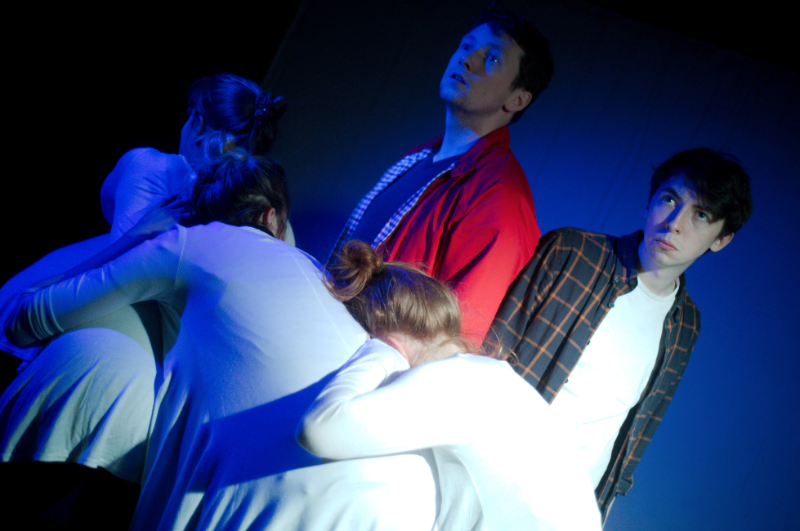
The State of Things is a new British musical, written by The AC Group’s artistic directors Elliot Clay and Thomas Attwood. Inspired by their own schooldays nostalgia and the current political situation, it’s the story of a high school band who find out the school is being forced to cut its music course. The show follows the young people’s fight to save their course, as they learn to live and love in austerity Britain.

“Myself and Thomas – the show’s book writer and director – grew up together, so The State of Things is semi-autobiographical, based on our own experiences and encounters with austerity both at school and at home,” explains Elliot. “Arts funding, both in schools and in general, seems to be falling every day the current government is in power. I’ve had people contacting me on Twitter, some of them music teachers, expressing their dismay at the effects of austerity on funding in schools, particularly in creative subjects.

“It’s also a musical about young people in the north, written by young people from the north – it’s these stories that need to be voiced. I hope that the story we tell will, at the very least, open up a discussion with members of our audience, no matter where they sit on the political spectrum. Theatre alone can’t change the world, but it can affect the way people think, talk and vote.”

As composer and lyricist, Elliot’s been enjoying the chance to work with different musical styles: “In terms of musical inspiration, it was a chance to write in styles that you usually wouldn’t find work in a musical. Because all the songs in the show are the songs that the ‘band’ have written, it allowed me to draw on inspiration from The Rolling Stones, Adele, The Beatles, Coldplay, and of course put in some crazy guitar solos!”

Following The AC Group’s acclaimed productions of Macbeth and Side By Side By Sondheim, the company are looking forward – with a little trepidation – to returning to the Brockley Jack Studio Theatre, this time with an original piece: “In the words of Stephen Sondheim – ‘excited and scared’!” admits Elliot. “It’s a real privilege to shape every artistic detail of the production, but we couldn’t do it without the brilliance of our creative team and cast.

“I’m incredibly lucky to be working with a supremely talented cast of young actors, all of whom play multiple instruments live on stage every night. It’s such a joy telling this story and sharing the stage with them.”

Surprisingly, the show has only been in development for three months. “Kate Bannister, the artistic director of the Jack Studio let us know in May that there was potentially a free slot for a production in September, and we instantly knew we wanted to write and stage The State of Things,” says Elliot. “Since then the ensuing three months have been a wonderful, crazy and thrilling blur.”

The AC Group was founded by Elliot and Thomas in 2014, when they staged a sell-out musical theatre concert in Covent Garden, with a cast and orchestra of over 50. “Since then we’ve been lucky enough to stage revivals such as the 40th anniversary production of Side By Side By Sondheim at the Jack Studio and Theatre Royal Drury Lane, and Macbeth, which was nominated for 2 off-West End awards – alongside developing our new writing. It’s been an exciting journey so far and we’d love to see you at the premiere of The State of Things.”

Book now for The State of Things at the Brockley Jack Studio Theatre from 7th-23rd September.
Interview: Douglas Baker, Dante’s Divine Comedy

So It Goes Theatre return to Barons Court next month with their 21st century interpretation of Dante’s Divine Comedy. Adapted from the 700-year-old narrative poem, it’s the story of Dante’s quest to rediscover the reasons for living by reuniting with his lost childhood love Beatrice; to do this he’s taken on a tour of hell, purgatory and heaven by mysterious stranger Virgil. “Naturally there’s loads to explore: faith, morality, friendship, redemption. You name it, there’s a whole world inside this show,” says director Douglas Baker.

Funnily enough, Douglas didn’t originally set out to adapt Dante’s classic poem. “I’m embarrassed to say it was basically a complete accident,” he admits. “I had in my head an entirely different piece of source material – which I won’t go into now because it may surface in the near future. However, when I arrived at the Barons Court, I knew instantly it wouldn’t work there, so I had a mad weekend reading lots of different texts to try and find something else to do.

“I wanted something that was seriously old, out of copyright, brimming with theatrical potential. There was one particularly desperate moment where I was considering stringing all Shakespeare’s sonnets together into a narrative; thank God I found the Divine Comedy. As I started reading it, I couldn’t put it down. It drew me in with every passage. The pace of the thing – despite its hefty length – is incredible.”

Despite its appeal, turning Dante’s original poem into a 90-minute play for a 21st century audience came with some pretty big challenges. “I don’t want to give too much away but I think there were three big problems,” says Douglas. “Firstly, trying to create a dramatic arc in a poem that is essentially a series of meetings where the main character simply accepts what he sees as truth; structurally this is so boring and doesn’t make so much sense as a coherent story. So we’ve flipped, rearranged and cut down lots in order to – fingers crossed – make an emotionally believable journey.

“Secondly, we wanted a culture in the rehearsal room where we worked openly with only dialogue on the page. So it was a challenge to try not premeditating what I thought it would look like on stage. Even though scenes were brimming with potential, I didn’t want to lock us into something that we couldn’t achieve. So finding that balance between honouring both the text and the devising process was tricky, but hopefully we’ve made it work.

“The other main problem was trying to present medieval morality sympathetically. I quickly saw that it was impossible, so as a result we’ve had to take some liberties. Our Dante is younger and more rebellious. I thought that youthful mindset could work because we the audience are basically seeing this stuffy old fashioned world through Dante’s eyes, so we can hopefully justify the difference between the Dante in the poem and the Dante we present on stage. The story is the same, but Dante’s feelings towards it have been modernised.”

Douglas is looking forward to introducing new audiences to Dante’s work, and says prior knowledge of the Divine Comedy isn’t a must: “I would say not. Part of the attraction to the poem was the feeling that many people knew of it, but not in any real detail. There’s something incredibly exciting about introducing people to a dusty old book for the first time; perhaps our interpretation will encourage people to read it for themselves and come to their own understanding about morality or the afterlife. I hope people will see our piece as a series of questions rather than assertions. The hope is we can ignite curiosities that will push people to reach their own conclusions.”

The show returns to Barons Court for a second time following a well-received run in April. “Being back is strangely unnerving,” says Douglas. “We always forget how small the stage is, so it requires seriously precise coordination to keep things visually interesting. Luckily our movement director Matthew is a genius at utilising space in interesting ways, so your eye is always drawn correctly. Other than that it’s just been a case of balancing creating with re-creating, we don’t want to just redo the original production but rather build on it and improve.”

This latest run, which opens on 5th September, sees almost all of the seven-strong cast reprise their roles. “They are the most generous people you could ever hope to meet,” says Douglas. “The bond between performer and director can be so fragile if egos are at play. If a cast don’t trust the director they will seize up and work only for themselves. But these cast members work for each other, they are beautifully spirited people.

“As a director I often get my actors to do very weird weird things to create the spectacle for the audience, so if it’s to translate into a coherent performance where they can commit completely it’s utterly reliant upon their trust in me. I think we have that trust, so the rehearsal room is a joyful space where we can really play and find the truth in what we’re doing.”

Douglas co-founded So It Goes Theatre with producer Charles Golding. “Charlie and I created the company way back in 2011, its been on hiatus for a while because Charlie now has a family but we always knew it would be back some day,” he explains. “We wanted to do a combination of reimagining classic stories and telling brand new ones. We want to showcase new performance talents in a largely ensemble context. We were also aware that the majority of actors auditioning for us were female, so we decided very quickly to produce work that in general favoured largely female casts. Maybe it was pragmatic rather than righteous, but it’s worked for us so far.”

Book now for Dante’s Divine Comedy at Barons Court Theatre from 5th-30th September.

Interview: Rachel Lee and Laura Taylor, Job’s A Good’Un

Job’s A Good’Un is a semi-autobiographical one-woman sketch comedy written and performed by Laura Taylor. Laura’s had 11 jobs in 10 years, from collecting glasses in a gangster-run bar in the Midlands to arranging flower baskets for Eva Longoria. Physical, narrative and highly relatable, the show includes all the ridiculous situations, eccentric characters and endless hours Laura’s spent in the workplace over the years.

“When I was bored in my jobs or was in a ridiculous situation, I thought it might be funny to put on stage,” she explains. “You meet so many characters in day to day life, and there’s something theatrical about that.”

Director Rachel Lee adds, “And as an extension of that, we think everyone’s been in a position where they hate their jobs or feel frustrated at certain workplace situations, whether laughable or just pure despair. We wanted to bring the ridiculous, emotional quality of that on stage.”


Since most of us will have had at least one or two rubbish jobs in our time, Rachel and Laura are hoping the show will be easy to relate to: “We’ve been discussing in our rehearsals how to make the connection with the audience and get them interested even though the storyline is very much autobiographical,” says Rachel. “I think people should come see it because it’s funny and it’s relatable. It’s a personal story, yes, but it is full of emotional moments that will make us go, ‘Oh yeah, I’ve been there!’ 

“I was reading a book and the author was talking about When Harry Met Sally – which is very different, obviously – and she describes that the film ‘has the precision of a personal story, but is actually interested in drawing out universal truths’. That’s exactly what we’re doing.”

They’re also, obviously, hoping it will make us laugh: “A good comedy begins with a story that is engaging that people can relate to or are interested in,” says Laura. “The way that story is delivered is the secret to a good comedy.”

Rachel adds, “As a director’s point of view, I think the secret is to be aware of the elements that are funny, but also not milk them too deliberately.”

The show features in the final week of the month-long Camden Fringe, whose programme has included over 200 shows across 20 venues. “I think Camden Fringe gives shows such a great placing no matter big or small, and we’re very excited to contribute our story to everything that’s out there and feel part of something that’s bigger,” says Rachel.

Together, Rachel and Laura make up Smol & Ginger (so named because one of them’s small and the other’s ginger). “We were on the same Drama course at Goldsmiths and graduated a year ago,” explains Rachel. “We’re both really interested in telling stories, no matter the really personal ones, untold ones, weird ones that no one really thinks about.”

Finally, what would be their number one tip for anyone stuck in a job they hate? “Don’t let jobs define who you are,” advises Laura. “The people and situations that you find unbearable at the moment, let them drive you forward. Anything bad that happens at work remind yourself that you aren’t saving lives – unless you’re a doctor…”

Job’s a Good’Un is at Camden People’s Theatre on 25th and 26th August.

Interview: Stephanie Silver, Monologues of a Tired Nurse

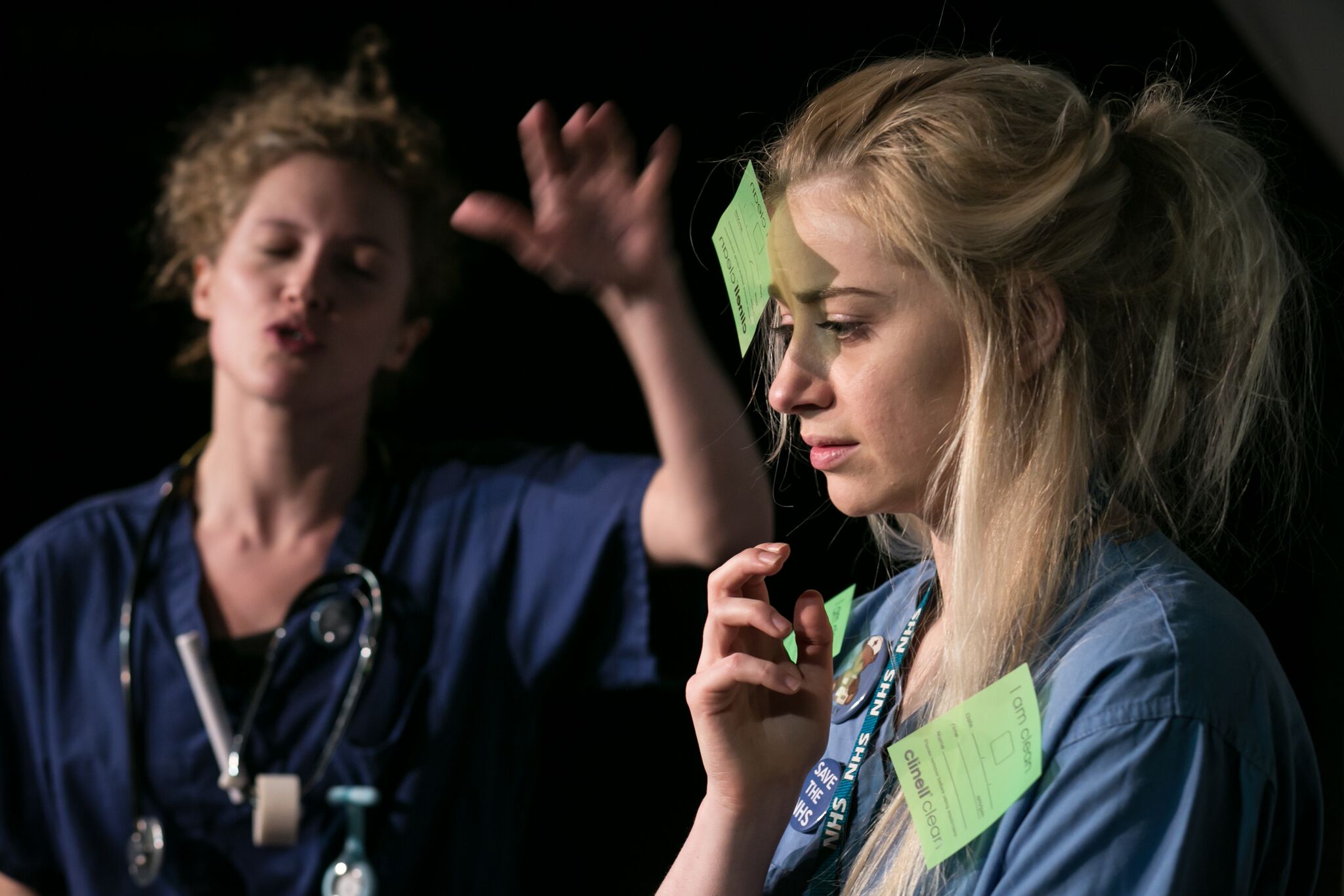
Who better to write a play about what it’s like to work for the NHS than someone who does it every day? Stephanie Silver was inspired by her own professional experiences to write Monologues of a Tired Nurse, which has its final run this week at the Lion and Unicorn as part of the Camden Fringe.

“I’m a nurse and have been for the last eight years,” says Stephanie. “I was working on a cardiothoracic intensive care for a while; it can be a tough environment. I was going through some personal problems and having some episodes of feeling very down about my job. I sat down and wrote some monologues to get some feelings off my chest and Tired Nurse kind of happened.

“It’s a brutally honest account of how it feels to work within the NHS in a understaffed, underpaid and emotionally draining time. The stories are fictionalised, but based on real life encounters of how it feels to be a nurse or any another healthcare professional working in today’s health service on an emotional and personal level.”

The show’s been in development since 2015, since Stephanie performed it at one of the first ever Actor Awareness scratch nights. “It’s changed a lot since then,” she says. “Even after performing it at Edinburgh 2016, we changed it up for the London run at Baron’s Court in 2017. I want it to be as visceral and engaging as possible to really grab the audience’s attention, and the director Simon Nader has always been fantastic in bringing the vision of the piece alive.

“Nurses definitely relate to the play. Anyone who works in the public services in any capacity, whether they are a teacher, policeman, fireman or army officer, can relate to the level of pain and stress in the play and the feelings of never being good enough, especially in the current climate with all the cuts and pressures to work faster and be more efficient but with twice the work load. An army veteran told us in Edinburgh it was some of the most honest accounts of working on the frontline he had seen – that meant a lot.

“I’d like people to see the human, the person behind the professional. I’m sure most people do but the papers and government spin so much crap that it is infuriating. Health care professionals aren’t cogs or robots, they’re people trying their best. And if you want a great health service providing the best care then please look at who you vote for and how you treat the people you meet at point of service. Make a conscious effort to invest in our healthcare in more ways than just saying, ‘I pay my taxes, so I am owed this’.”

After doing some acting as a child, Stephanie trained as a nurse before returning to theatre as an adult. “When I was ten I was in Goodnight Mister Tom, a TV film, and then at 18 I did a summer course at The Poor School, but after that thought I couldn’t afford drama school so I should do a sensible job, and kinda just stayed until I turned 28! Then I thought fuck it, time to probably do some acting before it’s too late. I also had a brain haemorrhage, which soon makes you realise that if you keep leaving things you might be dead before you actually get to do them!

“Juggling the two jobs is doable. Must actors have many jobs, it can feel like two very different worlds! Mainly it’s hard work, long hours and no sleep. I hardly see my friends but I’ve been trying to work on balance. I don’t waste time, I write everyday, and I do one thing everyday for my acting, whether it’s write an email or read a bit of a play or watch something to inspire me. I also do emails on the tube, on the toilet – anywhere really. You can sleep when you’re dead, right?! My mum always says that!”

As well as writing and performing in Tired Nurse, Stephanie’s also set up Glass Half Full Theatre, a company dedicated to creating daring, provocative work. “I really love writing and find it rather depressing waiting around as an actor so decided to produce my own writing,” she explains. “I’m not very well connected as I come from a zero theatrical background, so I got involved with Actor Awareness and met a lot of like-minded people looking to create work. At one of their first scratch nights, I performed Tired Nurse. I asked a mate along and then we decided due to the amazing response to take it to Edinburgh. That was financially not a great idea but it was one of the best experiences.

“I also got heavily involved with Actor Awareness and realised that there a lot of actors just not working – a lot – and what a brilliant thing if I can produce work. So I created Glass Half Full, dedicated to creating thought-provoking contemporary plays with a strong social, political, ethical, domestic backbone; plays with messages aimed at a young demographic, about the world we live in today and the kinds of world we could live in. So hopefully we are making thought-provoking challenging plays. Fingers crossed!”

Glass Half Full have lots of exciting plans for the year ahead: “This is our last run of Tired Nurse as we’ve been doing it for the last year. The immediate aim is to look to produce our show Walk of Shame for EdFringe 2018. I also produce new writing nights every so often. Hoping to do one of those in September so keep an eye out on Twitter, the event is called A Series of Short Plays – we did the first event in May, and it was a great night so we aim to be back with that but with a twist!

“We also have a play called Our Big Love Story, a story of racism after the July 2005 bombings which we are getting on its feet for production in 2018. That’s enough to get on with for now…”

Catch the final run of Monologues of a Tired Nurse at the Lion and Unicorn from 16th-19th August.

Interview: Nina Brazier and Hanna Grzeskiewicz, The Winter’s Tale

This Friday, RADA Studios Theatre will play host to a unique interpretation of The Winter’s Tale from award-winning contemporary quartet The Hermes Experiment. The hour-long piece combines live music with Shakespeare’s drama, focusing on the jealousy and fury of King Leontes when he believes his pregnant wife Hermione has been unfaithful with his best friend and is carrying his baby.

“It’s the original Shakespeare play, pared down to an hour of its core elements and portrayed through a musical as well as a theatrical perspective,” explains director Nina Brazier, who adapted the original text for the production. “The Hermes Experiment are a group dedicated to pushing the boundaries of their craft, and it is their first project involving theatre.

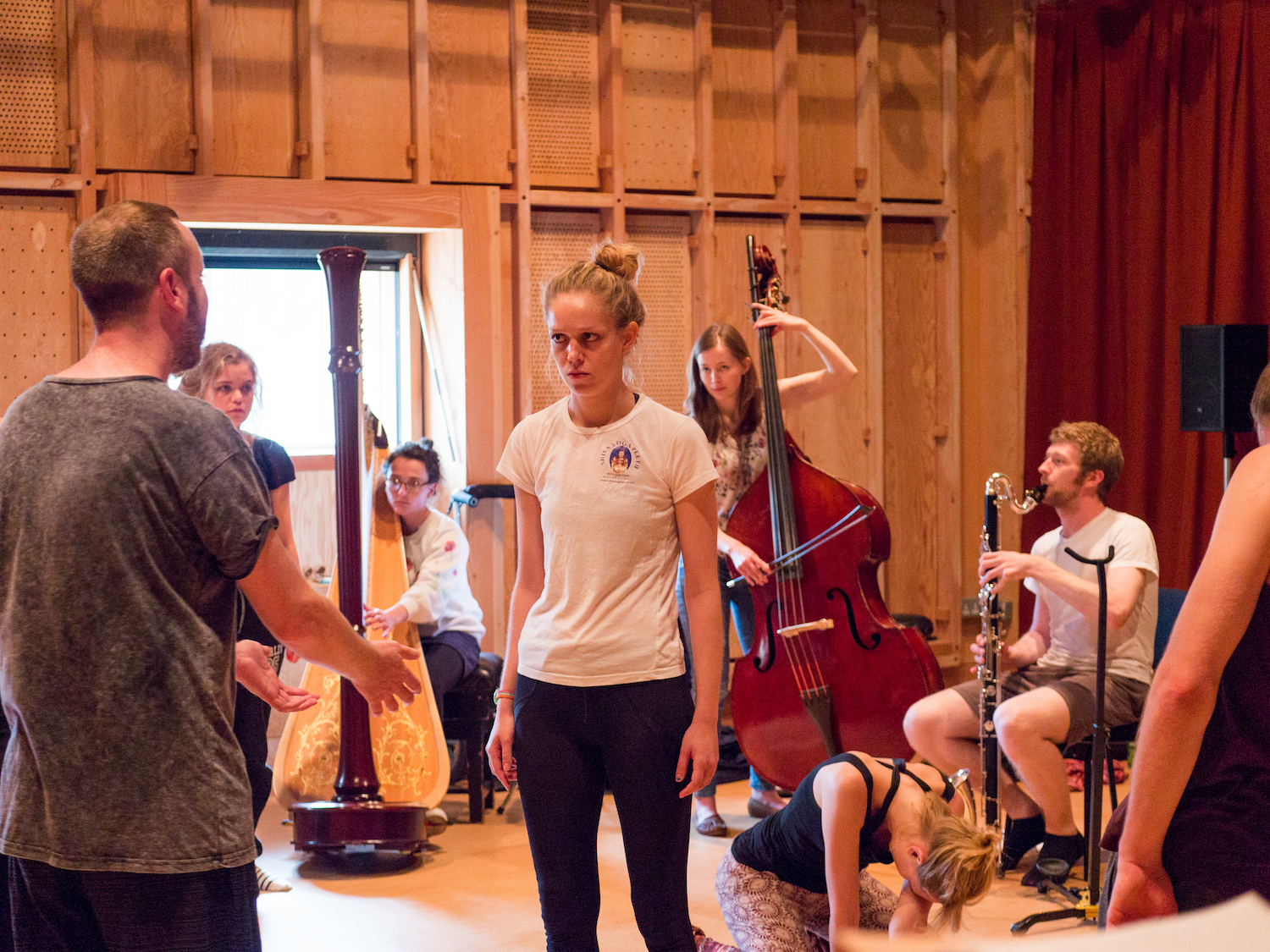
“Alongside The Hermes Experiment, composer Kim Ashton and myself have led the devising process with five extraordinary actors: Christopher Adams, William McGeough, Sadie Parsons, Robert Willoughby and Louisa Hollway. The music plays an equal part as the text in bringing the drama to life, with the actors, the music and the musicians become intrinsically intertwined.”

Photo credit: Sam Murray-Sutton

The Hermes Experiment are Héloïse Werner (soprano and co-director), Oliver Pashley (clarinet), Marianne Schofield (double bass), Anne Denholm (harp) and Hanna Grzeskiewicz (producer and co-director) who explains, “We’re a contemporary ensemble made up of harp, clarinet, soprano and double bass. We are mainly a musical ensemble, but we are very interested in working with different art forms – we have worked with a photographer, dancers, and now also actors. Aside from work with other art forms we commission new music for our group, and have commissioned now 40 composers to write for us, arrange better known works, and improvise. We started in late 2013, soon after we all graduated from Cambridge University, which is where we all met – and we all wanted to do something unique and innovative musically.

“We’d been planning to do a project that fuses music and drama for a while – we were interested in what would happen if we brought all these creative minds together, and we hoped that the practice of the actors and the musicians would be enhanced by working with the other – and luckily we think it did! We had a few ideas, but eventually settled on Shakespeare: people know the plots so we could play around with it, the musicality of his language lends itself to working with music, and who doesn’t love Shakespeare!”

The show was developed during a residency at Aldeburgh Music in September 2016. “The devising process gave us permission to think in a completely new way about how we approached the text, and allowed us to explore Shakespeare from a musical as well as theatrical perspective,” says Nina. “During the process we used movement and gesture as much as text and music, feeling that we were creating a theatrical language that extended beyond the written and spoken word. As composer Kim Ashton said in his blog, we began ‘layering text, music and movement together in a variety of ways, such that each strand is dominant or subordinate at different moments, sharing equally in the unfolding of the narrative’.

“This heightened theatricality is fully integrated with the music, not only extending the emotions of the character but communicating the symbolic content of The Winter’s Tale.”

Photo credit: Sam Murray-Sutton

The piece was first performed in a one night showcase at the Cockpit Theatre in December, where it was well received by critics. “It’s a completely new and original way of seeing Shakespeare,” says Nina. “Following our performance at the Cockpit, The Winter’s Tale was described as ‘groundbreaking’ (The Reviews Hub), ‘resourceful and inventive’ (The CUSP) and ‘skilfully crafted’ (London Theatre 1). The performance ‘gripped the capacity audience from beginning to end’ (Early Music Reviews) and was seen as ‘an exciting trend to start’ (Schmopera) with ‘tautly-directed action’ (The Evening Standard).”

The show is far from the only project for The Hermes Experiment, who have a busy year coming up. Hanna explains, “After The Winter’s Tale, we have about a month off and then we are performing as part of Colourscape Festival, we are doing a recital as part of the Park Lane Group concert series, and in November we are going to Russia to perform at a contemporary music festival in St Petersburg. We will be revealing even more projects we have coming up in the coming weeks so keep checking our website and social media for updates!”

Catch The Winter’s Tale at RADA Studios Theatre on Friday 11th August. And you can follow The Hermes Experiment on Twitter and Facebook for news and updates.