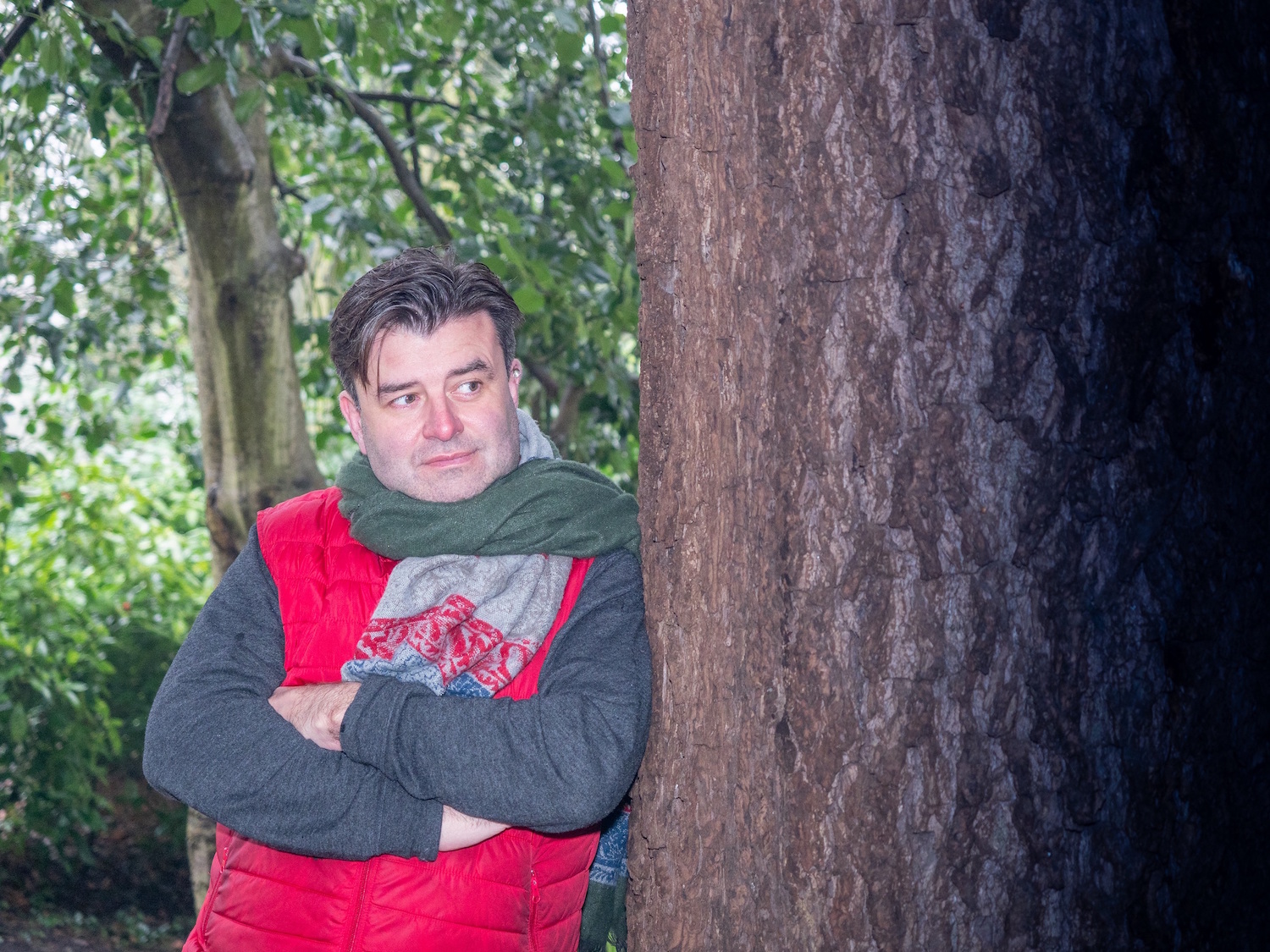
Interview: Hannah Samuels, Kiss Chase

Formed in 2017, Second Circle Theatre is an emerging theatre company of three core members and five associate artists, including street performers, musicians, visual artists and devisors. Last year they were finalists of the Pleasance Charlie Hartill Special Reserve, alongside emerging companies Unpolished Theatre and ThisEgg, and their debut show Meeting at 33 premiered to five-star reviews and a sell-out run. This month they’re bringing their second show, Kiss Chase, to The Bunker Theatre as part of the Breaking Out season.

“Our company aims to challenge what a night at the theatre looks like and how it is experienced, and put real people and stories at the heart of our work,” says artistic director Hannah Samuels, who founded Second Circle along with Topher Collins and Zoe Gibbons. “We want to encourage communities to feel connected to each other and individuals to feel less alone, and to create honest, visceral theatre in unique and intimate spaces. We aim to make work that can be and should be experienced by everyone. As a company, by revealing our hopes, fears, obsessions, anxieties and secrets, we strive to make work about the people we care about and the issues we want to scream about.”

Kiss Chase is a part-interactive, part-verbatim speed dating event, which explores the barriers we face when forming relationships, both in and out of love. “Audiences will be taken through a series of interactive tasks/games to develop their intimacy skills – as participants – as well as watching the narrative,” explains Hannah. “We’re inviting them into a world where they are immediately congratulated for taking the leap and entering the unknown. In keeping with our company style, minimal tech requirements and a reduced audience capacity will create an intimate experience for individuals as well as the collective group.

“During the event, the audience will go on dates, talk to characters and listen to songs, as we invite them to look up from their phones and to find commonality in shared experience. The original inspiration for the show sprung from the question: what is it about the pursuit of love that allows us to sometimes be treated badly in order to find it? As the show progressed we came across research calling London the ‘loneliness capital of Europe’ and we wanted to explore why this was and how/if this could be changed. With the rise of online dating, self-help books and the emergence of the Instagram filter, now feels an important time to look one another in the face.

“We’d like our audiences to feel changed in some way by the performance and connected to those they’ve only just met, having been through the experience together, and also to leave questioning what of Kiss Chase was performance and which parts were real. We want to celebrate a world where interactions happen face-to-face, drawing similarities between the ‘live-ness’ of seeing a theatrical event rather than something filmed. We hope to champion the forming of friendships as much as romantic relationships and to challenge who our significant other might be, and to create a shared audience experience celebrating similarities not differences.”

Kiss Chase has been in development since the beginning of 2018, and was still at a very early stage when it was selected for the Breaking Out season. “As with our first show, we always start developing a seed of an idea by doing lots of research,” explains Hannah. “The company have been out and about interviewing people across the country who have shared their stories of love, loss and friendship with us. We have also been going speed dating… a lot. Our associate artists have been involved in the development phase of the process, which is a really collaborative and fulfilling way of working. We’ve been building character through the verbatim interviews and experimenting with the game format of the show, and we’ve worked with Rich Maskey at Potential Difference, looking at ways to integrate technology into the show or to form part of our marketing campaign.

“The Breaking Out programme has quite literally helped us to ‘break out’ and launch ourselves into the industry with our second show, granting us the professional support to secure further funding and exposure as we strive to make life-changing theatre. Having worked alongside other emerging companies through the Pleasance Charlie Hartill tryouts 2017, we were delighted to be offered this opportunity to continue to learn from and support our peers. We are incredibly excited to develop our work with support from such an incredible and intimate venue, and we have already learned so much from the mentorship that’s been offered to us as part of the program. We love how The Bunker encourages shows and companies they work with to take risks and push the boundaries of conventional theatre. It has an incredible reputation for producing a hugely diverse programme and we share a passion for engaging the local community to tackle pressing personal/collective issues, with a unique approach.

“The Bunker is a perfect venue for Kiss Chase, local to us in East London, with a uniqueness and site-specific edge. The intimacy the space invites is amazing – it’s like watching a show in your lounge! Our first show was site-specific in a non-traditional theatre space, so we want to use the environment of The Bunker and all its various nooks and crannies when creating the work specifically for this venue. The mentorship we have already received from David and Josh has been invaluable at this early stage of the company’s growth, and we are really excited about continuing this relationship long after Breaking Out season is complete.”

Interview: Helena Jackson, Nine Foot Nine

What would happen if almost every self-identifying woman in the world grew to nine foot tall? Sleepless Theatre Company explore this intriguing concept in Alex Wood’s Nine Foot Nine, which opens at The Bunker Theatre in June as part of the Breaking Out season.

Nine Foot Nine follows a family over 16 years in a dystopic world where suddenly, painfully, self-identifying women start to grow and grow and grow and grow until the gender politics of the world start to break down,” explains director Helena Jackson. “We’re very interested in the concept of atypical bodies, and how bodies can shape and skew society’s view of an individual. We thought Nine Foot Nine would be a hugely interesting concept with which to interrogate the ‘monstrous’ – the atypical – and how it can affect gendered power dynamics. If self-identifying women had the ability to overpower every single cis male they came across without too much effort, how would the power structures of the world change?

“The concept is so broad there is no way that we’re ever going to be able to explore every single angle. We want the audience to walk out entertained, intrigued and for them to sit down for a pint afterwards saying ‘Gosh, yeh, what would happen if men were physically weaker than women?’ This is a show to hopefully make people talk and think way after they’ve left the venue, both in terms of gendered interaction and preconceptions attached to performers that identify as D/deaf, disabled or neurodiverse.”

In line with that commitment, Nine Foot Nine will be fully captioned and will involve performers and creatives who identify as D/deaf, disabled or neurodiverse. “We’ll be working as hard as we possibly can to make sure that the play is accessible to all audiences,” says Helena, “and we’re looking to create a culture where we interact with D/deaf, disabled or neurodiverse audiences and creatives no matter what the themes of the particular play we’re creating.”

Nine Foot Nine is the result of almost two years’ work – or, as Helena puts it, “The show has been in development forever, it seems. At first we had included way too many storylines – six characters instead of three – and it was more of a snapshot of society rather than something with a narrative focus. We completely redrafted around ten months ago, whittled our characters down to form this core family unit, and did a couple of other projects which boosted our confidence in terms of creating a piece of work that thinks about accessibility while not necessarily being about disability, as such.

“We showcased a section of it at the Royal Court in March and were part of the LET Award finalists in March as well, but this is the first time it’s been shown in its entirety. We’ve had tantrums, makeups, sleepless nights – it’s been a rock-and-roll ride but it’s now actually about to become a real physical thing, and we are so excited and terrified for it to actually become a proper play instead of this world existing on the computer screen. Sharing it with an audience will be one of the scariest and most thrilling moments – it’ll be so interesting to hear what people make of it, whether the way we portray the growth works and if it starts the kind of conversations we want it to. The Bunker is such a wonderful space for this kind of show, we have a huge amount of stage space and tech possibilities, so it should be pretty damn thrilling.”

It’s not just the venue that has Sleepless excited; they’re also looking forward to joining the other five theatre companies selected to be part of The Bunker’s Breaking Out season. “Breaking Out is fantastic because it allows us as an emerging company time to create, re-create and re-draft without the sort of financial pressure that is present in so many other spaces. It just means we can have fun with the piece and play around, developing our accessibility measures and audience pool in a way that wouldn’t be possible with a full run. It’s also so lovely to meet other companies that are in the same position we are – it creates a proper community of theatremakers that all critique and inspire each other – and then go to the pub together after. Of course.”

London-based Sleepless began around seven years ago at sixth form college. “We got fed up of the lack of opportunities there were in the performing arts and so decided to start making our own,” says Helena, who’s the company’s artistic director. “Over the years it’s massively developed, but there’s something wonderful about the naive, fearless attitude we had when it started, the sort of jump-first-and-figure-out-how-you’re-going-to-land-later type vibe that only 16-year-olds can really possess. We love that sense of community, of people getting their hands dirty, of sort of stumbling along and mucking up along the way but then knowing you’re going to do it better next time. Our aims are very much to keep accessibility at the core of what we do and to prove that emerging companies can engage in the access debate – and then just to produce exciting, magical, and anarchic theatre.”

Nine Foot Nine certainly sounds like it lives up to that ethos: “It’s going to be a thumping, ferocious, dystopic rollercoaster. If you’re into sci-fi, feminism or visually beautiful work you should definitely check us out – we’re going to have vast amounts of LEDs, some ridiculous soundscapes and will basically be portraying a world in uproar. It’s going to be chaotic, it’s going to be anarchic, it’s going to be banging, so check us out.”

Interview: Amy Bethan Evans, Libby’s Eyes

Created by a visually impaired writer, and starring two visually impaired actors, Libby’s Eyes is a play about disability, the benefits system and sight loss. It’s also one of the shows selected for next month’s Breaking Out season at The Bunker Theatre, alongside five other projects from emerging theatre companies. The play tells the story of Libby, a young visually impaired woman who’s given a government-issued assistance robot to describe her surroundings to her. The only problem is, the robot has opinions of its own – opinions that are very telling of the government’s attitude towards disabled people.

“As a visually impaired writer, I wanted to write the kind of visually impaired character I want to see – if you’ll excuse the pun,” explains writer Amy Bethan Evans. “Blindness is often used as a metaphor with a character who doesn’t see but knows ‘inner truth’, or visual impairment can be used as a slapstick comedy device. Failing that, along with other impairments, it’s seen as something to be ‘overcome’. I wanted to create a character who was visually impaired for no reason. Her impairment is a big part of her life, but her obstacles come from society.

“Also, while her impairment isn’t the butt of any jokes, there is comedy in the play as it is possible to be funny without that. The story has been through several development stages and the one I seemed keenest to tell was my PIP experience. I find it fascinating how governments and other organisations can tell disabled people what they do and don’t need, and that that can change and we’re all just expected to go along with it. I want to fly the flag for stories about being disabled in 2018, as told by disabled people. This is still quite rare and I hope others will be encouraged to do it by this piece.”


The show is narrated by an acting audio describer: “This is a sent-up version of the actor playing the part,” says Amy. “The character is very pretentious and wants to prove their acting ability but at the same time, needs to provide a reliable AD. There have been other shows working with creative audio description in the past, but I wanted to do it in a way that is reflective of the non-disabled gaze while making people laugh.

“I want sighted and visually impaired people to be inspired by the possibilities of audio description, of access for everyone and of the power of disabled protagonists played by disabled actors. I’d like people to feel for the injustices being heaped on the disabled community and even if they’re not spurred into action, appreciate the human stories behind all the numbers. I also want them to feel they’ve enjoyed a good piece of theatre!”

Amy was one of the top 100 entries for the Verity Bargate Award, and was shortlisted for Bristol Old Vic Open Sessions, Pint-Sized and 503 Five at Theatre503. She was also part of the Soho Theatre Writer Group, which is where Libby’s Eyes first came to life. “I’ve had an idea to explore the theme of defectiveness through disabled people and robots for some time, but Soho Writers’ Lab gave me the excuse to write it,” she says. “It was written for the programme, which involved writing three drafts with a dramaturg. The one in production will be the fourth. I had so many ideas in my first draft and didn’t want to leave any out because I could always cut them later, but as time went on I was still none the wiser about what to focus on, because I had so much to say and I’ve not really read anything like this before for a framework. I knew that it was lacking plot even by the third draft and that’s what a lot of the feedback said, so I’ve tried to make this the focus of my fourth draft. It’s difficult because there is no solution to the reality of what I present, so I want to respect the people currently going through it.”

As a writer at the start of her career, Amy’s thrilled to be part of the Bunker’s Breaking Out season. “It’s amazing. I had my first professionally commissioned short at Theatre 503 earlier this year and this is my first professional longer play. The other companies in Breaking Out are really exciting. I only moved to London last year and it’s great to see such talented people all around me and think I could be part of them. I’m also excited by the possibilities of the Bunker as a wheelchair-accessible fringe venue as it can be really difficult for disabled artists to access the fringe scene.”

The play’s being produced by Poke in the Eye Productions, a company founded by visually impaired actor Georgie Morrell, who also appears in the show. “The company aims to platform disabled-led work by up-and-coming artists,” says Amy. “Georgie and I met on a Soho Young Company Social; she was on Comedy Lab and I was on Writers’ Lab. I bumped into her, apologised, explained I was visually impaired and she said, ‘Me too!’ From that, a beautiful friendship was born. I sent her the play and she really liked it and wanted to bring Libby to the stage. I got in touch with my friend Adam, a brilliant visually impaired actor, and we took the first ten minutes to Yolanda Mercy’s Anything Goes scratch at Vaults, with two other actors. The event was a lovely atmosphere of exciting and diverse new work and was lovely to be part of.

“I’m now looking forward to seeing what the creative team do with the play and getting visually impaired people who don’t normally go to the theatre to come. The play is really important to me in subject matter and in what it could contribute to theatre and I think it will be important to other disabled people, artists or not. It has a witty and dynamic creative team behind it and I hope it will entertain and raise awareness. I’m equally excited and scared about watching it myself. I’ll be nervously hanging around the bar listening to what people say about it and gauging in what tone I should say ‘I’m the writer!’”

Interview: Nathan Ellis, No One Is Coming to Save You

Kicking off on 11th June, Breaking Out is a festival of world premiere shows by emerging theatre companies, chosen from over 45 different projects by the artistic team at The Bunker Theatre. One of those shows is No One Is Coming to Save You from This Noise, a new theatre company that try to find contemporary languages for political action. An experimental duologue about one night in the lives of two people in their early twenties, No One Is Coming to Save You explores youth loneliness, power and powerlessness, and the hope for something better.

“Pretty much every day a new article will come out online about how young people are really unhappy and disappointed with the world and their lives, and that didn’t seem to be being reflected in the work we were seeing onstage, which either ignores young people altogether or is extremely interested in their sex lives,” explains writer Nathan Ellis. “We wanted to be more reflective and talk about how it really feels to be young, and how that feeling that something better is coming is maybe masking a sneaking suspicion that it isn’t.

“We really want to accurately reflect what it feels like to be young right now in both the content and the form of the play. The form of the show has been ambitiously experimental from the beginning. The two performers tell the story of two people, but as the story progresses, the lines between themselves and their stories start to blur. It’s exploring the feeling of being not-quite-in-the-world that seems particularly salient to contemporary experience. If you like Caryl Churchill or Chris Thorpe – plays that demand you think and feel – then you’ll like this.”

Nathan started writing No One Is Coming to Save You in 2016 at a residency in Oxford. “It’s almost unrecognisable from that point, but it’s essentially got the same DNA as that play,” he says. “Since then the company have had a year’s worth of workshops and scratch performances and sharings to bring it to where it is now, and have been really generously supported by Arts Council England. A lot of the play has been collaborative, with lots of discussion with people within and outside the company about its themes – everyone in the company is under 25 – and experiences from their own lives.”

No One Is Coming to Save You is the first production from This Noise, who focus on making theatre by, with, and for young people: “We are made up of a group of interdisciplinary makers across writing, design, and performance and have been Arts Council East funded since 2018,” says Nathan. “We basically think theatre is a great space to talk about how complicated it is to be alive right now, without resorting to simple answers or platitudes. If you’re looking for a formally experimental show that explores how it really feels to be young today – about youth loneliness, mental health, and the terrors of a world not working, then give No One Is Coming to Save You a go.

“Although it deals with serious issues in a complex, challenging way, the play is actually very hopeful. Without spoiling the ending, it’s got a real belief behind it that communal experiences – like sharing space and sharing a story – can really make us feel more connected to each other. Hopefully it will challenge people with a new form and maybe make them smile a bit too. There are some funny bits – promise!”

With a little over two weeks until their first performance as part of Breaking Out, Nathan and the team are looking forward to bringing their work to The Bunker. “This Noise are unbelievably excited about Breaking Out. It’s so exciting to be part of such a vibrant season of other work by emerging companies. Particularly as a company exploring how it feels to be young, it will be so great to see where their work has taken them and to see the pieces in conversation with each other. We’ve been in love with the Bunker since it opened and always wanted to perform the show there. It already has such a history of supporting complicated, experimental work that would otherwise not get a platform in London. It’s such a versatile space and one that has a real atmosphere and engaged audience, who we think will really appreciate the challenge of a show like No One Is Coming to Save You.”

Interview: Tim McArthur, Into The Woods

Stephen Sondheim’s Into The Woods gets a 21st century makeover this week at the Cockpit Theatre, as All Star Productions join forces with Trilby Productions to revive Tim McArthur’s adaptation of the popular musical. First seen in 2014, the show returns with an ensemble of seventeen larger-than-life characters, all drawn from modern day Britain.

“By transporting the traditional fairy tales into the 21st century, the story resonates with and reflects society as it is now,” explains Tim, who both directs and performs as the Baker in the new production. “The characters will be familiar to reality TV viewers of shows ranging from Jeremy Kyle to TOWIE and Made in Chelsea. Another unique quality is that it’s staged in the round – I want the audience to feel they are part of the story. This also gives scope within the staging to convey better the sense of journey.”

Into The Woods draws on popular fairy tales including Rapunzel, Cinderella, Jack and the Beanstalk and Red Riding Hood to tell a cautionary tale about being careful what you wish for. “Into the Woods is about loss, wanting things that you maybe shouldn’t want, taking things for granted, wanting to be happy, realising that maybe what you have is better than wishing for more,” says Tim. “It’s about dysfunctional families and more importantly how an action you make may have consequences on someone else. This is of course all told through the traditional format of well-known fairy tales, which are interwoven with each other into the simple main story of a baker and his wife. They’re desperate for a child but the witch has put them under a curse, preventing them from having a baby unless they find unique and unusual items which will reverse the witch’s curse. Their future happiness depends on their search.”

Tim directed the show on its initial run in 2014, and says he’s thrilled to return four years later in the role of the Baker. “In 2014, the producers originally asked me to direct the piece and play the part of the Baker, but because I wanted to create a new fresh vision for the show I knew it would be a challenge to both direct and perform. So, I decided to just focus my attention on the direction. Now we have in a way tested the look and feel of the show, I know it works. I have loved and known this show for nearly 30 years, so it’s a dream come true to play the Baker – one of the best male roles in musical theatre.”

The show’s cast also includes Jo Wickham, who was a member of the 2014 company and reprises her role as the Baker’s Wife, alongside several new faces. “About 80% of the cast are new and weren’t in the 2014 production, so it’s exciting to create the characters with the new actors’ energy and ideas and see how that dynamic interacts with the interpretations of the returning actors,” says Tim. “The main factor for me as a director when casting is to bring together a group of actors who are comfortable with who they are, so we can create a safe space in rehearsal to be able to play and experiment. Particularly with an ensemble piece it’s vital that there are no dominant egos. The show is the ego and that’s it. This cast are nice and talented people who care about the production and are excited to be in the rehearsal room.

“They are a mix of performers with whom I have worked as a director and/or fellow actor plus new people, so we have a creative blend of familiarity and new impetus as we come together as a group for the first time and go ‘into the woods’. Our ensemble includes a range of ages and diversity of background and experience – performers with extensive West End pedigrees, including the Rapunzel from the original London production of Into the Woods (Mary Lincoln) who returns as Cinderella’s stepmother, to performers early in their careers.”

But the cast isn’t all that’s new this time around: “Both personally and as a director, my life has changed a lot in the past four years. I very much believe that we continue to learn, grow and develop as people and you naturally bring those life experiences into the creation of the show. One of the greatest aspects of Stephen Sondheim’s work is that you continually find new meanings and emotions within both the text and music of the story.

“My first Sondheim show was a production of Follies at the Shaftesbury Theatre in 1988. I instantly fell in love with his music and lyrics, and the love affair began. Into the Woods was the third Sondheim show I saw; I was 15 years old and I saw it three times. The structure of the show is so clever, and the story is so relevant in today’s world where commerciality drives everything and encourages us to always want more and to never be happy with what we have.”

Tim isn’t only an actor and director; he’s also a singer and presenter, who can currently be heard every Friday presenting The Curtain Up Show on Resonance 104.4 FM. With so many strings to his bow, choosing highlights proves a tough challenge: “That is a really difficult question. I trained to be an actor, and since leaving drama school I have been given so many wonderful opportunities in so many different areas of the entertainment industry. I never originally wanted to be a director or a producer, or perform my solo show or even be a TV/radio presenter. But highlights are probably performing my solo show Mountains in New York at Feinstein’s 54 Below earlier this year, and playing Sam Byck in a production of Stephen Sondheim’s Assassins a few years back – and of course the chance to revisit this fabulous show.”