
The Miss Havisham we meet at the beginning of Heather Alexander’s one woman show Havisham is exactly the one we’d expect, the character having become firmly established as one of English literature’s most iconic. Miss Havisham is known as the sinister manipulator of Charles Dickens’ Great Expectations, a jilted bride frozen in time in her ruined, cobweb-strewn mansion, who plots for her adopted daughter Estella to break the heart of the novel’s protagonist, Pip.
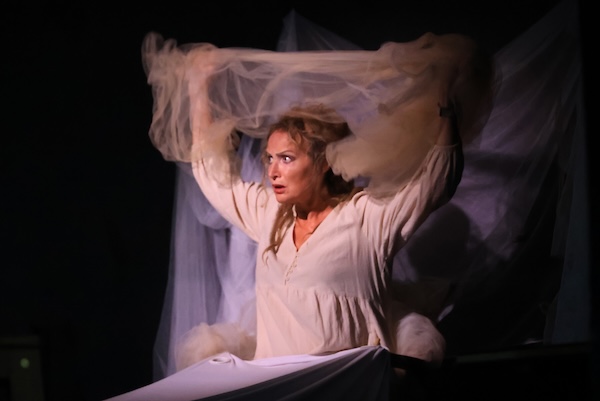
That Miss Havisham is who we first encounter at the centre of an atmospherically lit set filled with memories of a tragic life and with a frozen clock on the wall – but the Miss Havisham from whom we hear over the course of the evening is not at all that icy villain we believe we know. She is first and foremost a frightened child at the mercy of ruthless authority figures, the majority of whom (it hardly needs to be said) are men. The first half of the play deals with her brutally traumatic childhood and adolescence, and also establishes an important link between the play’s protagonist and the mythical monster Medusa, another woman now universally known more for what she became than for how – and, critically, at the hands of whom – it came about. Heather Alexander’s unflinching imagining of the young Miss Havisham’s misfortunes is at times a difficult watch and takes us to some very dark places, but also succeeds in establishing our sympathy for her – a sympathy that only builds as the charming character of Compeyson enters the story in the second half of the piece. Portrayed as he is only through the eyes of the woman who loves him helplessly, we need not be intimately familiar with Dickens’ novel to anticipate that the affair can never end well, and certainly through no fault of hers.

Heather Alexander is an accomplished, engaging writer and performer, and the highly visual, stripped back nature of director Dominique Gerrard’s production allows her to shine at centre stage as the story unfolds. Her intention with Havisham is to “restore her humanity and challenge the hostile stereotypes surrounding women past and present.” And in this she certainly succeeds; though the character may have been written in the 19th century, there are elements of Miss Havisham’s story that modern day women will, unfortunately, strongly relate to. The parallel between Miss Havisham and Medusa is also cleverly set up and mantained throughout the narrative, encouraging us to view the journey of both these women – and by extension, many others from literature – in a very different way.
Havisham‘s final performance at the Jack Studio Theatre is tonight, 15th March.
 Theatre Things